





















JWST’s JADES2: A Deep-Field Portrait that Rewrites Cosmic Dawn
Oct 26, 2025
Soumyadeep Mukherjee
Soumyadeep Mukherjee is an award-winning astrophotographer from India. He has a doctorate degree in Linguistics. His work extends to the sub-genres of nightscape, deep sky, solar, lunar and optical phenomenon photography. He is also a photography educator and has conducted numerous workshops. His works have appeared in over 40 books & magazines including Astronomy, BBC Sky at Night, Sky & Telescope among others, and in various websites including National Geographic, NASA, Forbes. He was the first Indian to win “Astronomy Photographer of the Year” award in a major category.
Share:

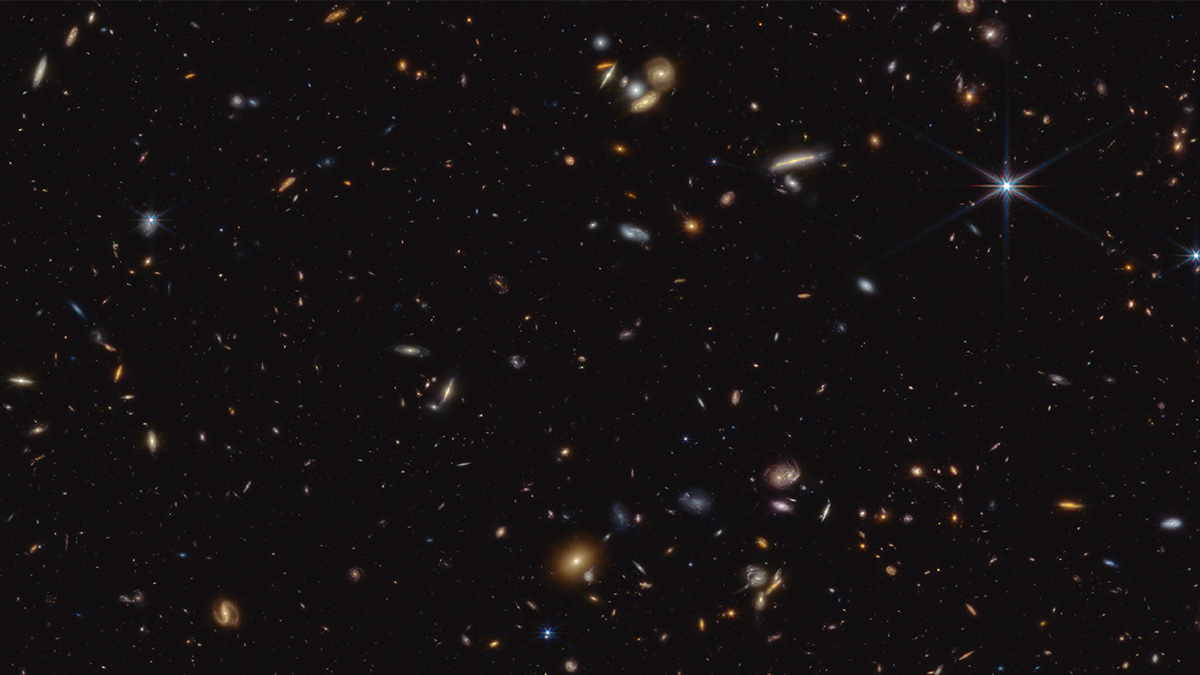
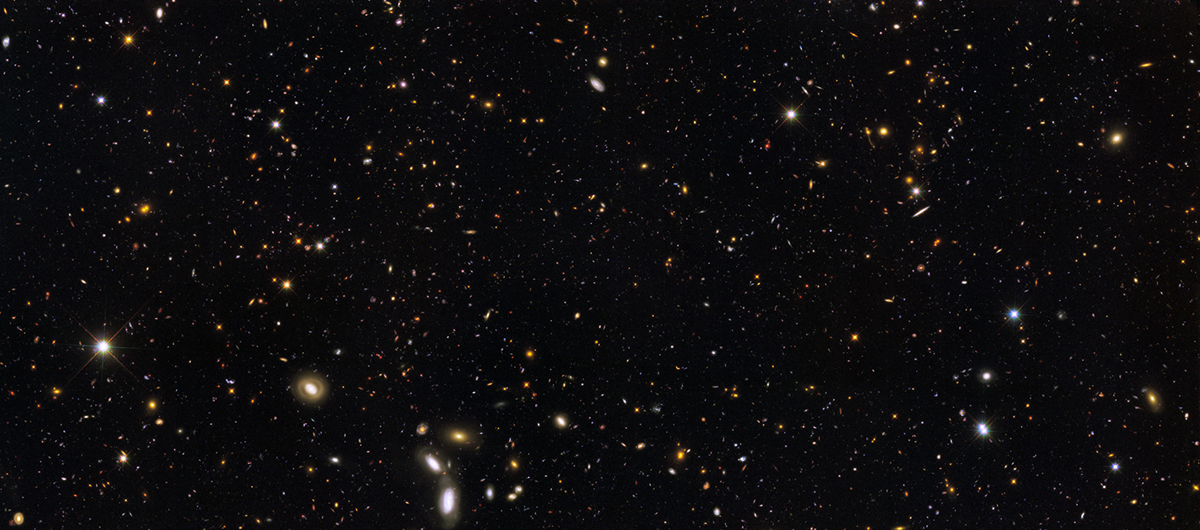
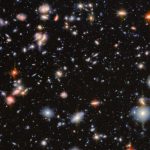
The James Webb Space Telescope’s JADES2 image is a glimpse into the first few hundred million years after the Big Bang. It is a look at galaxies that formed when the universe was still young and chaotic. The image comes from JWST’s Near-Infrared Camera (NIRCam) and focuses on a small but legendary region of the southern sky known as the GOODS-South field. Each glowing speck in this image represents a galaxy billions of light-years away. Together, they tell a story about how the first stars and galaxies assembled from cosmic darkness.
A new deep-field portrait
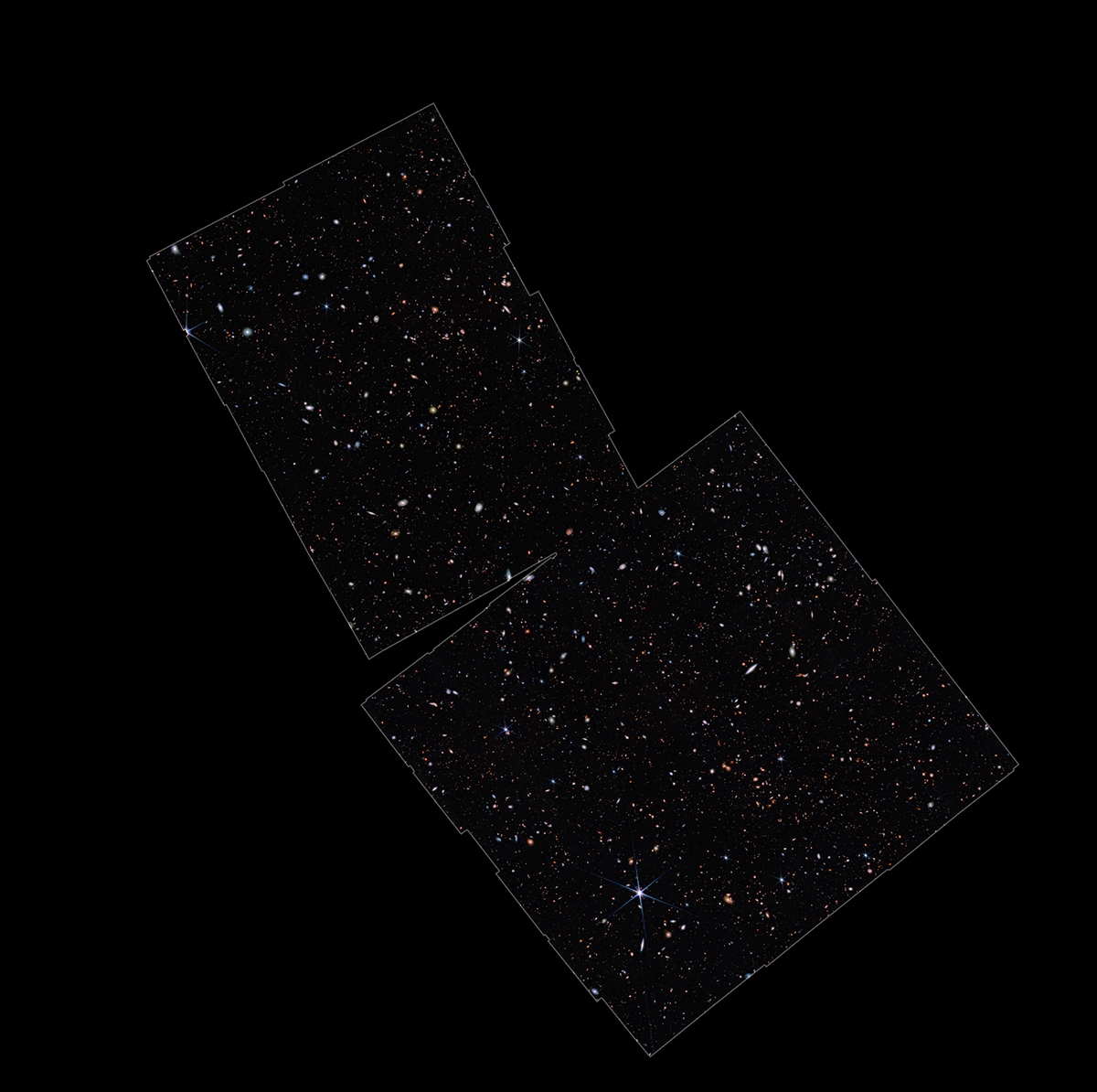
JADES2 captures a patch of sky measuring only about 6.04 by 4.24 arcminutes, roughly one-fifth the apparent size of the Moon. It is centered at right ascension 3h32m39.55s and declination −27°47′06.39″, in the constellation Fornax. That may sound small, but within this field, JWST reveals thousands of galaxies spanning a huge range of distances. Some are relatively nearby; others date back more than 13 billion years. The field glows with faint light that has travelled across almost the entire age of the universe to reach us.
The image is part of the JWST Advanced Deep Extragalactic Survey, or JADES, a large collaboration between NASA, ESA, and the Canadian Space Agency. The survey uses both NIRCam and NIRSpec, JWST’s infrared imaging and spectroscopic instruments, to build the most detailed census yet of early galaxies. JADES2 is one of the deepest looks so far into the cosmos, continuing the legacy of Hubble’s famous deep-field observations but with far greater sensitivity and infrared reach.
The GOODS legacy: A window into cosmic history
To understand why astronomers targeted this region, we need to look back at the Great Observatories Origins Deep Survey (GOODS). Conducted in the early 2000s, GOODS combined data from NASA’s Hubble Space Telescope, the Spitzer Space Telescope, and the Chandra X-ray Observatory. It focused on two patches of the sky, GOODS-North and GOODS-South, each chosen for its lack of bright stars and minimal dust interference. These fields became ideal laboratories for studying the distant universe.
The GOODS-South field, located in Fornax, was repeatedly imaged by the Hubble Space Telescope over many years. It became one of the most thoroughly studied regions of the sky, home to Hubble’s Ultra Deep Field and several major surveys. By focusing on this same region, JWST can directly compare its data to decades of earlier observations. That continuity lets astronomers trace galaxy evolution from the nearby universe all the way back to the first billion years after the Big Bang. In that sense, JADES2 doesn’t replace GOODS; it extends it into wavelengths and depths that Hubble could never reach.
JWST’s infrared eyes
The James Webb Space Telescope operates in the infrared light range, which is crucial for studying ancient galaxies. As the universe expands, the light from distant galaxies stretches into longer wavelengths, a process known as redshift. By observing in the near- and mid-infrared, JWST can detect this stretched light and reveal objects that are invisible to optical telescopes.
For JADES2, astronomers used a carefully selected set of NIRCam filters covering wavelengths from about 0.9 to 4.4 microns. These filters isolate specific parts of the infrared spectrum and highlight features like young stars, glowing hydrogen gas, and warm dust. Each colour channel in the released image corresponds to a combination of these filters, giving a composite that encodes physical information. The result is a natural-looking colour view, but one that also reveals key clues about the galaxies’ age, temperature, and composition.
Because JWST operates far beyond Earth’s atmosphere, it avoids the heat, moisture, and turbulence that limit ground-based infrared telescopes. Its 6.5-meter mirror and deep-space orbit allow it to collect faint light with unmatched sensitivity. Combined with NIRSpec’s spectroscopic data, scientists can precisely measure galaxy distances, star formation rates, and chemical signatures.
Discoveries hidden in the deep
The JADES program has already transformed our understanding of early galaxy formation. From this dataset alone, researchers have identified hundreds of galaxies that existed when the universe was less than 600 million years old. Some of these are among the most distant galaxies ever observed. Others display properties that surprise astronomers, such as unexpectedly high brightness and rapid star formation.
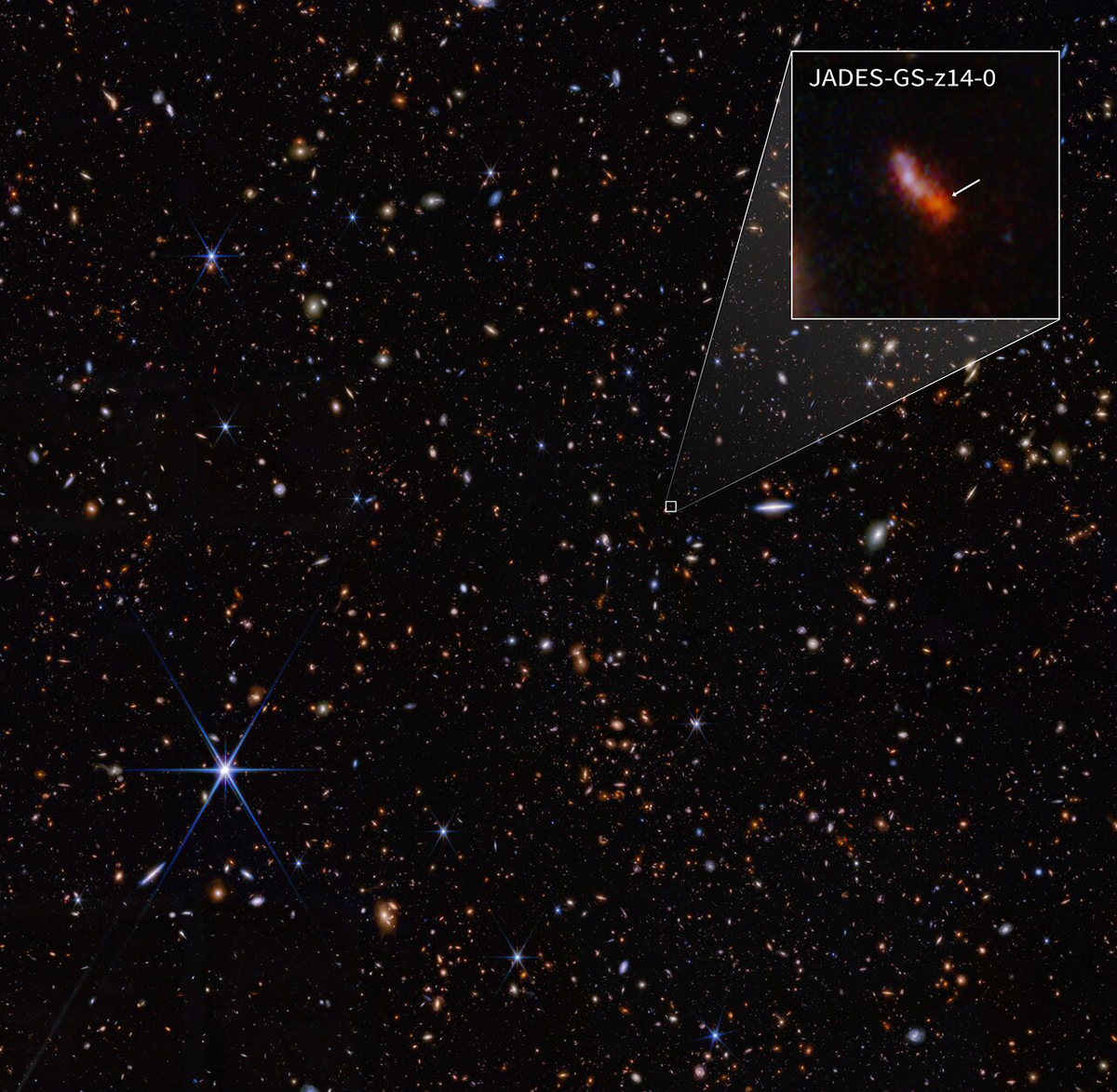
One of the standout discoveries from the JADES data is JADES-GS-z14-0, a galaxy seen just 290 million years after the Big Bang. This object, confirmed using spectroscopic data, is both massive and luminous, challenging previous models that predicted galaxies at this epoch would be small and faint. The existence of such large systems so early suggests that star formation in the young universe was faster and more efficient than expected.
JADES2 also reveals galaxies rich in heavy elements, indicating that several generations of stars had already lived and died by that time. This evidence of chemical maturity implies that cosmic evolution, the process by which stars and galaxies grow and enrich their surroundings, began astonishingly early.
A new window on the universe
The JADES program is far from over. More observations from both NIRCam and NIRSpec will continue to refine what we know about these early galaxies. Scientists are already studying the structure, composition, and star-formation histories of the faintest objects in the image. Some of the galaxies that appear as simple smudges in JADES2 may, under closer inspection, show spiral arms, merging cores, or even evidence of early black holes.
Future deep surveys will expand beyond GOODS-South, mapping other regions of the sky to test whether the same patterns hold elsewhere. Together, these observations will shape our understanding of how the first stars formed, how galaxies grew, and how the early universe became transparent to light.

Clear skies!
See more from DIYPhotography.net on Google
Add DIYPhotography.net as a trusted source. This makes
our stories more likely to appear in your Google Search results.
 Add as a preferred source on Google

Soumyadeep Mukherjee
Soumyadeep Mukherjee is an award-winning astrophotographer from India. He has a doctorate degree in Linguistics. His work extends to the sub-genres of nightscape, deep sky, solar, lunar and optical phenomenon photography. He is also a photography educator and has conducted numerous workshops. His works have appeared in over 40 books & magazines including Astronomy, BBC Sky at Night, Sky & Telescope among others, and in various websites including National Geographic, NASA, Forbes. He was the first Indian to win “Astronomy Photographer of the Year” award in a major category.

Join the Discussion
DIYP Comment Policy
Be nice, be on-topic, no personal information or flames.