



















John Abernathy Throwing his Camera: A Symbol Of Press Freedom Under Pressure
Jan 29, 2026
Dunja Đuđić Kalinin
Dunja Djudjic is a multi-talented artist based in Novi Sad, Serbia. With 15 years of experience as a photographer, she specializes in capturing the beauty of nature, travel, concerts, and fine art. In addition to her photography, Dunja also expresses her creativity through writing, embroidery, and jewelry making.
Share:
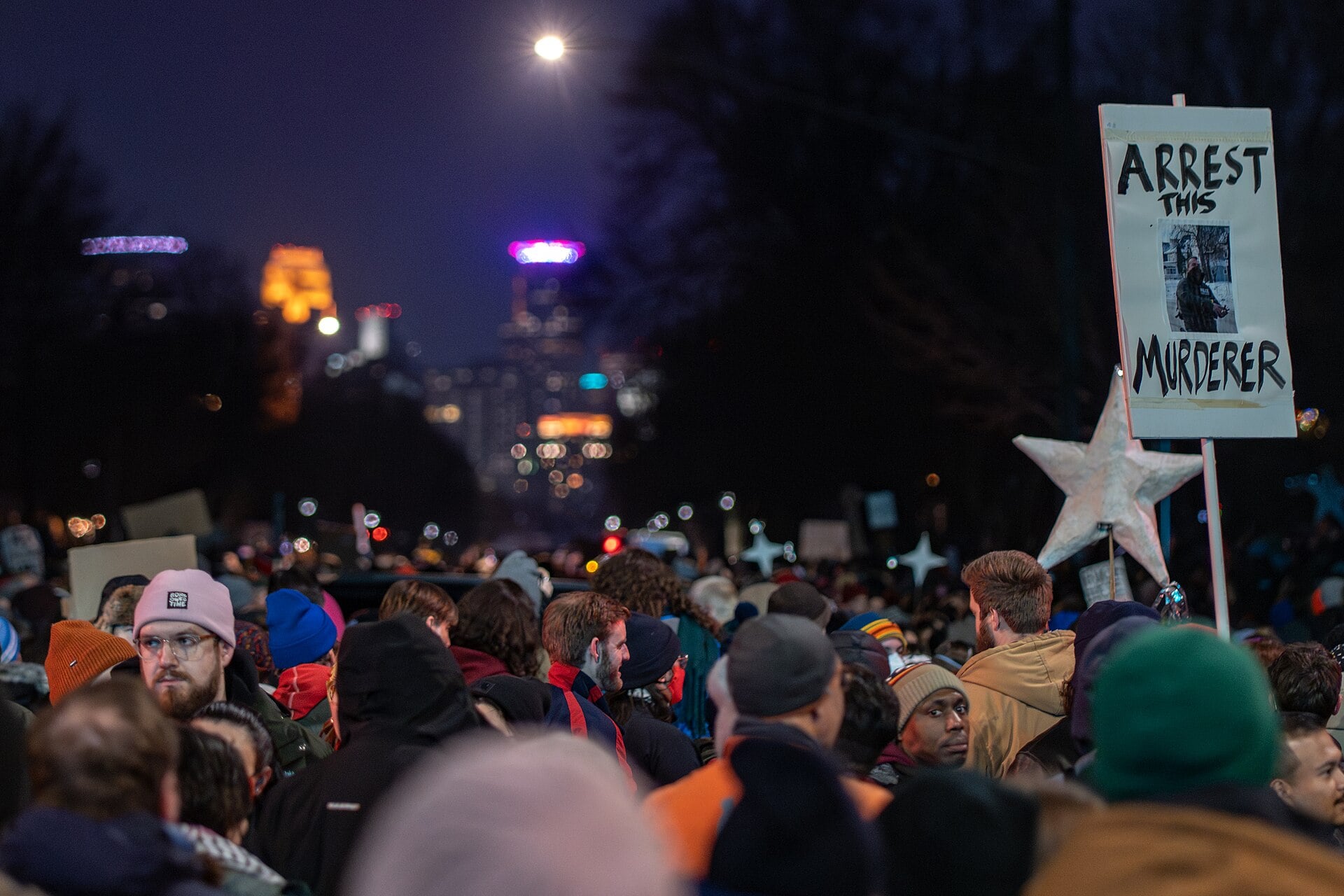
By now, you all know the names Renée Nicole Good and Alex Pretti. Their killings by the ICE led to a series of protests in Minneapolis and beyond. Midst this chaos, I believe you saw the photo that cut through the noise. It shows a photographer on the ground with federal agents on top of him, with his camera mid-air. His name is John Abernathy, and the man behind this historic image is Pierre Lavie.
I firmly believe these are the other two names we should remember. Abernathy’s gesture shows why photojournalism still matters, showing what a devoted photojournalist is – the one who’d save the truth he captured rather than saving his expensive camera he captured it with.
How it All Began
The current wave of protests began in Minneapolis in early January 2026 after the fatal shooting of Renée Nicole Good by a U.S. Immigration and Customs Enforcement (ICE) officer during a federal operation in the city. The local medical examiner ruled Good’s death a homicide, and widely shared bystander videos conflicted with the federal narrative. Therefore, there was immediate outrage and anger among residents, resulting in protests.
But the initial outrage did not dissipate. In fact, things got worse. On January 24, Alex Pretti, a 37-year-old ICU nurse, was shot and killed by a U.S. Border Patrol officer in Minneapolis. There are competing narratives about what happened. Federal officials claim that Pretti was armed and resisted disarmament. However, his family members and local witnesses dispute.
Protests spread through Minneapolis and to other cities. Demonstrators are demanding answers, accountability, and an end to aggressive federal immigration enforcement tactics that have left two local residents dead in less than a month. Vigils, marches, and larger organized demonstrations have continued even as federal agents have begun to pull back from the city in response to political and community pressure.
Abernathy and Lavie on the Scene
John Abernathy and Pierre Lavie were both photographing the same protest near the Whipple Federal Building in Minneapolis. Neither was assigned; both were there independently, moving with the crowd, documenting what unfolded.
According to Abernathy, the atmosphere that day was tense but familiar. There were pushbacks, brief surges by law enforcement, and moments when photographers had to constantly recalibrate their positions. At one point, while he was photographing and simultaneously live-streaming on his phone, he lost situational awareness for a moment. That was enough.
“I don’t even know why they tackled me,” Abernathy said in an interview with Status Coup News.
“I wasn’t even… I’m not like protesting as far as like I’m not… No signage. I’m not screaming. I’m not doing anything. I’m just here taking photos and and I turned my back on him and yeah, I got bumrushed and taken to the ground.”
Pinned face down, with multiple agents on top of him, John Abernathy wrote on his Instagram about what happened.
I was pinned face-down, with knees on my back, and detained. Tear gas was deployed. I was pepper sprayed directly in the eye. Earlier I had been shot twice by less-lethal munitions. I couldn’t breathe. I told them I couldn’t breathe.
The last two images I took while I was being attacked, and moments before ICE and border police agents swarmed me without warning.
As this was happening, Lavie was only a few feet away. He saw Abernathy go down and turned his camera toward him. What followed happened in seconds. Abernathy, realizing he was likely about to be detained and separated from his gear, made a snap decision.
“It was instinctual at that moment,” Abernathy told DPReview. He believed an ICE agent was trying to grab his phone out of his hand, and he had to think fast. “I didn’t know what would happen to me after that, so in a split second I decided: ‘I gotta throw it.’”
Lavie, who was crouching down to take photos of what was happening, says it was all very quick. “In my head, I was like, ‘Do I grab this? Do I not? If I do, am I gonna get pulled into this thing?” But then he told himself, “Okay, screw it. I’m doing it.”
Lavie kept shooting, and the rest is history. The resulting sequence of photos shows Abernathy looking straight at him, then throwing his Leica M10-R and phone mid-detention. Moments later, the agents pulled Abernathy back in, restrained him, pepper-sprayed him, and cited him for obstruction.
Finding the Camera
After his release, Abernathy tells DPReview that he started panicking and searching for his camera. He thought his instinctive reaction might have been a mistake. Sure, he saved the photos, but where are they? Where’s the camera? He even asked someone with a bullhorn to ask if anyone had seen his Leica, but no one had.
Thankfully, it took some phone tracking and the help of other photographers for the search to end well. John Abernathy was reunited with both his gear and the images still on it. Some of the last frames he took show federal agents advancing aggressively on protesters.
“So in hindsight, throwing my camera was the right thing to do, for multiple reasons. One, bringing attention to this entire issue we’re having. And two, the images show the aggression that they’re coming down on for no apparent reason.”
“I threw my Leica so the image wouldn’t be lost,” he wrote on Instagram. “Not just from my camera but from this city, this community, this country. The world needs to see what’s happening here…”
Too many images disappear into evidence lockers.
I didn’t want mine to.
Why Photojournalism Matters… Perhaps More Than Ever
What John Abernathy did is not heroic in the cinematic sense. It was instinctive, sure, but it was above all practical. But I also find it symbolic.
Photojournalism is often framed as documentation, but it in moments like this, it goes way beyond that. It becomes resistance and the difference between an official statement and a visual record of the truth. It makes a difference between “according to authorities” and “this is what it actually looked like.” Witnessing a mess in my own country for goddamn 15 months now, I feel this in my bones! We need more depictions of genuine moments as they happen, and less “according to authorities” spins.
This job has always been dangerous, but I feel it is becoming increasingly hostile even when journalists are not in the war zone. I feel like the entire world is a war zone now, and photographers are among those in the first rows. They singled out, detained, sprayed, tackled. The “authorities” seize their equipment and erase the truth they capture. Their presence is treated as provocation rather than observation, which I find insane in a so-called “democratic society.” And trust me, I’m not referring only to the USA.
Freedom Of The Press?
A photo fixes a moment in place and removes plausible deniability. It makes it harder to rewrite timelines, reframe intent, and quietly move on. A documentary photo is not an AI-generated narrative you want to plant on the gullible consumers. A documentary photo is the truth. This is why our cameras are grabbed and disappear into evidence lockers, and our memory cards end up “lost”. This is why independent photographers are asked who they work for, as if employment status determines the right to witness.
It is easy to support press freedom in theory. It is much harder when it means accepting that photographers will stand close to the events and record them without sugarcoating.
What happened to John Abernathy is, sadly, not an isolated incident. We’ve witnessed many cases of photojournalists being tackled, sprayed, detained, and even shot during protests. Perhaps you remember Linda Tirado, who was blinded by a rubber bullet in 2020, also in Minneapolis.
As I said, I also find this personally difficult and triggering because Serbian photojournalists have been going through the same torture. And it’s not only during the protests that have been going on since November 1, 2024. Arrests, beatings, and even deaths of journalists have a long history here. Some of the photographers attacked and detained more recently are my friends and acquaintances, my colleagues, and my comrades. And even if they weren’t, they’re fighters against state-enforced information blackout. And everyone who fights for press freedom is my comrade.
Because of them, and because of all honest and brave photojournalists out there, I find Abernathy’s tossing of the camera symbolic. I see it as choosing the truth and freedom of the press, even at the cost of his own freedom. In a moment when so many things are taken away, throwing the camera was a way of refusing to let the truth be one of them. It was an act of “keeping the witness alive.”
See more from DIYPhotography.net on Google
Add DIYPhotography.net as a trusted source. This makes
our stories more likely to appear in your Google Search results.
 Add as a preferred source on Google

Dunja Đuđić Kalinin
Dunja Djudjic is a multi-talented artist based in Novi Sad, Serbia. With 15 years of experience as a photographer, she specializes in capturing the beauty of nature, travel, concerts, and fine art. In addition to her photography, Dunja also expresses her creativity through writing, embroidery, and jewelry making.
Related Posts
 Photographer creates epic wildlife murals on his driveway with a pressure washer
 Here is how to create a cinematic video piece under extreme time pressure
 From press photographer to capturing ailing children: John Maniaci’s Journey
 New Lomo MC-A 35 mm Film Camera – Full Manual, Autofocus, and Total Creative Freedom
Join the Discussion
DIYP Comment Policy
Be nice, be on-topic, no personal information or flames.
One response to “John Abernathy Throwing his Camera: A Symbol Of Press Freedom Under Pressure”
THANK YOU! Hell of a mess we’re in right now in the US. Let Freedom Ring!