
























NASA’s Chandra Captures Unusual Supernova Activity in M83 Galaxy
Jun 29, 2026
Soumyadeep Mukherjee
Soumyadeep Mukherjee is an award-winning astrophotographer from India. He has a doctorate degree in Linguistics. His work extends to the sub-genres of nightscape, deep sky, solar, lunar and optical phenomenon photography. He is also a photography educator and has conducted numerous workshops. His works have appeared in over 40 books & magazines including Astronomy, BBC Sky at Night, Sky & Telescope among others, and in various websites including National Geographic, NASA, Forbes. He was the first Indian to win “Astronomy Photographer of the Year” award in a major category.
Share:
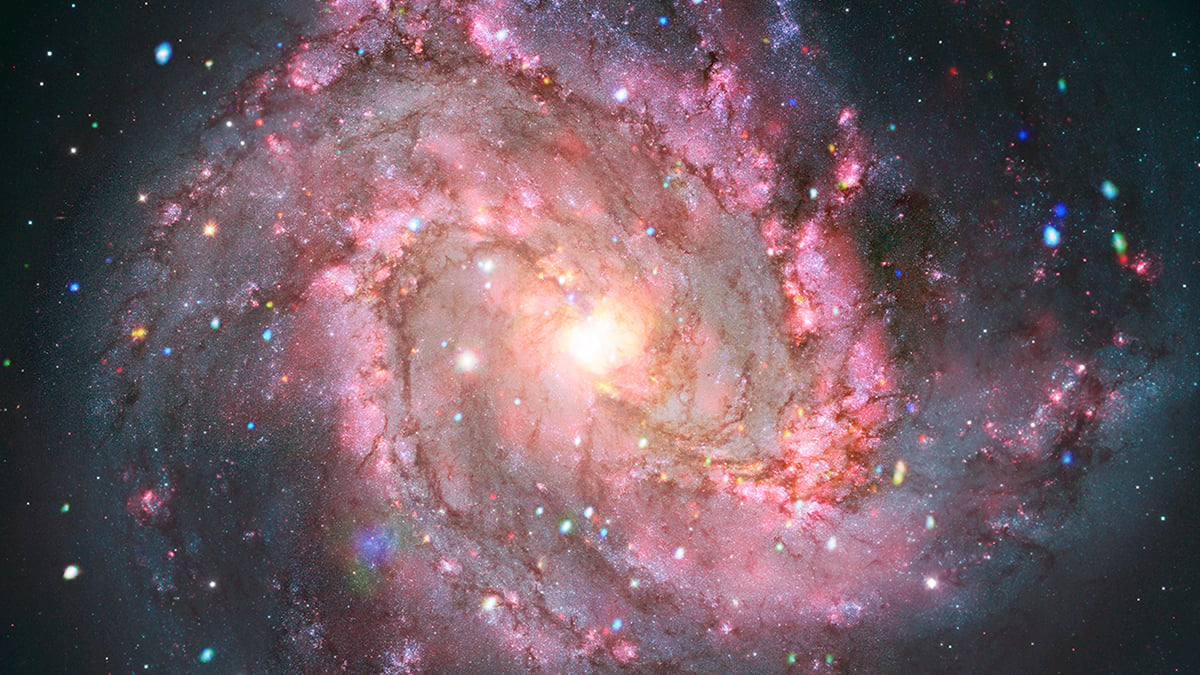
The evolution of a supernova remnant follows a well-established sequence. A massive star ends its life in a powerful explosion that launches an expanding shock wave into the surrounding interstellar medium. As the shock compresses and heats nearby gas, the remnant emits radiation across the electromagnetic spectrum, including strong X-rays. Over the following centuries, the shock wave slows down, the hot gas cools, and the X-ray emission gradually weakens. Although every remnant evolves in a slightly different environment, astronomers expect this overall trend to remain the same.
A new study using NASA‘s Chandra X-ray Observatory has now somewhat challenged this picture. After analyzing 14 years of observations of the nearby spiral galaxy Messier 83 (M83), researchers found that several known supernova remnants are not fading as expected. Rather, they brighten and dim over relatively short periods. Such behaviour is difficult to explain through the normal evolution of an expanding shell of hot gas. The observations point to another source of X-rays hidden inside many of these remnants.
M83: An ideal laboratory for studying stellar explosions
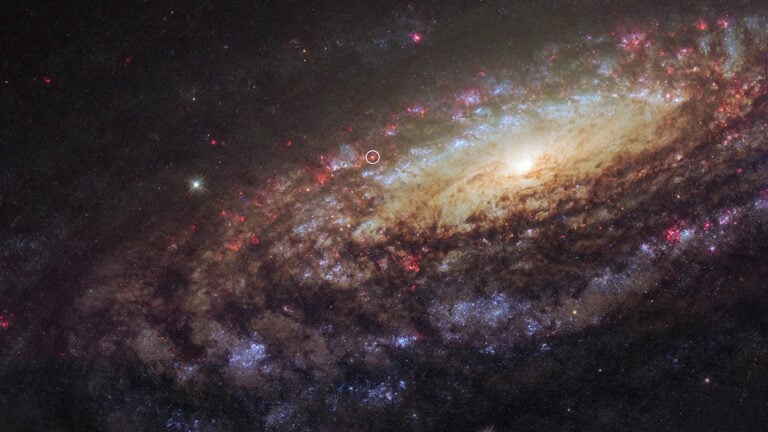
Messier 83 lies about 15 million light-years from Earth in the constellation Hydra. It is one of the closest face-on spiral galaxies, giving astronomers an unobstructed view of its structure. Bright spiral arms, active star-forming regions, and a rich population of massive stars make it one of the best nearby galaxies for studying stellar evolution.
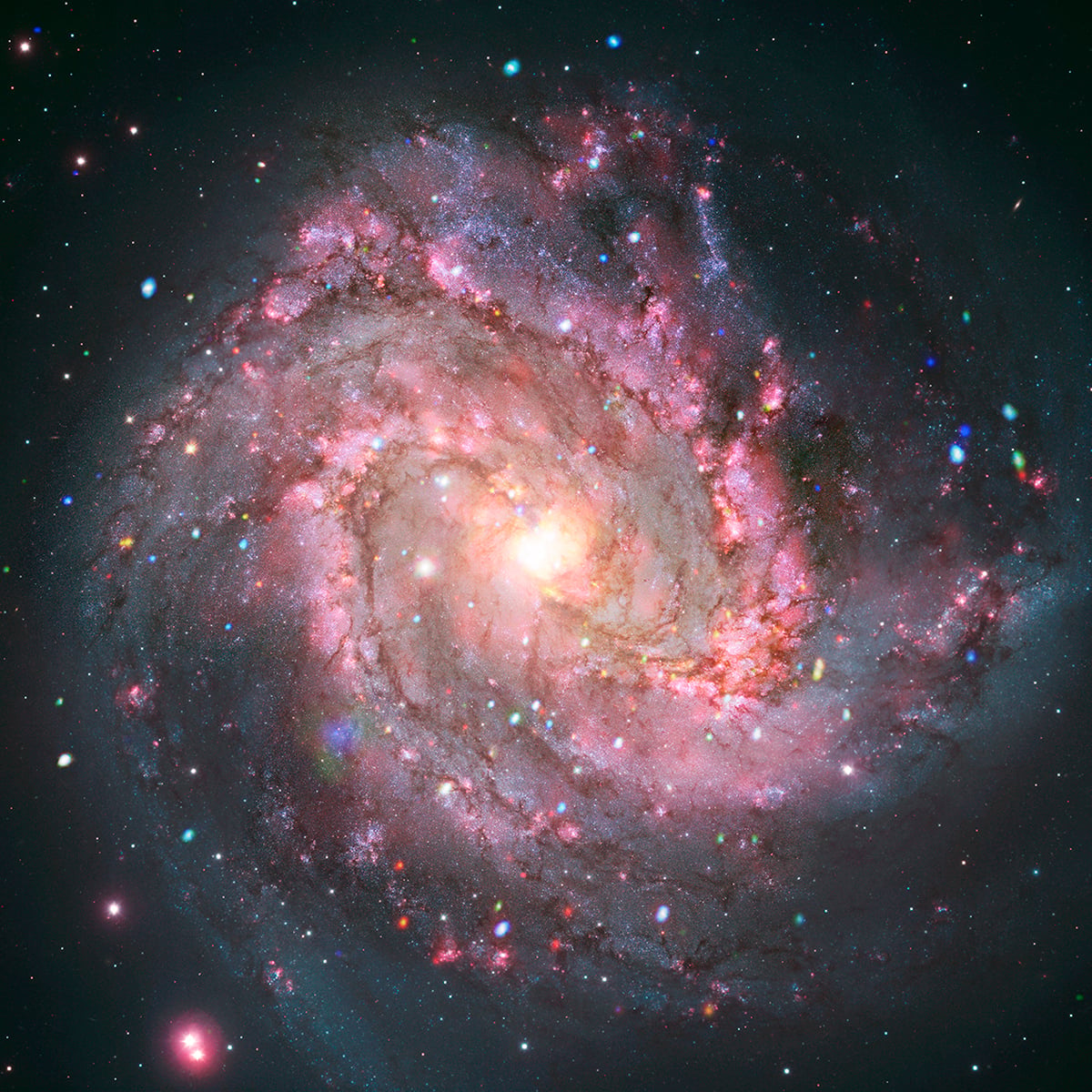
The galaxy has another advantage. It has produced an unusually large number of observed supernovae during the past century. Since 1923, astronomers have recorded at least six supernova explosions in M83. Those explosions have left behind a large collection of supernova remnants spread throughout the galaxy. Each remnant preserves valuable information about the explosion that created it and the environment through which its shock wave now travels.
Because all of these remnants lie at essentially the same distance from Earth, astronomers can compare their properties with much greater confidence than they can for remnants scattered across our own Galaxy. Differences in brightness are more likely to reflect real physical changes rather than uncertainties in distance.
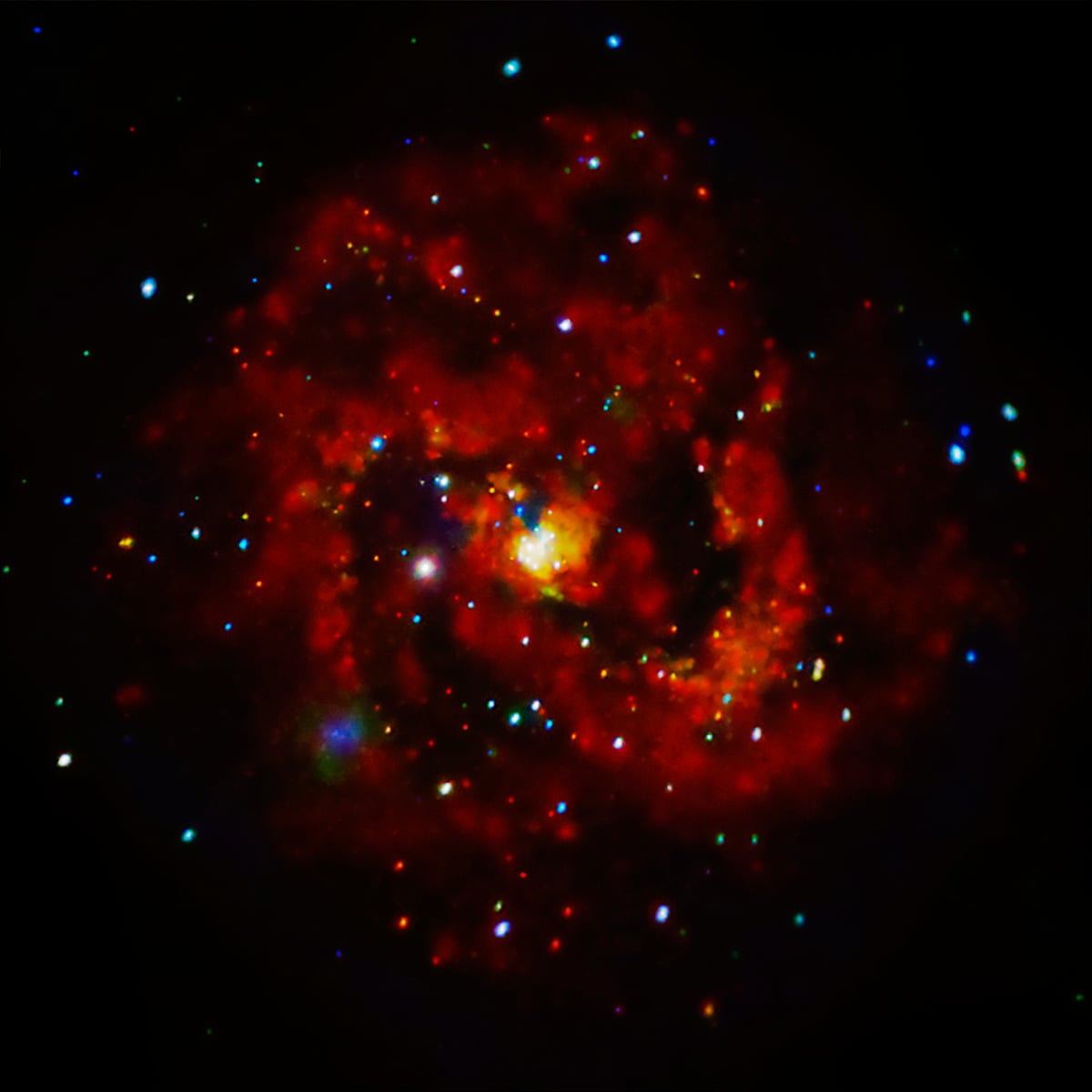
Chandra has observed M83 repeatedly since 2000. Those observations have produced one of the longest continuous X-ray records for any nearby spiral galaxy. Long-term datasets of this kind are extremely valuable because many astrophysical processes unfold slowly. A single observation captures only one moment in time. Multiple observations collected over many years allow astronomers to follow how individual objects evolve.
Observations with the Chandra Observatory
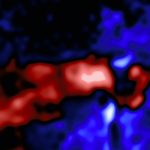
The study examined 22 previously identified supernova remnants in M83. Nearly half of them displayed noticeable changes in X-ray brightness during the 14-year observing period. That result immediately attracted attention because supernova remnants usually evolve over much longer timescales.
The X-rays detected from these remnants originate in extremely hot plasma. The supernova shock wave sweeps through the surrounding interstellar gas at several thousand kilometers per second. As the gas is compressed, its temperature rises to millions of degrees. At those temperatures, the gas radiates strongly in X-rays.

This process remains active while the shock wave carries large amounts of energy. As the remnant expands, however, the shock gradually weakens. The surrounding gas becomes less dense, the plasma cools, and the X-ray emission slowly decreases. Astronomers have observed this behaviour in many remnants throughout the Milky Way and nearby galaxies.
The Chandra observations suggested that another source of energy was contributing to the X-ray emission. That source had to be compact enough to vary over relatively short timescales and powerful enough to produce substantial changes in brightness. An expanding cloud of hot gas alone could not account for the observations.
Two possible explanations
The research team found that the most convincing explanation involves high-mass X-ray binaries. These systems form when two massive stars are born together and remain gravitationally bound throughout much of their lives. Since massive stars evolve rapidly, one of them reaches the end of its life first and explodes as a supernova. The explosion leaves behind either a neutron star or a black hole.
Astronomers once believed that many supernova explosions would destroy the binary system. The violent blast can push the newly formed compact object away at high speed, while the sudden loss of mass can weaken the gravitational bond between the two stars. In many cases, that does happen. Yet some binary systems survive the explosion and continue orbiting each other.
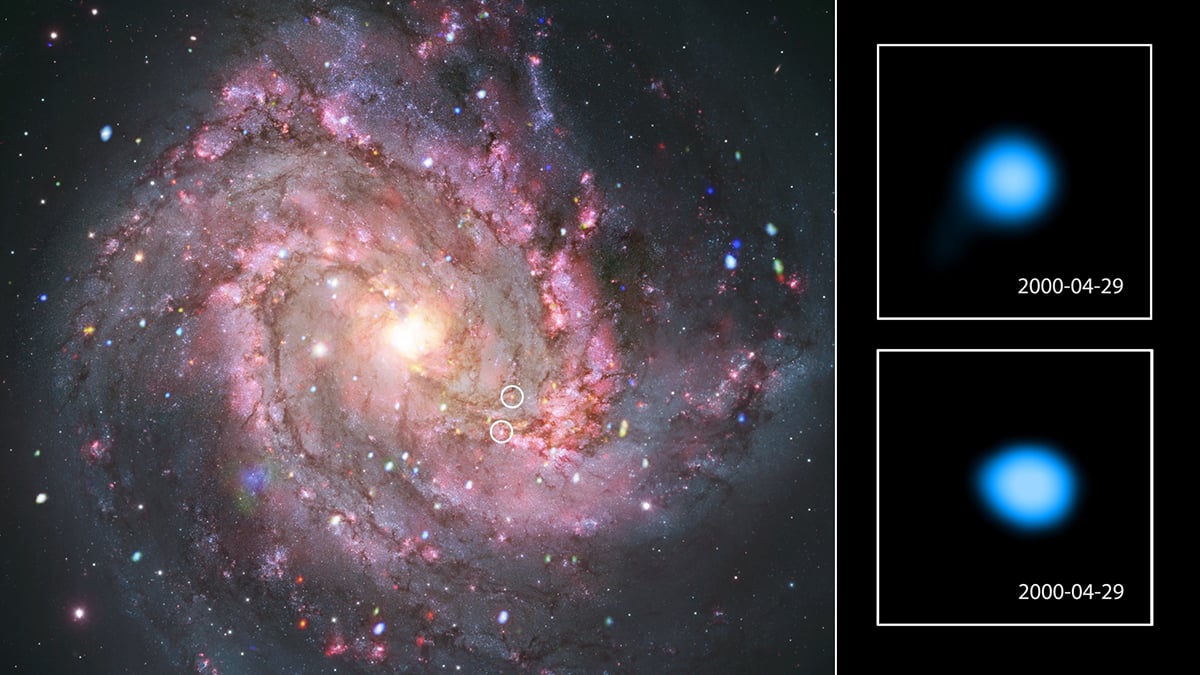
The researchers also explored another mechanism that could produce the observed variability. This idea does not require a surviving companion star. Although a supernova throws enormous amounts of material into space, not all of that gas necessarily escapes forever. Some of the slower-moving debris can remain gravitationally bound to the newly formed neutron star or black hole. Over time, part of this material may reverse direction and fall back toward the compact object.
Astronomers call this process fallback accretion. As the returning gas moves inward, gravity accelerates it to very high speeds. The gas becomes extremely hot before reaching the compact object and begins emitting X-rays. Since the flow of fallback material is unlikely to remain steady, the X-ray emission can also change with time. That behaviour resembles the variability observed in several remnants within M83.
Clear skies!
See more from DIYPhotography.net on Google
Add DIYPhotography.net as a trusted source. This makes
our stories more likely to appear in your Google Search results.
 Add as a preferred source on Google

Soumyadeep Mukherjee
Soumyadeep Mukherjee is an award-winning astrophotographer from India. He has a doctorate degree in Linguistics. His work extends to the sub-genres of nightscape, deep sky, solar, lunar and optical phenomenon photography. He is also a photography educator and has conducted numerous workshops. His works have appeared in over 40 books & magazines including Astronomy, BBC Sky at Night, Sky & Telescope among others, and in various websites including National Geographic, NASA, Forbes. He was the first Indian to win “Astronomy Photographer of the Year” award in a major category.



Join the Discussion
DIYP Comment Policy
Be nice, be on-topic, no personal information or flames.