

















James Webb Telescope Reveals a Lion-faced Nebula in Space
Aug 10, 2026
Soumyadeep Mukherjee
Soumyadeep Mukherjee is an award-winning astrophotographer from India. He has a doctorate degree in Linguistics. His work extends to the sub-genres of nightscape, deep sky, solar, lunar and optical phenomenon photography. He is also a photography educator and has conducted numerous workshops. His works have appeared in over 40 books & magazines including Astronomy, BBC Sky at Night, Sky & Telescope among others, and in various websites including National Geographic, NASA, Forbes. He was the first Indian to win “Astronomy Photographer of the Year” award in a major category.
Share:
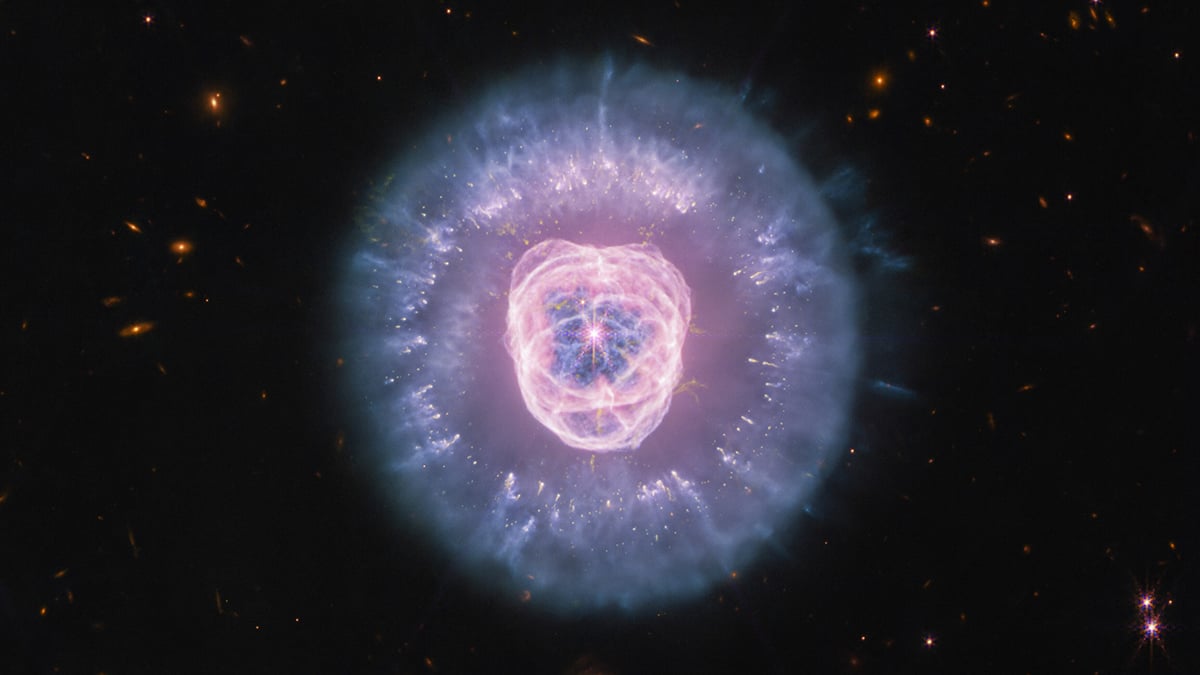
Planetary nebulae mark one of the final stages in the lives of stars with relatively low masses. They form when a dying star loses its outer layers and exposes its hot stellar core. NGC 2392, better known as the Lion Nebula, is a particularly useful example of this process. NGC 2392 lies about 5,000 light-years away in the constellation Gemini. William Herschel discovered it in 1787, and the object later became one of the best-known planetary nebulae observed by amateur and professional astronomers.
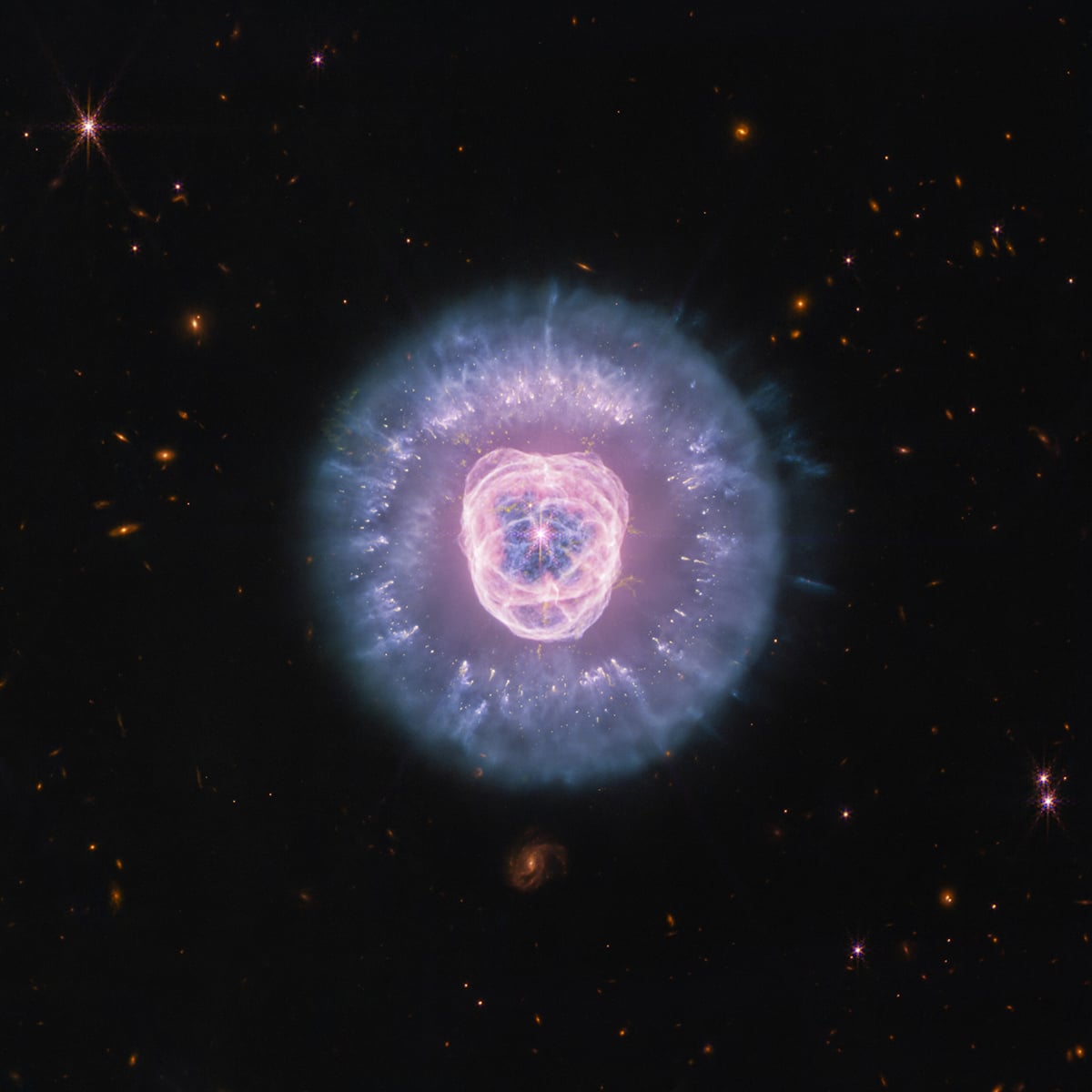
In a new image, NASA’s James Webb Space Telescope has observed NGC 2392 with both its Near Infrared Camera (NIRCam) and Mid-Infrared Instrument (MIRI). The observations reveal the nebula in wavelengths that differ from those used in earlier Hubble observations, which employed visible light.
JWST separates the gas and dust inside NGC 2392
The central feature in JWST’s image is the white dwarf left behind by the original star. It appears as a small bright point with diffraction spikes. Around it, several shells of ionized gas form the inner part of the nebula. Farther out, a broad ring of dusty material surrounds this region.
NIRCam and MIRI detect different portions of infrared radiation. NIRCam works at near-infrared wavelengths, while MIRI observes farther into the infrared. This allows James Webb to study material that does not stand out as strongly in visible light.
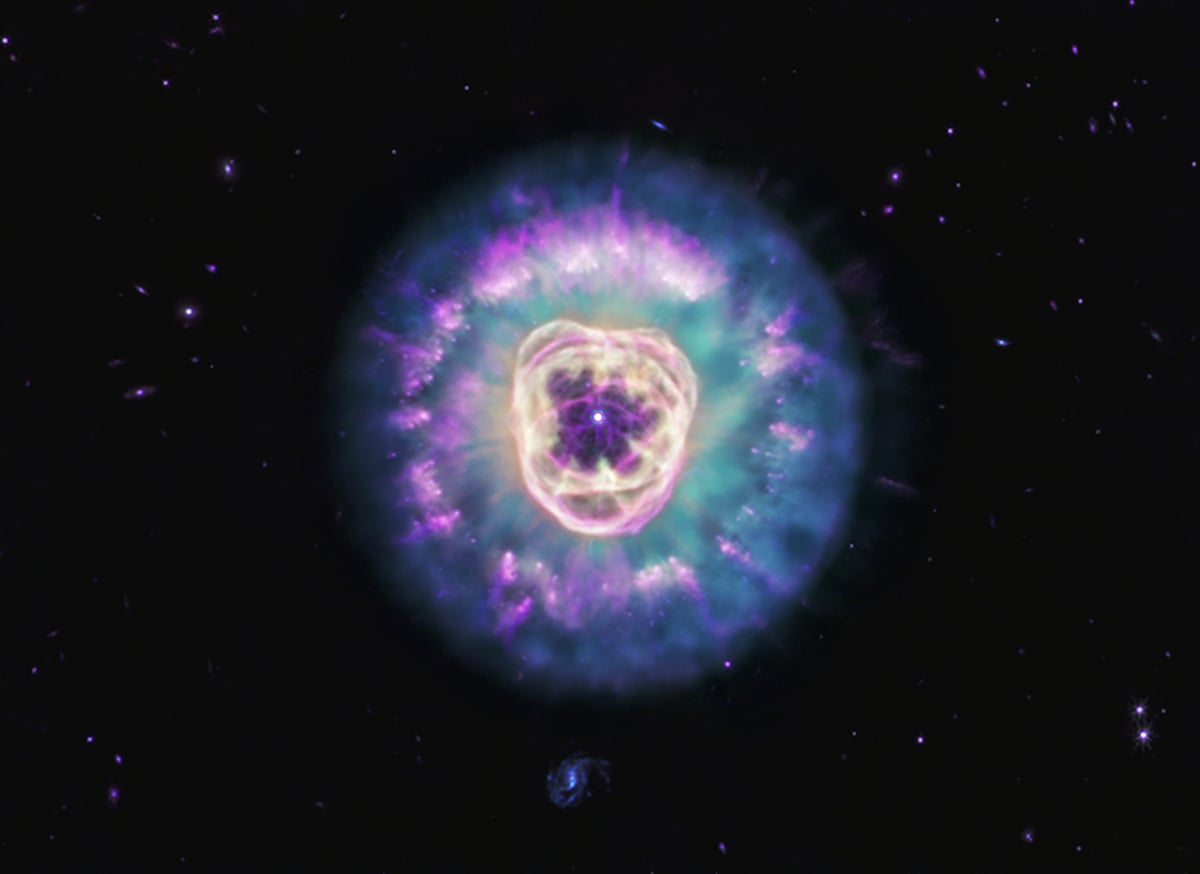
The images illustrate the relationship between the bright inner gas and the cooler, dusty material surrounding it. NASA notes that JWST’s observations reveal compact dust clumps and a haze of ionized gas within the nebula. The MIRI view is especially useful for examining the dust because it shows variations in its structure across the outer regions.
Some of the dust forms dense filaments and clumps. Other regions appear more diffuse. The difference reflects the conditions created by the central white dwarf. Its radiation reaches into the surrounding material and gradually changes it.
A dead star shaping the nebula
The star responsible for NGC 2392 began losing its outer layers about 10,000 years ago. NASA’s Hubble observations showed that the nebula contains two elongated lobes of material extending above and below the central star. One lobe lies partly in front of the other from our viewpoint, which affects the way the three-dimensional structure appears in images.
The star itself has changed dramatically during this period. It has shed much of its outer atmosphere and left behind a dense stellar core. That core is now a white dwarf.
Although the star has stopped normal nuclear fusion, the white dwarf remains extremely hot. Its radiation ionizes the surrounding gas, causing the material to glow. The radiation also interacts with the dust and can destroy it in exposed regions.
The central star’s radiation is not the only force at work. Stellar winds have also played a major role in shaping the nebula. Faster winds from the later stages of stellar evolution can collide with slower material that the star expelled earlier. This creates compressed regions and expanding bubbles.
JWST saw what Hubble could not
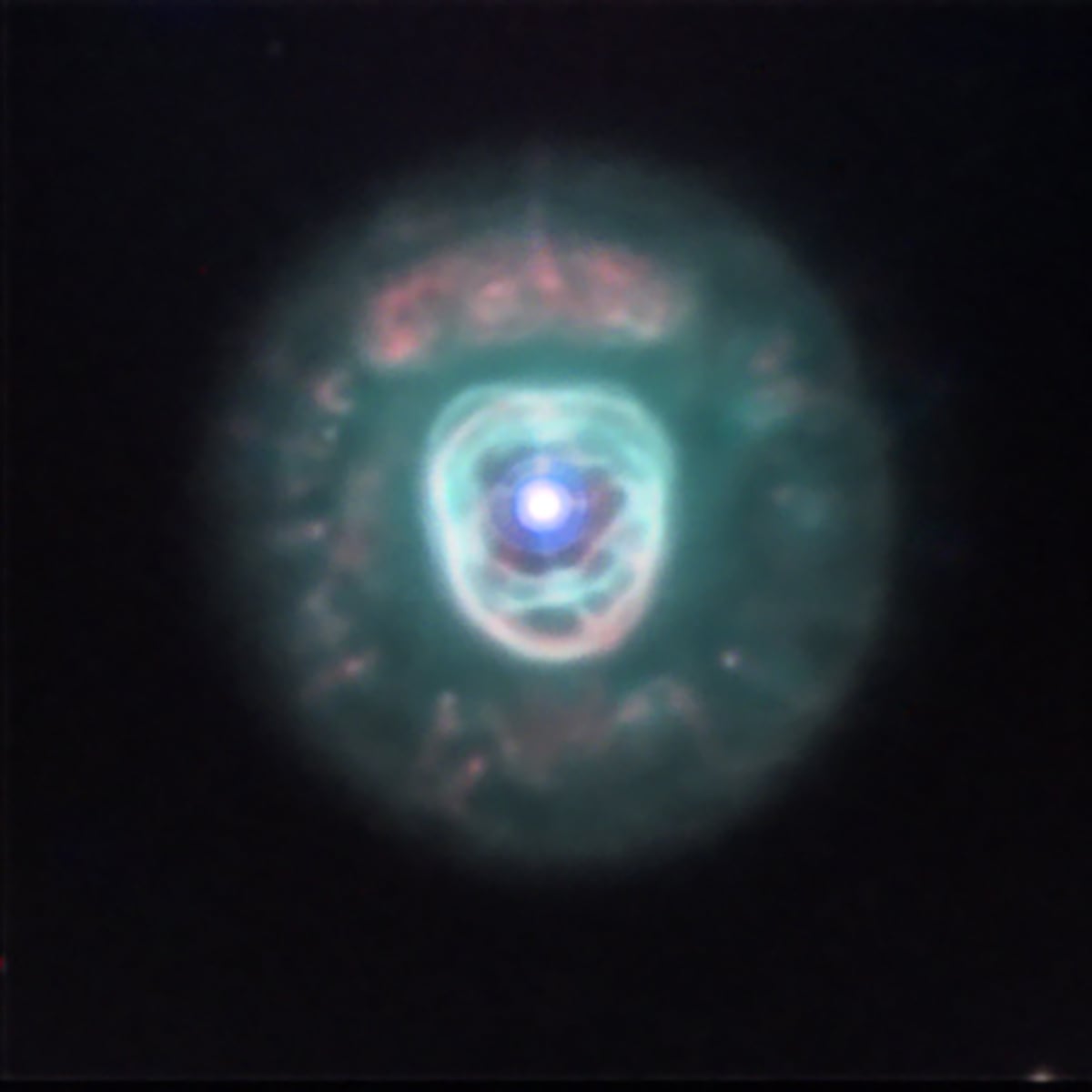
Hubble photographed NGC 2392 in 2000 and produced the image that made the nebula famous. Its optical observations showed the bright inner gas and the unusual structures surrounding it. Among the most distinctive features were numerous comet-shaped clumps in the outer region, with tails pointing away from the central star.
These structures raised questions about how the nebula formed. The clumps appear at similar distances from the central star, suggesting that they may have formed during a particular stage of the star’s evolution rather than appearing randomly throughout the nebula.
![The Hubble Space Telescope captured the famous image of the Lion Nebula in 2000. Credit: NASA, Andrew Fruchter and the ERO Team [Sylvia Baggett (STScI), Richard Hook (ST-ECF), Zoltan Levay (STScI)]](https://www.diyphotography.net/wp-content/uploads/2026/08/lion-nebula-jwst-2.jpg)
JWST had a solution to the problem that Hubble could not solve. Infrared observations are sensitive to cooler material and dust. This makes them useful for tracing regions that may be less obvious in visible light.
The difference between the two telescopes is especially apparent in the outer parts of NGC 2392. Hubble shows the glowing gas in considerable detail. James Webb reveals the dusty material mixed into and surrounding that gas. The result is a more complete picture of the environment around the white dwarf.
Clear skies!
See more from DIYPhotography.net on Google
Add DIYPhotography.net as a trusted source. This makes
our stories more likely to appear in your Google Search results.
 Add as a preferred source on Google

Soumyadeep Mukherjee
Soumyadeep Mukherjee is an award-winning astrophotographer from India. He has a doctorate degree in Linguistics. His work extends to the sub-genres of nightscape, deep sky, solar, lunar and optical phenomenon photography. He is also a photography educator and has conducted numerous workshops. His works have appeared in over 40 books & magazines including Astronomy, BBC Sky at Night, Sky & Telescope among others, and in various websites including National Geographic, NASA, Forbes. He was the first Indian to win “Astronomy Photographer of the Year” award in a major category.

Join the Discussion
DIYP Comment Policy
Be nice, be on-topic, no personal information or flames.