






















Chandra’s 25-Year Time-Lapse Reveals Kepler’s Supernova Remnant in Motion
Jan 8, 2026
Soumyadeep Mukherjee
Soumyadeep Mukherjee is an award-winning astrophotographer from India. He has a doctorate degree in Linguistics. His work extends to the sub-genres of nightscape, deep sky, solar, lunar and optical phenomenon photography. He is also a photography educator and has conducted numerous workshops. His works have appeared in over 40 books & magazines including Astronomy, BBC Sky at Night, Sky & Telescope among others, and in various websites including National Geographic, NASA, Forbes. He was the first Indian to win “Astronomy Photographer of the Year” award in a major category.
Share:

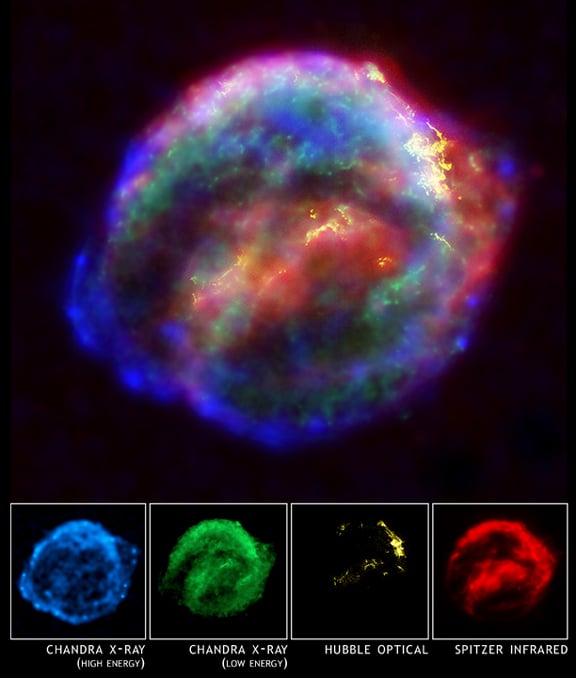
Type Ia supernova remnants provide a rare opportunity to study the long-term consequences of thermonuclear stellar explosions. Kepler’s Supernova Remnant, the debris field left behind by the stellar event observed in 1604, remains one of the most important examples in the Milky Way. Located roughly 17,000 light-years from Earth, the remnant continues to evolve as its shock waves interact with the surrounding interstellar medium. Until recently, however, astronomers could only infer this evolution from static images taken years apart.
In January 2026, the Chandra team released a multi-epoch X-ray video constructed from observations spanning 25 years. These data sets, collected between 2000 and 2025, form the longest time-baseline video ever released by Chandra. As a result, astronomers can now directly observe the expansion of a supernova remnant on human time scales. This release marks a significant step forward in understanding how stellar explosions shape their environments over centuries.
Kepler’s supernova and its historical significance
Kepler’s Supernova was first recorded in October 1604 and remained visible in daylight for weeks. Johannes Kepler documented the event in detail, making it one of the best-studied supernovas of the pre-telescope era. Modern observations have since identified the explosion as a Type Ia supernova, triggered when a white dwarf star exceeded its stable mass limit.
Unlike core-collapse supernovas, Type Ia events do not leave behind a neutron star or black hole. Instead, they disperse most of the stellar mass into space at extreme velocities. Kepler’s Supernova Remnant preserves this debris in the form of an expanding shell of hot gas. Because the remnant lies within our galaxy, astronomers can study its structure with far greater spatial resolution than distant extragalactic remnants.
Over the last several decades, Kepler’s remnant has become a benchmark object for studying shock physics, element distribution, and plasma heating in supernova debris. Chandra’s long operational lifetime has now added a new dimension to this research by enabling direct measurements of motion and change.

Building a 25-year x-ray time-lapse
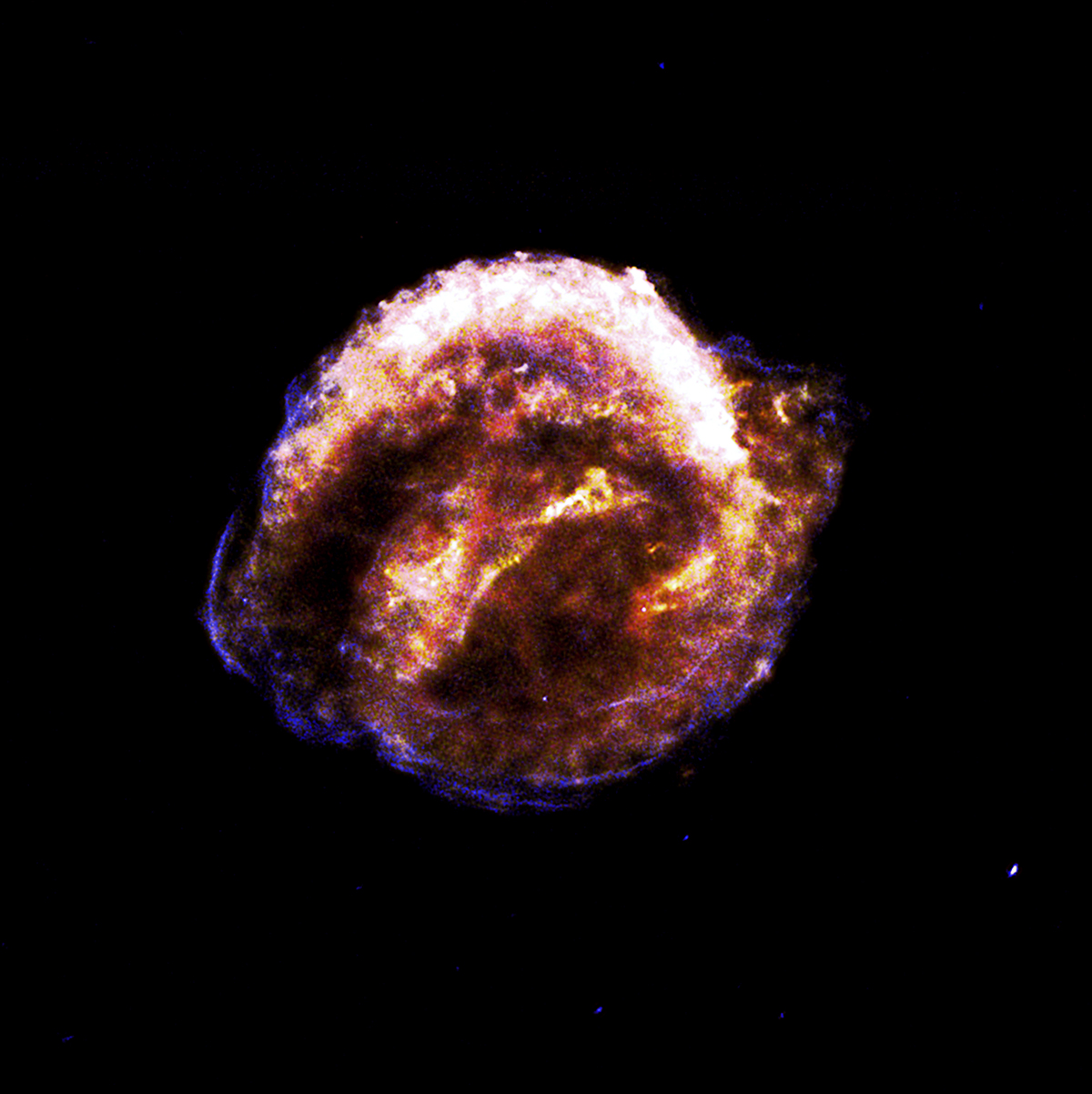
The newly released video combines Chandra observations obtained in 2000, 2004, 2006, 2014, and 2025. Each observation captured X-ray emission from gas heated to millions of degrees by the supernova shock wave. By aligning and scaling these images, scientists produced a smooth sequence that clearly shows the remnant expanding outward.
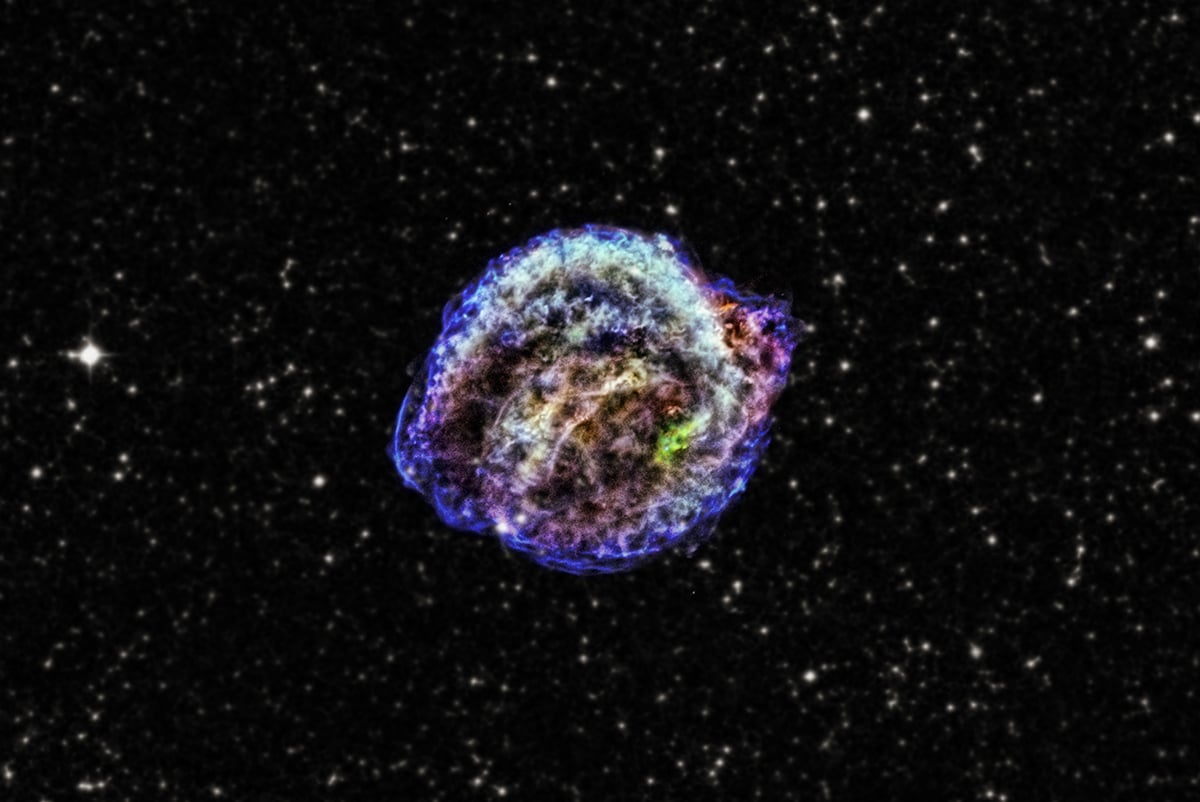
To provide visual context, the X-ray data appear overlaid on optical images from the Pan-STARRS survey. The optical background highlights cooler stars and gas, while the X-rays isolate the energetic structures driven by the explosion. This multiwavelength approach allows viewers to distinguish the supernova debris from unrelated foreground and background objects.
What makes this release scientifically valuable is not just its visual impact. The consistent imaging strategy across 25 years allows astronomers to measure expansion rates with high precision. This approach transforms Kepler’s Supernova Remnant from a static object into a dynamic laboratory for studying shock evolution.
Uneven expansion and clues to the surrounding environment
The Chandra time-lapse reveals that the remnant does not expand uniformly in all directions. Instead, different regions move at markedly different speeds. The fastest portions of the shock front expand at approximately 13.8 million miles per hour, or about two percent of the speed of light. Meanwhile, slower regions advance at closer to four million miles per hour.
This asymmetry carries important physical meaning. Faster expansion indicates regions where the surrounding interstellar medium is relatively thin. Slower motion, in contrast, signals encounters with denser material that resists the shock wave. As a result, the remnant’s shape reflects the structure of the environment shaped by the star before it exploded.
By mapping these speed variations, astronomers gain insight into how matter was distributed around the progenitor system. These measurements also help refine computer models that simulate the evolution of supernova remnants. Without long-baseline observations like these, such models would rely heavily on assumptions rather than direct evidence.
X-ray astronomy for supernova studies
Supernova remnants emit radiation across the entire electromagnetic spectrum, but X-rays play a particularly unique role. When the supernova shock slams into surrounding gas, it heats the material to tens of millions of degrees. At these temperatures, the gas emits strongly in X-rays, making this wavelength ideal for tracing high-energy processes.
Chandra’s angular resolution allows astronomers to resolve fine structures within the remnant. This capability is essential for detecting subtle changes over time. Few space observatories combine such resolution with the operational longevity required for multi-decade studies. Chandra’s continued performance since its 1999 launch has therefore been critical to this project.
When scientists combine X-ray data with optical and infrared observations, they can separate hot shock-heated gas from cooler material. This layered view reveals how energy flows through the remnant and how different components respond to the explosion. In Kepler’s case, X-ray imaging has proven indispensable for tracking expansion and understanding shock dynamics.
Type Ia supernovae and cosmic evolution
Type Ia supernovas serve as standard candles for measuring cosmic distances, and they played a central role in discovering the accelerating expansion of the universe. Understanding how these explosions work in detail remains a priority for astrophysics. By studying a nearby remnant in depth, astronomers can test theories about how Type Ia supernovae ignite and evolve. The distribution of elements within the remnant also provides clues about nuclear processes during the explosion. These insights feed directly into models used to interpret observations of distant supernovas.
Moreover, supernova remnants act as engines of galactic evolution. They inject energy into the interstellar medium and distribute heavy elements that later form new stars and planets. The Chandra time-lapse demonstrates this process in action, showing how stellar debris continues to shape its environment centuries after the initial explosion.
The release of this 25-year time-lapse underscores the scientific value of sustained space missions. As Chandra continues its mission, similar long-term studies may emerge for other supernova remnants. Each new time-lapse will add depth to our understanding of how stars end their lives and influence the galaxy around them.
Clear skies!
See more from DIYPhotography.net on Google
Add DIYPhotography.net as a trusted source. This makes
our stories more likely to appear in your Google Search results.
 Add as a preferred source on Google

Soumyadeep Mukherjee
Soumyadeep Mukherjee is an award-winning astrophotographer from India. He has a doctorate degree in Linguistics. His work extends to the sub-genres of nightscape, deep sky, solar, lunar and optical phenomenon photography. He is also a photography educator and has conducted numerous workshops. His works have appeared in over 40 books & magazines including Astronomy, BBC Sky at Night, Sky & Telescope among others, and in various websites including National Geographic, NASA, Forbes. He was the first Indian to win “Astronomy Photographer of the Year” award in a major category.
Join the Discussion
DIYP Comment Policy
Be nice, be on-topic, no personal information or flames.