





















James Webb Captures Its Most Detailed View of the Cigar Galaxy
Jun 27, 2026
Soumyadeep Mukherjee
Soumyadeep Mukherjee is an award-winning astrophotographer from India. He has a doctorate degree in Linguistics. His work extends to the sub-genres of nightscape, deep sky, solar, lunar and optical phenomenon photography. He is also a photography educator and has conducted numerous workshops. His works have appeared in over 40 books & magazines including Astronomy, BBC Sky at Night, Sky & Telescope among others, and in various websites including National Geographic, NASA, Forbes. He was the first Indian to win “Astronomy Photographer of the Year” award in a major category.
Share:
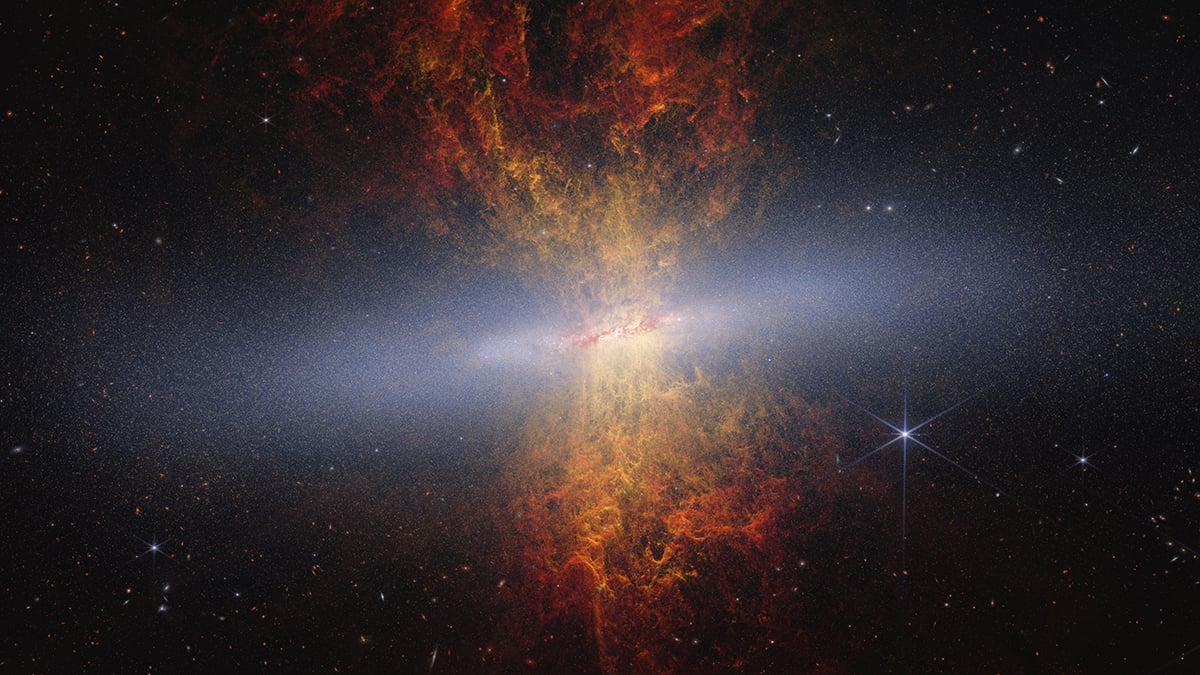
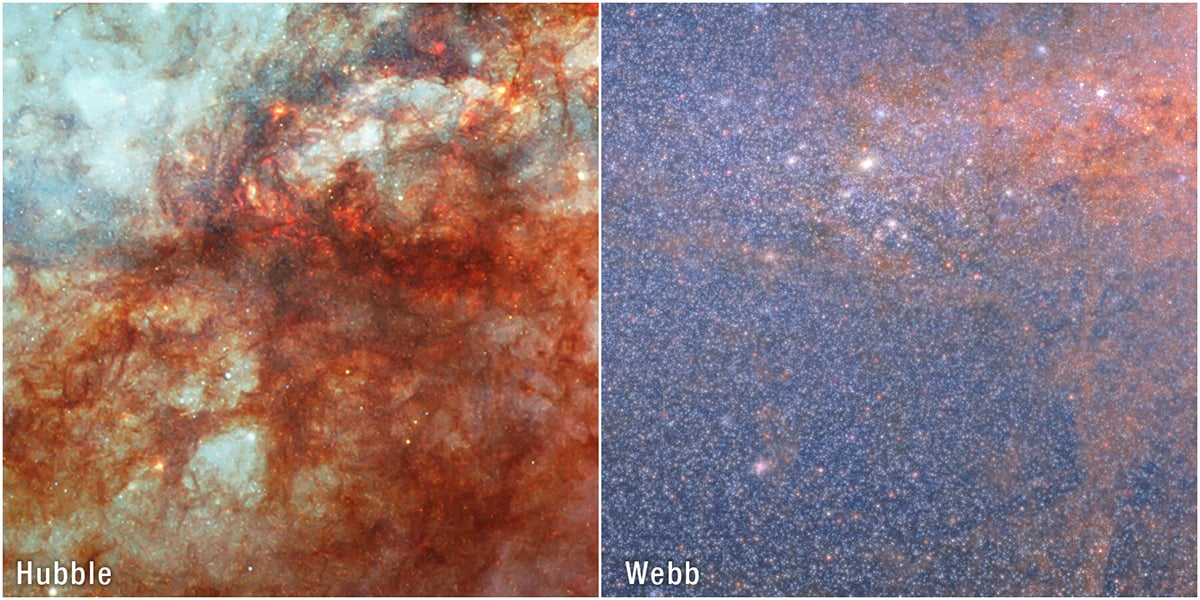
The James Webb Space Telescope (JWST) has produced the deepest near-infrared survey ever made of M82. During a 65-hour observing campaign, JWST captured an extraordinary level of detail across the galaxy. Its Near-Infrared Camera (NIRCam) resolved around 16.5 million individual stars, many of which had never been observed before. The new dataset offers astronomers an opportunity to examine one of the nearest starburst galaxies almost star by star.
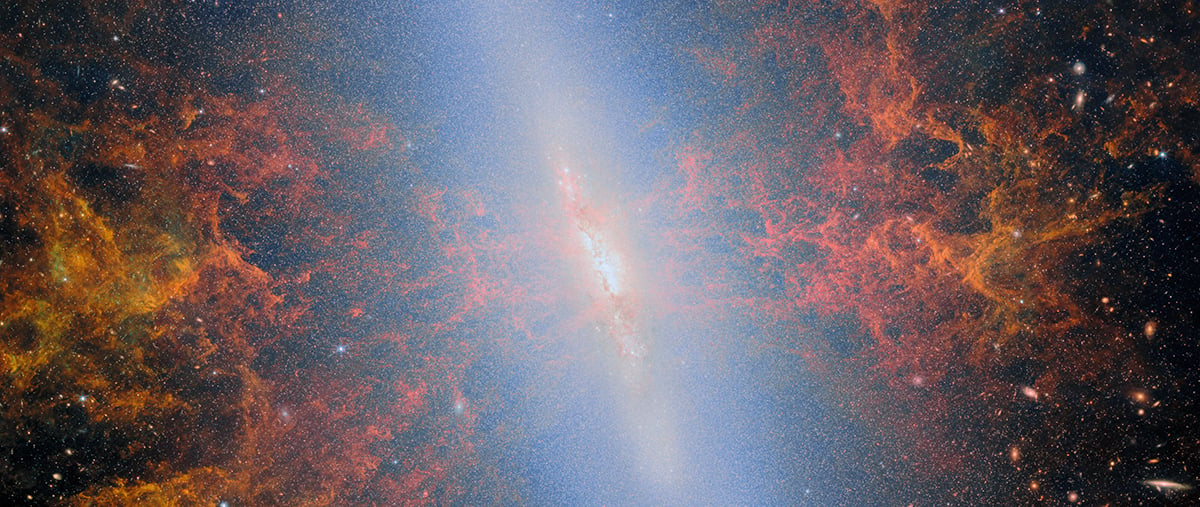
The observations also combine JWST‘s infrared images with data from the Hubble Space Telescope. Each telescope contributes something different. JWST uncovers stars buried inside dusty regions, while Hubble traces the glowing gas pushed into space by young, massive stars.
M82: The Cigar Galaxy
Located about 12 million light-years away in the constellation Ursa Major, M82 appears as a long, narrow galaxy when viewed through telescopes. Its shape earned it the popular name Cigar Galaxy. However, its appearance tells only a small part of the story.
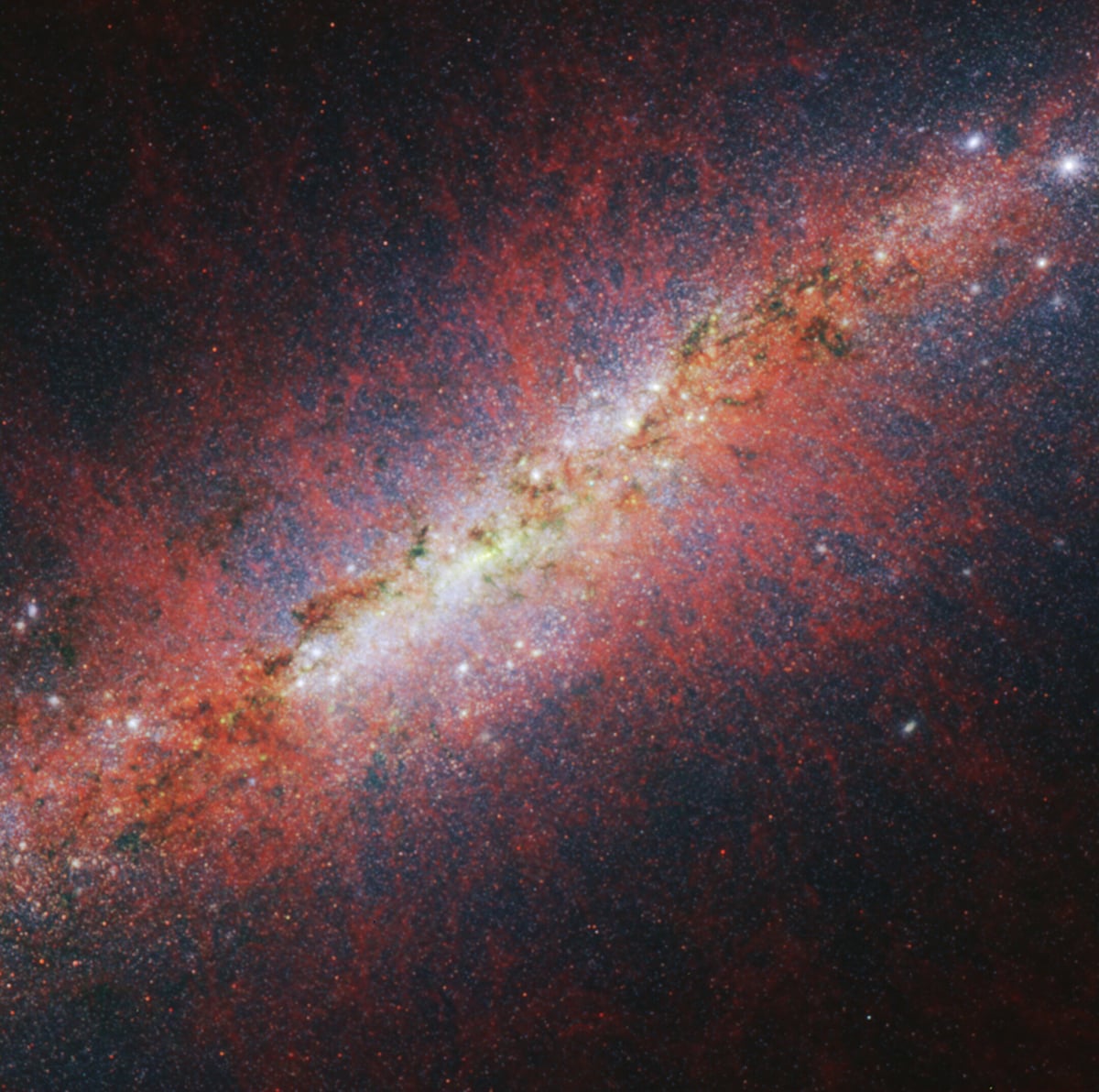
Unlike galaxies that form stars at a steady pace, M82 is experiencing an exceptionally active period of stellar birth. The galaxy produces new stars several times faster than the Milky Way. Massive stars continue to emerge inside dense clouds of gas, while older generations explode as supernovae. These energetic events release enormous amounts of radiation and inject fresh energy into the surrounding environment.
Astronomers believe this extraordinary activity began hundreds of millions of years ago after M82 experienced a close gravitational encounter with the neighboring spiral galaxy M81. The two galaxies never collided directly. Even so, their mutual gravity dramatically disturbed M82’s gas clouds. Those clouds became compressed and unstable, allowing gravity to trigger widespread star formation across the galaxy.
Looking through the dust with infrared vision
Interstellar dust is an essential ingredient of every galaxy. Tiny particles of carbon, silicon, and other elements drift between the stars. These particles provide the raw material from which new stars and planets eventually form. At the same time, they absorb and scatter visible light, making many regions of galaxies appear dark even though they contain countless stars.
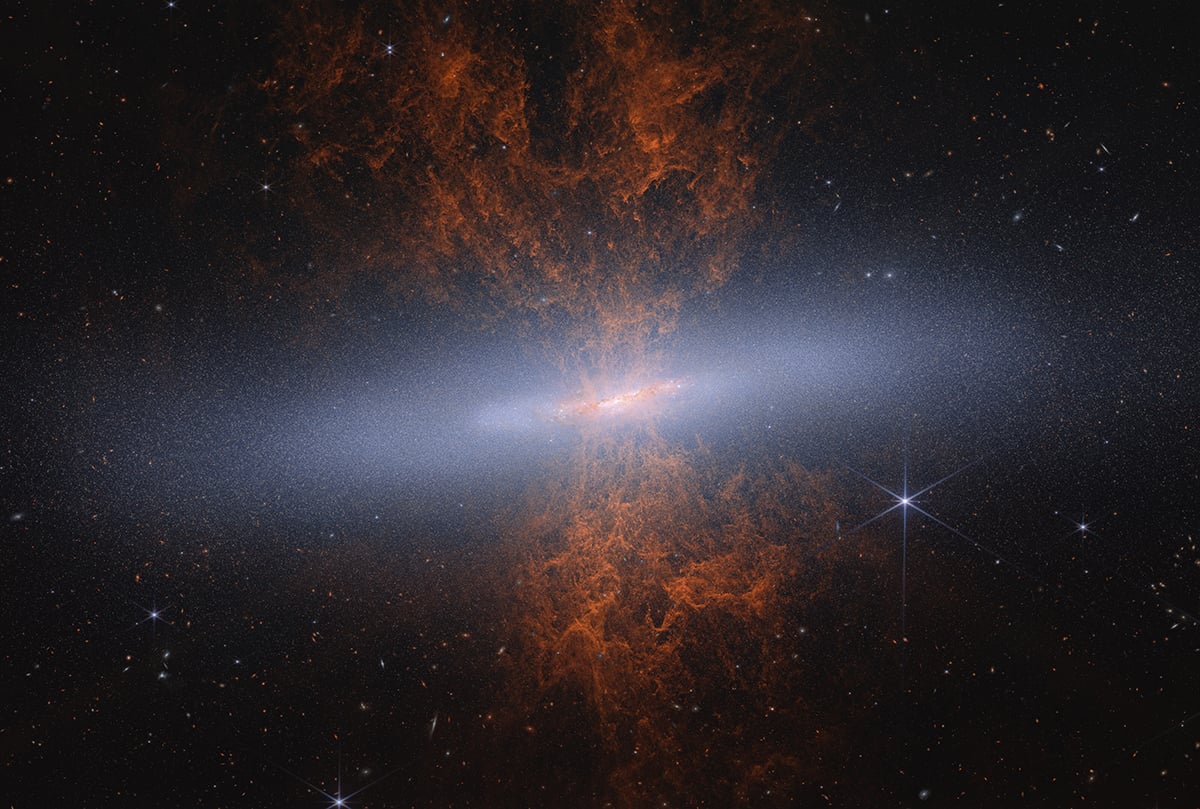
In M82, thick dust lanes stretch across its central regions, hiding much of the galaxy’s interior from optical telescopes. Earlier observations with Hubble and other space observatories revealed spectacular star clusters and giant clouds of glowing gas.
JWST, however, observes primarily in infrared wavelengths. Infrared light passes through dust far more efficiently than visible light. Regions that appear almost opaque in optical images become surprisingly transparent in JWST’s observations.
Sixty-five hours of observations
The telescope observed M82 for nearly 65 hours, making this one of the most ambitious imaging campaigns ever carried out for a nearby galaxy. Long observing times allow telescopes to collect more light from faint objects. Each additional exposure improves the image and reveals stars that remain invisible in shorter observations.
That effort resulted in one of the largest stellar catalogues ever created for M82. JWST resolved approximately 16.5 million individual stars.
Earlier investigations relied largely on integrated light. Billions of stars blended into a smooth glow, forcing researchers to estimate the average properties of large regions. JWST separates many of those stars into individual sources. That simple change opens an entirely new field of investigation.
JWST and Hubble together: A more complete story
JWST’s infrared instruments penetrate the galaxy’s dust and uncover stars that remain hidden in visible light. Hubble, meanwhile, excels at recording the glowing clouds of ionized hydrogen produced by massive young stars. Those observations also trace the spectacular streams of gas flowing away from the galaxy.
When these datasets are combined, astronomers can compare the positions of young stars with surrounding gas and dust, identify regions where star formation remains active, and investigate how stellar feedback reshapes the galaxy.
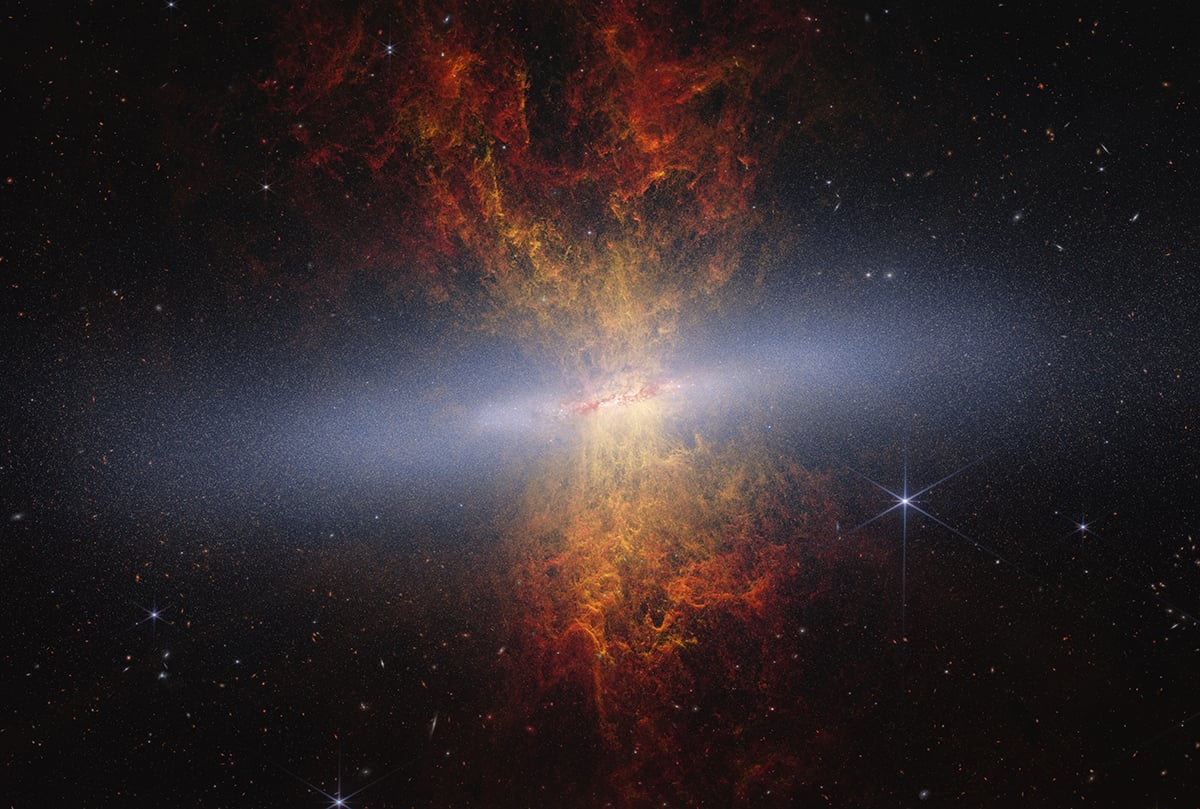
That feedback plays a crucial role in galaxy evolution. Massive stars release powerful stellar winds throughout their lives. When they reach the end of their evolution, they explode as supernovae and inject enormous amounts of energy into the surrounding gas. These processes heat the interstellar medium, compress nearby gas clouds, and sometimes trigger a new generation of star formation. In other cases, they disperse the gas and bring star formation to an end.
The combined JWST-Hubble observations make these interactions much easier to study. Researchers can now investigate how young stars, gas, and dust influence one another across the entire galaxy instead of focusing on only a few isolated regions.
Clear skies!
See more from DIYPhotography.net on Google
Add DIYPhotography.net as a trusted source. This makes
our stories more likely to appear in your Google Search results.
 Add as a preferred source on Google

Soumyadeep Mukherjee
Soumyadeep Mukherjee is an award-winning astrophotographer from India. He has a doctorate degree in Linguistics. His work extends to the sub-genres of nightscape, deep sky, solar, lunar and optical phenomenon photography. He is also a photography educator and has conducted numerous workshops. His works have appeared in over 40 books & magazines including Astronomy, BBC Sky at Night, Sky & Telescope among others, and in various websites including National Geographic, NASA, Forbes. He was the first Indian to win “Astronomy Photographer of the Year” award in a major category.

Join the Discussion
DIYP Comment Policy
Be nice, be on-topic, no personal information or flames.