



















James Webb Captures Methane on Interstellar Comet 3I/ATLAS
Jun 4, 2026
Soumyadeep Mukherjee
Soumyadeep Mukherjee is an award-winning astrophotographer from India. He has a doctorate degree in Linguistics. His work extends to the sub-genres of nightscape, deep sky, solar, lunar and optical phenomenon photography. He is also a photography educator and has conducted numerous workshops. His works have appeared in over 40 books & magazines including Astronomy, BBC Sky at Night, Sky & Telescope among others, and in various websites including National Geographic, NASA, Forbes. He was the first Indian to win “Astronomy Photographer of the Year” award in a major category.
Share:
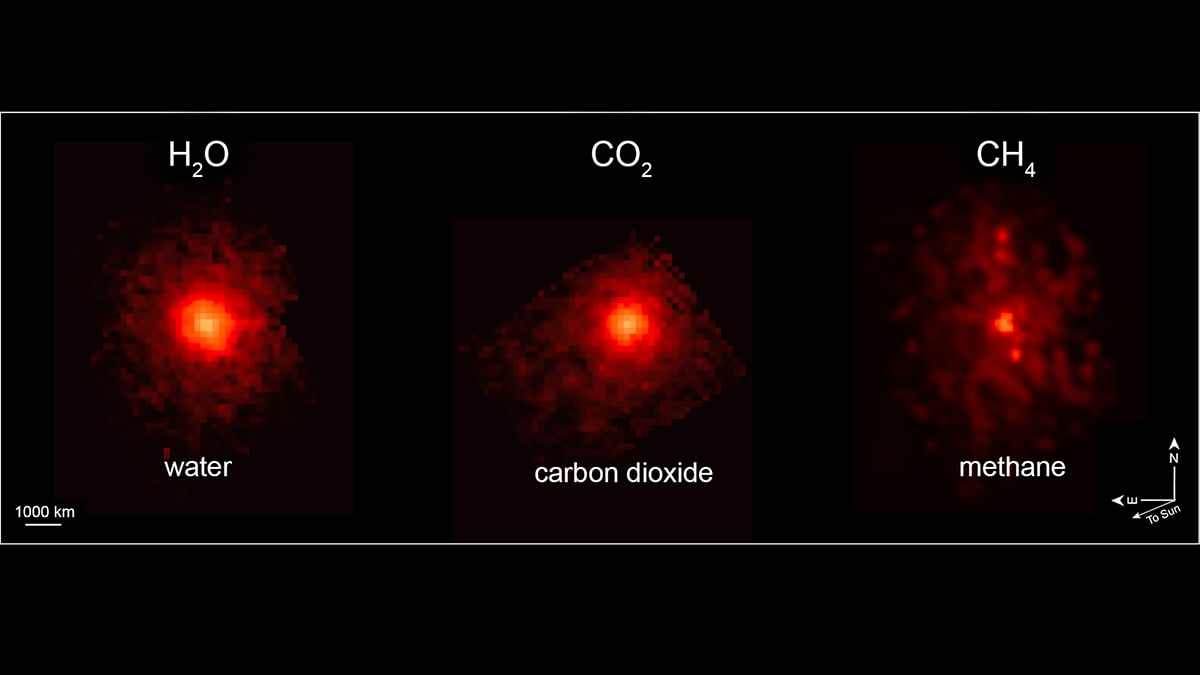
The James Webb Space Telescope has detected methane in the coma of interstellar comet 3I/ATLAS, adding a major new result to the growing field of interstellar object science. Using the Mid-Infrared Instrument (MIRI), JWST identified methane, water vapor, and carbon dioxide in material escaping from the comet’s nucleus as it moved through the inner Solar System. The observations provide one of the most detailed chemical studies ever performed on an object that formed around another star.
The results continue a trend established by earlier interstellar visitors. Both ʻOumuamua and Comet 2I/Borisov challenged existing ideas about small-body formation and evolution beyond the Solar System. Now, 3I/ATLAS has introduced another chemically complex object into that discussion. Unlike previous detections, however, JWST’s infrared sensitivity allowed researchers to study the distribution of gases within the comet’s coma in much greater detail.
Discovery of 3I/ATLAS and its interstellar origin
Astronomers first identified 3I/ATLAS through the Asteroid Terrestrial-impact Last Alert System, commonly called ATLAS. Early orbital calculations immediately drew attention because the comet followed a strongly hyperbolic trajectory. Such trajectories suggest that the object did not originate within the Solar System.
Unlike periodic comets that orbit the Sun repeatedly, interstellar objects enter the Solar System only once. Gravitational interactions in their original planetary systems likely ejected them into interstellar space long ago. Afterward, they drifted through the galaxy for millions or even billions of years before eventually passing near another star system.
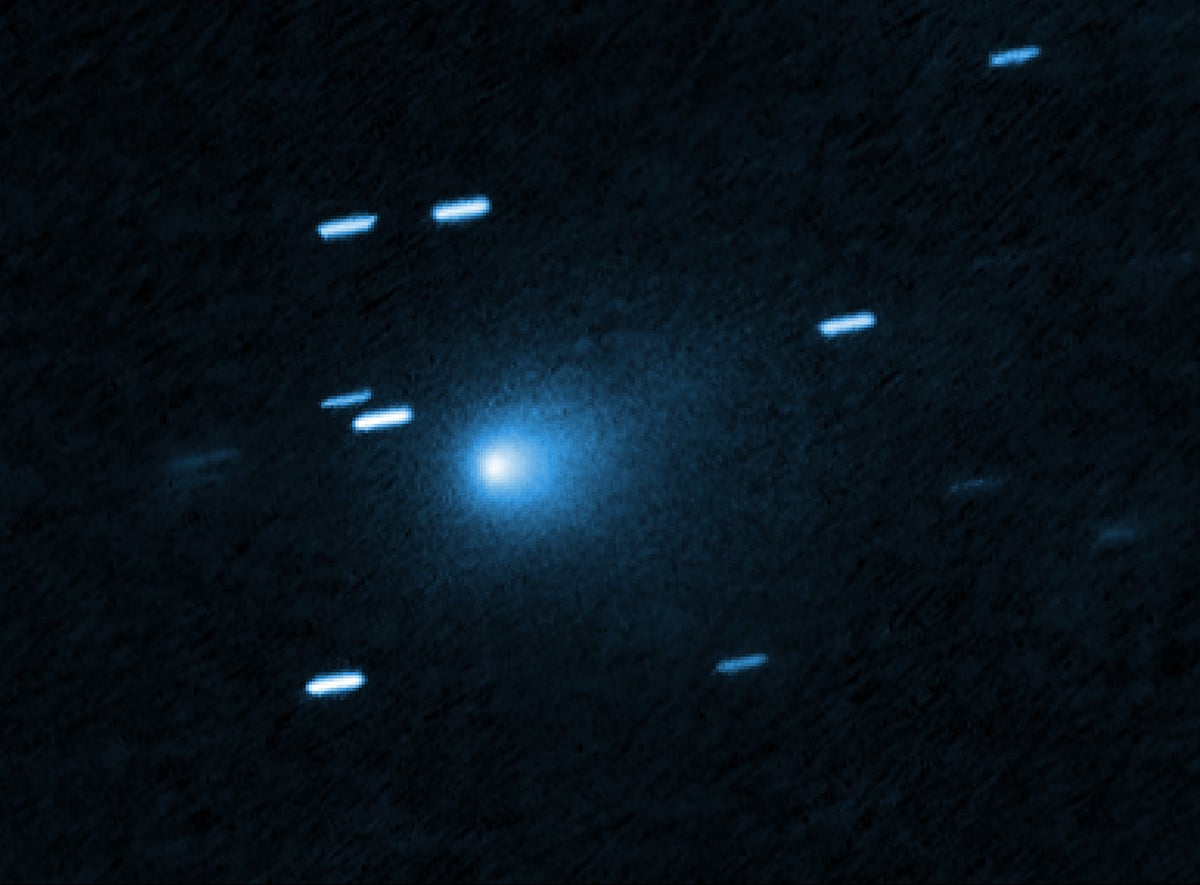
As 3I/ATLAS approached the Sun, solar heating triggered increasing activity on the nucleus. Frozen volatile compounds sublimated into gas and dust, creating a bright coma surrounding the comet. This process exposed material that had remained trapped beneath the surface since the object formed around its parent star.
Ground-based observatories began monitoring the comet across multiple wavelengths. Soon afterward, astronomers scheduled JWST observations to examine the comet’s volatile chemistry in the infrared regime.
JWST’s MIRI instrument maps the comet’s chemistry
The James Webb Space Telescope has revolutionized infrared astronomy since it began scientific operations. Although much public attention focuses on distant galaxies and exoplanets, JWST has also become an exceptionally powerful observatory for Solar System science.
For comet research, infrared observations remain especially important because many volatile molecules produce strong spectral signatures at infrared wavelengths. Instruments like MIRI can separate these wavelengths and identify the chemical composition of escaping gases.
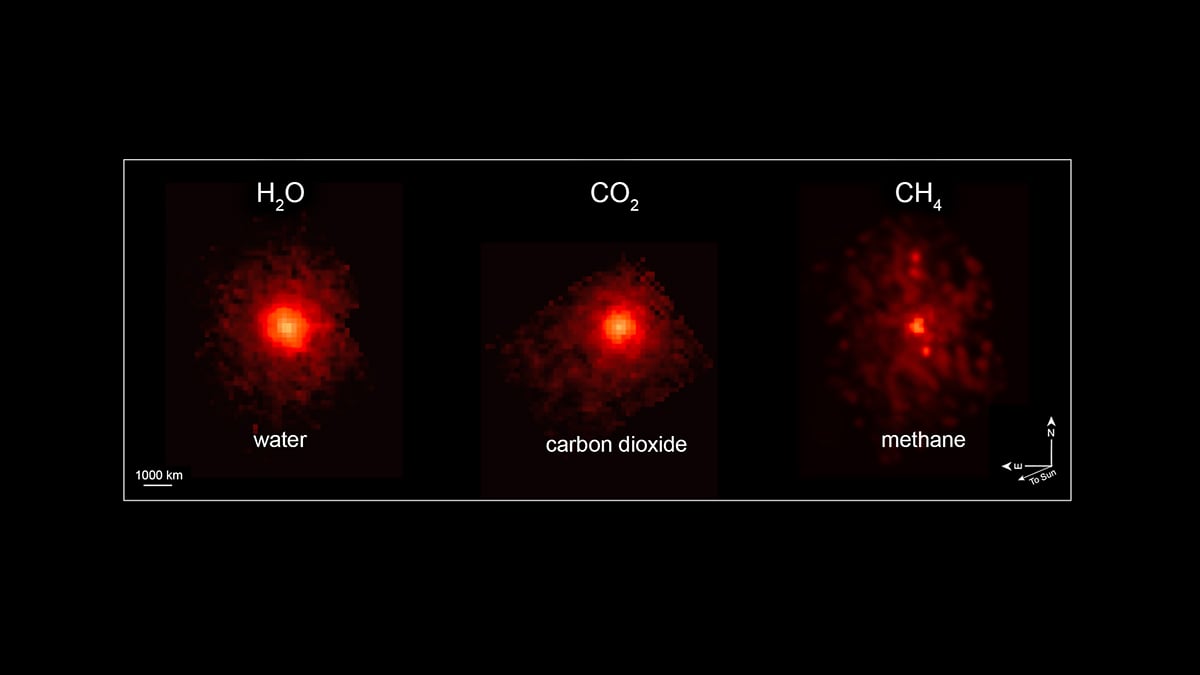
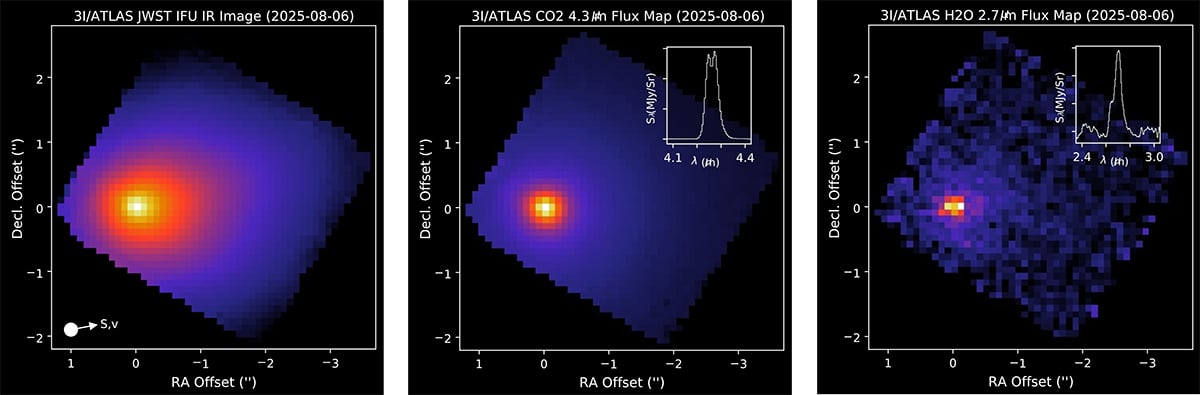
JWST observed 3I/ATLAS using MIRI spectroscopy and imaging. The data revealed strong signatures from water vapor and carbon dioxide, along with the unexpected methane detection. Scientists also examined how these gases are distributed around the nucleus.
The resulting observations showed that water vapor extended much farther outward into the coma, while methane and carbon dioxide remained concentrated closer to the central region. This difference provides insight into how various volatile compounds escape from the comet and respond to solar heating.
Importance of Methane detection in a comet
Methane occupies an important role in cometary science because it responds strongly to thermal evolution. In active cometary environments, repeated stellar heating gradually removes methane from near-surface layers. As a result, methane-rich material often survives only in deeper and colder regions of a nucleus.
The methane detection on 3I/ATLAS suggests that the comet preserved rudimentary volatile reservoirs beneath its outer crust. Solar heating during its current passage through the Solar System likely exposed these deeper layers for the first time in a very long period.
Methane-rich icy bodies generally form in extremely cold regions where volatile compounds can condense and remain stable over long timescales. Scientists now suspect that 3I/ATLAS formed in a distant cold region around another star before gravitational interactions expelled it into interstellar space.
The observations may also help researchers compare chemical diversity between planetary systems. Some Solar System comets show methane depletion, while others retain substantial volatile inventories. JWST’s results indicate that interstellar comets may preserve chemical combinations not commonly observed in local comet populations. Future discoveries may eventually reveal whether the chemistry observed in 3I/ATLAS represents a common feature of interstellar comets or an unusual exception.
Further reading
Right from the discovery of the interstellar comet 3I/ATLAS, DIYP has published several articles on its photographs and features. Here is the list of articles:
- A New Visitor from the Stars: Comet 3I/ATLAS
- Gemini North Photographs the Interstellar Comet 3I/ATLAS
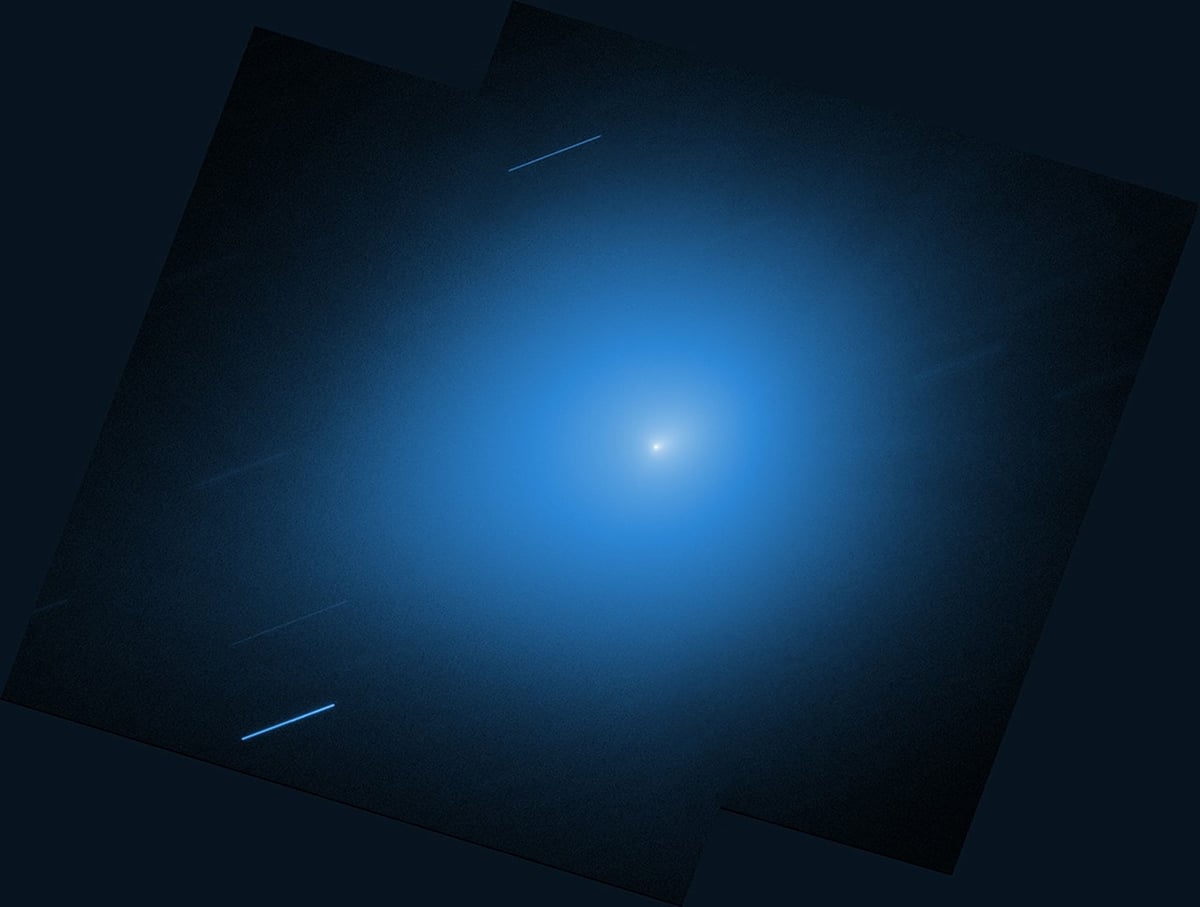
- Hubble’s Sharpest Portrait of a Visitor from the Stars: Comet 3I/ATLAS
- JWST Reveals the Secrets of Interstellar Comet 3I/ATLAS in New Images
- SPHEREx Maps the Carbon Dioxide Breath of Interstellar Comet 3I/ATLAS
- Gemini South Photographs Anti-Solar Tail of 3I/ATLAS
- Interstellar Comet 3I/ATLAS: Gemini South Images Reveal a Growing Tail
- Interstellar Comet 3I/ATLAS through Many Eyes: All Images so Far
- A Faint Smudge from Mars: Did Perseverance Really Capture Interstellar Comet 3I/ATLAS?
- ESA’s Mars Orbiter Capture “Closest Yet” View of Interstellar Comet 3I/ATLAS
- Comet 3I/ATLAS Returns: Astronomer Photographs it after Perihelion
- Tianwen-1’s Surprise Close-Up: China’s Mars Orbiter Images Interstellar Comet 3I/ATLAS
- Interstellar Comet 3I/ATLAS Returns to View with a Growing Ion Tail
- NASA Shares Eight New Images of Interstellar Comet 3I/ATLAS
- Hubble Space Telescope Revisits Interstellar Comet 3I/ATLAS
- ESA’s JUICE captures a detailed image of Interstellar Comet 3I/ATLAS
- X-Ray Images of 3I/ATLAS: XRISM and XMM-Newton Captures Interstellar Comet
- Gemini North Reveals Green Glow in Interstellar Comet 3I/ATLAS
- NASA’s TESS Tracks Interstellar Comet 3I/ATLAS in Its Final Act
- Rubin Observatory Captured Interstellar Comet 3I/ATLAS Before Its Discovery
- ESA’s JUICE Photographed Comet 3I/ATLAS 180 Million Kms Away
Clear skies!
See more from DIYPhotography.net on Google
Add DIYPhotography.net as a trusted source. This makes
our stories more likely to appear in your Google Search results.
 Add as a preferred source on Google

Soumyadeep Mukherjee
Soumyadeep Mukherjee is an award-winning astrophotographer from India. He has a doctorate degree in Linguistics. His work extends to the sub-genres of nightscape, deep sky, solar, lunar and optical phenomenon photography. He is also a photography educator and has conducted numerous workshops. His works have appeared in over 40 books & magazines including Astronomy, BBC Sky at Night, Sky & Telescope among others, and in various websites including National Geographic, NASA, Forbes. He was the first Indian to win “Astronomy Photographer of the Year” award in a major category.


Join the Discussion
DIYP Comment Policy
Be nice, be on-topic, no personal information or flames.