



















James Webb Captures the Clearest-Ever View of M87’s Supermassive Black Hole Jet
Oct 9, 2025
Soumyadeep Mukherjee
Soumyadeep Mukherjee is an award-winning astrophotographer from India. He has a doctorate degree in Linguistics. His work extends to the sub-genres of nightscape, deep sky, solar, lunar and optical phenomenon photography. He is also a photography educator and has conducted numerous workshops. His works have appeared in over 40 books & magazines including Astronomy, BBC Sky at Night, Sky & Telescope among others, and in various websites including National Geographic, NASA, Forbes. He was the first Indian to win “Astronomy Photographer of the Year” award in a major category.
Share:

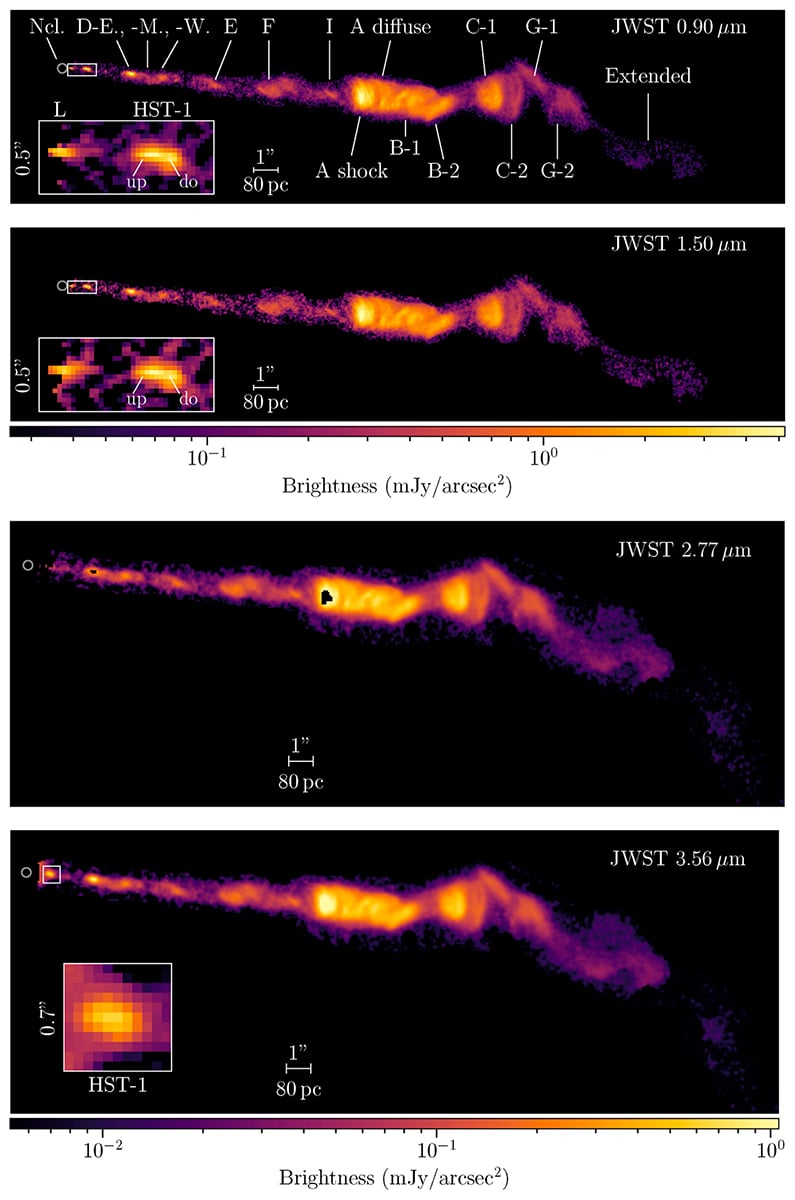
The James Webb Space Telescope (JWST) has turned its infrared eyes on one of the most famous objects in astronomy: the supermassive black hole at the heart of the galaxy Messier 87. The new image, released by an international team of astronomers, shows the jet of energy erupting from M87’s core in unprecedented clarity.
This is the same galaxy where the Event Horizon Telescope (EHT) captured the first-ever image of a black hole’s shadow in 2019. Now, JWST has taken that achievement to the next level, revealing how the powerful jet connects to the black hole itself, something scientists have long struggled to see clearly.
A galaxy at the center of attention
M87 lies about 55 million light-years away in the Virgo Cluster. It’s a giant elliptical galaxy, containing trillions of stars and one of the most massive black holes known. The black hole, called M87*, weighs about 6.5 billion times the mass of the Sun.
For decades, astronomers have observed a brilliant jet of high-energy material shooting out from M87’s center, stretching for nearly 5,000 light-years. This jet is visible across the entire electromagnetic spectrum, from radio waves to X-rays, and is one of the most studied cosmic structures in astrophysics.
What makes the new JWST image so special is its clarity. By observing in the near-infrared using its NIRCam (Near-Infrared Camera), JWST has cut through clouds of dust and gas that normally obscure the region. The result is the sharpest-ever infrared image of the jet and its immediate surroundings.

Seeing the jet up close
The new data reveal the jet emerging directly from the region around the black hole. In the image, the bright core marks the location of M87*, while the narrow beam of material extends outward, glowing brightly where particles collide and heat up.
Infrared light helps scientists trace where the jet interacts with interstellar material. In optical wavelengths, much of that glow is hidden behind gas clouds. But in the infrared, JWST can see through those veils, mapping the jet’s structure and how it changes with distance from the core.
A global effort across wavelengths
This observation wasn’t done in isolation. The JWST data are part of a multiwavelength campaign that also includes radio observations from the Atacama Large Millimeter/submillimeter Array (ALMA) and optical and X-ray data from the Hubble Space Telescope and the Chandra X-ray Observatory.

Jets are believed to form when magnetic fields around a spinning black hole channel some of the infalling material into narrow beams that shoot out at nearly the speed of light. But exactly how this happens, and why some black holes produce such powerful jets while others don’t, is still unclear.
JWST’s ability to probe the infrared region bridges the gap between optical and radio studies. It shows the structure of warm dust and synchrotron radiation from high-energy particles that are invisible in other wavelengths. This gives researchers a more complete picture of the entire system.

Building on the legacy of EHT
The 2019 image of M87*, taken by the Event Horizon Telescope, gave humanity its first direct glimpse of a black hole’s shadow. That groundbreaking photo showed a glowing ring of gas heated to billions of degrees as it swirled around the event horizon.
However, the EHT observes in radio wavelengths and cannot directly see the jet. JWST’s near-infrared view complements that radio image, revealing how material flows outward from the region the EHT imaged. Together, they offer a multi-layered perspective on how matter behaves in one of the most extreme environments in the universe.

Rewriting the physics of black hole jets
One of the early findings from JWST’s observations is that the jet seems to emit strongly in the infrared, even close to the black hole. That suggests the particles are being accelerated more efficiently than previously thought.
The image also shows fine structures, ripples, and knots within the jet that may correspond to regions where magnetic fields twist or where shock waves compress the plasma. These features can help scientists refine models of how jets stay collimated over such vast distances.

The new M87 image is a symbol of what’s possible when the world’s most advanced observatories work together. It bridges decades of effort, combining JWST’s cutting-edge infrared vision with the pioneering groundwork laid by Hubble, Chandra, and EHT.
Clear skies!
See more from DIYPhotography.net on Google
Add DIYPhotography.net as a trusted source. This makes
our stories more likely to appear in your Google Search results.
 Add as a preferred source on Google

Soumyadeep Mukherjee
Soumyadeep Mukherjee is an award-winning astrophotographer from India. He has a doctorate degree in Linguistics. His work extends to the sub-genres of nightscape, deep sky, solar, lunar and optical phenomenon photography. He is also a photography educator and has conducted numerous workshops. His works have appeared in over 40 books & magazines including Astronomy, BBC Sky at Night, Sky & Telescope among others, and in various websites including National Geographic, NASA, Forbes. He was the first Indian to win “Astronomy Photographer of the Year” award in a major category.


Join the Discussion
DIYP Comment Policy
Be nice, be on-topic, no personal information or flames.