



















Hubble Reveals How an Early Galaxy Helped Clear the Cosmic Fog
Jun 27, 2026
Soumyadeep Mukherjee
Soumyadeep Mukherjee is an award-winning astrophotographer from India. He has a doctorate degree in Linguistics. His work extends to the sub-genres of nightscape, deep sky, solar, lunar and optical phenomenon photography. He is also a photography educator and has conducted numerous workshops. His works have appeared in over 40 books & magazines including Astronomy, BBC Sky at Night, Sky & Telescope among others, and in various websites including National Geographic, NASA, Forbes. He was the first Indian to win “Astronomy Photographer of the Year” award in a major category.
Share:
The first billion years of cosmic history witnessed one of the most dramatic transitions in the evolution of the Universe. During this period, the intergalactic medium changed from being dominated by neutral hydrogen to one filled with ionized gas. Astronomers refer to this transformation as the Epoch of Reionization, marking the moment when the Universe became transparent to ultraviolet light. Without this transition, light from distant galaxies would never have travelled freely across billions of light-years to reach modern telescopes.
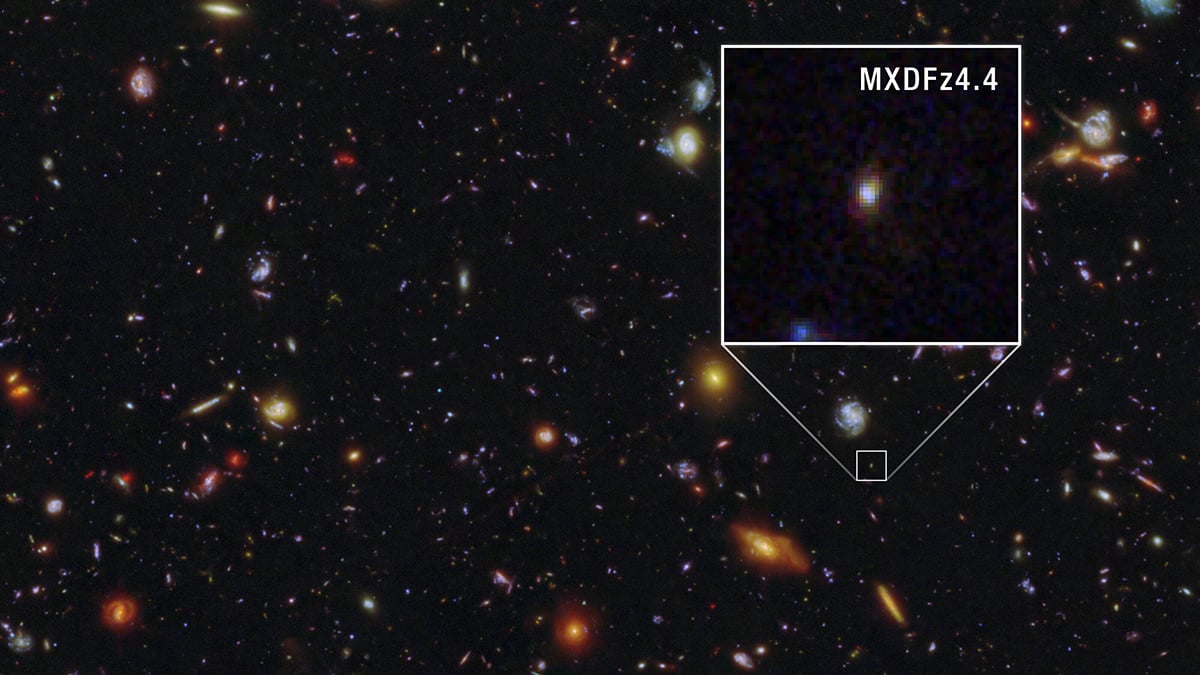
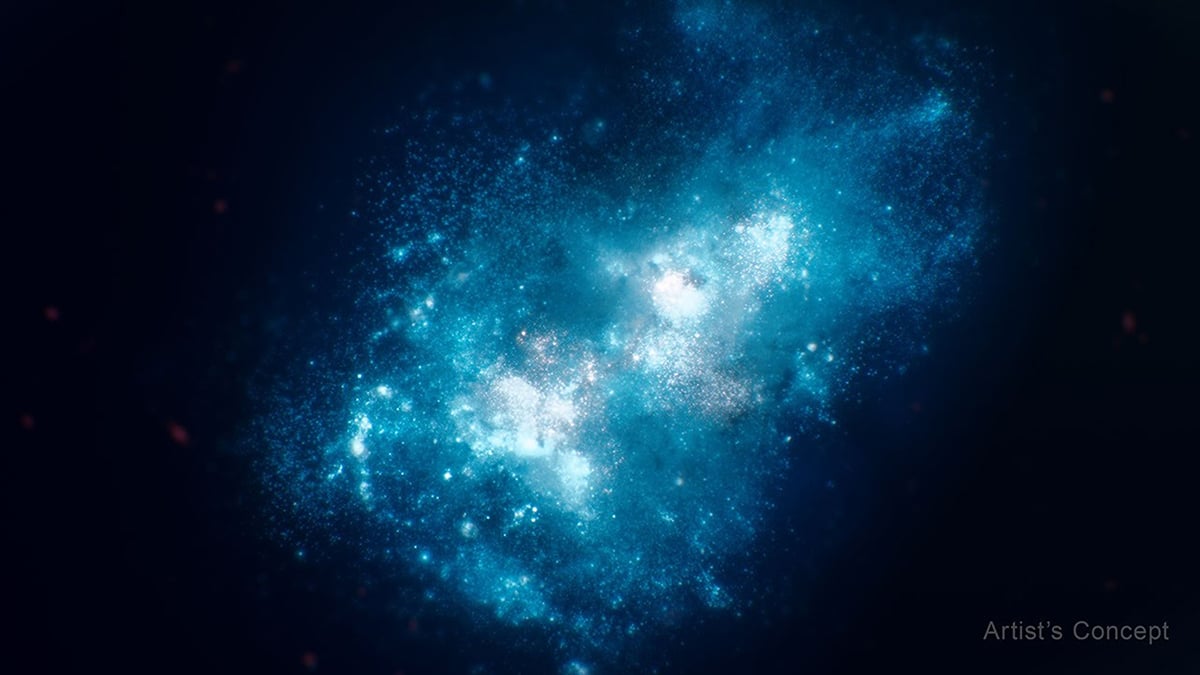
New observations from NASA‘s Hubble Space Telescope have provided one of the strongest pieces of observational evidence yet. By studying a compact galaxy known as MXDFz4.4, researchers detected ionizing ultraviolet radiation leaking from the galaxy. More importantly, they uncovered the physical process that allowed this radiation to escape. The observations show how intense episodes of star formation reshaped the galaxy’s gas, creating pathways through which energetic photons flowed into the surrounding Universe.
A compact galaxy with remarkable star-forming activity
Astronomers observed MXDFz4.4 as it appeared around 1.4 billion years after the Big Bang. At that time, the Universe had already produced large populations of stars and galaxies, yet the reionization process was still shaping the intergalactic environment. Neutral hydrogen remained widespread, while young galaxies continued to flood space with energetic radiation.
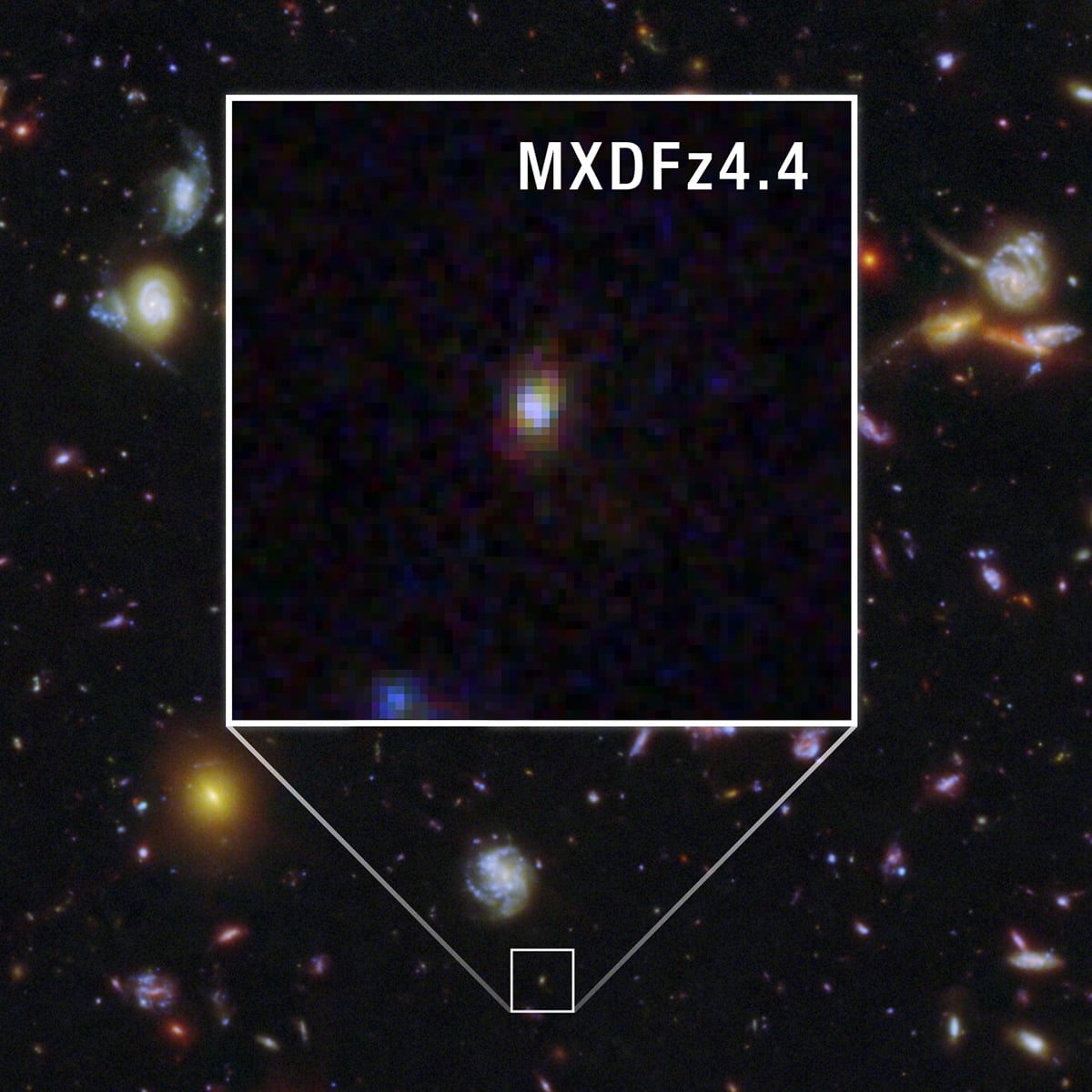
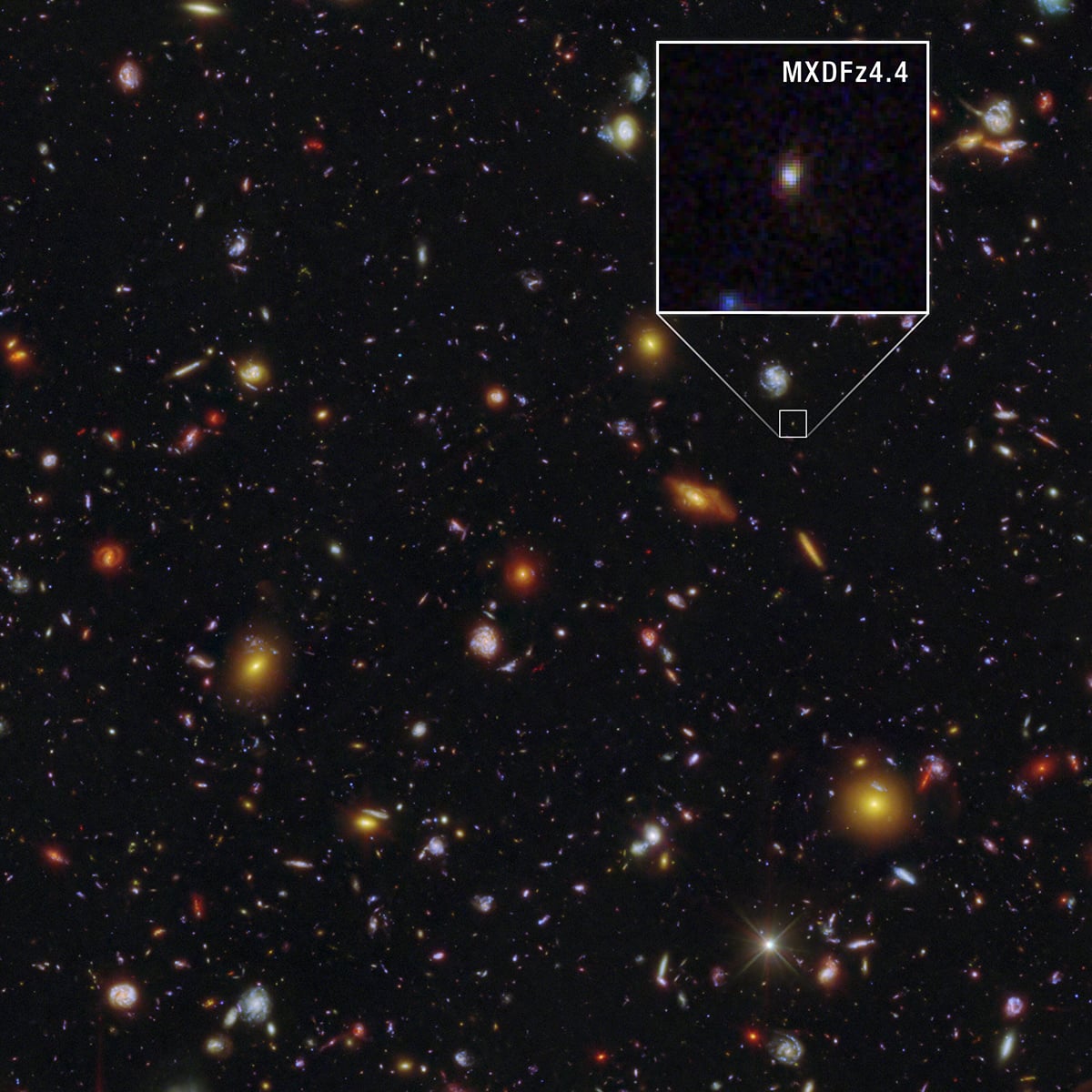
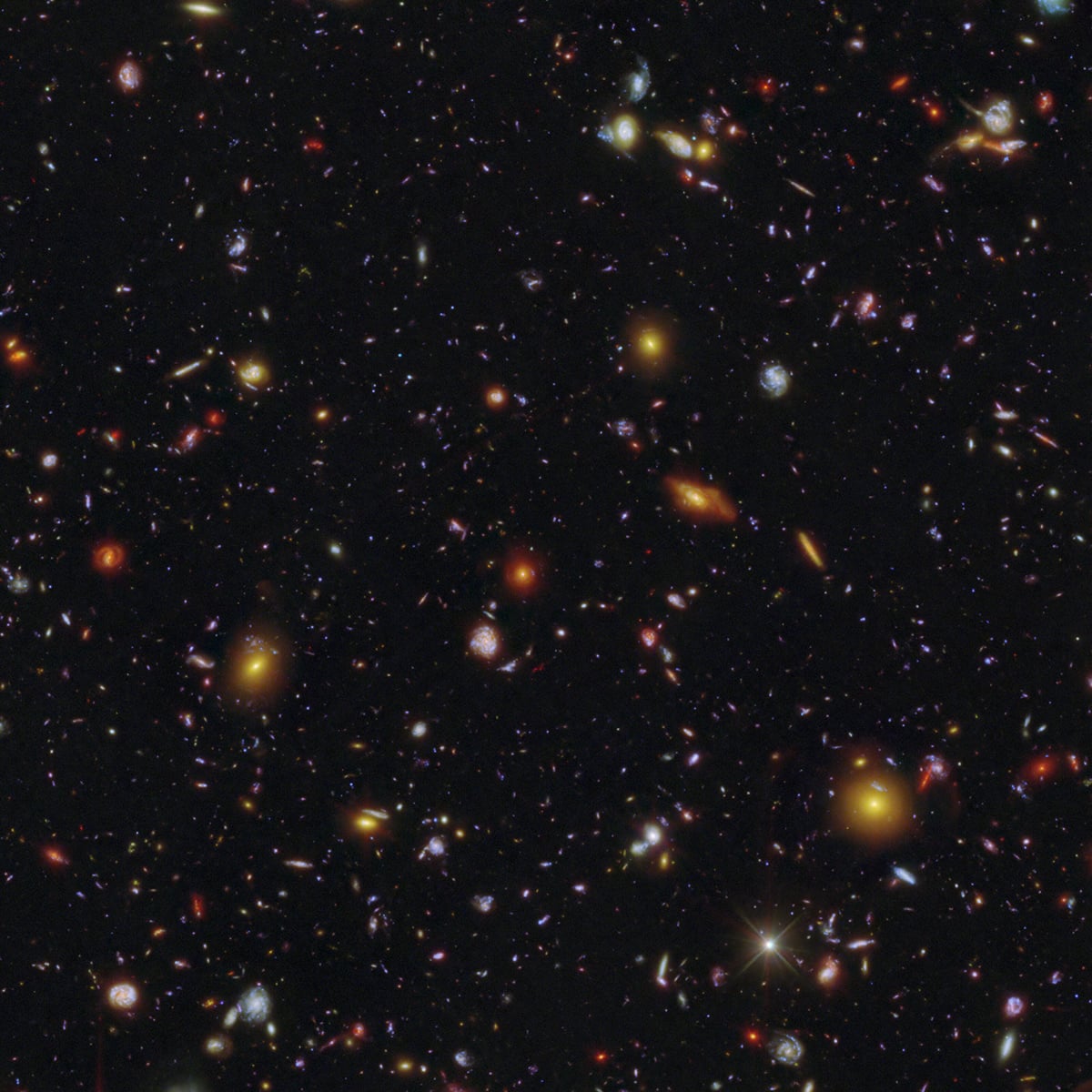
MXDFz4.4 lies within the MUSE eXtremely Deep Field, one of the deepest astronomical surveys ever carried out. The field contains some of the faintest and most distant galaxies known, making it an ideal laboratory for studying the early Universe.
Despite its enormous distance, the galaxy itself is surprisingly small. Researchers estimate that it occupies an area nearly 100 times smaller than the Milky Way. Its compact size, however, hides extraordinary activity.
The galaxy produces new stars at a rate roughly ten times higher than that of the Milky Way. Such rapid star formation creates large numbers of massive, short-lived stars. These stars burn at extremely high temperatures and emit intense ultraviolet radiation throughout their lives.
Hubble detects radiation escaping into intergalactic space
The most significant result from this study comes from Hubble‘s detection of Lyman-continuum radiation, the energetic ultraviolet light capable of ionizing hydrogen atoms. These photons carry enough energy to remove electrons from neutral hydrogen. Once hydrogen becomes ionized, it no longer blocks ultraviolet radiation. As more galaxies released these photons, larger regions of the Universe became transparent. Eventually, individual ionized bubbles expanded until they merged, ending the Epoch of Reionization.
Detecting this radiation is far from easy. Neutral hydrogen inside galaxies absorbs most ionizing photons before they can travel significant distances. Even after escaping a galaxy, the remaining photons often encounter hydrogen clouds between galaxies, where they are absorbed once again.
This double layer of absorption explains why astronomers have struggled for decades to observe escaping ionizing radiation. Most distant galaxies reveal little or no evidence that these energetic photons ever left their birthplace.
Hubble detected a remarkably strong signal of escaping ultraviolet radiation from the galaxy. Analysis suggests that between 50 and 100 percent of the ionizing photons produced by the galaxy escape into the surrounding intergalactic medium. Such a high escape fraction is unusual and provides valuable insight into conditions within the galaxy.
Three observatories solved the puzzle together
This discovery depended on the combined capabilities of three powerful astronomical observatories, each contributing a different piece of the scientific picture.
The Hubble Space Telescope played the central role by detecting the escaping ionizing ultraviolet radiation. Hubble remains uniquely valuable for this work because Earth’s atmosphere blocks ultraviolet wavelengths, making such observations impossible from ground-based telescopes.
The James Webb Space Telescope provided a detailed view of the galaxy’s stellar population. Its infrared instruments reconstructed the recent history of star formation and identified multiple generations of young stars responsible for producing the energetic radiation.
Meanwhile, the European Southern Observatory’s Very Large Telescope, equipped with the Multi Unit Spectroscopic Explorer (MUSE) instrument, measured the galaxy’s distance with high precision and confirmed its redshift. Its observations also helped researchers study the surrounding gas and the galaxy’s larger environment.
Clear skies!
See more from DIYPhotography.net on Google
Add DIYPhotography.net as a trusted source. This makes
our stories more likely to appear in your Google Search results.
 Add as a preferred source on Google

Soumyadeep Mukherjee
Soumyadeep Mukherjee is an award-winning astrophotographer from India. He has a doctorate degree in Linguistics. His work extends to the sub-genres of nightscape, deep sky, solar, lunar and optical phenomenon photography. He is also a photography educator and has conducted numerous workshops. His works have appeared in over 40 books & magazines including Astronomy, BBC Sky at Night, Sky & Telescope among others, and in various websites including National Geographic, NASA, Forbes. He was the first Indian to win “Astronomy Photographer of the Year” award in a major category.

Join the Discussion
DIYP Comment Policy
Be nice, be on-topic, no personal information or flames.