



















NASA’s Europa Clipper Captures Uranus Using a Star Tracker
Dec 26, 2025
Soumyadeep Mukherjee
Soumyadeep Mukherjee is an award-winning astrophotographer from India. He has a doctorate degree in Linguistics. His work extends to the sub-genres of nightscape, deep sky, solar, lunar and optical phenomenon photography. He is also a photography educator and has conducted numerous workshops. His works have appeared in over 40 books & magazines including Astronomy, BBC Sky at Night, Sky & Telescope among others, and in various websites including National Geographic, NASA, Forbes. He was the first Indian to win “Astronomy Photographer of the Year” award in a major category.
Share:

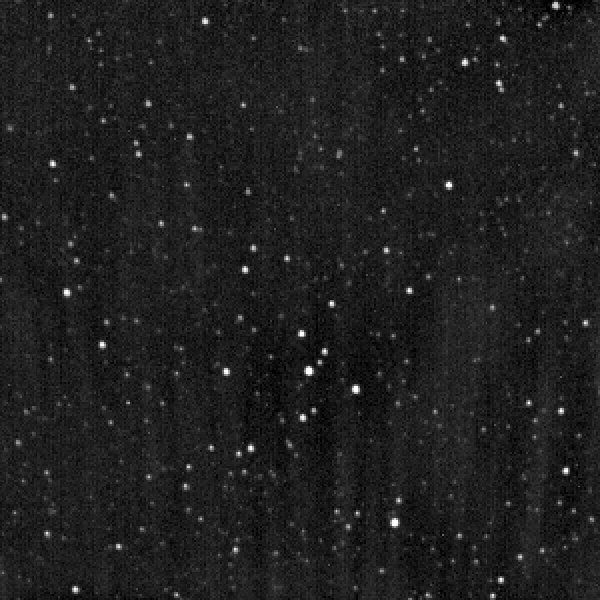
Deep-space spacecraft spend years in transit before reaching their scientific targets. During this long cruise, engineers rely on constant system verification to ensure mission readiness. Navigation hardware plays a central role in this process, because, without precise Course knowledge, communications fail and science becomes impossible. In early November 2025, a routine navigation check aboard NASA’s Europa Clipper produced an unexpected yet revealing result. A stellar reference unit, commonly known as a star tracker, recorded a field of stars that included the distant planet Uranus.
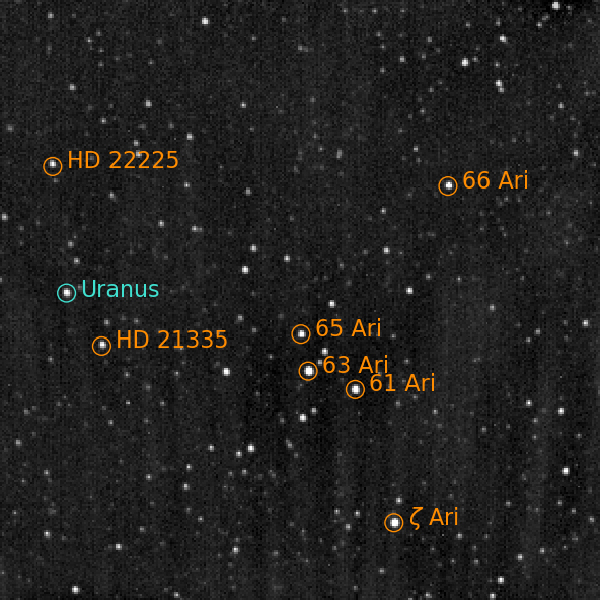
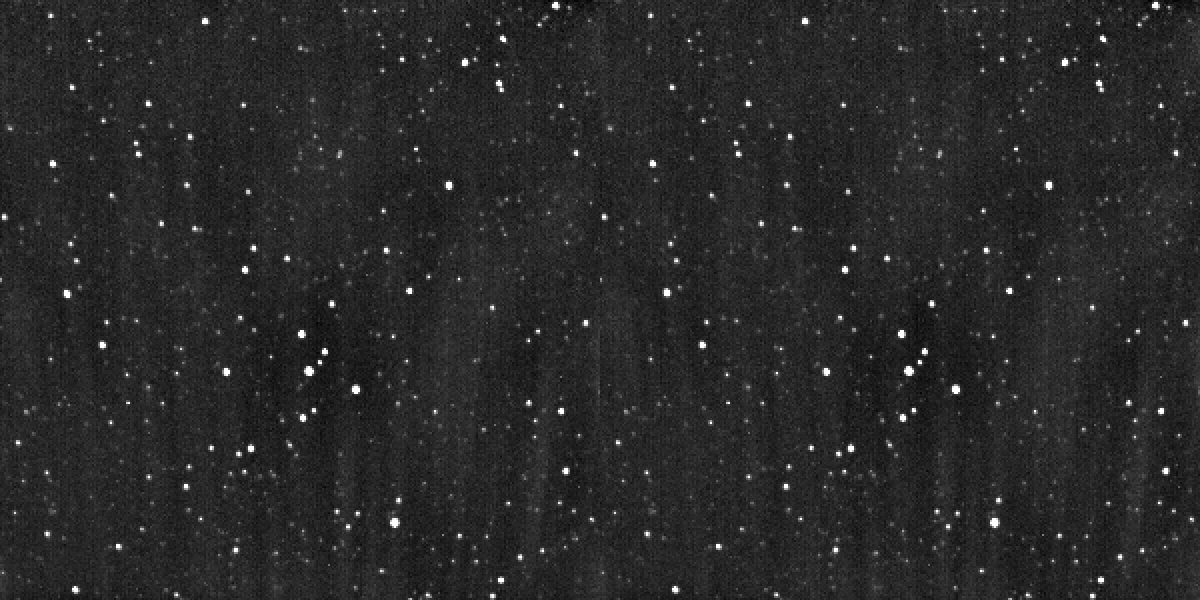
The image was not planned as a scientific observation. It emerged naturally from standard cruise operations. At the time, Europa Clipper was traveling through the outer solar system on its way to Jupiter, while Uranus lay roughly 3.2 billion kilometers from the spacecraft. Despite this vast separation, the planet appeared as a distinct object against a dense stellar background. NASA later released the image through its official Photojournal to illustrate the health and navigation performance of the spacecraft, rather than for scientific discovery.
Star trackers and the foundation of spacecraft orientation
Star trackers form the backbone of spacecraft course determination. They are not built to study planets or moons, and they do not generate science data. Their role is entirely operational. Each star tracker continuously images a wide region of the sky, while onboard software identifies stars and compares their positions with stored catalogs. From this comparison, the spacecraft calculates its orientation in three dimensions. This information feeds directly into the guidance and control system.
Europa Clipper carries two independent stellar reference units. This redundancy is essential for a mission that will last more than six years. Loss of accurate orientation knowledge would threaten communications with Earth and compromise the precise pointing of the spacecraft’s science instruments. The design of these systems required special care because Europa Clipper will eventually operate inside Jupiter’s intense radiation environment. High-energy particles can strike imaging detectors and generate false signals that resemble stars if not handled correctly.
Engineers addressed this challenge through radiation-tolerant electronics and robust filtering algorithms. Hardware shielding reduces exposure, while onboard software rejects transient noise events. The clarity of the Uranus image confirms that these protections are functioning as intended during cruise, well before the spacecraft encounters Jupiter’s harsh conditions.

How Uranus entered the star tracker’s view
Europa Clipper did not target Uranus intentionally. The planet entered the star tracker’s field of view during normal spacecraft orientation adjustments. Star trackers observe only a small fraction of the surrounding sky at any moment, and that region shifts continuously as the spacecraft maintains its course. In the released image, Uranus appears as a slightly extended point of light that stands out from background stars due to its brightness and apparent size.
NASA also released a second image taken roughly ten hours later. When viewed together, the two frames show Uranus shifting position slightly relative to the surrounding stars. This motion confirms the object’s planetary nature, since background stars remain effectively fixed over short timescales while planets show measurable motion. The effect is subtle, but it is detectable even with navigation cameras.
The field of view shown represents only about 0.1 percent of the sky surrounding the spacecraft. Capturing a bright planet within such a narrow window is uncommon. The result highlights the sensitivity of the star tracker system and illustrates how much information navigation hardware continuously processes without being routinely transmitted to Earth.
Europa Clipper’s long cruise to the Jupiter system
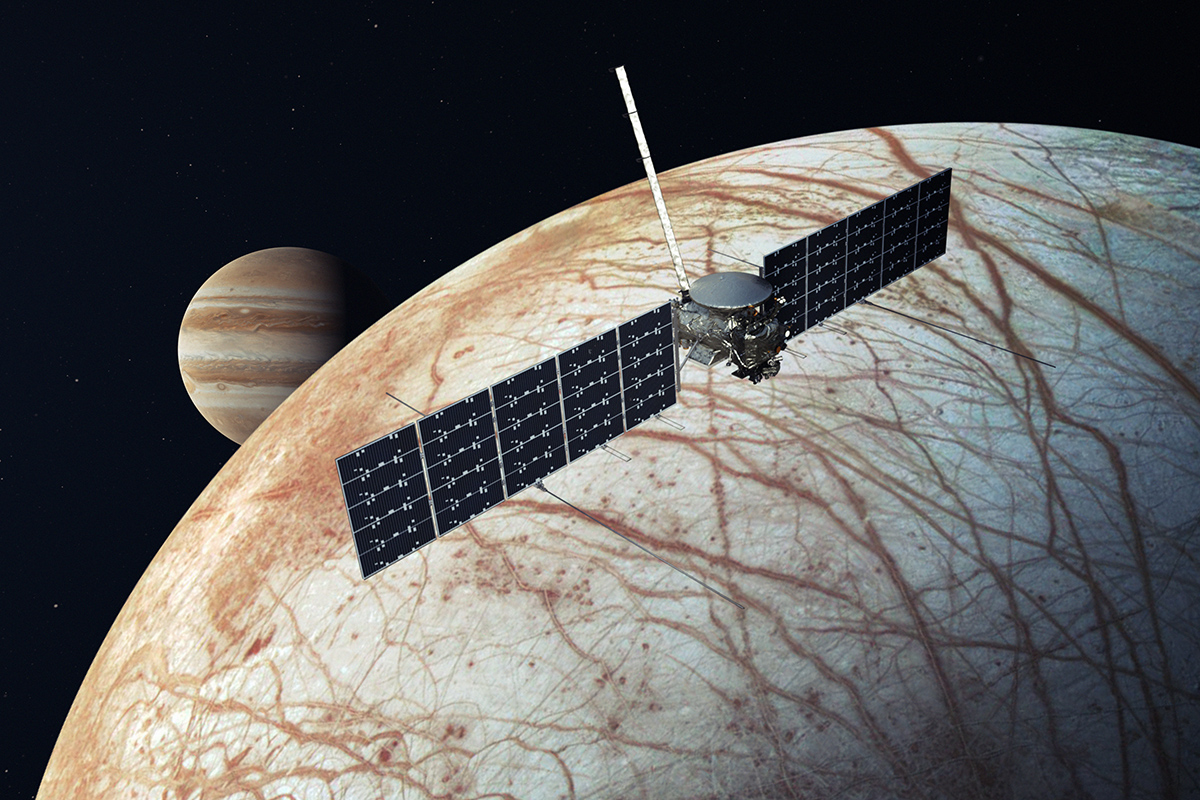
Europa Clipper launched on October 14, 2024, aboard a SpaceX Falcon Heavy rocket. After leaving Earth, the spacecraft entered a carefully planned interplanetary trajectory. The path to Jupiter is not direct and relies on gravity assists to adjust speed and direction. These maneuvers reduce fuel requirements and extend mission flexibility.
The spacecraft will first fly past Mars and later return to Earth for another gravity assist. Only after these encounters will it head toward Jupiter’s orbit, with arrival planned for 2030. Once there, Europa Clipper will not orbit Europa directly. Instead, it will orbit Jupiter and conduct close flybys of the moon. NASA plans approximately 49 such encounters, each occurring at a different altitude and location.
This mission architecture reduces radiation exposure, which is critical near Jupiter. The planet’s radiation belts are among the most intense in the solar system and pose a serious risk to spacecraft electronics. Short, targeted flybys limit cumulative damage while allowing repeated sampling of Europa’s surface and subsurface environment.
Uranus seen from an unintended vantage point
Uranus remains one of the least explored planets in the solar system. Voyager 2 conducted the only close flyby in 1986, and all subsequent observations have relied on Earth-based telescopes or space observatories. Europa Clipper adds a different perspective by observing Uranus from deep space while traveling toward another destination.
The viewing geometry differs from Earth-based observations, and the observational context is unique. While the image does not replace dedicated Uranus studies or add new measurements, it contributes to the broader visual record of the planet as seen from beyond Earth’s orbit. Such incidental observations are common during long cruise phases and reflect the interconnected nature of planetary exploration. Spacecraft designed for specific targets still traverse shared environments and occasionally capture other worlds along the way.
Europa Clipper will remain in cruise mode for several more years. During this time, engineers will continue routine system checks, while instruments undergo calibration and functional testing. Software updates will be uploaded as needed to maintain performance. As the spacecraft approaches Jupiter, operations will intensify. Radiation exposure will increase sharply, navigation accuracy will become even more critical, and science planning will transition from preparation to execution.
Once flybys begin, Europa Clipper will study Europa in detail. Radar will probe the ice shell and search for subsurface structures. Spectrometers will analyze surface composition, while magnetometers examine interactions with Jupiter’s magnetic field. The mission’s central question remains unchanged: whether Europa’s subsurface ocean could support life. Every subsystem aboard the spacecraft supports this objective, and reliable navigation remains a foundational requirement.
Clear skies!
See more from DIYPhotography.net on Google
Add DIYPhotography.net as a trusted source. This makes
our stories more likely to appear in your Google Search results.
 Add as a preferred source on Google

Soumyadeep Mukherjee
Soumyadeep Mukherjee is an award-winning astrophotographer from India. He has a doctorate degree in Linguistics. His work extends to the sub-genres of nightscape, deep sky, solar, lunar and optical phenomenon photography. He is also a photography educator and has conducted numerous workshops. His works have appeared in over 40 books & magazines including Astronomy, BBC Sky at Night, Sky & Telescope among others, and in various websites including National Geographic, NASA, Forbes. He was the first Indian to win “Astronomy Photographer of the Year” award in a major category.



Join the Discussion
DIYP Comment Policy
Be nice, be on-topic, no personal information or flames.