























Hubble Reveals an Album of Planet-Forming Disks across the Milky Way
Jan 16, 2026
Soumyadeep Mukherjee
Soumyadeep Mukherjee is an award-winning astrophotographer from India. He has a doctorate degree in Linguistics. His work extends to the sub-genres of nightscape, deep sky, solar, lunar and optical phenomenon photography. He is also a photography educator and has conducted numerous workshops. His works have appeared in over 40 books & magazines including Astronomy, BBC Sky at Night, Sky & Telescope among others, and in various websites including National Geographic, NASA, Forbes. He was the first Indian to win “Astronomy Photographer of the Year” award in a major category.
Share:

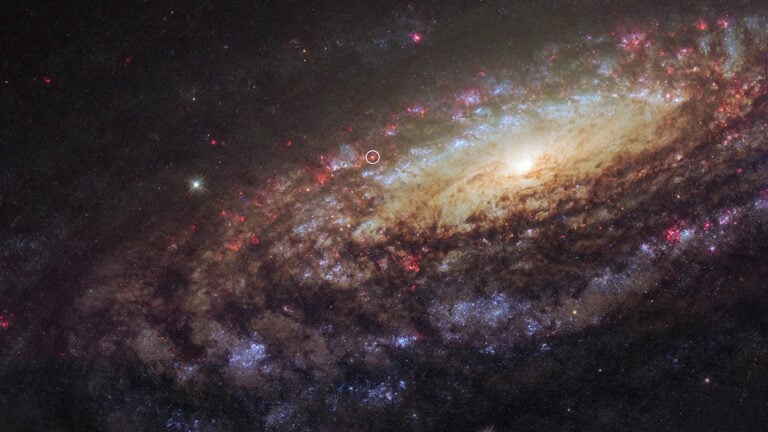
Planet formation is not a theoretical abstraction anymore. It is an observable process. Over the past three decades, the Hubble Space Telescope has played a central role in turning models into measurable reality. Its latest release, titled Hubble’s Album of Planet-Forming Disks, brings together a carefully curated set of observations that capture young stars surrounded by gas-rich disks. These disks represent the earliest stages of planetary system assembly.
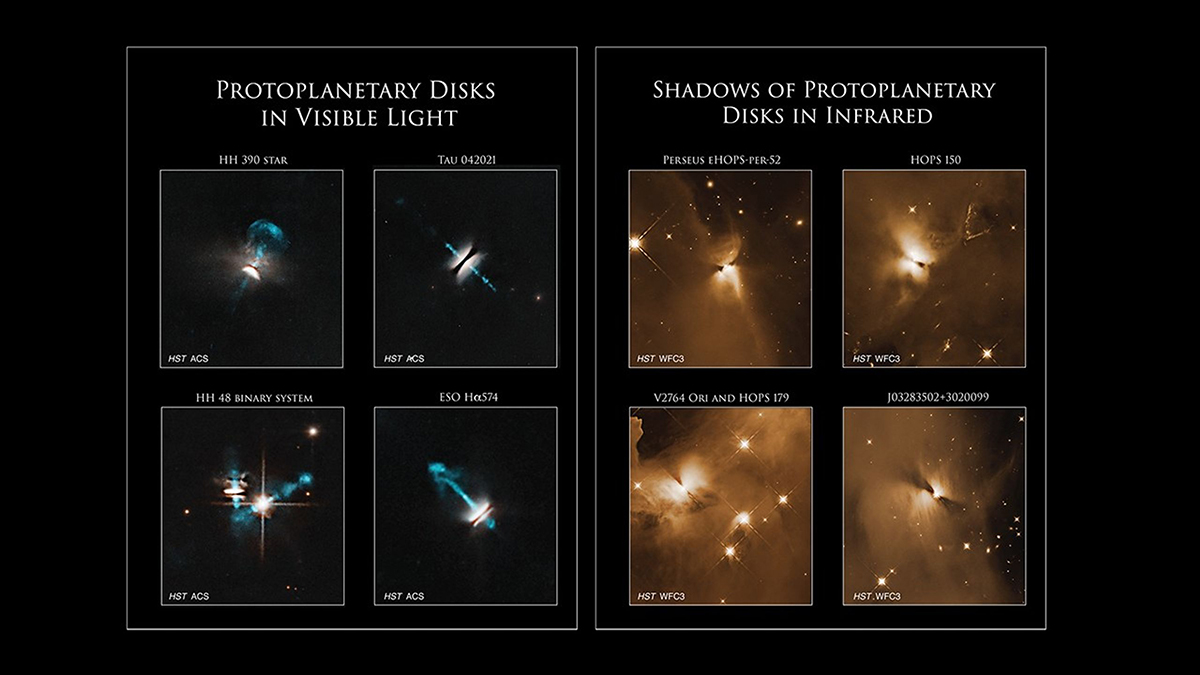
The album does not focus on a single region or evolutionary phase. Instead, it presents a comparative view. Each image documents a different disk geometry, environment, and stage of development. Together, they allow astronomers to examine how disks behave under varying physical conditions. Despite the arrival of newer observatories, Hubble remains uniquely capable of resolving disk structures in visible and near-infrared light. These wavelengths are critical for tracing jets, dust lanes, and scattered starlight.
The physical origin of planet-forming disks
Every planet begins inside a rotating disk of gas and dust. This disk forms naturally during star birth. When a dense molecular cloud collapses, gravity pulls material inward. At the same time, angular momentum forces the remaining material to spread into a flattened structure around the young star.
This structure becomes a protoplanetary disk. Gas dominates its mass, while dust shapes its long-term evolution. Initially, dust grains remain microscopic. However, repeated collisions allow them to stick together. Over time, grains grow into pebbles, rocks, and eventually planetesimals. This gradual process forms the backbone of modern planet formation theory.
Hubble has confirmed the presence of such disks around hundreds of young stars. Earlier observations established their existence. This new album expands that knowledge by showing disks at different inclinations and ages. Some disks appear thick and turbulent. Others look thin and settled. These differences matter because disk structure influences the types of planets that can form.
Moreover, disk lifetimes remain short on cosmic timescales. Observations suggest that most disks lose their gas within a few million years. Therefore, giant planet formation must occur quickly. The disks in this album capture that narrow window of opportunity.
A comparative view through Hubble’s optics
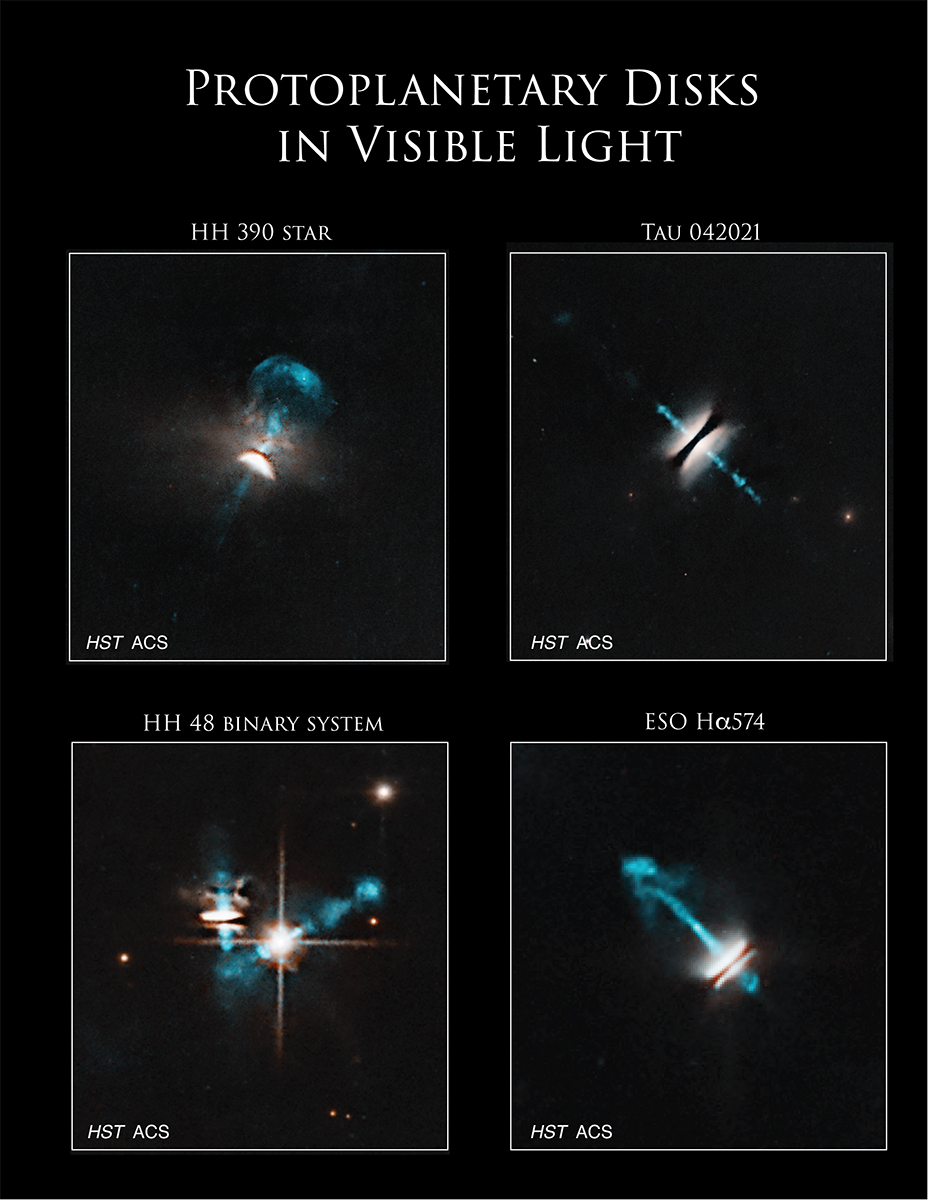
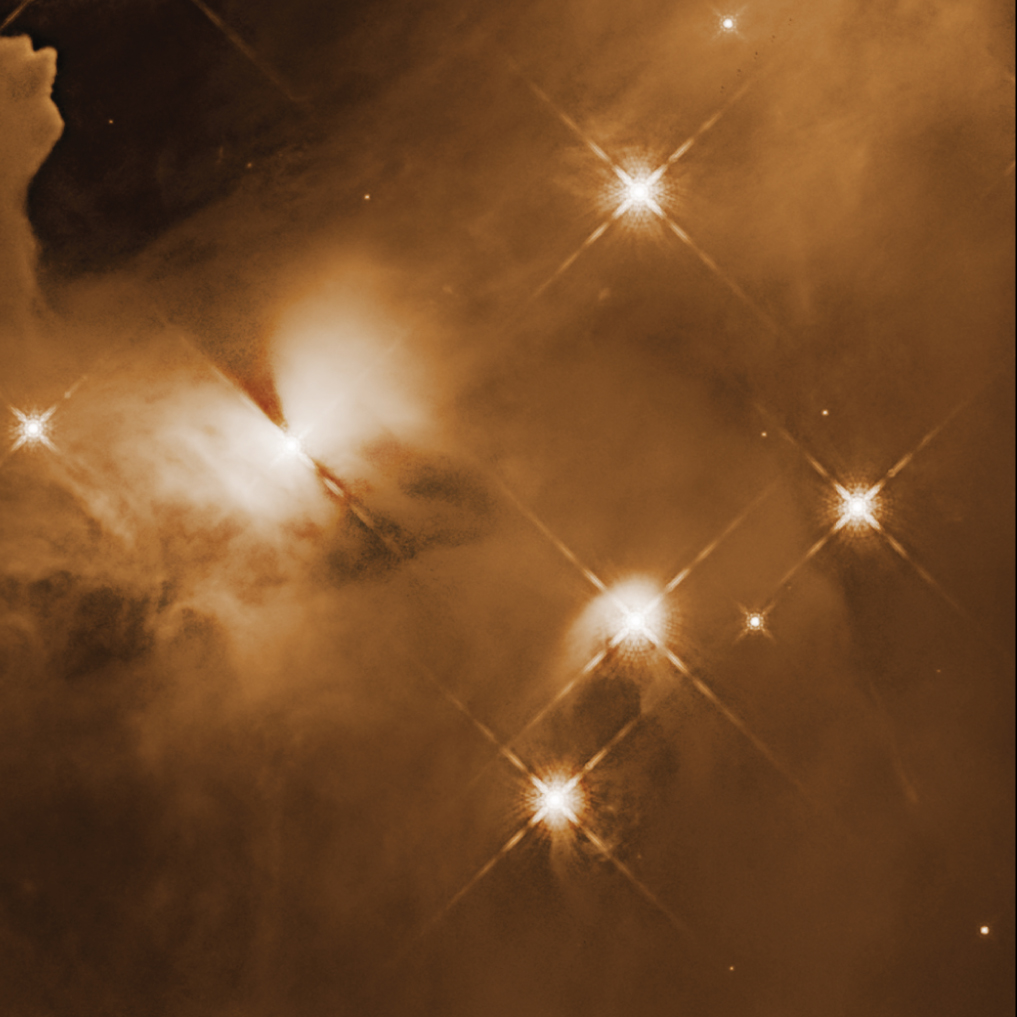
The strength of this album lies in comparison. Each image serves as a data point in a broader narrative. Some disks appear face-on, revealing circular symmetry and surrounding nebular glow. Others appear edge-on, blocking the central star and exposing the disk’s vertical structure.
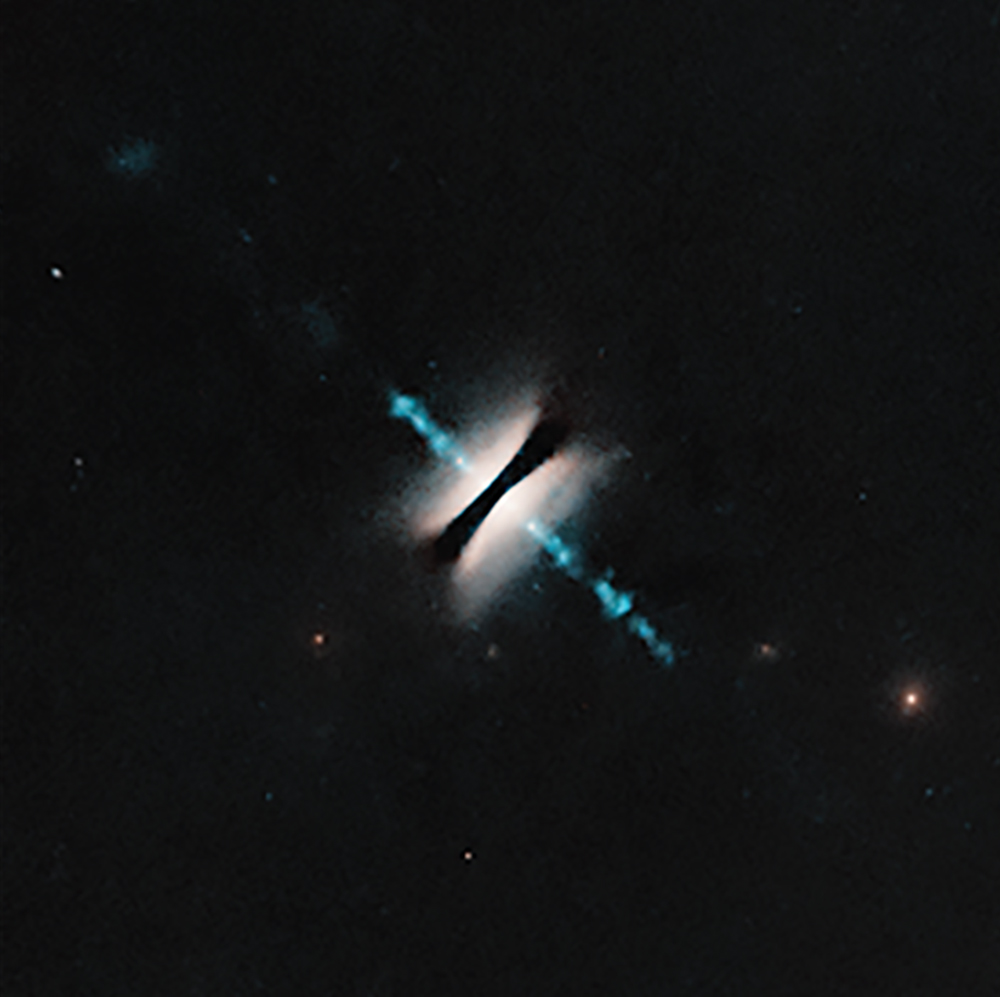
Edge-on systems prove especially valuable. In these cases, Hubble resolves dark dust lanes against luminous backgrounds. Astronomers can measure disk thickness and infer dust grain growth. Larger grains settle toward the disk midplane. This settling marks a critical transition toward planet formation.
Several systems in the album also display jets. These jets emerge from the star-disk interface. Strong magnetic fields accelerate gas along the star’s rotation axis. As the gas escapes, it carries angular momentum away. This process allows more material to fall onto the star while stabilizing the disk.
Not all disks exist in isolation. Some orbit binary stars. In these environments, gravity distorts disk shapes and alters mass distribution. Hubble images reveal warped disks and asymmetries caused by stellar companions. These systems challenge simple formation models. Yet their existence confirms that planet formation remains robust even in complex settings.
Importance of visible and infrared light
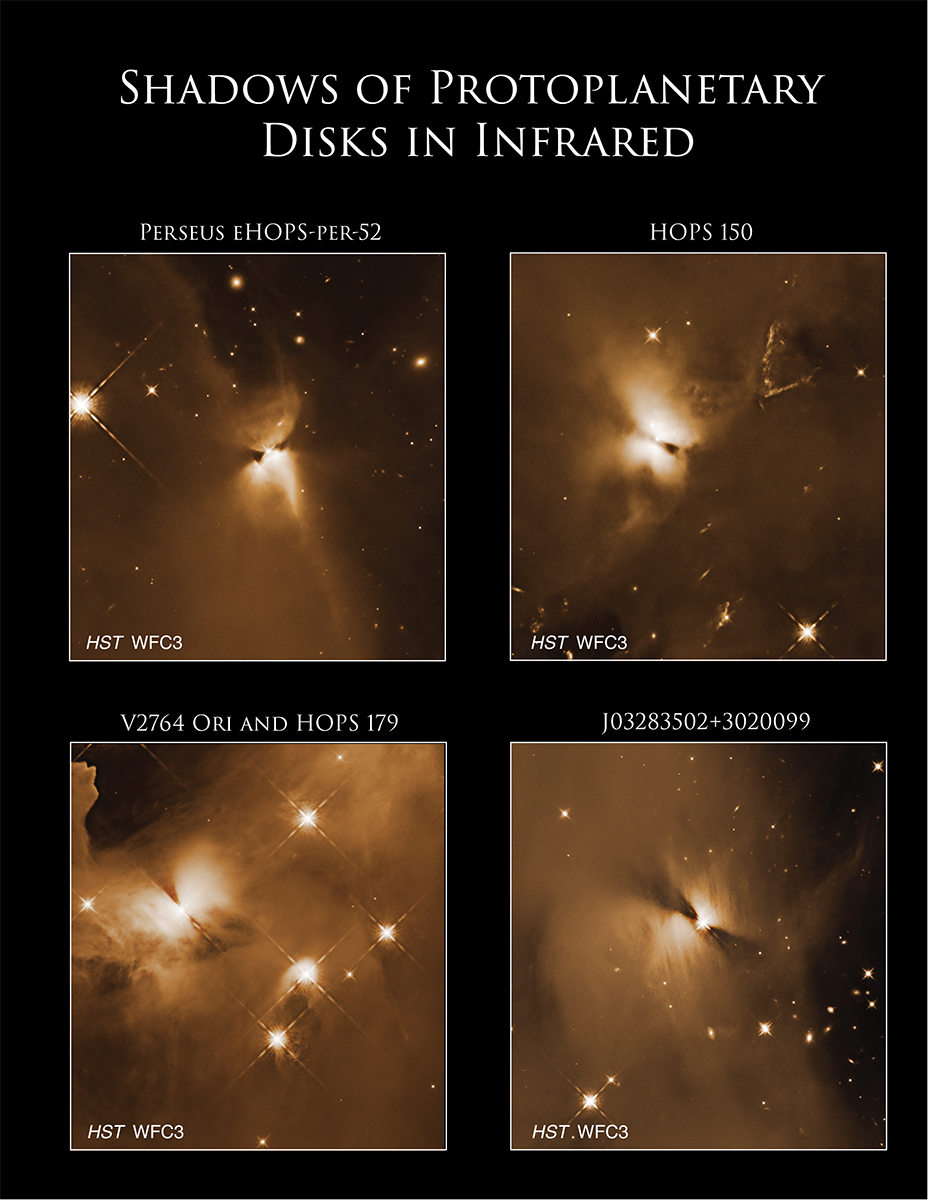
Many modern disk studies rely on infrared and radio wavelengths. However, visible light remains essential. Hubble’s sensitivity in optical wavelengths reveals features that disappear at longer wavelengths. Jets, shocks, and reflection nebulae glow strongly in visible light.
Near-infrared observations complement this view. Infrared light penetrates dust more effectively. It reveals stars hidden behind thick envelopes and highlights scattered light from disk surfaces. Together, these wavelengths provide a layered understanding of disk structure.
Hubble’s long operational lifetime adds another advantage. Astronomers can compare new observations with older data. In some systems, they track subtle changes in jets or nebular illumination. Few observatories offer such temporal continuity.
NASA emphasizes that disk evolution depends strongly on the environment. Nearby massive stars emit intense radiation. This radiation erodes disks from the outside. Hubble images show disks in various stages of photoevaporation. These observations confirm theoretical predictions and constrain disk survival times.
Planet formation theory
The album reinforces several conclusions that now define planet formation science. First, disks are common. Most stars begin life with sufficient material to form planets. This fact supports the abundance of exoplanets detected across the galaxy.
Second, disk diversity leads to planetary diversity: disk mass, composition, and geometry shape outcomes. Thick, gas-rich disks favor giant planet formation. Thin disks may produce rocky planets only. Binary systems may yield planets on tilted or eccentric orbits.
Third, external influences matter. Radiation, gravity, and magnetic fields all affect disk evolution. The album shows disks subjected to different levels of stress. These conditions help explain why planetary systems exhibit such a wide range of variations.
Importantly, Hubble’s observations align with results from other observatories. ALMA has revealed dust rings and gaps. JWST has detected water vapor and organic molecules. Hubble provides the structural and environmental context that ties these findings together.
Hubble’s album in the JWST era
The James Webb Space Telescope has transformed infrared astronomy. Yet Hubble remains irreplaceable. Its visible-light imaging provides spatial resolution that complements JWST’s spectral power. Hubble identifies targets and structures. JWST can then analyze their chemistry. Together, they offer a complete picture of planet formation.
Beyond science, the album carries broader significance. It shows that planetary birth is not rare or exceptional. It is a standard outcome of star formation. That realization reshapes how scientists think about habitability and cosmic evolution.
Hubble’s continued productivity also underscores the value of long-term missions. Decades of consistent data allow astronomers to see patterns that short missions cannot. This album benefits directly from that continuity. By observing these systems, astronomers study the same processes that once shaped the solar system. The physics remains unchanged. Gravity, angular momentum, and magnetic fields still govern the outcome.
Clear skies!
See more from DIYPhotography.net on Google
Add DIYPhotography.net as a trusted source. This makes
our stories more likely to appear in your Google Search results.
 Add as a preferred source on Google

Soumyadeep Mukherjee
Soumyadeep Mukherjee is an award-winning astrophotographer from India. He has a doctorate degree in Linguistics. His work extends to the sub-genres of nightscape, deep sky, solar, lunar and optical phenomenon photography. He is also a photography educator and has conducted numerous workshops. His works have appeared in over 40 books & magazines including Astronomy, BBC Sky at Night, Sky & Telescope among others, and in various websites including National Geographic, NASA, Forbes. He was the first Indian to win “Astronomy Photographer of the Year” award in a major category.

Join the Discussion
DIYP Comment Policy
Be nice, be on-topic, no personal information or flames.