


























Yellow and Blue, Old and New: Hubble’s Striking View of NGC 6000
Oct 2, 2025
Soumyadeep Mukherjee
Soumyadeep Mukherjee is an award-winning astrophotographer from India. He has a doctorate degree in Linguistics. His work extends to the sub-genres of nightscape, deep sky, solar, lunar and optical phenomenon photography. He is also a photography educator and has conducted numerous workshops. His works have appeared in over 40 books & magazines including Astronomy, BBC Sky at Night, Sky & Telescope among others, and in various websites including National Geographic, NASA, Forbes. He was the first Indian to win “Astronomy Photographer of the Year” award in a major category.
Share:
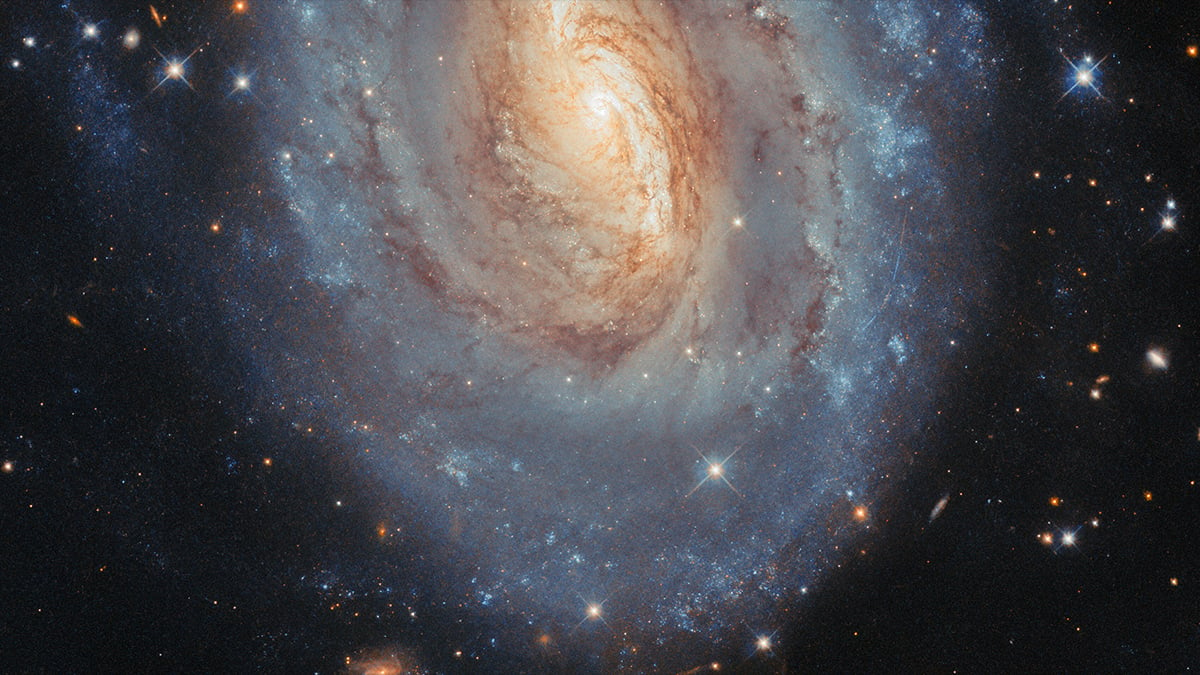
When the Hubble Space Telescope turns its eye toward the universe, it often produces images that combine beauty with science. One of its latest releases, titled “Yellow and Blue, Old and New,” captures a barred spiral galaxy known as NGC 6000, located around 102 million light-years away in the constellation Scorpius. The image carries important clues about the lives of stars, the structure of galaxies, and even the chance encounters that occur when a telescope points deep into the sky.
A galaxy in Scorpius
NGC 6000 belongs to the class of barred spiral galaxies. Its structure is typical of this category: a central bulge dominated by older stars, a bar feature that channels gas inward, and sweeping spiral arms where new stars are born. Astronomers classify it as type SB(s)bc, indicating that its arms are moderately loose and connected to a distinct bar.
The galaxy was discovered in 1834 by John Herschel during his southern sky survey. With modern instruments, its distance has been measured to about 31 megaparsecs, or roughly 102 million light-years. That makes it far enough to appear as a small, faint smudge through ground-based telescopes, but detailed structure is revealed clearly when Hubble’s instruments collect deep exposures.
The colors that tell a story
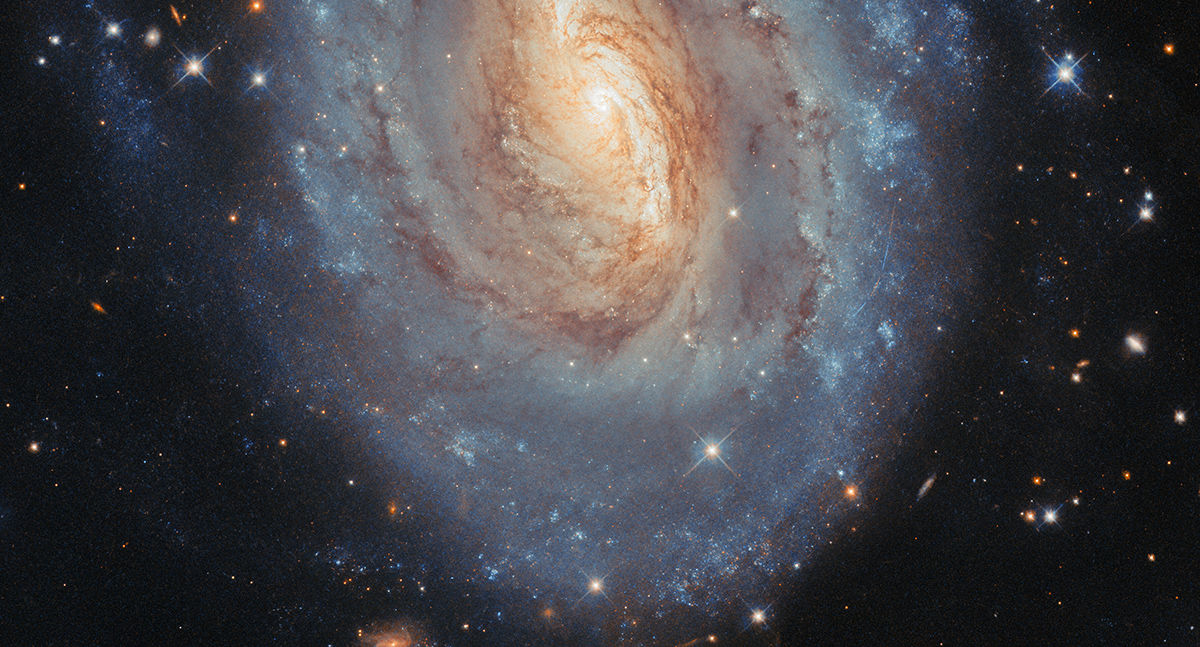
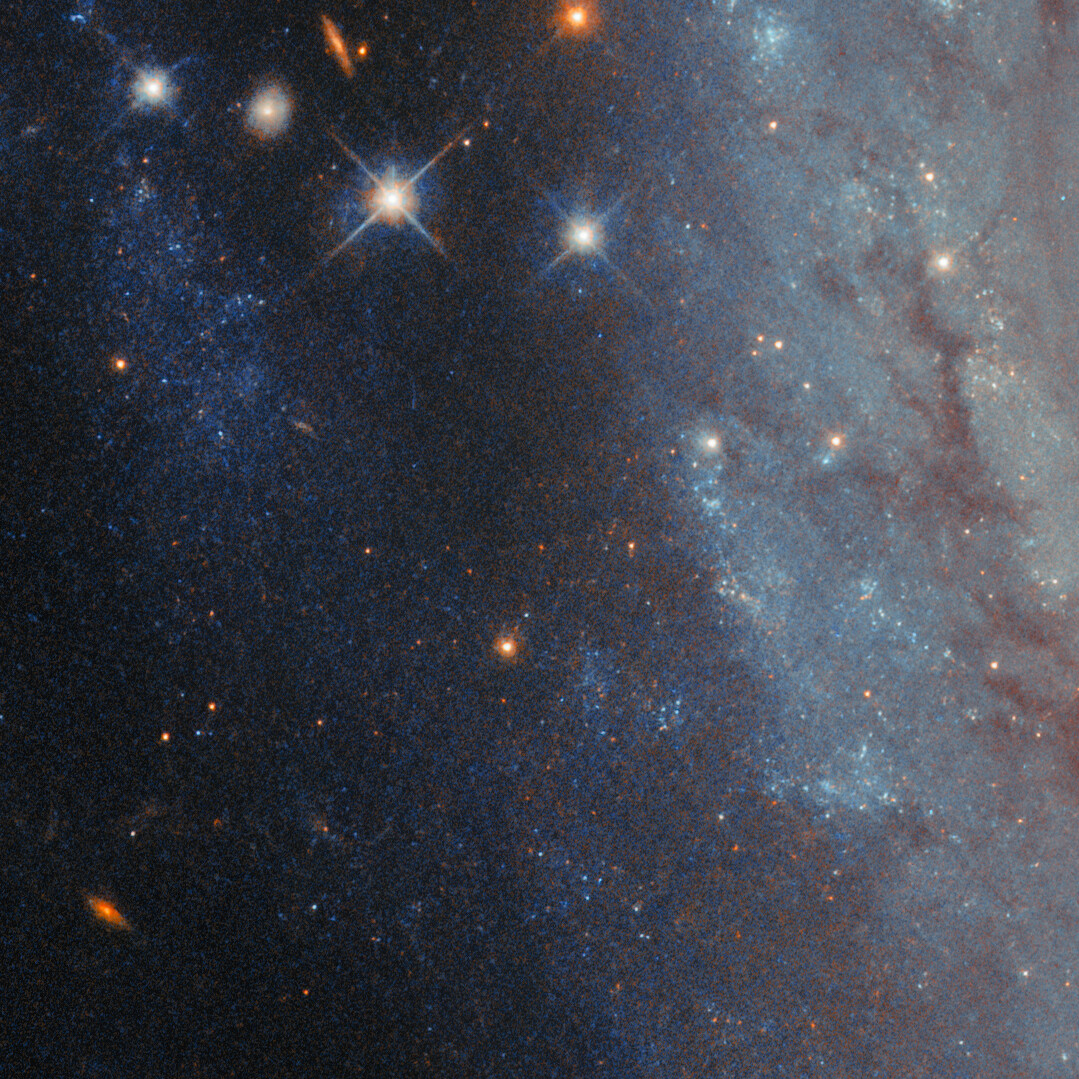
The most striking feature of the Hubble image is its contrasting colors. The central region glows yellow, while the spiral arms shine bright blue. But this contrast is not an artistic choice. It rather reflects the different ages and temperatures of stars.
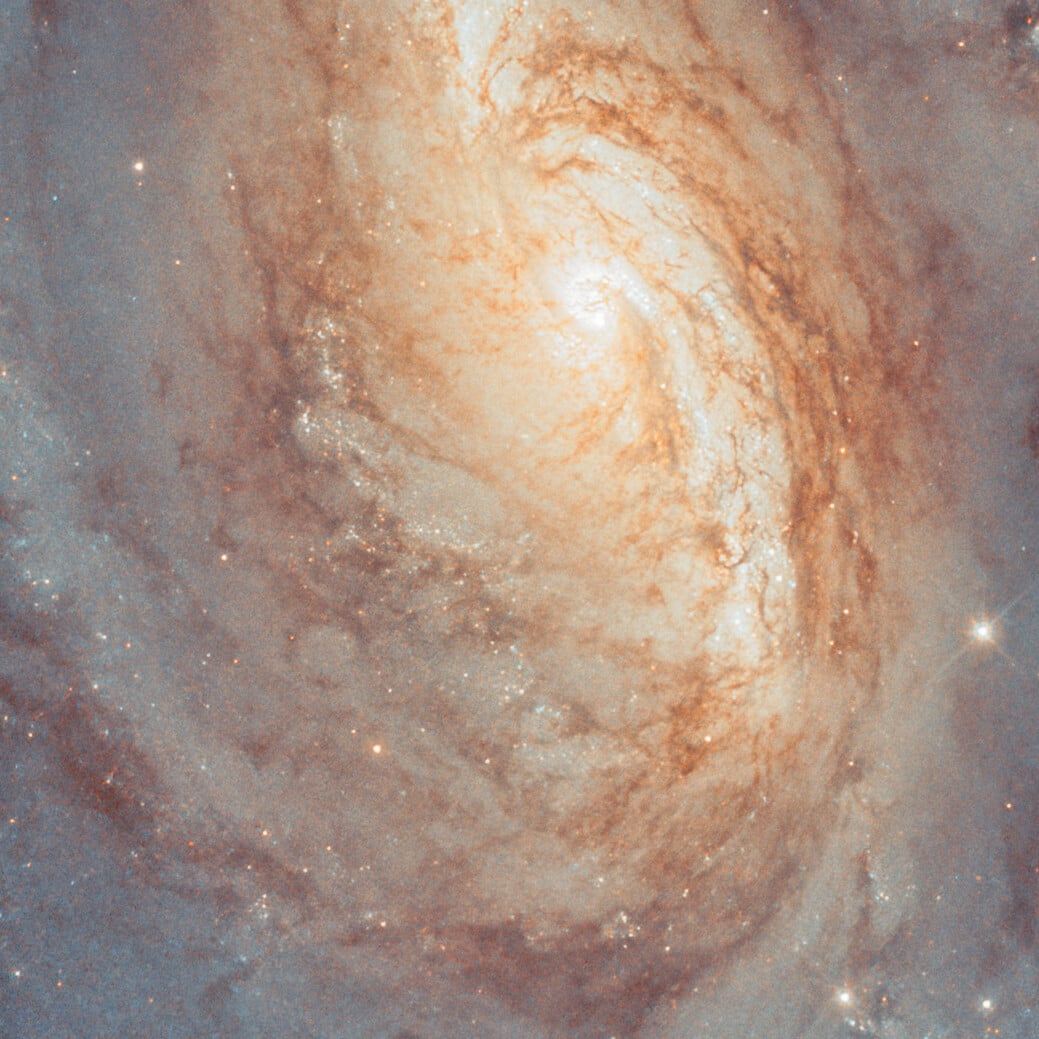
Yellow tones in the core indicate older stars. These stars are smaller, cooler, and longer-lived. They dominate the bulge because the rapid star formation of earlier epochs has slowed, leaving behind populations that burn more steadily.
The outer spiral arms tell a different story. The blue regions mark sites of active star formation. Young, massive stars burn hot and bright, releasing most of their energy in blue and ultraviolet light. These stars live only a few million years, a blink in cosmic time, but during their short lifespans, they light up the spiral arms and shape their environment with strong winds and radiation.
The image was made using Hubble’s Wide Field Camera 3. Several filters isolate different parts of the spectrum. By combining data from filters centered around 555 and 814 nanometers, astronomers build a color composite that separates older populations from younger ones. The method also enhances structures like dust lanes and highlights the contrast between the bulge and arms.
An unexpected visitor
Careful observers will notice something unusual on the right side of the image: four thin, colored streaks crossing the star field. These are not cosmic jets or background galaxies. They are the trails of an asteroid from our own Solar System, captured accidentally as it moved across Hubble’s field of view.
Because the telescope collected exposures in different filters one after the other, the asteroid left multiple streaks. Each streak appears in a slightly different position, revealing its motion during the imaging sequence. The streaks are also tinted differently because each filter captures a different part of the spectrum. This kind of coincidence happens occasionally with Hubble. The telescope, orbiting Earth, can be pointed at distant targets, but closer bodies, such as asteroids, sometimes pass through the same line of sight.
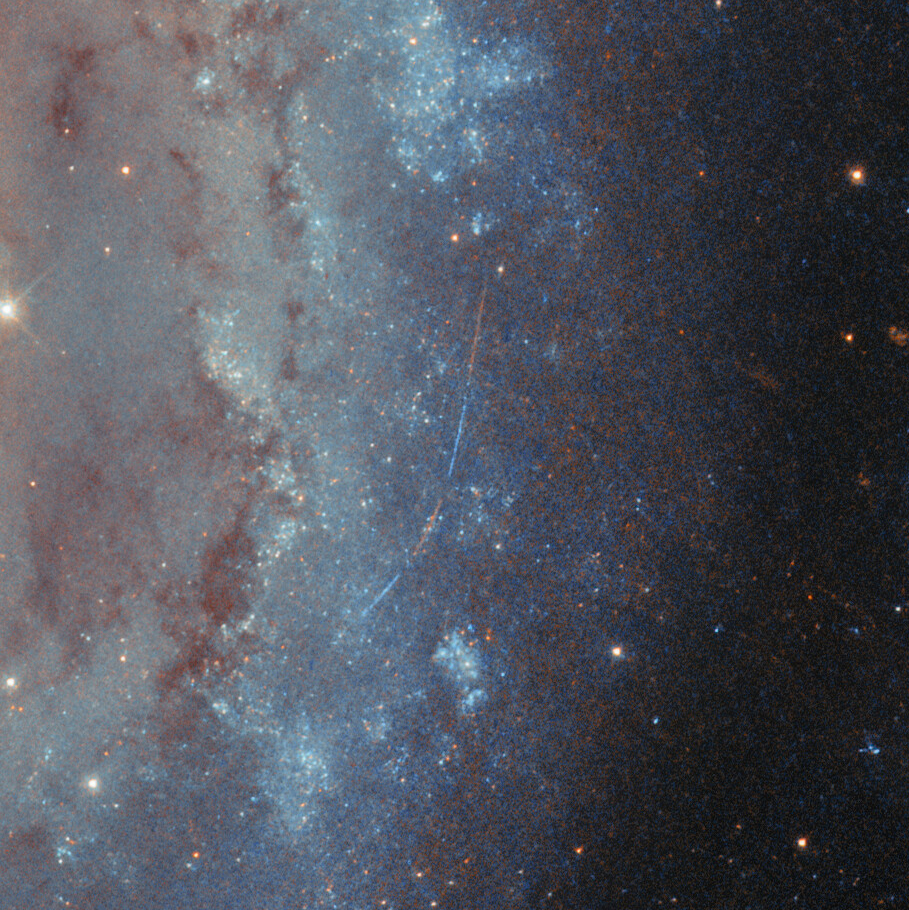
Yellow and blue, old and new: NGC 6000
NGC 6000’s portrait stands out for its clarity and layered detail. Many Hubble images showcase grand collisions or dramatic nebulae. This one shows subtler contrasts that are equally important. The difference between the yellow bulge and the blue arms encapsulates billions of years of stellar history in a single view. The presence of dust, supernovae remnants, and even a passing asteroid enriches the story.
Yellow and blue, Old and new, capture the essence of what Hubble has shown us: a galaxy where old stars in the bulge shine steadily, while new stars ignite in the arms. NGC 6000’s image is a layered record of cosmic history, spanning from the discovery centuries ago to modern deep-space imaging, from ancient stellar populations to fleeting visitors in our Solar System.
Clear skies!
See more from DIYPhotography.net on Google
Add DIYPhotography.net as a trusted source. This makes
our stories more likely to appear in your Google Search results.
 Add as a preferred source on Google

Soumyadeep Mukherjee
Soumyadeep Mukherjee is an award-winning astrophotographer from India. He has a doctorate degree in Linguistics. His work extends to the sub-genres of nightscape, deep sky, solar, lunar and optical phenomenon photography. He is also a photography educator and has conducted numerous workshops. His works have appeared in over 40 books & magazines including Astronomy, BBC Sky at Night, Sky & Telescope among others, and in various websites including National Geographic, NASA, Forbes. He was the first Indian to win “Astronomy Photographer of the Year” award in a major category.


Join the Discussion
DIYP Comment Policy
Be nice, be on-topic, no personal information or flames.