
























VLT Identifies a New Gas Cloud Orbiting the Centre of the Milky Way
Mar 11, 2026
Soumyadeep Mukherjee
Soumyadeep Mukherjee is an award-winning astrophotographer from India. He has a doctorate degree in Linguistics. His work extends to the sub-genres of nightscape, deep sky, solar, lunar and optical phenomenon photography. He is also a photography educator and has conducted numerous workshops. His works have appeared in over 40 books & magazines including Astronomy, BBC Sky at Night, Sky & Telescope among others, and in various websites including National Geographic, NASA, Forbes. He was the first Indian to win “Astronomy Photographer of the Year” award in a major category.
Share:

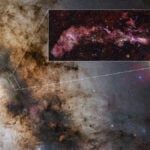
The central region of the Milky Way provides one of the most valuable laboratories for studying the physics of supermassive black holes. At a distance of about 27,000 light-years from Earth lies Sagittarius A*, the compact radio source that marks the location of the Galaxy’s central black hole. Infrared observations over the past three decades have revealed a dense stellar cluster surrounding Sagittarius A*. These stars move on rapid and often highly eccentric orbits around the black hole. At the same time, astronomers have detected several unusual objects that show properties of both stars and gas clouds. Understanding the nature of these objects has remained a major challenge.
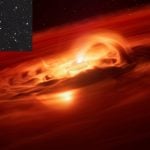
Recent observations from the European Southern Observatory’s Very Large Telescope have now added a new member to this mysterious group. While analysing infrared data of the Galactic centre, astronomers identified a previously unknown gas cloud orbiting Sagittarius A*. The cloud has been named G2t. Its discovery reveals an intriguing connection with two previously known objects, G1 and G2, and it offers new clues about the origin of gas structures in the extreme environment near the Milky Way’s central black hole.
A complex environment at the galactic centre
The centre of the Milky Way is one of the most energetic and crowded regions in the Galaxy. Within just a few light-years of Sagittarius A*, thousands of stars orbit the black hole. Many of these stars move at speeds of several thousand kilometres per second as they respond to the intense gravitational pull of the central mass.
However, observing this region from Earth is not straightforward. Large amounts of interstellar dust lie along the line of sight between the Solar System and the Galactic centre. These dust clouds absorb visible light and hide the region from ordinary telescopes. For this reason, astronomers rely on infrared observations to study the central cluster.
Infrared wavelengths penetrate the dust and reveal the stars and gas within the nuclear region. Using this technique, researchers have mapped the motion of stars near Sagittarius A* with remarkable precision. These measurements confirmed the presence of the supermassive black hole and allowed astronomers to determine its mass.
Alongside the stars, astronomers have also identified several compact objects that emit infrared radiation but behave partly like gas clouds. These objects move along well-defined orbits around Sagittarius A*, yet they show signs of diffuse gas surrounding them. For years, the nature of these objects remained uncertain. The discovery of the new cloud G2t now adds another important piece to this complex picture.

Detection of the new cloud G2t
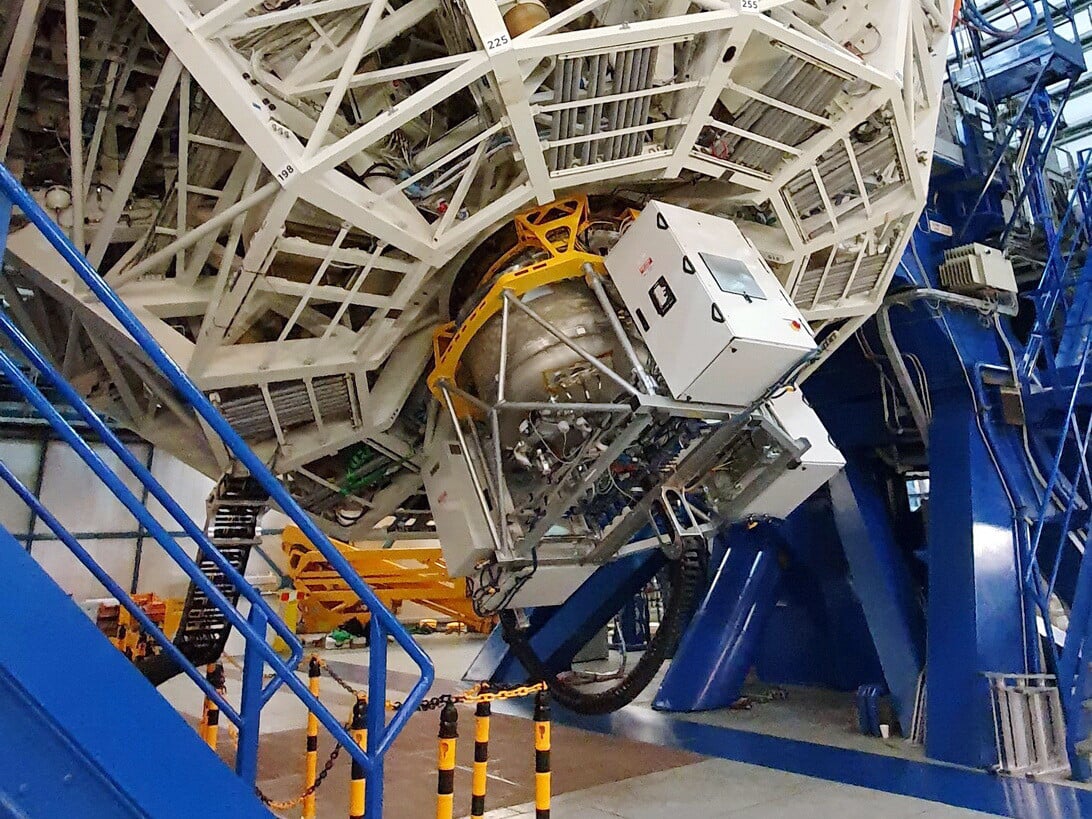
Astronomers discovered G2t while analysing recent observations of the Galactic centre obtained with the Very Large Telescope at ESO’s Paranal Observatory in Chile. The observations used the Enhanced Resolution Imager and Spectrograph (ERIS), an infrared instrument designed for high-resolution imaging and spectroscopy.
The VLT operates under exceptionally clear skies in the Atacama Desert. These conditions allow astronomers to observe faint infrared sources in crowded stellar environments. With ERIS, researchers can obtain both detailed images and precise spectroscopic measurements of objects near Sagittarius A*.
During the analysis of the data, astronomers noticed a faint source moving through the dense stellar field close to the black hole. The object showed spectral characteristics consistent with ionised gas. Further measurements confirmed that the source followed an orbit around Sagittarius A*.
The research team classified the object as a gas cloud and assigned it the name G2t. The designation reflects its similarity to two previously known objects, G1 and G2, which orbit the black hole in the same region. Although these earlier objects had been studied for years, their origin remained unclear. The discovery of G2t allowed astronomers to compare the trajectories of all three clouds and search for possible connections between them.
The existence of this triplet suggests that the clouds formed through the same physical process and were released into similar trajectories around the black hole.
A likely source: The massive binary system IRS16SW
Once astronomers established the connection between the three clouds, they began searching for a possible source. Their investigation pointed toward a massive stellar system located close to the Galactic centre.
This system, known as IRS16SW, consists of two very massive stars orbiting each other in a tight binary configuration. Such stars produce strong stellar winds that continuously eject large quantities of gas into the surrounding space.
In massive binary systems, the winds from the two stars can collide and compress the gas between them. These interactions often produce clumps or blobs of dense material. Once formed, these blobs can be expelled into the surrounding environment.
Astronomers propose that the gas clouds G1, G2, and G2t may have originated in this way. Material expelled from the IRS16SW system could have broken into several compact clumps. After leaving the binary system, each clump would begin to move under the gravitational influence of Sagittarius A*.
Because the clouds formed in the same region, they would initially travel along similar trajectories. Small differences in the direction or speed of ejection could produce the slight variations seen in their orbital orientations.
This explanation accounts for the nearly identical paths followed by the three clouds. It also explains why they appear as compact gas structures rather than ordinary stars.

Continuing exploration of the Galactic Centre
Despite decades of detailed observations, the centre of the Milky Way remains a region of ongoing discovery. Thousands of stars orbit Sagittarius A*, and many follow complex paths shaped by the black hole’s gravity.
Studies of these stellar orbits provided some of the strongest evidence for the existence of a supermassive black hole in our galaxy. These observations also enabled precise measurements of its mass and location. The research eventually led to the Nobel Prize in Physics in 2020.
Yet the environment around the black hole is far from fully understood. Gas clouds, stellar winds, and compact objects interact in ways that are still being explored. The discovery of the G2t cloud demonstrates that new structures can still emerge from detailed observations of the region.
Future telescopes will push these investigations even further. The European Southern Observatory is currently constructing the Extremely Large Telescope (ELT) in Chile. With a primary mirror nearly 40 metres across, the ELT will offer dramatically improved resolution and sensitivity.

Clear skies!
See more from DIYPhotography.net on Google
Add DIYPhotography.net as a trusted source. This makes
our stories more likely to appear in your Google Search results.
 Add as a preferred source on Google

Soumyadeep Mukherjee
Soumyadeep Mukherjee is an award-winning astrophotographer from India. He has a doctorate degree in Linguistics. His work extends to the sub-genres of nightscape, deep sky, solar, lunar and optical phenomenon photography. He is also a photography educator and has conducted numerous workshops. His works have appeared in over 40 books & magazines including Astronomy, BBC Sky at Night, Sky & Telescope among others, and in various websites including National Geographic, NASA, Forbes. He was the first Indian to win “Astronomy Photographer of the Year” award in a major category.


Join the Discussion
DIYP Comment Policy
Be nice, be on-topic, no personal information or flames.