





















Precious Rings of Space: ALMA’s New Image of Debris Discs
Jan 24, 2026
Soumyadeep Mukherjee
Soumyadeep Mukherjee is an award-winning astrophotographer from India. He has a doctorate degree in Linguistics. His work extends to the sub-genres of nightscape, deep sky, solar, lunar and optical phenomenon photography. He is also a photography educator and has conducted numerous workshops. His works have appeared in over 40 books & magazines including Astronomy, BBC Sky at Night, Sky & Telescope among others, and in various websites including National Geographic, NASA, Forbes. He was the first Indian to win “Astronomy Photographer of the Year” award in a major category.
Share:

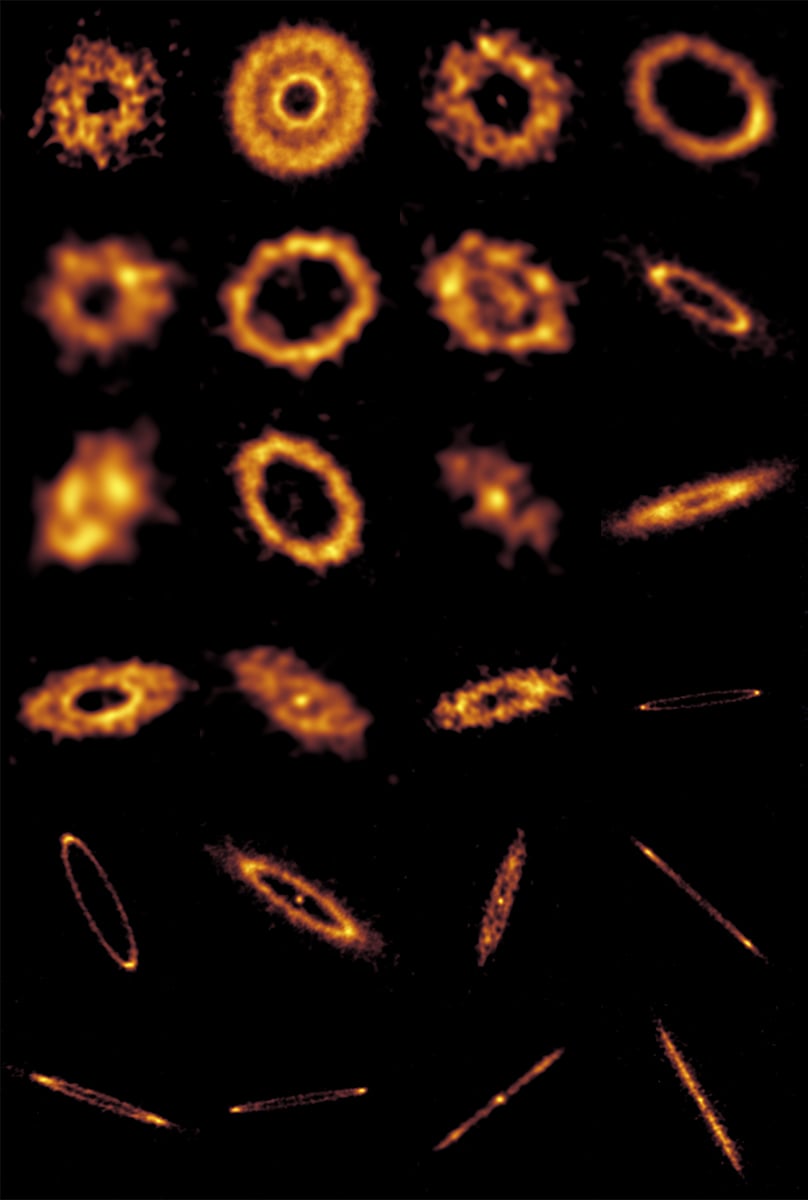
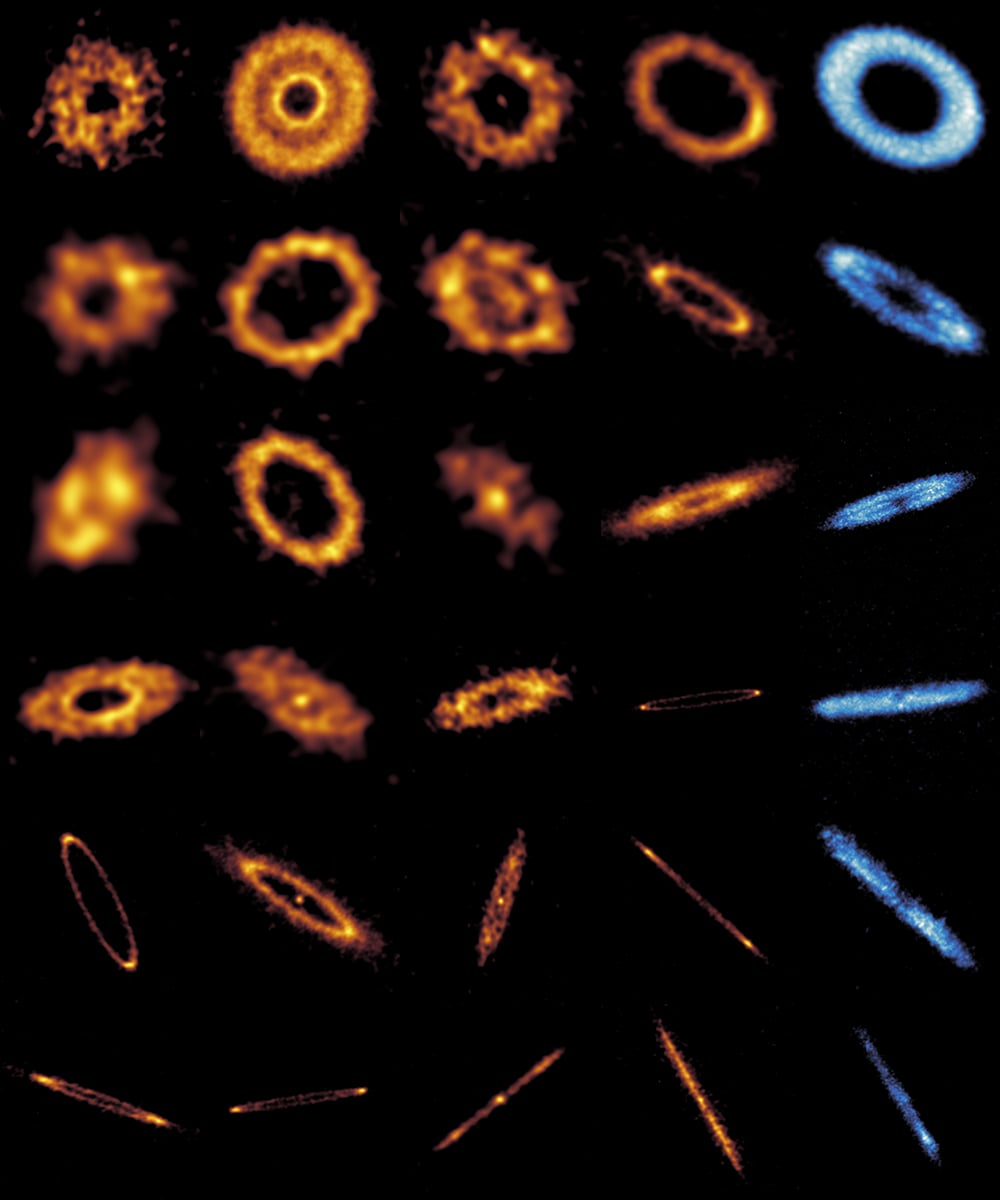
Astronomers around the world study the dusty remains of planet formation to understand how planets and solar systems come into being. Recently, the European Southern Observatory (ESO) released one of its most striking observational mosaics to date. This new image highlights 24 debris discs around distant stars. These rings of dust and gas were captured using the Atacama Large Millimeter/submillimeter Array (ALMA) in Chile.
Debris discs are not mere cosmic decoration. They are the residual footprints of planetary birth. These rings tell a story of dust, collisions, and unseen forces at play long after planets have formed.
From primordial chaos to quiet dust: The life of a debris disc
When a star first forms, it is surrounded by a dense disk of gas and dust. This early structure is called a protoplanetary disc. Within this spinning disc, tiny particles collide and stick together. Gradually, they grow into larger bodies. Some evolve into planets. Others become asteroids, comets, and rocky debris. Over millions of years, most of the gas dissipates into space. What remains is a different kind of structure: a debris disc.
A debris disc is essentially the leftover material from planet formation. It is composed mainly of dust and solid fragments. These particles orbit the star long after the main process of planet formation has ended. In this sense, debris discs are the cosmic equivalent of fossil records. They preserve evidence of past events. They also hint at ongoing dynamics within the system.
Our own Solar System has a debris disc. It is known as the Kuiper Belt, a band of icy bodies beyond Neptune’s orbit. The Kuiper Belt contains comets, dwarf planets, and rock-ice fragments. It survived because the giant planets, especially Neptune, stirred the material, preventing it from clumping into a larger body. This vast ring of debris remains today as a testament to the tumultuous early years of our planetary neighbourhood.
ALMA: Seeing more than meets the eye
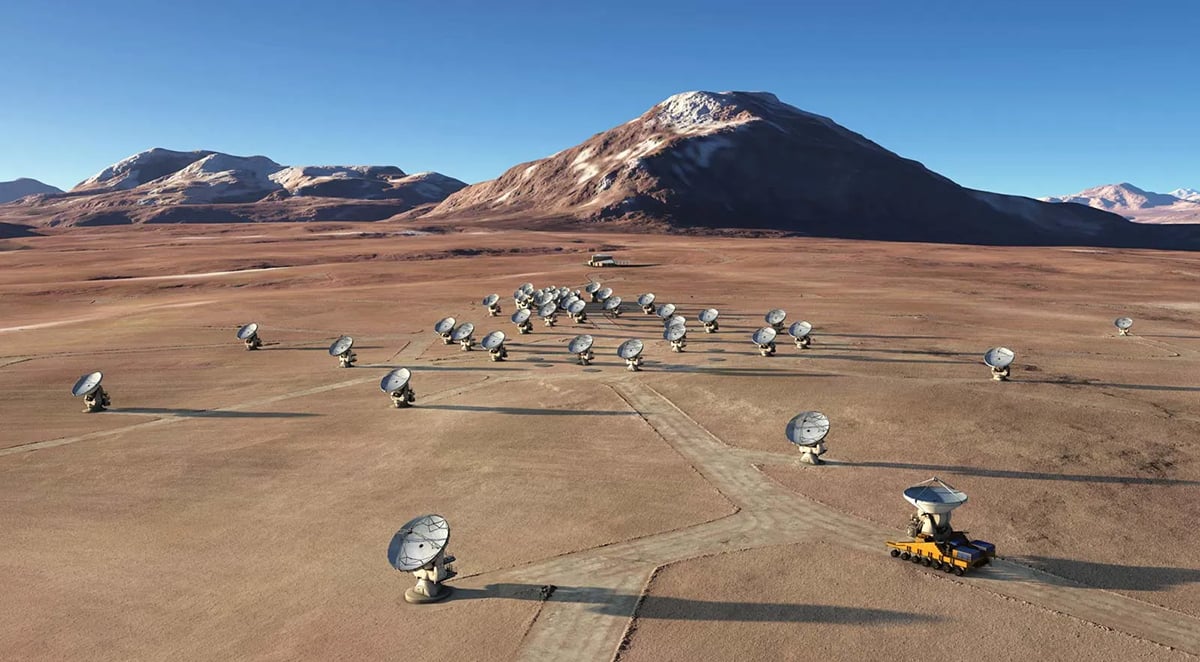
To study debris discs, astronomers must look beyond visible light. Dust and gas in these rings glow faintly at millimetre wavelengths. These wavelengths are invisible to the human eye. They reveal the cold material that optical telescopes often miss. This is where ALMA steps in.
ALMA is a radio interferometer composed of 66 antennas. These antennas work together as one giant telescope. They detect faint emissions from dust grains and certain molecules in the discs. ALMA does not produce images like a typical camera. Instead, it collects radio signals and constructs detailed maps of the discs’ structure. Its high resolution allows scientists to distinguish fine details in discs that lie dozens or even hundreds of light-years away.
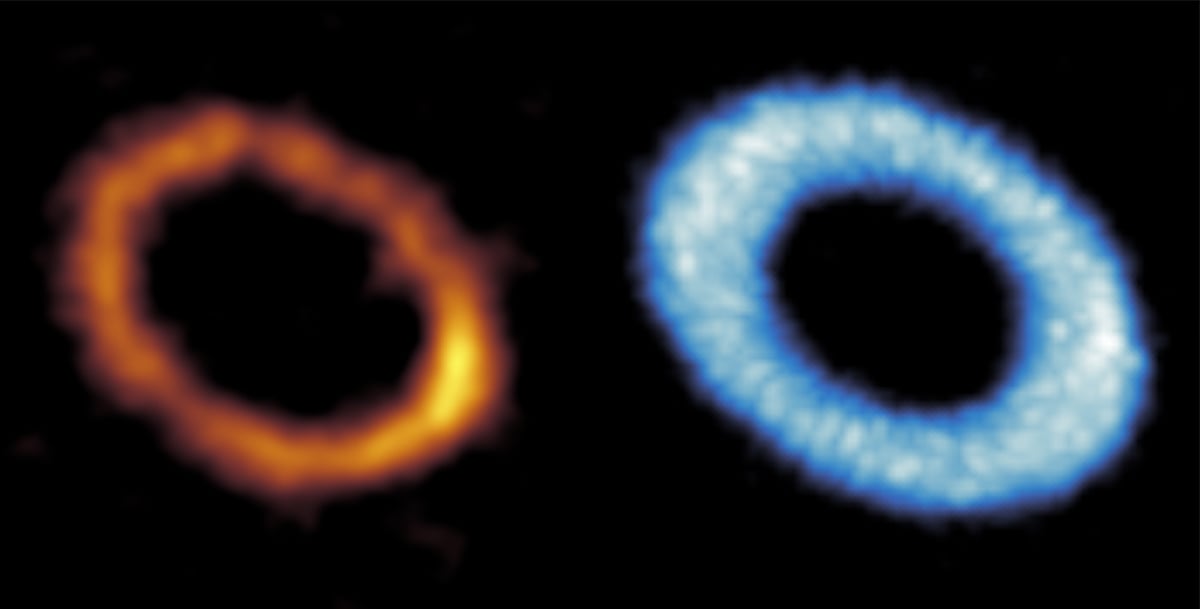
In the ESO mosaic, each disc is represented by a small circular image. Most discs appear in orange tones, which show the distribution of dust. A subset of six discs also includes blue regions. These regions indicate where gas has been detected alongside dust. These colors are not “true color.” They are false-color overlays that help scientists interpret the data.
What the new image reveals
At first glance, the debris discs in the ESO image resemble rings and bands of material. But the differences between them are significant. Some discs are narrow and sharply defined. Others are broad, faint, or uneven. Some show hints of gaps or spikes in dust density. Each variation has a story to tell.
In some systems, discs appear smooth and symmetric. These likely represent stable, mature belts of debris. In others, the dust rings are clumpy or brighter on one side. One especially interesting example is the disc around the star HD 121617. In this case, the dust ring is brighter on one side. Models suggest the brighter region may result from a vortex of gas trapping dust particles. This vortex would require an unusually high gas density, which intrigues researchers. It may imply that the gas is not merely a secondary byproduct of collisions, but could be leftover from earlier stages of the system’s evolution.
The presence of gas in debris discs raises important questions. Traditional models predicted that most gas should disappear early in a star system’s life. Yet gaseous components persist in at least some of the discs in this new image. Scientists debate whether this gas is primordial, meaning left over from the original protoplanetary disc, or whether it is replenished through ongoing collisions of comet-like bodies. Future analysis of the full debris disc sample may help answer these questions.
More than dust: Importance of gas in debris discs
Dust alone tells part of the story. But the detection of gas, even in small amounts, has profound implications for our understanding of planetary systems. Gas affects the motion of dust and small bodies. It can act as a drag force, altering the paths of particles over time. It can also provide clues about past and present collisional processes.
Astronomers once assumed that debris discs were almost entirely gas-free. This assumption came from the idea that the original gas would be gone by the time the disc entered the debris stage. But observations from ALMA and other facilities have challenged this view. Some debris discs retain detectable amounts of gas, and in rare cases, this gas is surprisingly abundant.
The debate centers around two possibilities. One is that the gas is primordial, a remnant from the protoplanetary era that has somehow survived much longer than expected. The other is that the gas is secondary, meaning it is created by collisions and evaporation of icy bodies within the disc. Each possibility has different implications for how we understand planetary system evolution.
If gas is indeed primordial in some systems, then the timeline for gas dispersal is longer than models predict. This could affect theories about how giant planets form and how atmospheres settle onto young worlds. If the gas is secondary, then high-energy collisions may play a larger role in shaping debris discs over time than previously thought. Both scenarios demand closer study.

Debris discs and the search for planets
Debris discs do more than tell us about leftover material. They also offer indirect clues about planets that cannot be seen directly. Gaps, asymmetries, and sharp edges in a disc may signal the gravitational influence of unseen planets. Such features can act like footprints left by a planet as it shapes its surrounding debris.
For example, in our own Solar System, the gravitational pull of Jupiter helps shape the asteroid belt. Likewise, Neptune influences the Kuiper Belt’s structure. In distant systems, similar effects may indicate the presence of large planets. By studying disc structure with ALMA and other telescopes, astronomers can infer the existence of planets even when they are too faint to detect directly.
Debris discs also hint at the dynamics of collisions in a system. A disc filled with fresh dust suggests ongoing fragmentation among larger bodies. These collisions may be caused by gravitational perturbations from planets or passing stars. By mapping dust distribution and motion, scientists can glimpse the dynamic history of a planetary system.
Clear skies!
See more from DIYPhotography.net on Google
Add DIYPhotography.net as a trusted source. This makes
our stories more likely to appear in your Google Search results.
 Add as a preferred source on Google

Soumyadeep Mukherjee
Soumyadeep Mukherjee is an award-winning astrophotographer from India. He has a doctorate degree in Linguistics. His work extends to the sub-genres of nightscape, deep sky, solar, lunar and optical phenomenon photography. He is also a photography educator and has conducted numerous workshops. His works have appeared in over 40 books & magazines including Astronomy, BBC Sky at Night, Sky & Telescope among others, and in various websites including National Geographic, NASA, Forbes. He was the first Indian to win “Astronomy Photographer of the Year” award in a major category.



Join the Discussion
DIYP Comment Policy
Be nice, be on-topic, no personal information or flames.