



















JWST, ALMA, and VLA unveil The Cosmic Owl in Space
Jun 22, 2025
Soumyadeep Mukherjee
Soumyadeep Mukherjee is an award-winning astrophotographer from India. He has a doctorate degree in Linguistics. His work extends to the sub-genres of nightscape, deep sky, solar, lunar and optical phenomenon photography. He is also a photography educator and has conducted numerous workshops. His works have appeared in over 40 books & magazines including Astronomy, BBC Sky at Night, Sky & Telescope among others, and in various websites including National Geographic, NASA, Forbes. He was the first Indian to win “Astronomy Photographer of the Year” award in a major category.
Share:
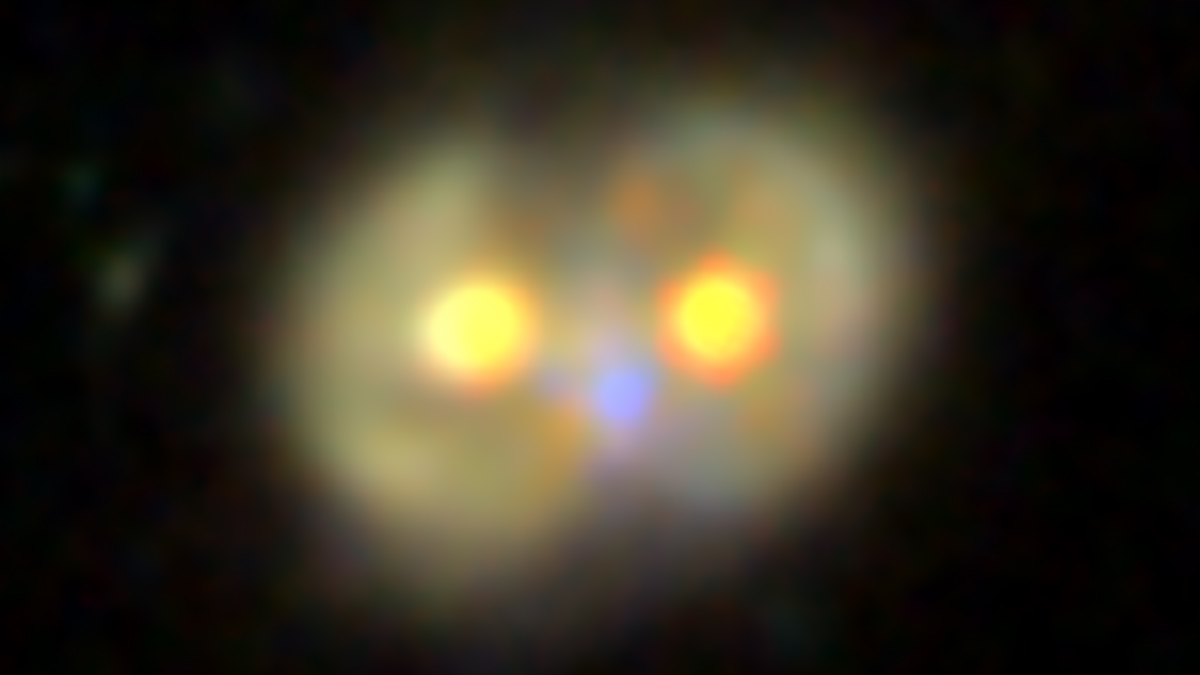
In June 2025, astronomers unveiled one of the most visually stunning cosmic discoveries of the year. Dubbed the Cosmic Owl, this newly found galaxy merger has captivated scientists and the public alike. Its twin ring-shaped galaxies resemble a wide-eyed owl, staring back across time from over 8.8 billion years ago. This discovery provides vital insights into how galaxies evolve. It also offers a rare look at how violent cosmic collisions shape the universe. Using some of the world’s most powerful observatories, astronomers captured this galactic merger in incredible detail.
What is the Cosmic Owl?
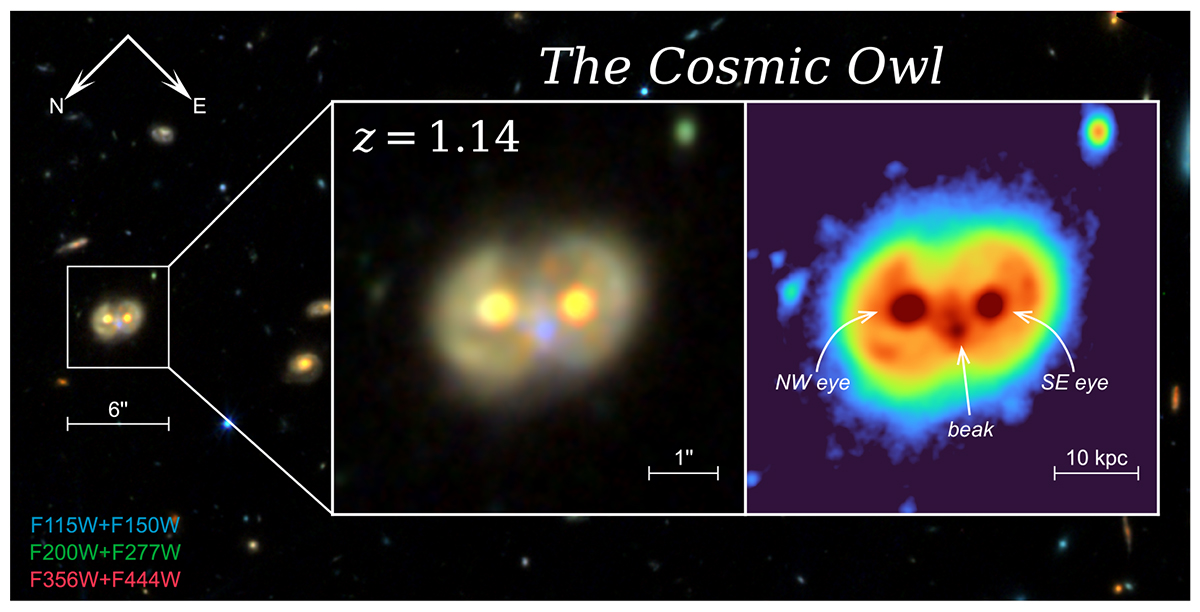
The Cosmic Owl is not a single object. It is a system of two colliding galaxies. Each galaxy forms a bright ring of stars, gas, and dust. These rings resemble two giant eyes. A patch of young, blue stars in the middle looks like a beak. The overall effect is striking. It looks just like the face of an owl. This object is not the same as the well-known Owl Nebula (M97). The Cosmic Owl is a far more distant and complex system. Scientists describe it as a “collisional ring galaxy merger.”
What are ring galaxies?
Ring galaxies are rare. They form when one galaxy plunges through another. This head-on collision sends ripples through the gas and dust, much like a stone dropped in a pond. These ripples create rings of intense star formation that expand outward. The Cosmic Owl features two such rings. Both galaxies in the system experienced direct collisions. Their rings are nearly the same size, about 26,000 light-years across. They are also perfectly aligned, making the symmetry of the system even more remarkable.
Behind the discovery
A team led by Mingyu Li of Tsinghua University in China discovered the Cosmic Owl. The team used a combination of data from several powerful observatories:
- James Webb Space Telescope (JWST)
- Atacama Large Millimeter/submillimeter Array (ALMA)
- Very Large Array (VLA)
The discovery was not planned. It was found while the team was studying galaxies in the COSMOS field. The stunning owl-like shape caught their attention immediately.
What the telescopes revealed
The James Webb Space Telescope played a crucial role. Its infrared camera captured sharp images of the two rings. These images revealed the detailed structure of the galaxies and the star-forming regions. JWST’s spectroscopic data also measured the age and composition of the stars. It confirmed that the galaxies are forming stars at a high rate.
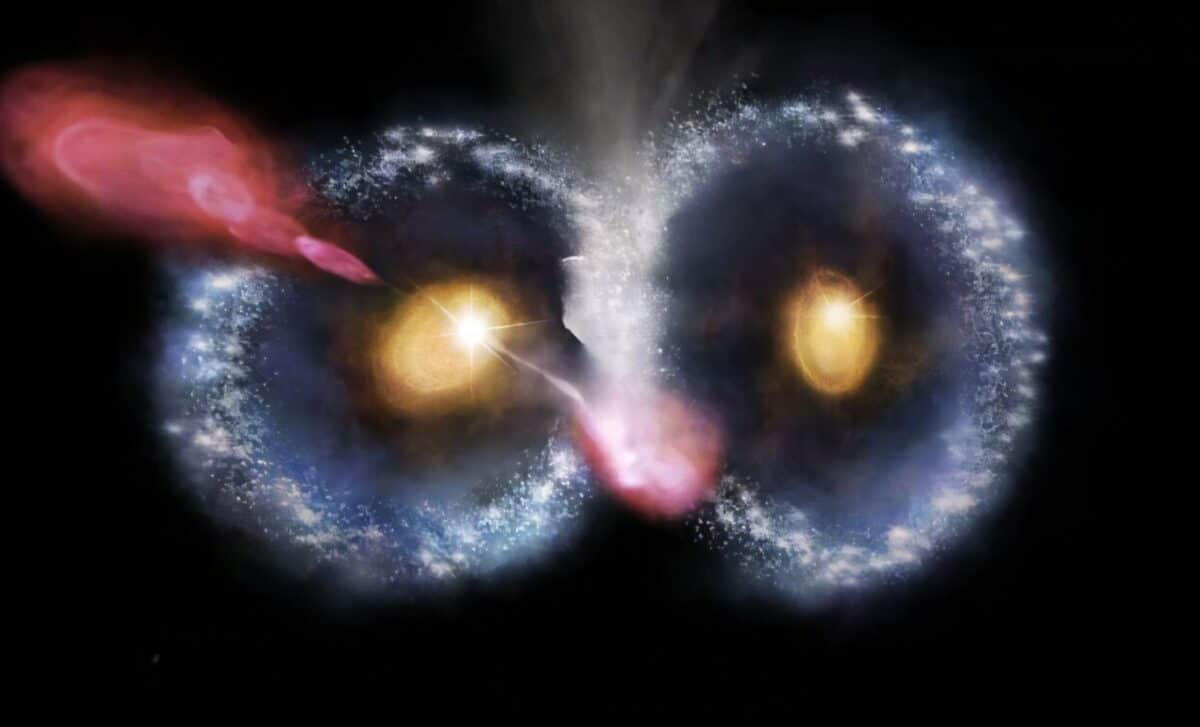
The ALMA telescope in Chile detected the cold gas in the system. Cold gas is the fuel for star formation. ALMA’s data showed that the collision compressed the gas into dense clumps. These clumps are where new stars are forming. The VLA, based in New Mexico, detected the radio jet. Its data helped map the structure and impact of the jet on the surrounding gas.
A glimpse into the early universe
The Cosmic Owl is not just beautiful. It is also ancient. Because it is so far away, we see it as it was 8.8 billion years ago. That means we are looking at a young universe. Galaxies were still forming and colliding more often. By studying the Cosmic Owl, astronomers get a direct view of how complex and dynamic galaxy evolution can be. They also gain insights into the role of black holes in shaping galaxies.
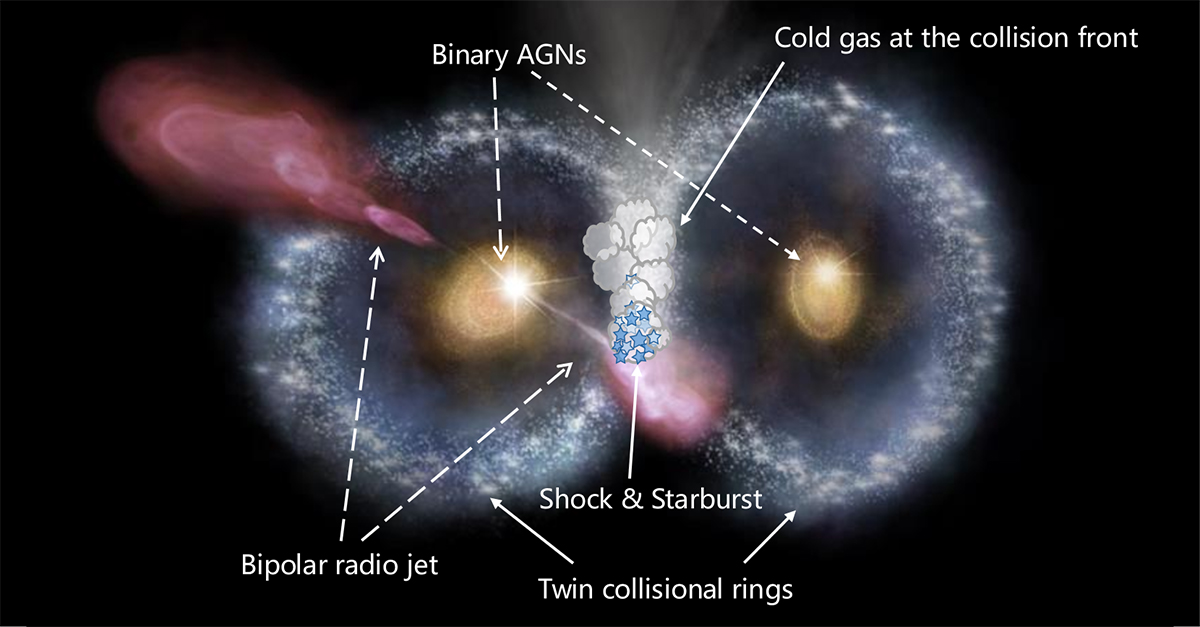
The Cosmic Owl is one of the most beautiful and scientifically rich discoveries in recent years. It shows us how violent, yet organized, the universe can be. Two galaxies collide. Rings of stars expand. Black holes roar. New stars are born. And all of it forms the face of an owl, frozen in time, 8.8 billion light-years away.
Clear skies!
See more from DIYPhotography.net on Google
Add DIYPhotography.net as a trusted source. This makes
our stories more likely to appear in your Google Search results.
 Add as a preferred source on Google

Soumyadeep Mukherjee
Soumyadeep Mukherjee is an award-winning astrophotographer from India. He has a doctorate degree in Linguistics. His work extends to the sub-genres of nightscape, deep sky, solar, lunar and optical phenomenon photography. He is also a photography educator and has conducted numerous workshops. His works have appeared in over 40 books & magazines including Astronomy, BBC Sky at Night, Sky & Telescope among others, and in various websites including National Geographic, NASA, Forbes. He was the first Indian to win “Astronomy Photographer of the Year” award in a major category.

Join the Discussion
DIYP Comment Policy
Be nice, be on-topic, no personal information or flames.