























JWST Detects Sand Clouds and Moon Birth around Exoplanets
Jun 17, 2025
Soumyadeep Mukherjee
Soumyadeep Mukherjee is an award-winning astrophotographer from India. He has a doctorate degree in Linguistics. His work extends to the sub-genres of nightscape, deep sky, solar, lunar and optical phenomenon photography. He is also a photography educator and has conducted numerous workshops. His works have appeared in over 40 books & magazines including Astronomy, BBC Sky at Night, Sky & Telescope among others, and in various websites including National Geographic, NASA, Forbes. He was the first Indian to win “Astronomy Photographer of the Year” award in a major category.
Share:
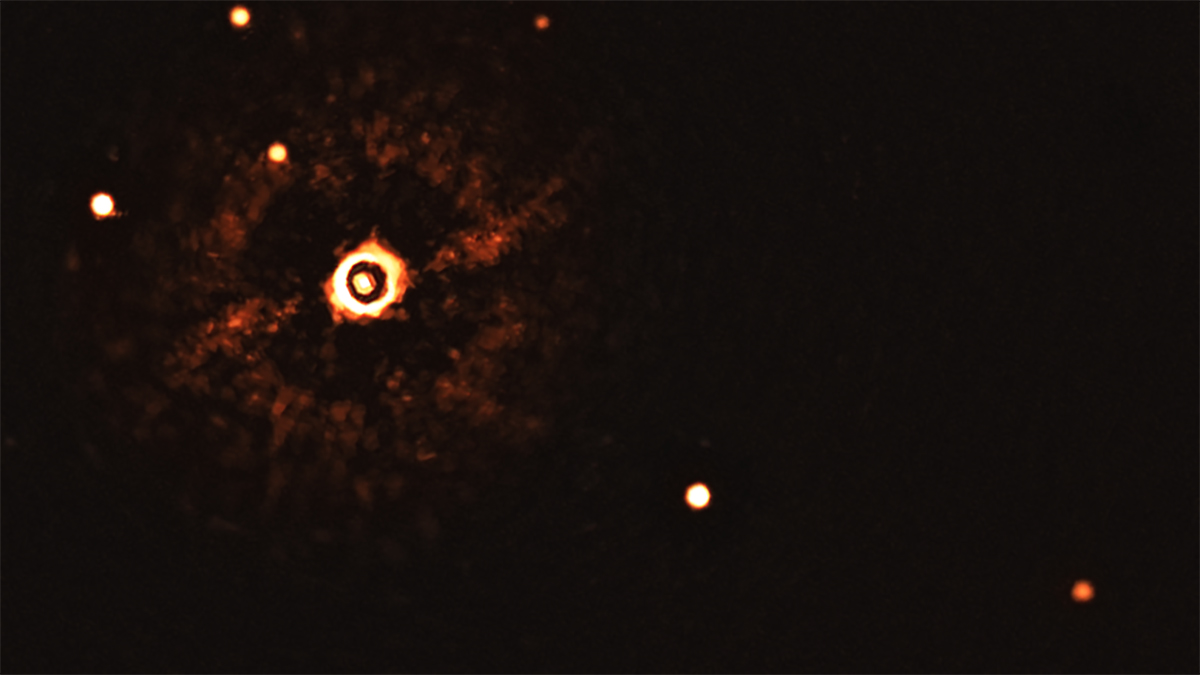
The James Webb Space Telescope (JWST) has given us an unprecedented glimpse into a young star system, YSES-1, located about 300 light-years away from Earth. This system is home to two massive exoplanets that are still hot from their formation, offering astronomers a chance to study planetary development in its early stages.
YSES-1: A glimpse into the young universe
At the center of the YSES-1 system is a star known as TYC 8998-760-1. This star is only about 17 million years old, a mere infant in cosmic terms. For comparison, our Sun is over 4.5 billion years old. Studying such a young star is crucial for understanding the early formation of planetary systems.
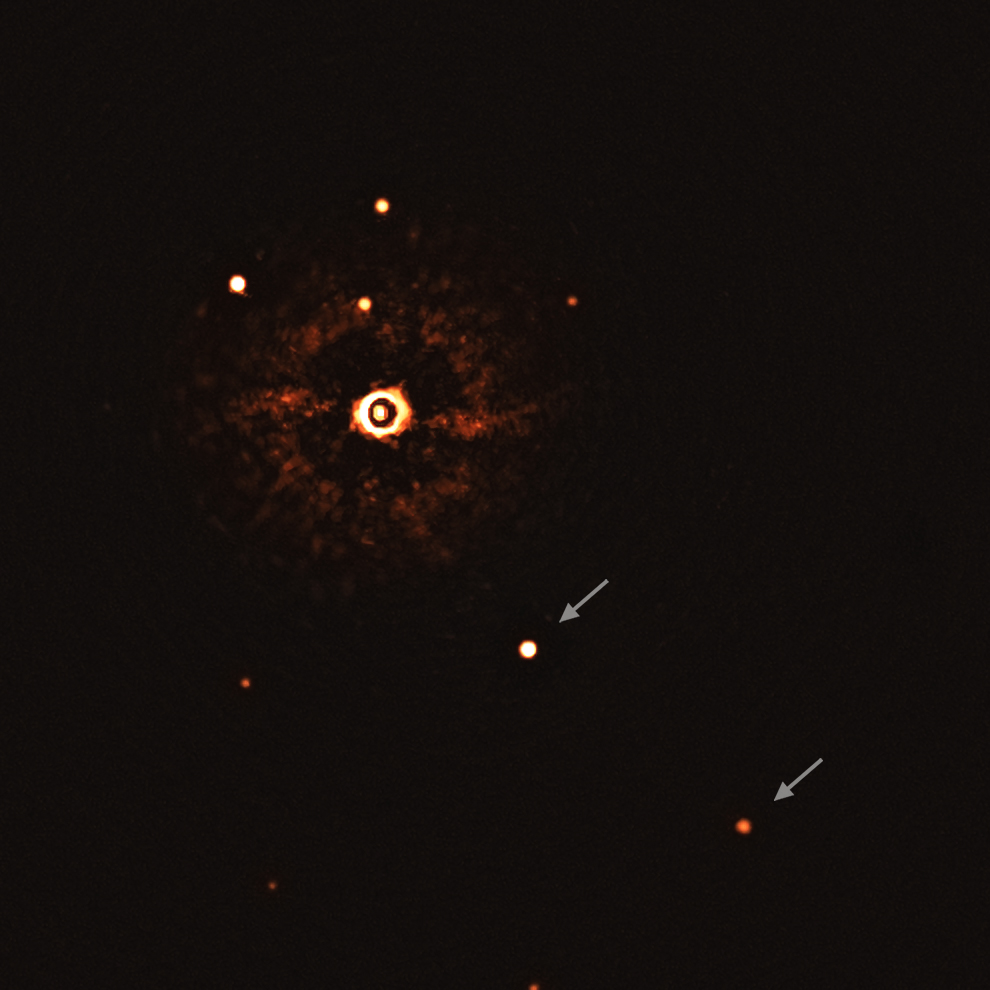
The most remarkable aspect of this discovery is that the two planets, YSES-1b and YSES-1c, can be observed directly in infrared light. These planets are far enough from their star, about 160 and 300 times the distance from Earth to the Sun, respectively, that their light doesn’t get overwhelmed by the glare from the star.
The giants of YSES-1
YSES-1b and YSES-1c are both massive exoplanets, with YSES-1b being up to 22 times the mass of Jupiter and YSES-1c reaching 14 Jupiter masses. These planets are so massive that there’s ongoing debate about whether YSES-1b, in particular, could be classified as a brown dwarf, a type of star that never fully ignites. These planets are still warm from their formation, emitting infrared light that makes them visible to JWST.
Unexpected discoveries in the atmosphere
What makes these observations so intriguing is the discovery of complex molecules in the atmospheres of both planets. JWST’s NIRSpec and MIRI instruments detected water vapor, carbon monoxide, carbon dioxide, and methane in the atmosphere of YSES-1c. But the biggest surprise came from the detection of silicate particles in the form of tiny grains of sand. These particles, composed of magnesium silicates, are found in the upper atmosphere of the planet and reflect infrared light, making them detectable by JWST.
For the first time, scientists have observed actual sand clouds in the atmosphere of an exoplanet. These clouds are made up of minuscule grains, smaller than a tenth of a micron across, and they are suspended in the planet’s atmosphere, swirling around like an alien form of weather. The grains are so small that they would fall through the atmosphere like rain, contributing to a phenomenon called “sand rain.”
The circumplanetary disk around YSES-1b
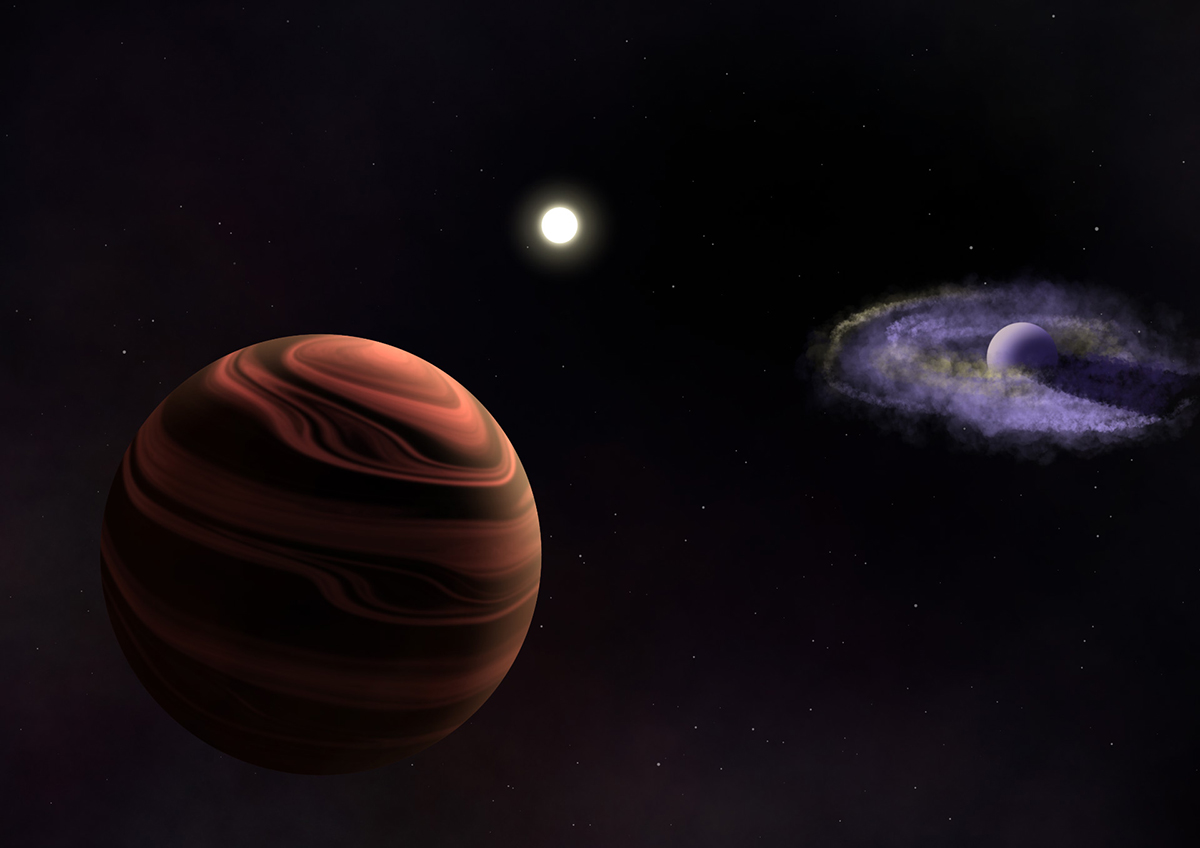
The second planet, YSES-1b, revealed another fascinating discovery: a warm, glowing disk of dust surrounding the planet. This disk, known as a circumplanetary disk, consists of tiny particles of dust orbiting the planet, similar to Saturn’s iconic rings. However, the disk around YSES-1b is much hotter and denser, indicating that it may be in the process of forming moons.
The presence of this disk is significant because it offers insights into how moons form around giant planets. In our solar system, moons like Ganymede and Titan likely formed in similar disks around Jupiter and Saturn. Observing a disk around YSES-1b suggests that moon formation is a much more common process in young planetary systems than previously thought.
The YSES-1 system offers a rare glimpse into the early stages of planetary evolution. With its massive exoplanets, sand clouds, and moon-forming disks, this system challenges our understanding of how planetary systems form and evolve. JWST’s ability to capture such detailed spectra of these distant worlds allows us to study processes that took place billions of years ago in our solar system. This remarkable mission is reshaping our understanding of the cosmos and reminding us how much we still have to learn.
Clear skies!
See more from DIYPhotography.net on Google
Add DIYPhotography.net as a trusted source. This makes
our stories more likely to appear in your Google Search results.
 Add as a preferred source on Google

Soumyadeep Mukherjee
Soumyadeep Mukherjee is an award-winning astrophotographer from India. He has a doctorate degree in Linguistics. His work extends to the sub-genres of nightscape, deep sky, solar, lunar and optical phenomenon photography. He is also a photography educator and has conducted numerous workshops. His works have appeared in over 40 books & magazines including Astronomy, BBC Sky at Night, Sky & Telescope among others, and in various websites including National Geographic, NASA, Forbes. He was the first Indian to win “Astronomy Photographer of the Year” award in a major category.
Related Posts
 This photographer filled a house with sand to exhibit her photos of houses filled with sand
 JWST Detects Massive Black Holes Growing Ahead of Host Galaxies
 Witnessing Birth of Planets: A Groundbreaking Photograph by ALMA and JWST
 ESO’s PoET Telescope Begins Operations to Detect Earth-like Exoplanets
Join the Discussion
DIYP Comment Policy
Be nice, be on-topic, no personal information or flames.