

























NASA’s Chandra Captures Mysterious X-Ray Objects in a Spiral Galaxy
Sep 9, 2026
Soumyadeep Mukherjee
Soumyadeep Mukherjee is an award-winning astrophotographer from India. He has a doctorate degree in Linguistics. His work extends to the sub-genres of nightscape, deep sky, solar, lunar and optical phenomenon photography. He is also a photography educator and has conducted numerous workshops. His works have appeared in over 40 books & magazines including Astronomy, BBC Sky at Night, Sky & Telescope among others, and in various websites including National Geographic, NASA, Forbes. He was the first Indian to win “Astronomy Photographer of the Year” award in a major category.
Share:
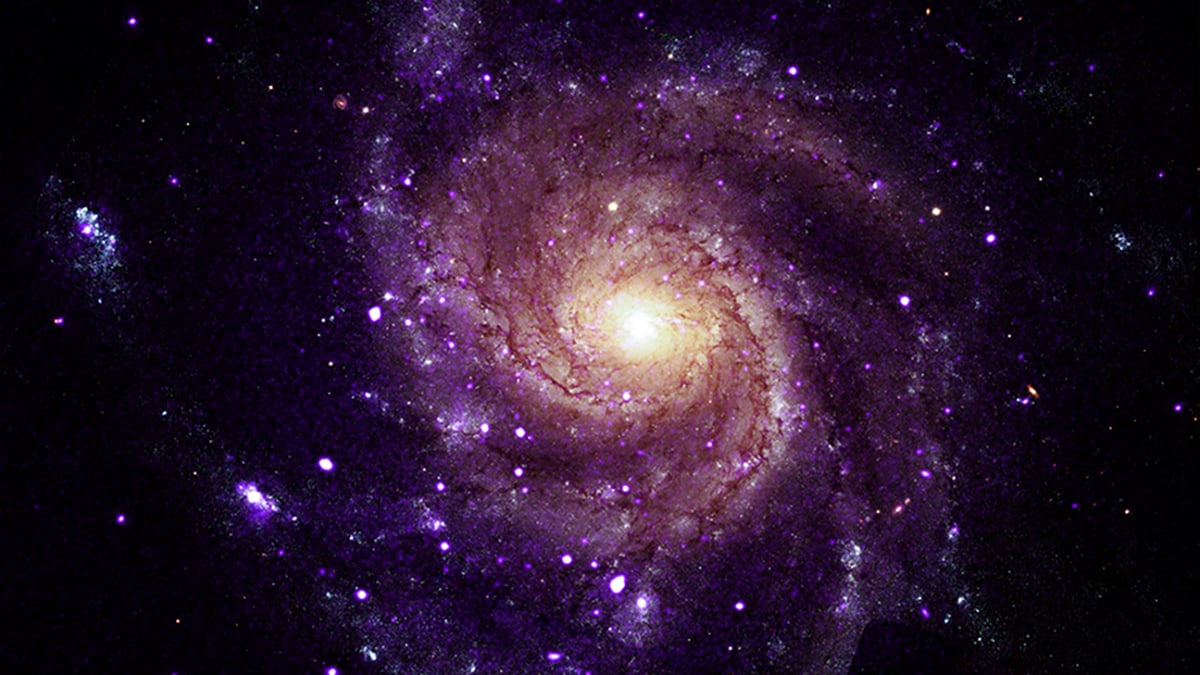
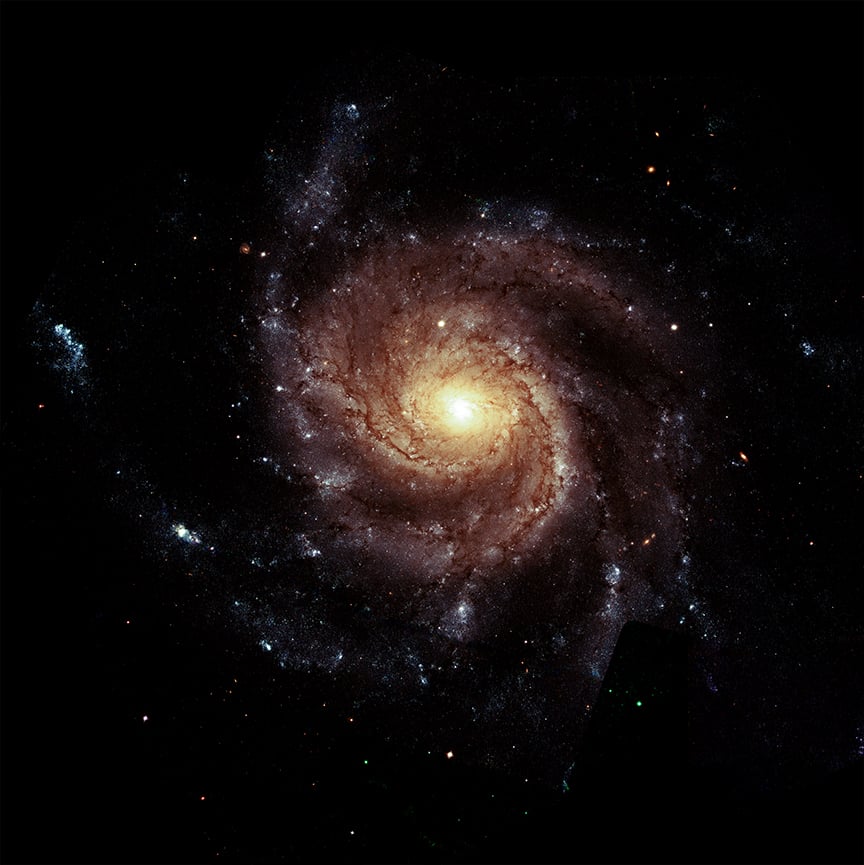
M101 (Pinwheel Galaxy) has been photographed countless times. Amateur astrophotographers have captured its spiral arms from dark-sky sites, while space telescopes have studied its stars, gas, and violent stellar explosions. But even familiar objects like this can have surprises!
Using the Chandra X-Ray Observatory, astronomers have now found seven unusual X-ray sources inside M101. They belong to a group of 84 objects identified across six galaxies. The sources produce extremely soft X-rays, with most of their detected emission falling between 0.15 and 0.3 kiloelectronvolts. The researchers have named them Hypersoft X-ray Sources, or HSSs.
M101 has seven newly found sources
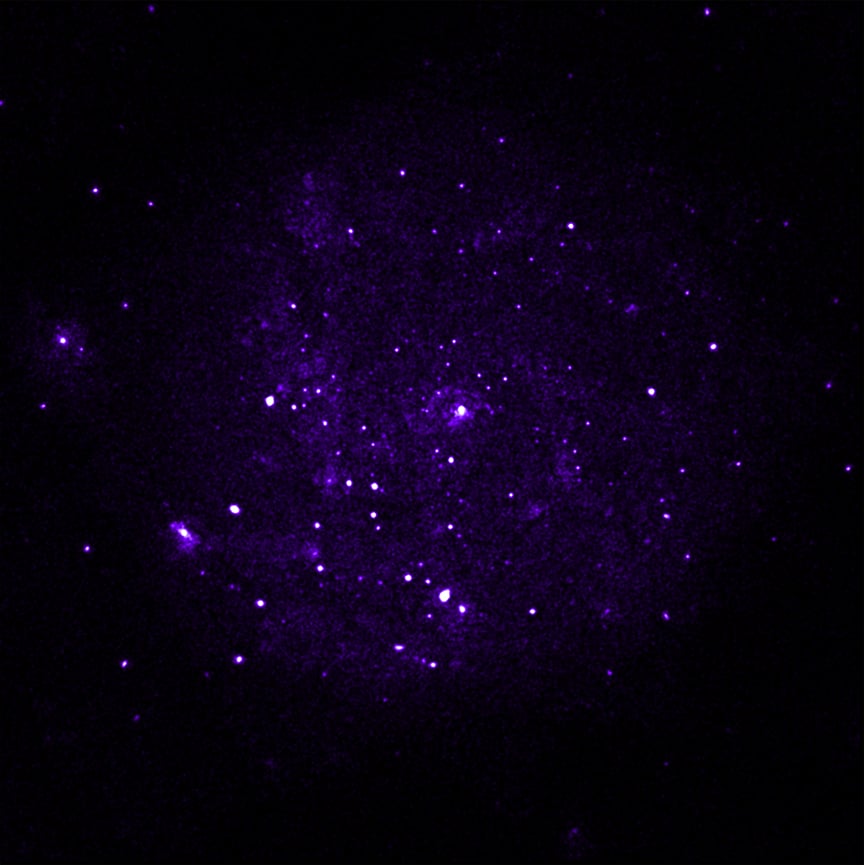
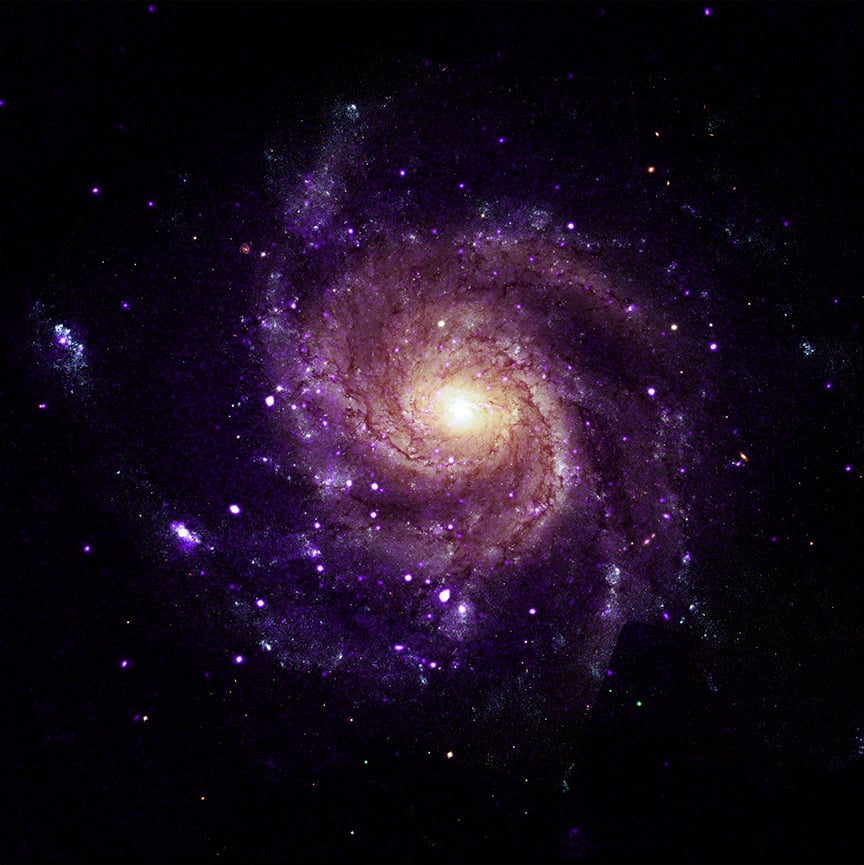
The new Chandra image shows M101, a face-on spiral galaxy. Its central region is surrounded by sweeping arms, with purple X-ray emission scattered across the galaxy. The optical part of the image comes from the Hubble Space Telescope, and Chandra supplies the X-ray data. Seven of the newly identified sources are marked with red circles.
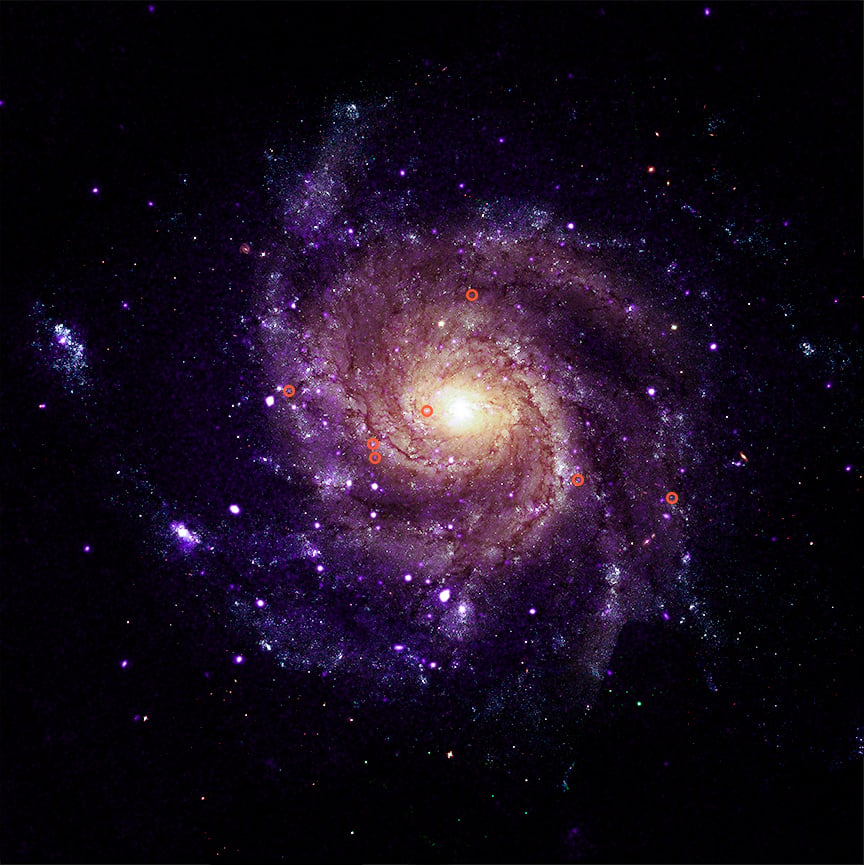
There is nothing visually unusual about these seven points in the picture. They look much like the other small sources scattered through the galaxy. The difference becomes apparent when astronomers sort the X-ray photons according to their energy.
The team searched for objects that showed up in Chandra’s lowest-energy images but disappeared when the researchers looked at higher-energy X-rays. This gave them a way to isolate sources with unusually soft spectra.
The same search was carried out in five other galaxies. The sample includes the Andromeda Galaxy, M31, along with M101. The remaining four targets are elliptical galaxies: NGC 3115, NGC 3379, NGC 4697, and NGC 4472. Together, the six galaxies produced 84 HSS candidates.
The X-rays are “soft”
Typical X-ray binaries produce much of their detectable emission above 0.3 keV. The newly identified sources sit below that boundary. Their strongest emission appears at energies between about 0.15 and 0.3 keV, and some are detected almost exclusively in that range. The researchers describe the objects as “hypersoft” because of this unusually low-energy emission.
That term does not mean the sources are cold. Their estimated temperatures can reach roughly 20 electron volts, or around 230,000 kelvins. The researchers’ models suggest that much of the radiation from these sources may actually emerge at even lower energies, in the extreme-ultraviolet part of the spectrum.
Extreme ultraviolet radiation is easily absorbed by hydrogen and helium. These elements fill the space between stars and can block the radiation before it travels very far. The gas effectively hides the strongest part of the sources’ emission from our telescopes.
Chandra can detect the higher-energy tail of the radiation. The amount that reaches the telescope may be a small fraction of the total energy produced by the source, but it can still reveal that something unusual is happening.
A binary star system could power them
The leading explanation starts with a binary star. Many X-ray binaries contain a compact object orbiting another star. The compact object can be a white dwarf, neutron star, or black hole. Its gravity pulls material away from the companion, and that material becomes hot as it falls inward.
The process can generate powerful X-ray emission. Astronomers have studied many such systems before. What sets the HSS population apart is the combination of strong luminosity, very soft X-rays, and an apparent peak in the extreme ultraviolet.
The researchers suggest that HSSs may include several physical types. Some could be accreting white dwarfs or systems that have recently experienced a nova. Others could contain accreting black holes. Neutron-star systems remain another possibility.
The study does not identify a single object responsible for every source. The name HSS describes how the sources behave in X-rays. It does not yet tell astronomers exactly what sits at the centre of each system.
Clear skies!
See more from DIYPhotography.net on Google
Add DIYPhotography.net as a trusted source. This makes
our stories more likely to appear in your Google Search results.
 Add as a preferred source on Google

Soumyadeep Mukherjee
Soumyadeep Mukherjee is an award-winning astrophotographer from India. He has a doctorate degree in Linguistics. His work extends to the sub-genres of nightscape, deep sky, solar, lunar and optical phenomenon photography. He is also a photography educator and has conducted numerous workshops. His works have appeared in over 40 books & magazines including Astronomy, BBC Sky at Night, Sky & Telescope among others, and in various websites including National Geographic, NASA, Forbes. He was the first Indian to win “Astronomy Photographer of the Year” award in a major category.




Join the Discussion
DIYP Comment Policy
Be nice, be on-topic, no personal information or flames.