





















Hubble and JWST Team Up to Capture the Heart of Messier 64
Apr 1, 2026
Soumyadeep Mukherjee
Soumyadeep Mukherjee is an award-winning astrophotographer from India. He has a doctorate degree in Linguistics. His work extends to the sub-genres of nightscape, deep sky, solar, lunar and optical phenomenon photography. He is also a photography educator and has conducted numerous workshops. His works have appeared in over 40 books & magazines including Astronomy, BBC Sky at Night, Sky & Telescope among others, and in various websites including National Geographic, NASA, Forbes. He was the first Indian to win “Astronomy Photographer of the Year” award in a major category.
Share:
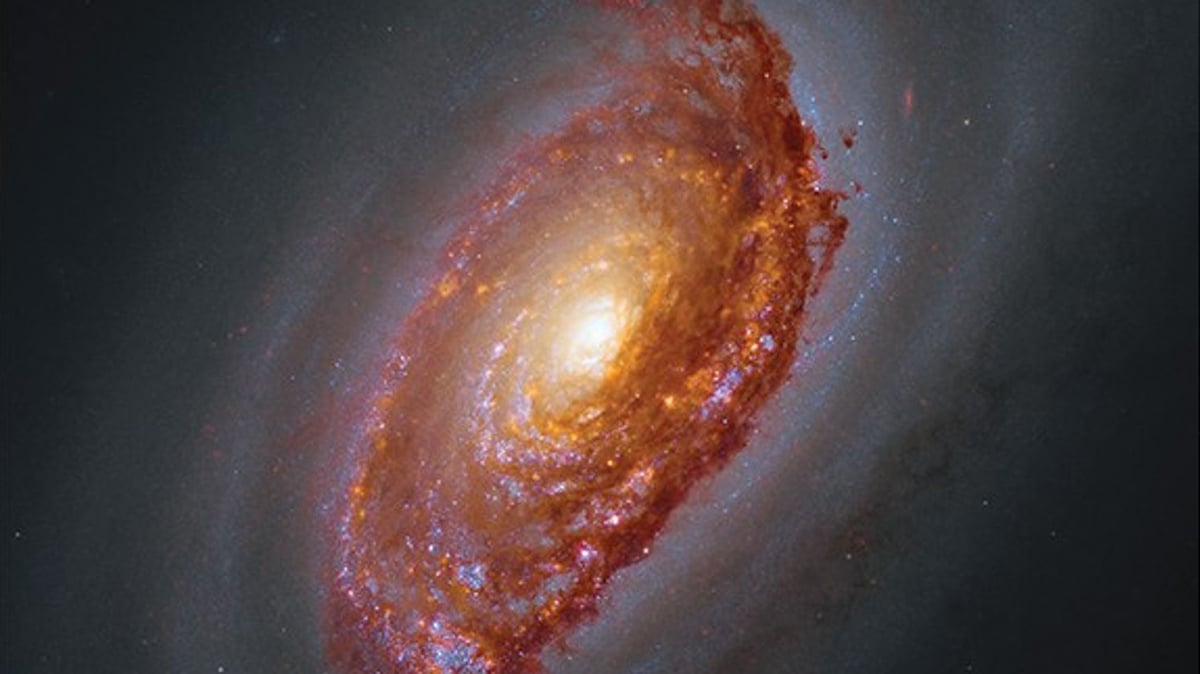
Astronomers study nearby spiral galaxies to understand how mergers reshape disk structure and regulate star formation across cosmic time. One of the best laboratories for this work lies only about 17 million light-years away. The spiral galaxy Messier 64, widely known as the Black Eye Galaxy, contains a rare counter-rotating gas disk and a prominent central dust lane that records the signature of an ancient interaction.
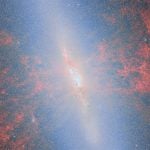
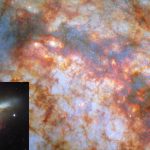
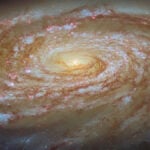
A new multi-wavelength composite image assembled from observations by the Hubble Space Telescope and the James Webb Space Telescope reveals this structure with exceptional clarity. This image was released as a part of NASA‘s Messier Marathon 2026. The combined dataset allows astronomers to examine stellar populations, obscuring dust, and gas motion within a single integrated view.
A nearby spiral galaxy with an unusual central structure
Messier 64 lies in the constellation Coma Berenices, where it appears as a compact but bright spiral galaxy through moderate telescopes. Observers have long noticed its luminous central bulge. However, they have also seen a sharp dust feature cutting across one side of that nucleus. This dark structure gives the galaxy its familiar nickname and continues to define its appearance in visual observations.
Astronomers now understand that this feature represents a dense concentration of interstellar dust rather than an absence of stars. The dust absorbs visible light efficiently. Consequently, it produces the strong contrast that makes the central region look partially obscured. At the same time, the dust lane marks an active environment where gas collects, and new stars form.
Earlier ground-based observations revealed only the surface geometry of this structure. Later, space-based imaging began to resolve finer detail across the nucleus. Now, the combination of visible and infrared observations from Hubble and JWST provides a far more complete picture of the material distribution within the inner disk. This improvement allows researchers to connect the dust lane with the galaxy’s unusual internal motion.
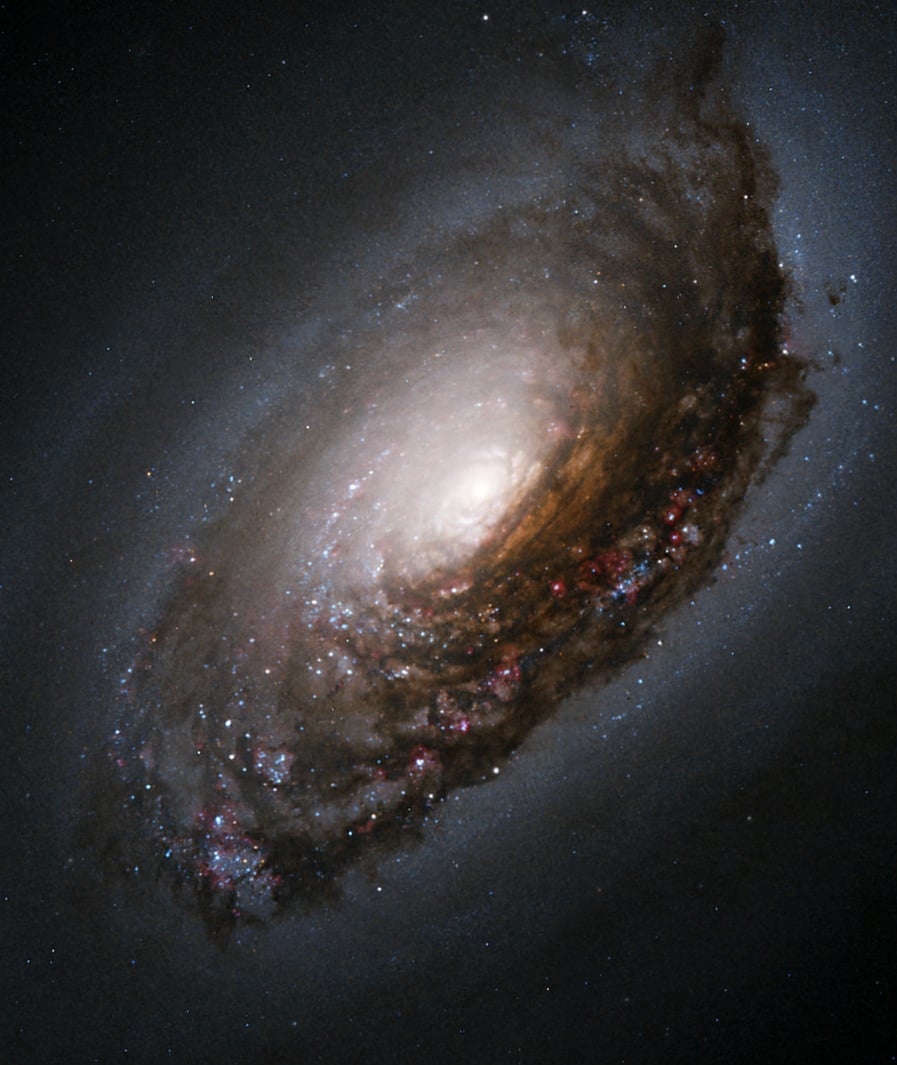
The new Hubble–JWST composite image
Multi-wavelength imaging plays a central role in galaxy studies. Different wavelengths trace different physical processes. Visible light reveals exposed stellar populations and ionized gas clouds. Infrared light penetrates dust and detects embedded star-forming regions that remain hidden in optical observations. By combining both regimes, astronomers can reconstruct a more accurate map of internal structure.
The new composite image of Messier 64 follows this. Hubble observations highlight clusters of young blue stars distributed across the inner disk. They also trace glowing hydrogen gas surrounding newly formed stellar associations. Meanwhile, JWST observations reveal cooler dust and deeply embedded stellar nurseries inside the prominent absorption lane.
These observations show that the dust feature does not simply block light from the nucleus. Instead, it represents a complex layer of gas and dust interacting with the surrounding disk. This realization strengthens earlier evidence that the galaxy experienced a merger in the distant past. It also shows that the interaction continues to influence the current distribution of gas and star formation.
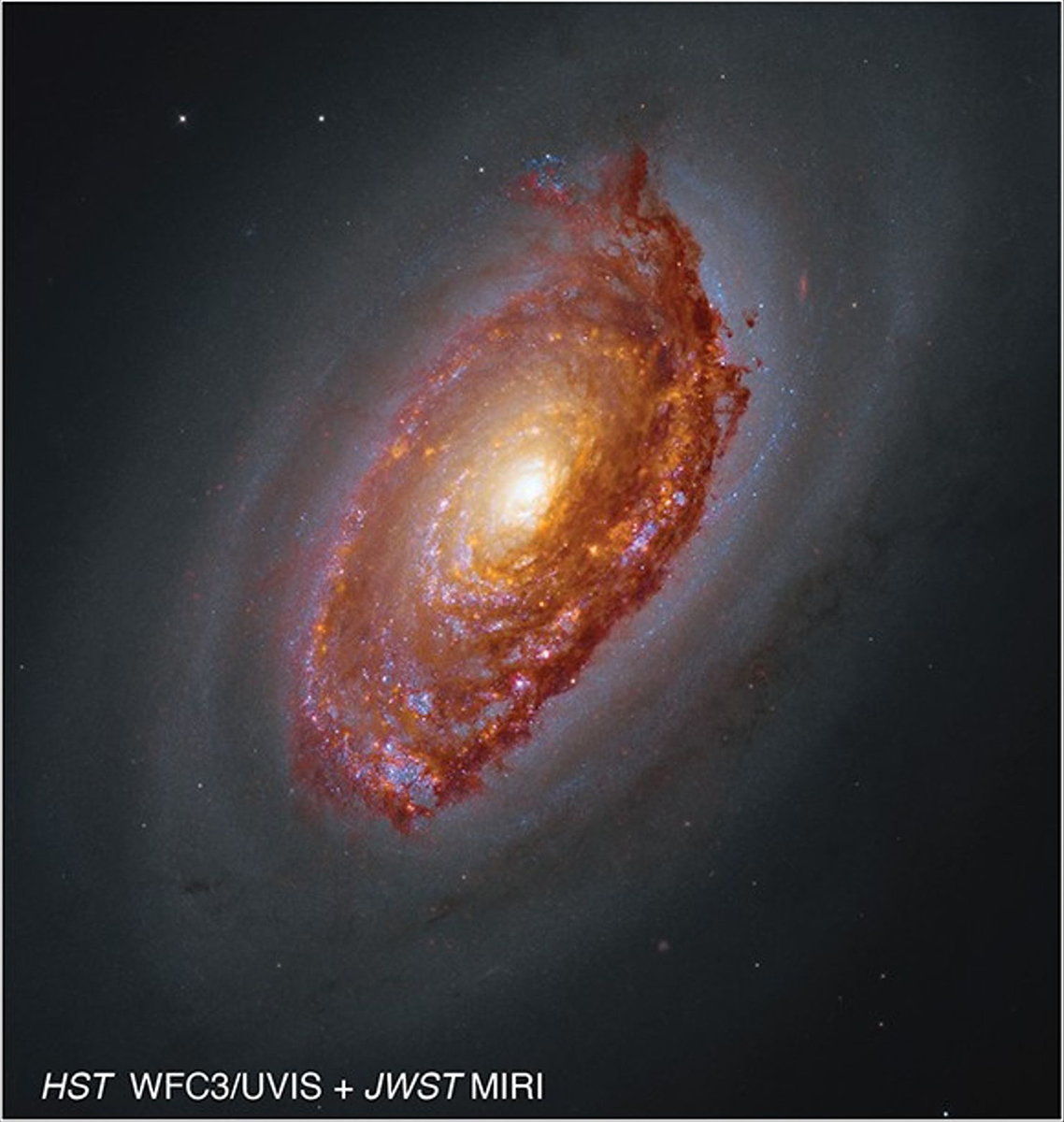
Counter-rotating gas reveals the signature of a past merger
Most spiral galaxies display ordered rotation across their disks. Gas and stars generally orbit the center in the same direction. Messier 64, however, behaves differently. Observations show that gas in the outer disk rotates opposite to gas and stars in the inner region. Astronomers refer to this configuration as counter-rotation. It remains rare among nearby spiral systems.
This unusual motion provides strong evidence for a past interaction with a smaller companion galaxy. During such an encounter, incoming material can enter the disk with a different angular momentum direction. Over time, that material settles into orbit but retains its original rotational sense. The result appears as a counter-rotating outer layer surrounding a normally rotating inner disk.
In Messier 64, the boundary between these two regions still exists today. Gas moving in opposite directions meets along that interface. As a result, the interaction zone becomes dynamically active. Compression occurs there as clouds collide. That compression triggers star formation across the boundary.
The new Hubble and JWST observations strengthen this interpretation because they reveal both exposed and obscured star-forming regions along the interaction zone. These regions trace the location where the counter-rotating components continue to influence the galaxy’s structure.
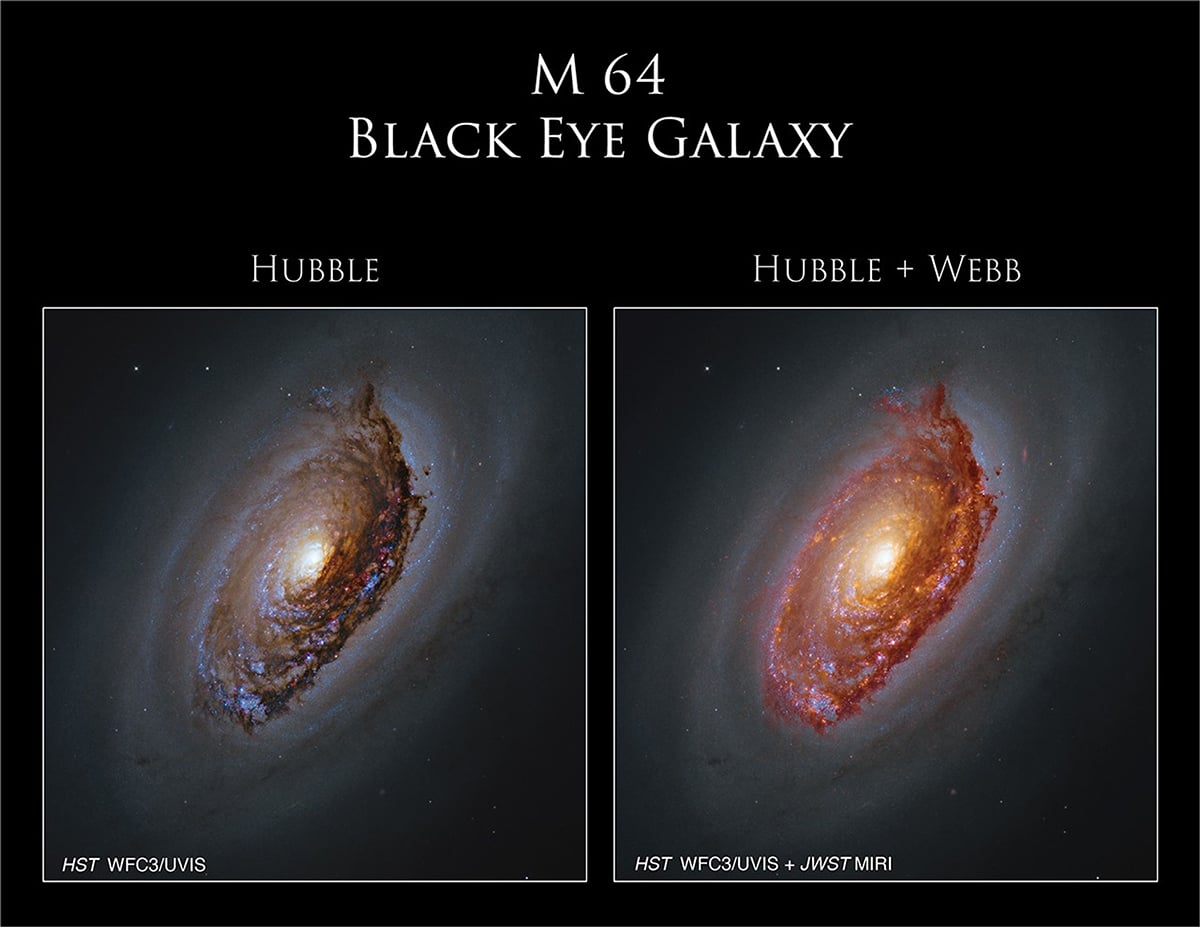
Star formation continues along the rotational boundary
Gas compression plays a role in the formation of new stars. When gas clouds collide or slow relative to each other, their density increases. Gravity then pulls material inward, and star formation begins. Messier 64 provides an example of this process.
Young stellar clusters appear along the region where the two rotating gas systems meet. Many of these clusters shine strongly in visible wavelengths. Others remain hidden within dense dust clouds that absorb optical light. Here, the combined Hubble and JWST observations become especially valuable.
Hubble reveals the exposed stellar populations that have already cleared their surrounding gas. JWST detects younger clusters still embedded within their birth clouds. These observations show that star formation continues across multiple stages within the same interaction zone.
This layered structure shows that the ancient merger continues to shape the distribution of star formation today. Messier 64 provides an accessible example of how minor mergers sustain star-forming activity across long timescales.
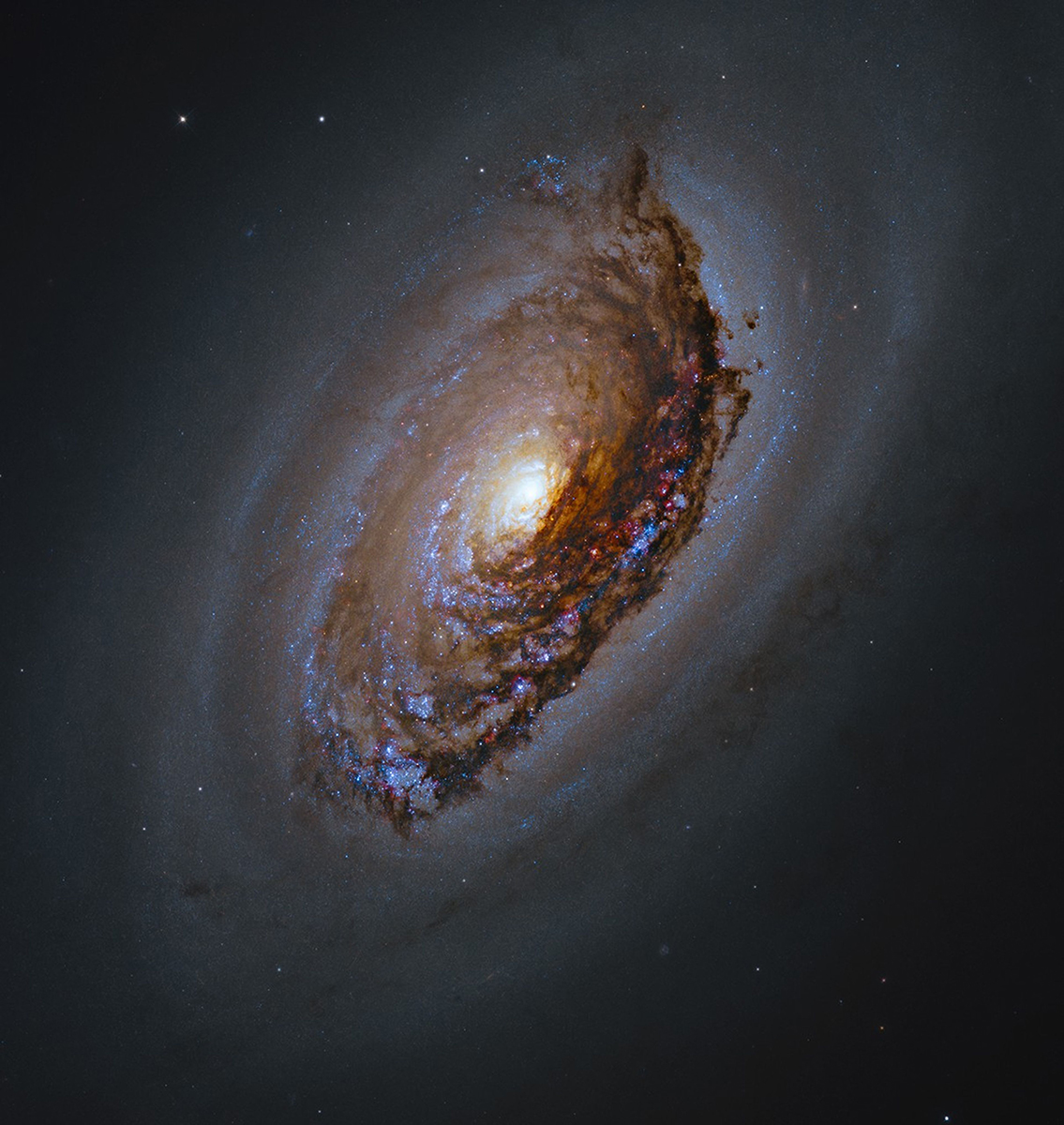
Clear skies!
See more from DIYPhotography.net on Google
Add DIYPhotography.net as a trusted source. This makes
our stories more likely to appear in your Google Search results.
 Add as a preferred source on Google

Soumyadeep Mukherjee
Soumyadeep Mukherjee is an award-winning astrophotographer from India. He has a doctorate degree in Linguistics. His work extends to the sub-genres of nightscape, deep sky, solar, lunar and optical phenomenon photography. He is also a photography educator and has conducted numerous workshops. His works have appeared in over 40 books & magazines including Astronomy, BBC Sky at Night, Sky & Telescope among others, and in various websites including National Geographic, NASA, Forbes. He was the first Indian to win “Astronomy Photographer of the Year” award in a major category.

Join the Discussion
DIYP Comment Policy
Be nice, be on-topic, no personal information or flames.