



















Hubble Photographs 25 Years of Expansion in the Crab Nebula
Mar 24, 2026
Soumyadeep Mukherjee
Soumyadeep Mukherjee is an award-winning astrophotographer from India. He has a doctorate degree in Linguistics. His work extends to the sub-genres of nightscape, deep sky, solar, lunar and optical phenomenon photography. He is also a photography educator and has conducted numerous workshops. His works have appeared in over 40 books & magazines including Astronomy, BBC Sky at Night, Sky & Telescope among others, and in various websites including National Geographic, NASA, Forbes. He was the first Indian to win “Astronomy Photographer of the Year” award in a major category.
Share:
For nearly a thousand years, the Crab Nebula has expanded slowly across space. Astronomers have studied it for centuries. Yet very recently, we can clearly watch its motion unfold across decades. The results provide new insight into the structure, motion, and energy flow inside one of the most important objects in modern astronomy.
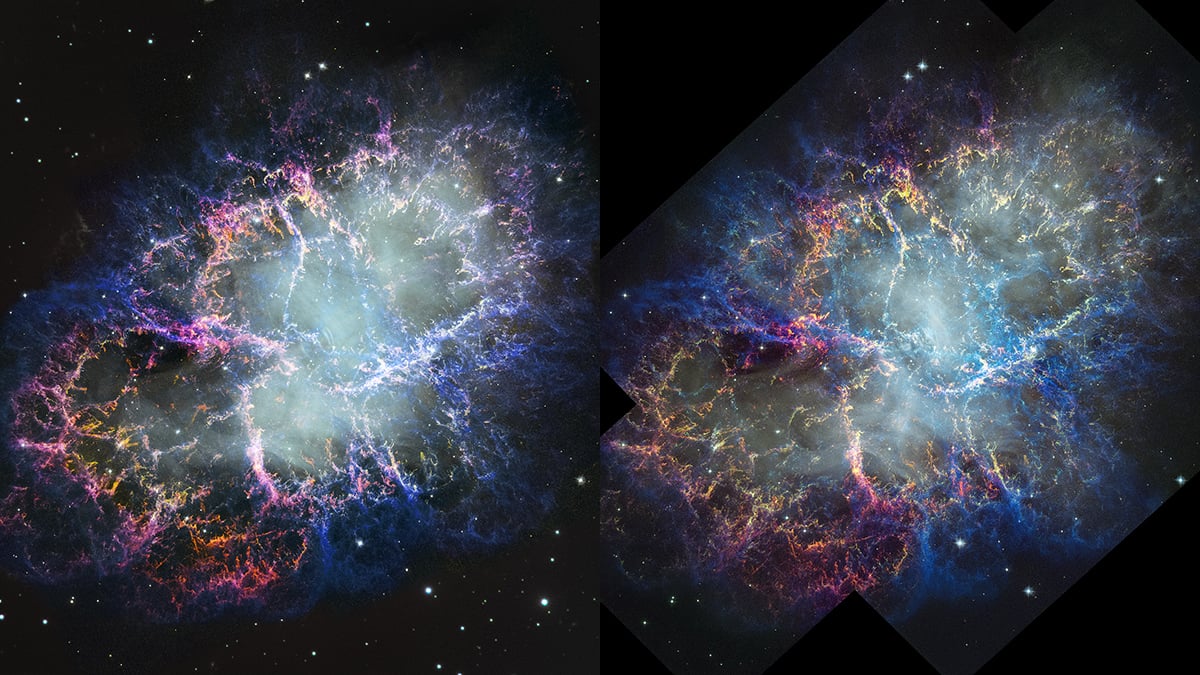
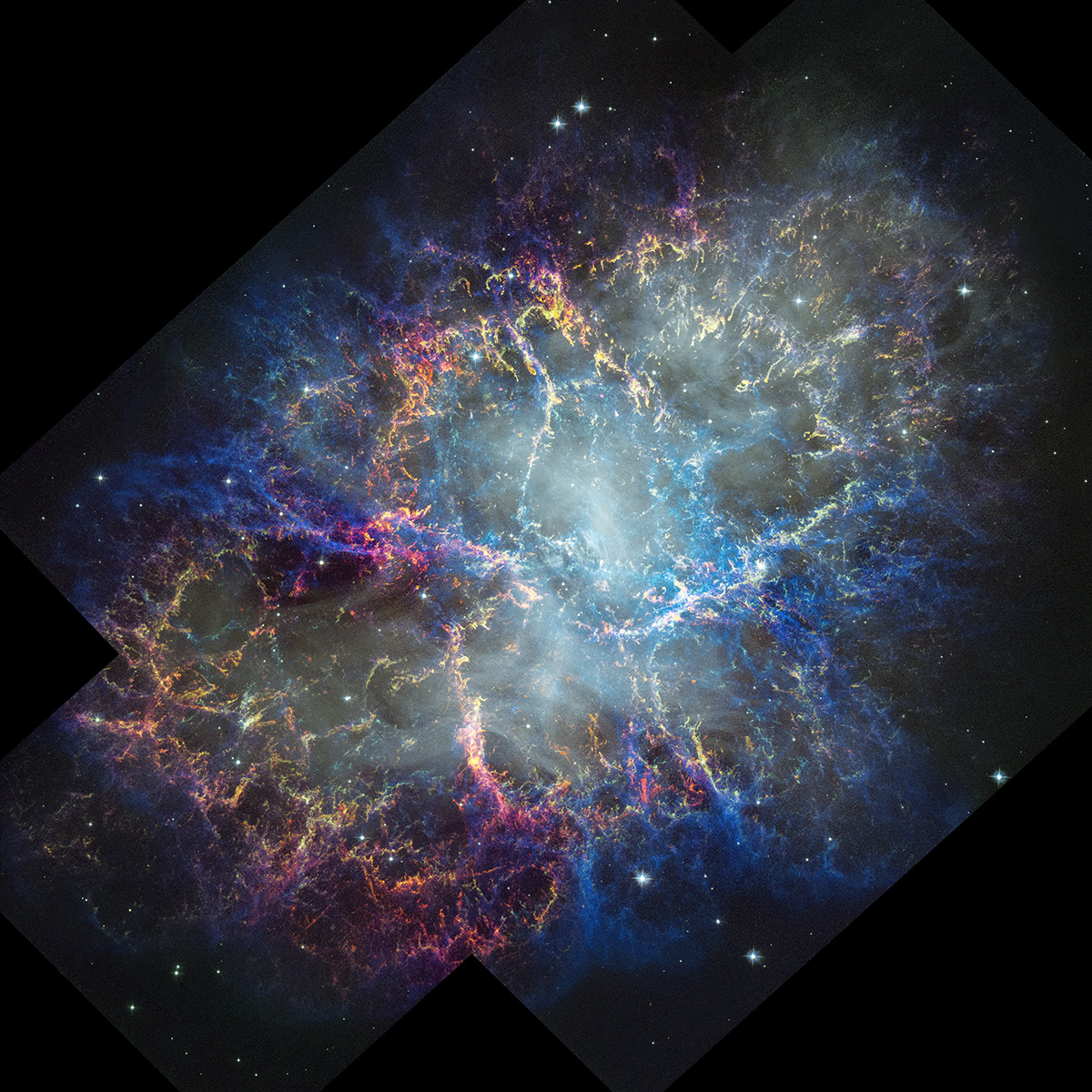
A new comparison of full-field observations of the Crab Nebula by the Hubble Space Telescope, obtained in 1999 and again in 2024, now provides one of the clearest demonstrations of such long-term evolution in a pulsar-powered remnant. These observations strengthen the Crab Nebula’s role as a benchmark laboratory for studying the interaction between neutron stars and supernova ejecta over century-long timescales.
A supernova recorded nearly a thousand years ago
The Crab Nebula formed during a stellar explosion observed in the year 1054. Historical records from East Asia describe a bright “guest star” that remained visible in daylight for several weeks. Modern astronomy has confirmed that this event marked the collapse of a massive star that produced a neutron star at its center and expelled large amounts of material into space.
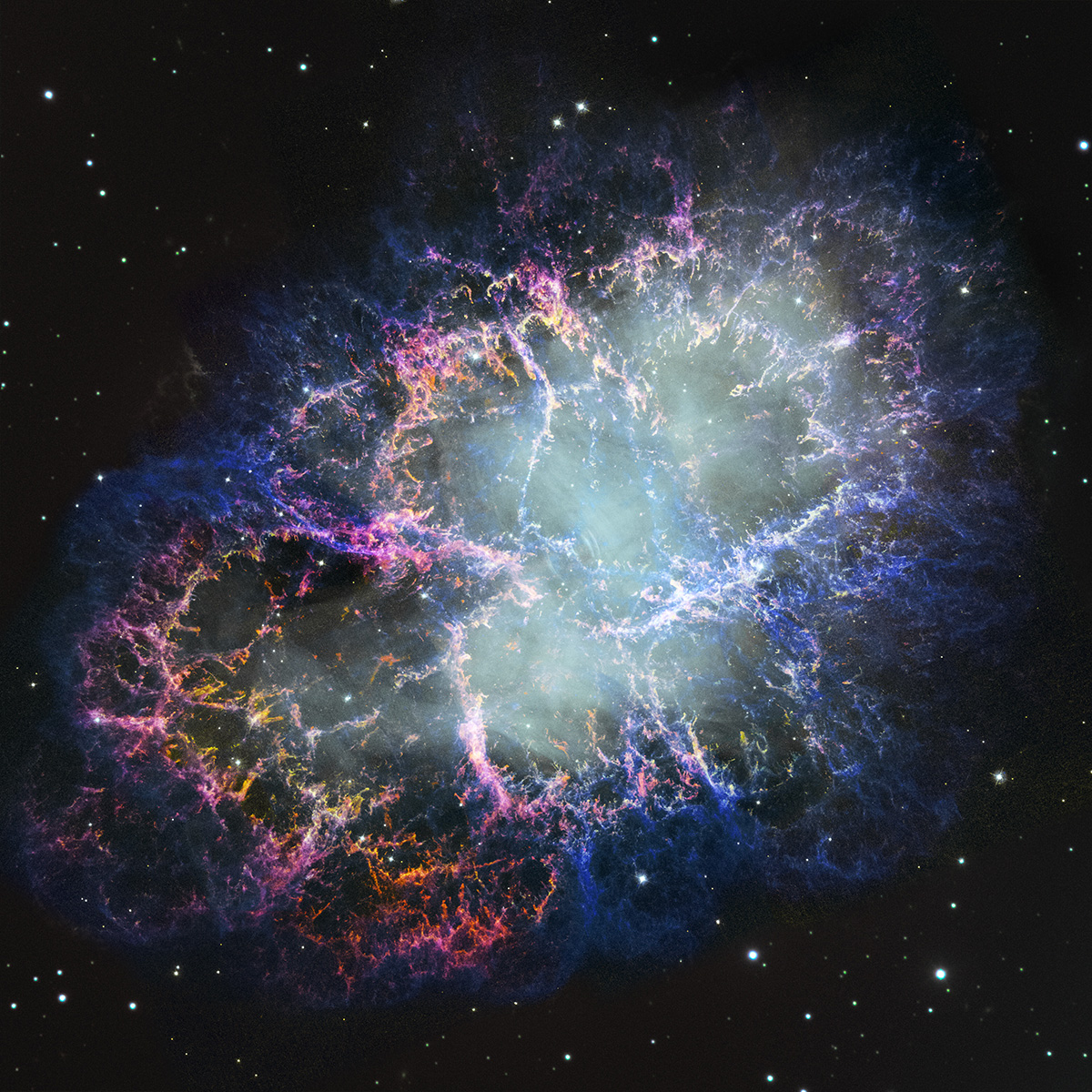
Today, the remnant lies about 6,500 light-years from Earth in the constellation Taurus. It extends roughly 11 light-years across and continues to expand outward as the debris cloud evolves. The nebula contains chemically enriched material produced during the life and explosion of the progenitor star. Observations detect emission from hydrogen, helium, carbon, nitrogen, oxygen, sulfur, and iron within its filamentary structure.
At the center of the nebula sits the Crab Pulsar. This compact neutron star rotates approximately 30 times each second and releases a continuous flow of energetic particles into its surroundings. As a result, the Crab Nebula differs from many classical supernova remnants. Instead of fading gradually after the initial explosion shockwave weakens; it remains strongly influenced by energy injected from the pulsar. Consequently, astronomers classify it as a pulsar wind nebula rather than a shell-dominated remnant.
Measuring motion across a quarter century
Astronomical structures usually evolve too slowly for motion to be detected within a single human lifetime. However, the Crab Nebula expands rapidly enough that precise measurements can reveal changes over only a few decades. The Hubble Space Telescope first produced a complete high-resolution mosaic of the nebula in 1999 using the Wide Field and Planetary Camera 2. Astronomers then repeated the observation in 2024 with the Wide Field Camera 3.
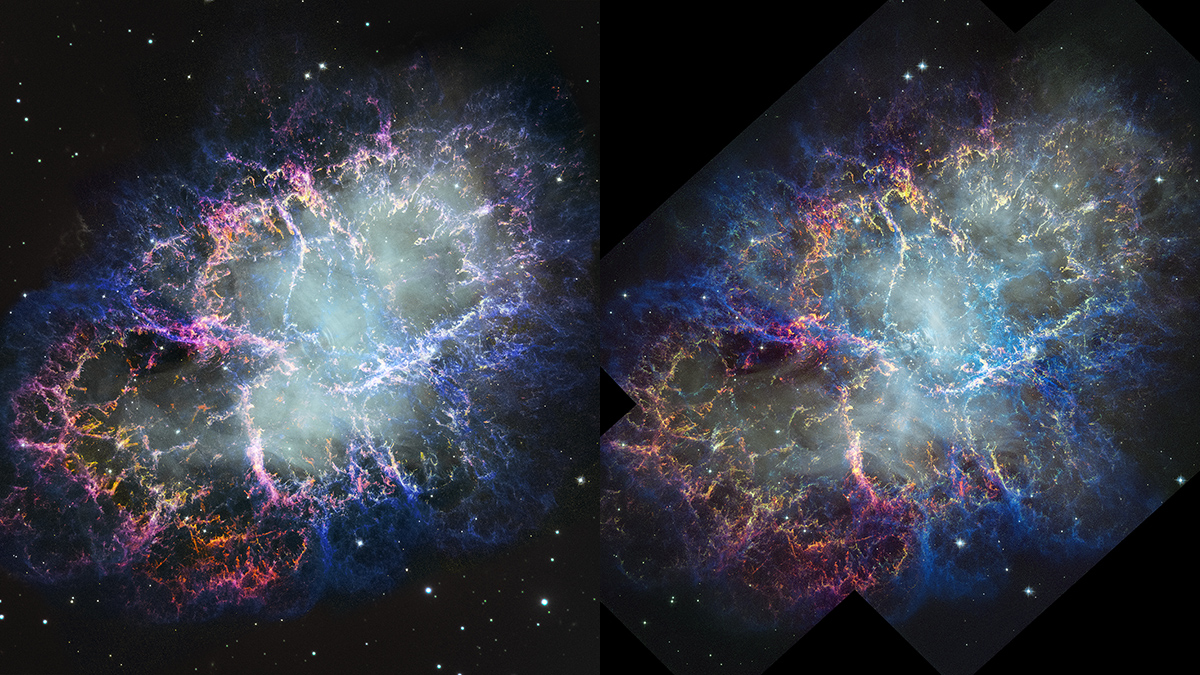
Because both instruments observed the nebula using matched filters, researchers could compare the two datasets. This comparison revealed measurable outward displacement of many filamentary structures across the nebula. Some filaments moved at speeds approaching 3.4 million miles per hour. Although the motion appears small in telescope images, it becomes clearly detectable when observations separated by 25 years are aligned with high precision.
Such measurements are extremely valuable for understanding the physical evolution of supernova remnants. They provide direct observational constraints on expansion rates instead of relying only on theoretical reconstruction. Moreover, they allow astronomers to test models that describe how pulsar winds interact with surrounding ejecta over long periods of time.
The analysis also benefited from modern processing techniques applied to the original 1999 observations. Improved calibration and image alignment increased the accuracy of the comparison and revealed structural changes that earlier studies could not measure with the same confidence. As a result, the new dataset provides one of the most detailed time-baseline expansion measurements ever obtained for a pulsar wind nebula.
Continued energy injection from the central pulsar
The Crab Nebula continues to expand primarily because of the energy supplied by its central neutron star. The Crab Pulsar produces a powerful wind of relativistic charged particles that flows outward into the surrounding ejecta. This pulsar wind interacts with magnetic fields inside the nebula and generates strong synchrotron radiation that dominates the emission seen in optical and high-energy observations.
This process explains why the nebula still evolves actively nearly one thousand years after the original explosion. Instead of behaving like a typical shock-driven remnant, the Crab Nebula forms a magnetized bubble powered by continuous particle injection from the pulsar. The outward pressure of this particle wind pushes against the surrounding filaments and drives their expansion.
The comparison between the 1999 and 2024 images provides important observational confirmation of this mechanism. The filaments shift outward as coherent structures rather than stretching apart significantly. This behavior matches expectations for a pulsar-driven expansion environment. It also indicates that magnetic pressure and particle flow from the neutron star continue to shape the nebula’s structure on large spatial scales.
Furthermore, the persistence of synchrotron emission across the nebula demonstrates that relativistic particles remain distributed throughout the expanding cloud. These particles trace the energy transport process that links the central pulsar to the outer filamentary boundary.
Revealing the Nebula’s Three-Dimensional Geometry
Determining the three-dimensional structure of a supernova remnant remains a challenging task because telescope images provide only two-dimensional projections on the sky. However, the long-baseline Hubble comparison offers new clues that help reconstruct the internal geometry of the Crab Nebula.
Some filaments appear in front of the bright synchrotron background and therefore cast visible shadows against the emission behind them. Other filaments produce no such shadows, indicating that they lie farther from the observer along the line of sight. By identifying these positional differences, astronomers can estimate the relative placement of structures within the expanding cloud.
In addition, the comparison reveals that outer filaments moved more strongly than those located closer to the central region. This pattern reflects how the pulsar wind transfers energy through the nebula over time. Regions near the boundary respond differently to this energy flow than regions closer to the center.
These observations help refine models that describe how the pulsar wind bubble interacts with the surrounding ejecta. They also improve estimates of the density distribution and magnetic structure inside the nebula. As a result, astronomers can now reconstruct the spatial organization of the remnant with greater confidence than before.
Clear skies!
See more from DIYPhotography.net on Google
Add DIYPhotography.net as a trusted source. This makes
our stories more likely to appear in your Google Search results.
 Add as a preferred source on Google

Soumyadeep Mukherjee
Soumyadeep Mukherjee is an award-winning astrophotographer from India. He has a doctorate degree in Linguistics. His work extends to the sub-genres of nightscape, deep sky, solar, lunar and optical phenomenon photography. He is also a photography educator and has conducted numerous workshops. His works have appeared in over 40 books & magazines including Astronomy, BBC Sky at Night, Sky & Telescope among others, and in various websites including National Geographic, NASA, Forbes. He was the first Indian to win “Astronomy Photographer of the Year” award in a major category.


Join the Discussion
DIYP Comment Policy
Be nice, be on-topic, no personal information or flames.