

















JWST Celebrates Three Years of Science: The Cat’s Paw Nebula
Jul 10, 2025
Soumyadeep Mukherjee
Soumyadeep Mukherjee is an award-winning astrophotographer from India. He has a doctorate degree in Linguistics. His work extends to the sub-genres of nightscape, deep sky, solar, lunar and optical phenomenon photography. He is also a photography educator and has conducted numerous workshops. His works have appeared in over 40 books & magazines including Astronomy, BBC Sky at Night, Sky & Telescope among others, and in various websites including National Geographic, NASA, Forbes. He was the first Indian to win “Astronomy Photographer of the Year” award in a major category.
Share:

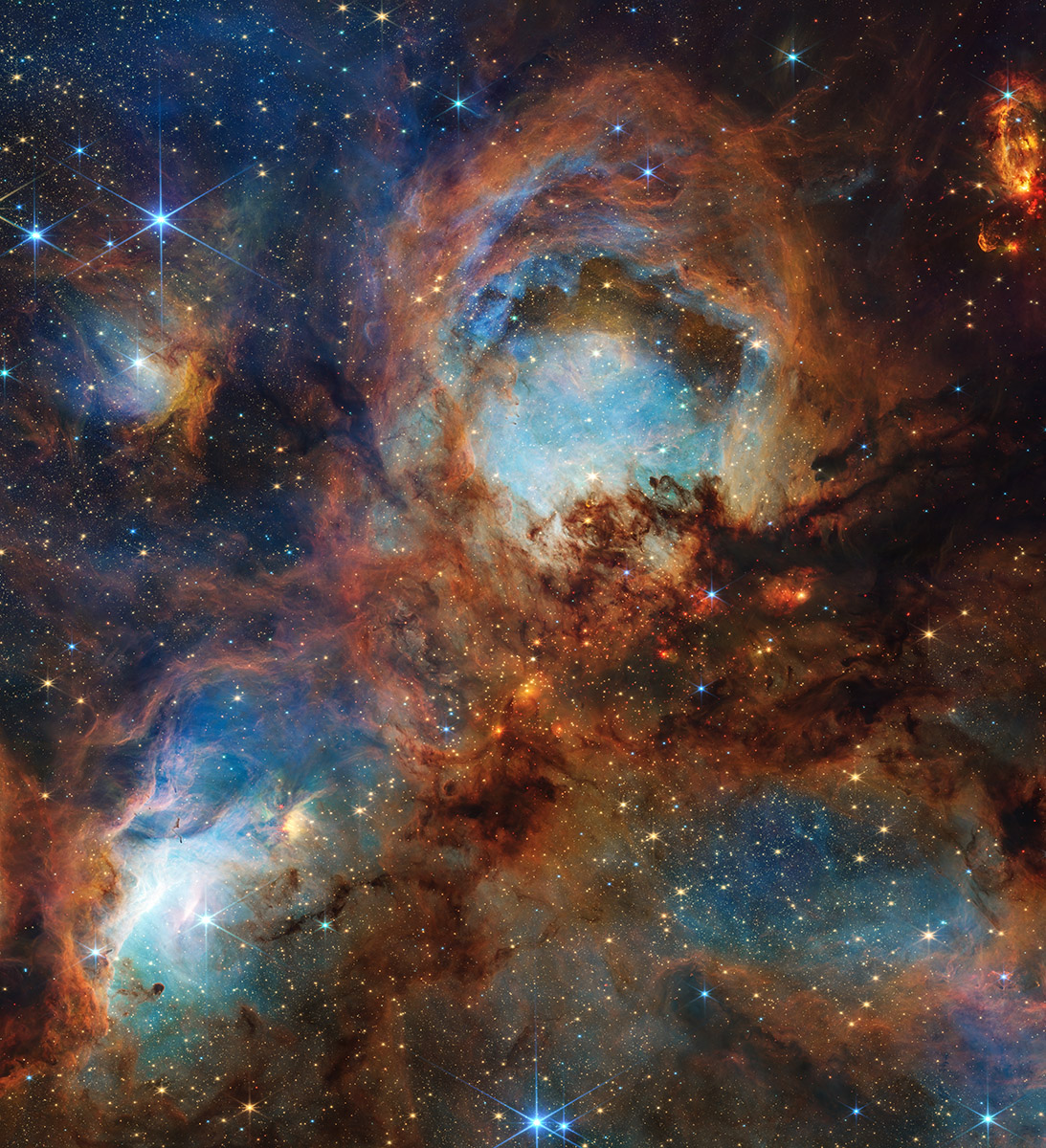
On July 10, 2025, NASA and ESA celebrated the third anniversary of full science operations of the James Webb Space Telescope (JWST). To mark the occasion, JWST released a breathtaking new image. It shows a deep infrared view of the famous Cat’s Paw Nebula (NGC 6334). This image is not only beautiful, but it is packed with scientific information. It reveals details about how stars are born and how they shape their surroundings.
The Cat’s Paw nebula: A quick overview
NGC 6334 is located about 5,500 light-years away in the constellation Scorpius. It is a huge cloud of gas and dust, stretching over 50 light-years. Its nickname, the Cat’s Paw, comes from its shape. In visible light, parts of the nebula resemble the pads of a feline paw. This nebula is one of the most active star-forming regions in our galaxy. It contains thousands of young stars, some still forming inside thick clouds of dust. Until now, these stars were hidden from view. But JWST’s infrared eyes can see through the dust.
The new JWST image
JWST’s image goes beyond what we’ve ever seen before in the Cat’s Paw Nebula. Using its powerful infrared instruments, JWST captured details that were invisible to Hubble or ground-based telescopes. The image shows a stunning array of bright stars, glowing gas, dark dust lanes, and compact objects. One standout feature is what scientists are playfully calling “toe beans.” These are small, dense knots of gas and dust. They look cute, but they are also scientifically important. They represent sites of active star formation, where gravity is pulling material together to form new stars.
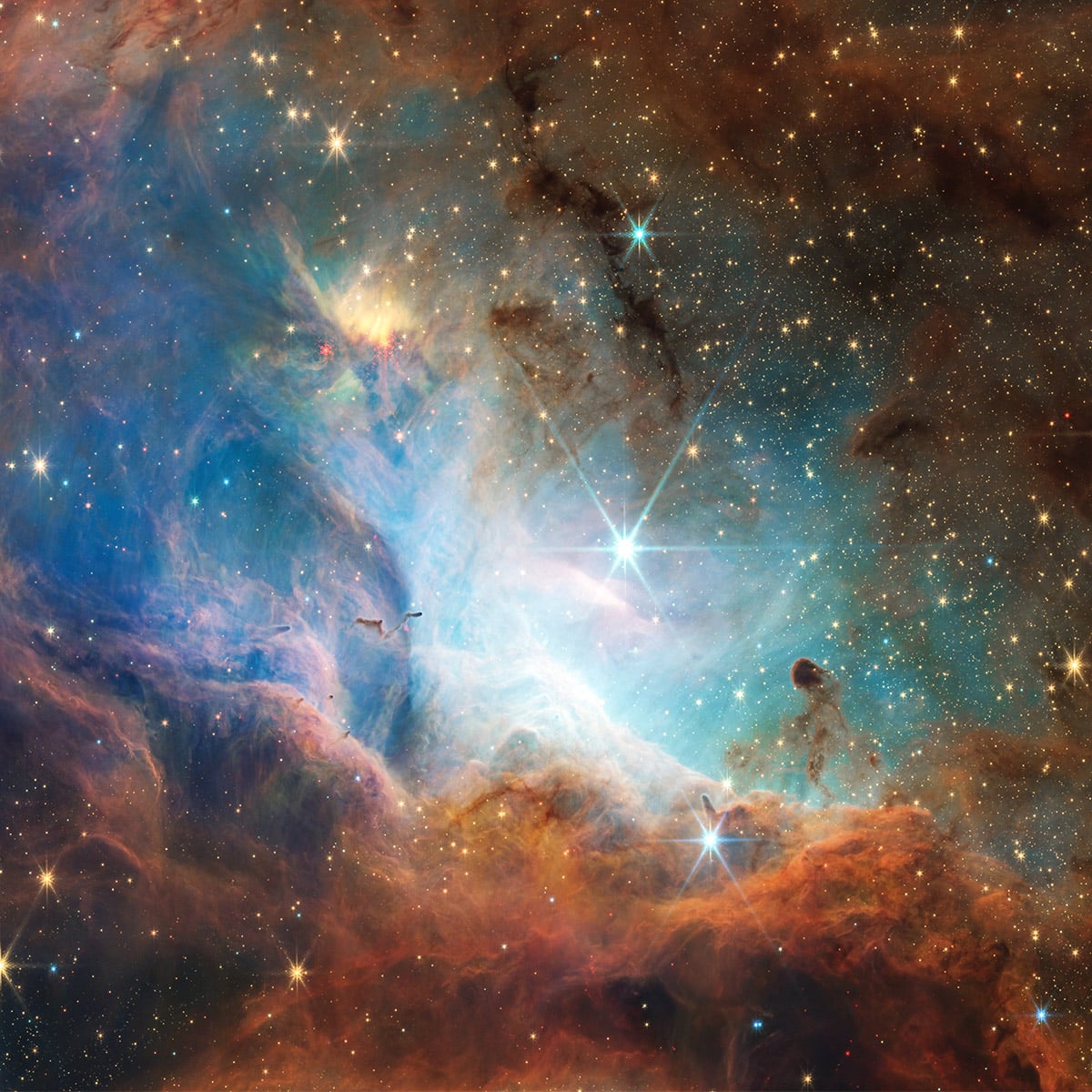
To capture this view, JWST used its Near-Infrared Camera (NIRCam). This instrument is designed to see deep into star-forming regions. NIRCam can detect cool stars, dusty filaments, and even jets of gas released by forming stars. In this image, NIRCam reveals multiple layers of the nebula. You can see large cavities carved by stellar winds and jets. There are also glowing ridges of gas, shaped by the energy of newborn stars. Some stars appear surrounded by disks of dust, and these may eventually form planets.
The Cat’s Paw Nebula is full of dust. That dust blocks visible light. Traditional telescopes like Hubble can only see the outer edges. But JWST’s infrared instruments can peer through the dust. This is what makes the new image so groundbreaking. Infrared light travels more easily through thick clouds. It also allows scientists to study cooler objects, such as newborn stars and dust filaments. This gives a more complete view of what’s happening inside the nebula.
Young stars and stellar nurseries
JWST’s new view reveals many protostars, baby stars still in the process of forming. These stars are deeply embedded in dust clouds. In visible light, they are completely hidden. But in infrared, they shine brightly. JWST captures their heat and light as they emerge from their birth cocoons. Some of these young stars are already changing their surroundings. They emit strong winds and jets of gas. These outflows create bubbles and cavities in the surrounding material. Over time, this process reshapes the nebula. It also helps regulate how many new stars can form.
A celebration of three years of science
The Cat’s Paw image marks a major milestone for the James Webb Space Telescope. Since July 2022, JWST has transformed our understanding of the universe. In just three years, it has:
- Captured the most distant galaxies ever seen
- Studied the atmospheres of exoplanets
- Explored star nurseries and planetary systems
- Observed black holes and active galactic nuclei
- Revealed fine details in local galaxies and nebulae
This new image is a perfect way to celebrate that legacy. It shows that JWST is not slowing down. In fact, it’s just getting started.
The new JWST image of the Cat’s Paw Nebula is a window into the heart of a star-forming region. It reveals dense knots, newborn stars, and the powerful effects of stellar feedback. It shows us the process of star birth in stunning clarity. JWST’s infrared vision has changed the way we see the universe. As we celebrate three years of science, this image reminds us of what’s possible. The universe is full of wonders. And with JWST, we’re seeing them like never before.
Clear skies!
See more from DIYPhotography.net on Google
Add DIYPhotography.net as a trusted source. This makes
our stories more likely to appear in your Google Search results.
 Add as a preferred source on Google

Soumyadeep Mukherjee
Soumyadeep Mukherjee is an award-winning astrophotographer from India. He has a doctorate degree in Linguistics. His work extends to the sub-genres of nightscape, deep sky, solar, lunar and optical phenomenon photography. He is also a photography educator and has conducted numerous workshops. His works have appeared in over 40 books & magazines including Astronomy, BBC Sky at Night, Sky & Telescope among others, and in various websites including National Geographic, NASA, Forbes. He was the first Indian to win “Astronomy Photographer of the Year” award in a major category.
Related Posts
 Quasar Science launches their new “Advanced Color Science” Rainbow Series RGBX tube LED lights
 Endocrine Images Art Competition Celebrates Stunning Intersection of Science and Art
 Missed the eclipse? Spain will have three for three consecutive years
 ESO’s VST Celebrates 15th Anniversary with Gum 10 Nebula Image
Join the Discussion
DIYP Comment Policy
Be nice, be on-topic, no personal information or flames.