






















A Cosmic Heart: Chandra’s X-Ray View of the Cocoon Nebula
Feb 12, 2026
Soumyadeep Mukherjee
Soumyadeep Mukherjee is an award-winning astrophotographer from India. He has a doctorate degree in Linguistics. His work extends to the sub-genres of nightscape, deep sky, solar, lunar and optical phenomenon photography. He is also a photography educator and has conducted numerous workshops. His works have appeared in over 40 books & magazines including Astronomy, BBC Sky at Night, Sky & Telescope among others, and in various websites including National Geographic, NASA, Forbes. He was the first Indian to win “Astronomy Photographer of the Year” award in a major category.
Share:
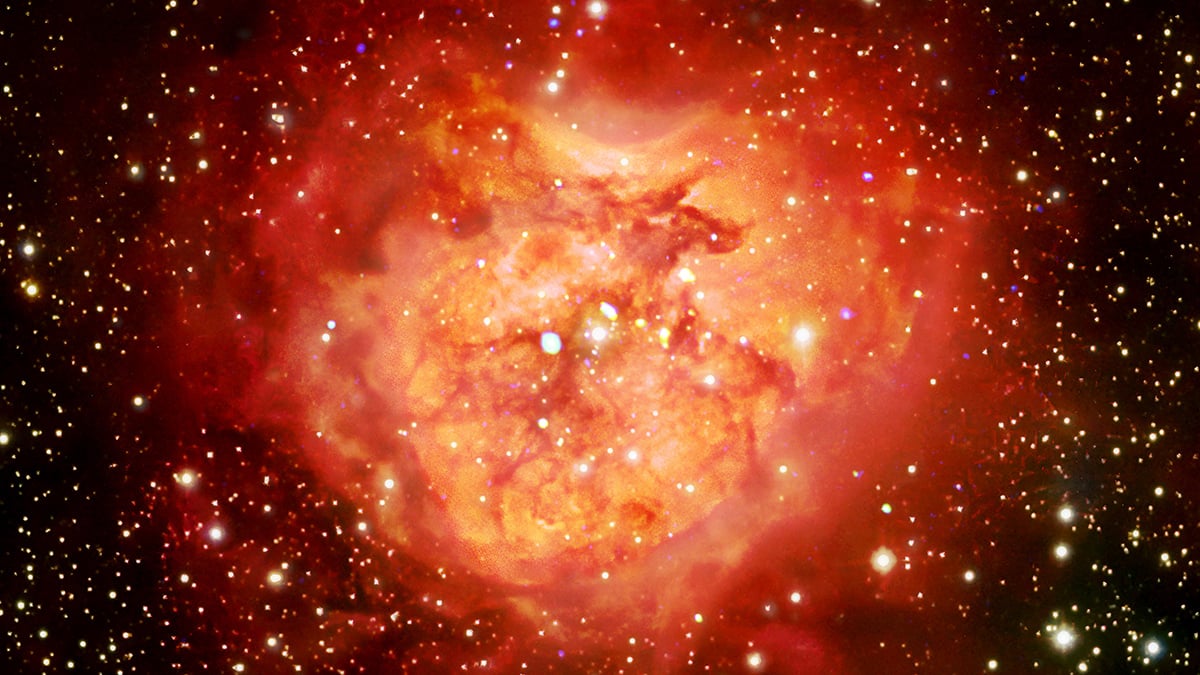
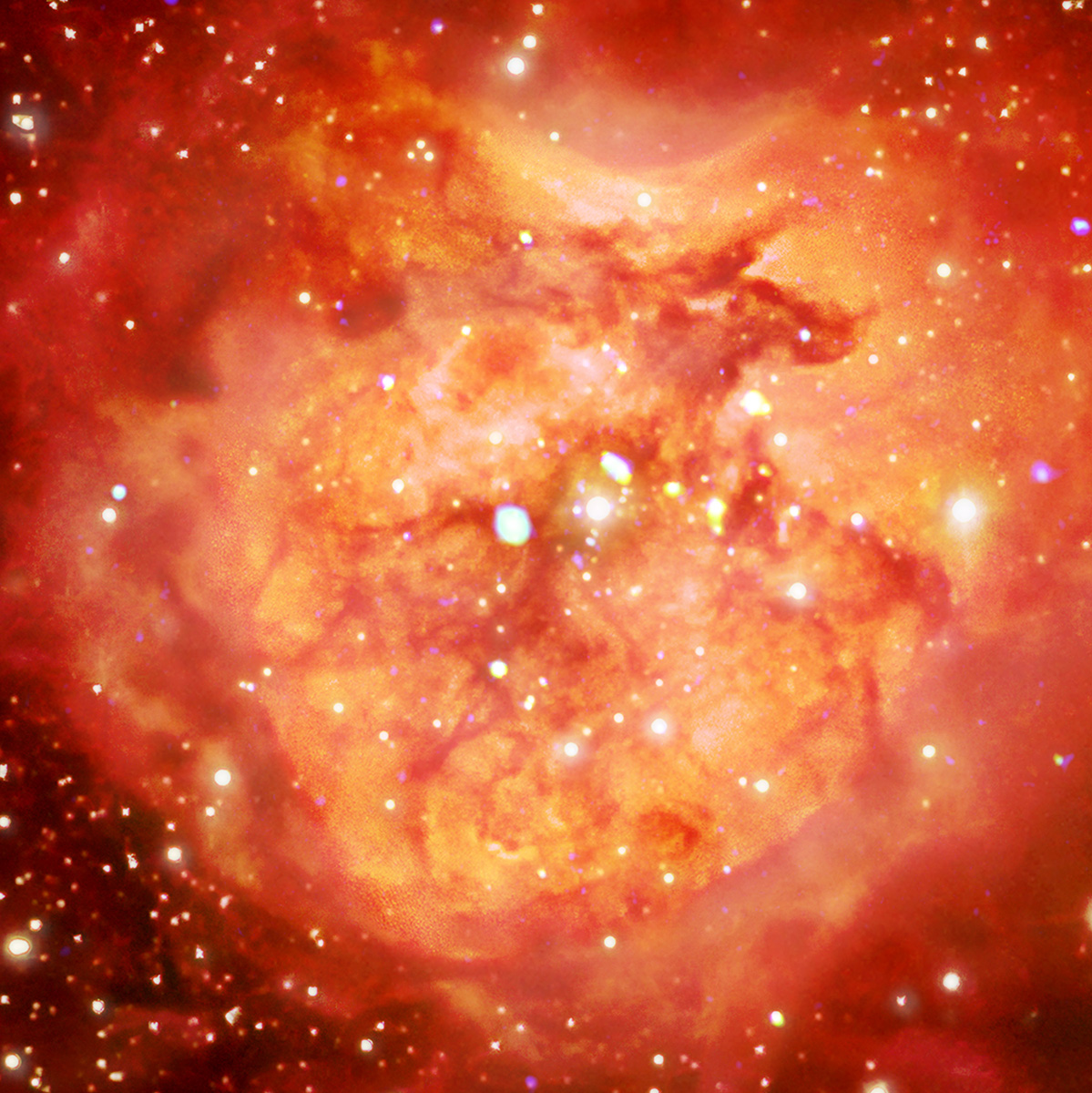
NASA has released a new composite image of the Cocoon Nebula (IC 5146) using data from the Chandra X-ray Observatory. The image highlights a nearby Galactic star-forming region through coordinated X-ray, optical, and infrared observations. This allows astronomers to examine both embedded young stellar objects and the ionized gas surrounding them. As a result, the image serves as a diagnostic tool for studying early stellar evolution.
IC 5146 lies within the disk of the Milky Way, approximately 2,650 light-years from Earth. It spans nearly 17 light-years in diameter. Because it resides in the constellation Cygnus, a region rich in molecular clouds, it forms part of a broader complex of star-forming material along the Galactic plane. Observations across multiple wavelengths reveal an active stellar nursery where gravity, radiation, and magnetic fields interact continuously.
Structural context and cluster environment
The Cocoon Nebula contains the open cluster Collinder 470, whose members formed from the same molecular cloud. These stars remain partially embedded within residual gas and dust. Consequently, the region offers an opportunity to study cluster evolution at an early stage.
The nebula displays both emission and reflection characteristics. Massive young stars emit ultraviolet radiation that ionizes surrounding hydrogen gas. When electrons recombine with protons, the gas emits optical radiation, particularly at the hydrogen-alpha wavelength. This process produces the red glow visible in optical images. At the same time, interstellar dust reflects starlight, contributing a bluish component in certain regions. Therefore, IC 5146 exhibits a layered structure shaped by both radiation and scattering.
A dark molecular extension, often called a streamer, extends away from the main nebula. This feature contains dense material that may collapse into future generations of stars. Its presence demonstrates that star formation within the region has not yet ceased. Instead, it continues in localized pockets of high density.
Because IC 5146 lies along the Milky Way’s plane, the field of view includes numerous foreground and background stars. However, X-ray data help distinguish true cluster members from unrelated stars along the line of sight. This separation is essential for accurate population analysis.
X-Ray emission as a tracer of stellar youth
Young stars generate intense magnetic activity. Rapid rotation and convective interiors amplify magnetic fields. These fields reconnect frequently, releasing large amounts of energy. As a result, plasma in stellar coronae heats to millions of degrees and emits X-rays.
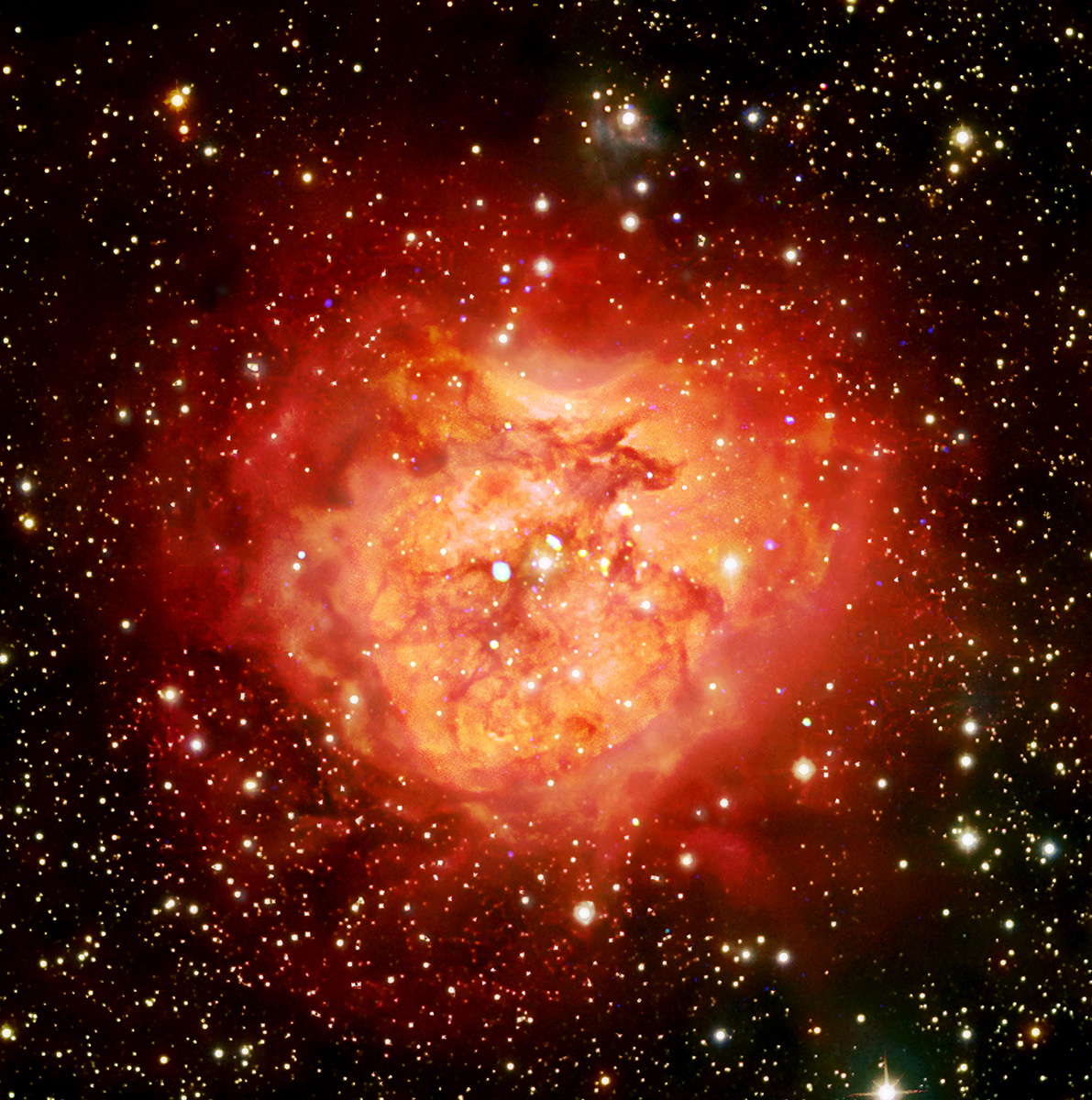
The Chandra X-ray Observatory detects this high-energy radiation with exceptional spatial resolution. In the composite image, X-ray sources appear as bright point-like emissions scattered across the nebula. Each source represents a young stellar object or a recently formed star within Collinder 470.
This capability carries scientific importance. Optical light alone cannot reveal the full stellar population because dust obscures many members. Infrared observations penetrate some of that dust, yet X-rays provide an independent tracer of stellar youth. Magnetically active pre-main-sequence stars shine brightly in X-rays even when partially hidden. Chandra data allow astronomers to construct a more complete census of the cluster. Researchers can estimate ages by comparing X-ray luminosity with theoretical models of stellar evolution. They can also study variability, since young stars often produce energetic flares.
Over time, magnetic activity decreases as stars spin down. Consequently, strong X-ray emission indicates relative youth. In IC 5146, the abundance of such sources confirms that star formation occurred recently and likely continues.

Infrared and optical perspectives on the gas and dust
Infrared data in the composite originate from the Wide-field Infrared Survey Explorer (WISE) mission. The infrared wavelengths trace thermal emission from dust grains heated by nearby stars. Because dust absorbs optical light but re-emits energy in infrared, these observations reveal structures that remain hidden at shorter wavelengths.
Within IC 5146, infrared imaging outlines dense filaments and clumps. These regions represent reservoirs of molecular gas. Under sufficient gravitational instability, parts of these clumps collapse to form protostars. Thus, infrared observations identify both present and future star-forming sites.
Meanwhile, optical data highlight ionized regions where ultraviolet radiation from hot stars interacts with surrounding gas. This interaction produces sharp boundaries between bright emission zones and darker dust lanes. Stellar winds further sculpt these structures, pushing gas outward and creating cavities.
By integrating infrared, optical, and X-ray information, astronomers reconstruct the physical state of the nebula. Optical emission reveals where ionization dominates. Infrared emission indicates where dense material persists. X-rays pinpoint young stars that energize the environment. Together, these layers describe an interconnected system governed by feedback processes.

Physical processes driving star formation
Star formation begins within cold molecular clouds composed mainly of hydrogen. Small density fluctuations grow under gravity. As material contracts, it forms a rotating core. Angular momentum leads to disk formation around the nascent star. Eventually, nuclear fusion ignites in the core, marking the birth of a main-sequence star.
In IC 5146, many stars remain in pre-main-sequence stages. Some likely retain circumstellar disks. These disks may evolve into planetary systems. Therefore, studying this region informs models of both stellar and planetary formation.
Radiative feedback plays a central role in shaping the nebula. Ultraviolet photons ionize nearby gas, raising its temperature and pressure. Stellar winds drive additional mechanical feedback. These processes compress some regions while dispersing others. As a result, star formation can either accelerate or halt locally.
The morphology visible in the Chandra composite reflects these interactions. Bright emission regions correspond to ionized gas. Dark lanes indicate dense dust that resists erosion. X-ray sources cluster where young stars concentrate. The apparent heart-like outline emerges from the interplay between radiation pressure and cloud geometry rather than from symbolic design.
Because IC 5146 lies relatively close on Galactic scales, astronomers can analyze individual stars rather than unresolved clusters. This proximity improves mass estimates, age determinations, and luminosity measurements. Consequently, the region serves as a benchmark for testing theoretical simulations of clustered star formation.
Clear skies!
See more from DIYPhotography.net on Google
Add DIYPhotography.net as a trusted source. This makes
our stories more likely to appear in your Google Search results.
 Add as a preferred source on Google

Soumyadeep Mukherjee
Soumyadeep Mukherjee is an award-winning astrophotographer from India. He has a doctorate degree in Linguistics. His work extends to the sub-genres of nightscape, deep sky, solar, lunar and optical phenomenon photography. He is also a photography educator and has conducted numerous workshops. His works have appeared in over 40 books & magazines including Astronomy, BBC Sky at Night, Sky & Telescope among others, and in various websites including National Geographic, NASA, Forbes. He was the first Indian to win “Astronomy Photographer of the Year” award in a major category.


Join the Discussion
DIYP Comment Policy
Be nice, be on-topic, no personal information or flames.