






















Player One Apollo-C: A Camera for Solar and Planetary Imaging
Feb 8, 2026
Soumyadeep Mukherjee
Soumyadeep Mukherjee is an award-winning astrophotographer from India. He has a doctorate degree in Linguistics. His work extends to the sub-genres of nightscape, deep sky, solar, lunar and optical phenomenon photography. He is also a photography educator and has conducted numerous workshops. His works have appeared in over 40 books & magazines including Astronomy, BBC Sky at Night, Sky & Telescope among others, and in various websites including National Geographic, NASA, Forbes. He was the first Indian to win “Astronomy Photographer of the Year” award in a major category.
Share:

High-resolution solar and planetary imaging places unique demands on camera hardware. Unlike deep-sky photography, these disciplines require extreme frame rates, precise exposure control, and absolute timing accuracy across every pixel. Atmospheric turbulence changes in milliseconds. Solar surface features evolve continuously. Any delay in readout or distortion in exposure timing can compromise the data.
This is the technical context in which the Player One Apollo-C USB3.0 color camera was designed. It is not a repurposed planetary camera or an industrial sensor adapted for astronomy. Instead, it belongs to the Apollo series, a camera platform created specifically to address the optical, thermal, and temporal challenges of solar imaging, while remaining fully capable for lunar and planetary work.
A solar-first design philosophy
Player One introduced the Apollo series with the idea that solar imaging deserves dedicated hardware. Traditional astronomy cameras evolved primarily for night-time use. Solar imaging, however, operates under entirely different constraints. Light levels are extreme, and exposure times are short. Thermal stability becomes critical even in moderate ambient temperatures.
The Apollo series addresses these conditions by adopting global-shutter CMOS sensors across the lineup. Global shutters expose every pixel simultaneously. This eliminates geometric distortions caused by rolling shutters during rapid brightness changes or atmospheric motion. For solar imaging, granulation, filaments, and prominences demand temporal consistency across the frame.
The Apollo-C represents the color branch of this platform. It maintains the same solar-centric engineering approach while adding direct color capture. As a result, it offers a simpler imaging pipeline without abandoning the precision required for serious observation.

The Sony IMX174 sensor
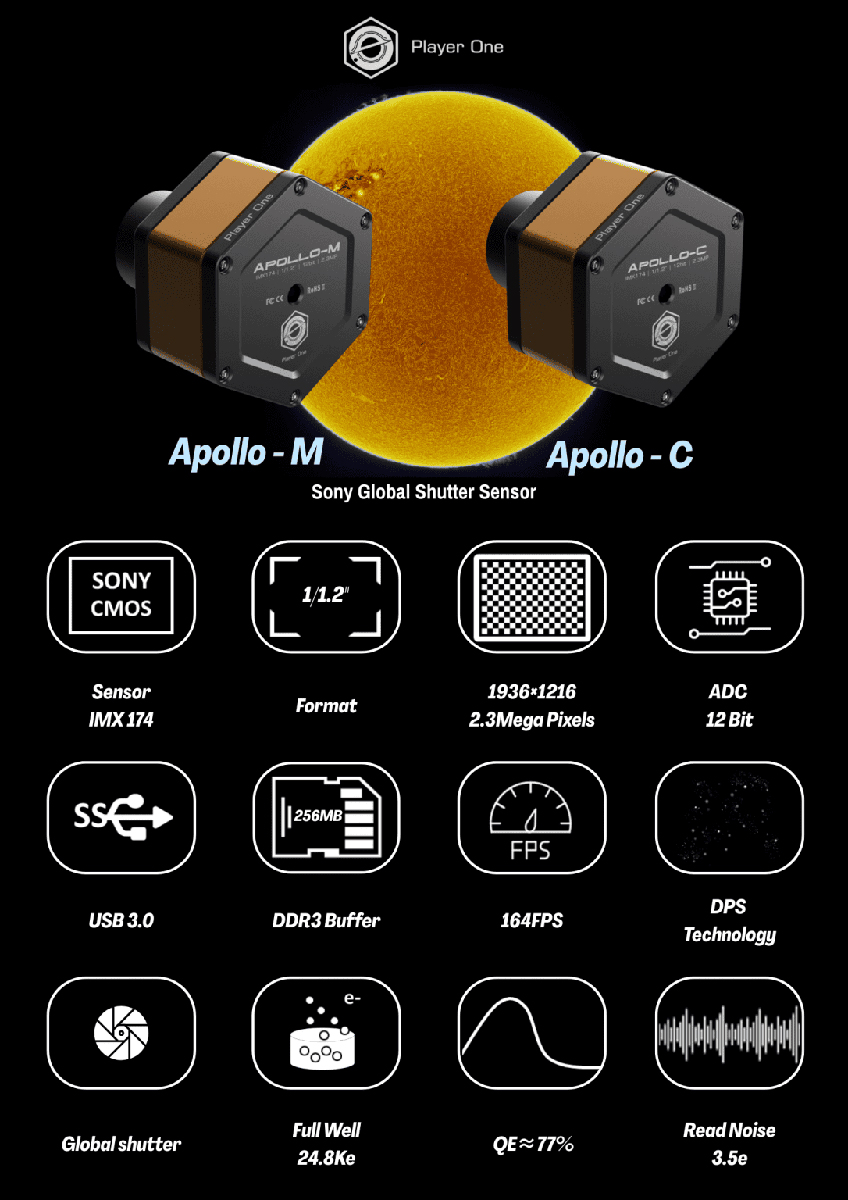
At the heart of the Apollo-C is the Sony IMX174 CMOS sensor, part of Sony’s Pregius global-shutter family. This sensor has earned long-standing respect in scientific and astronomical imaging. Its design prioritizes signal integrity and readout stability over raw pixel count.
The sensor uses a 1/1.2-inch optical format with a native resolution of 1936 × 1216 pixels. While modest on paper, this resolution matches well with typical solar and planetary focal lengths. More importantly, the 5.86-micron pixel size allows strong photon collection and excellent full-well capacity.
The color version of the IMX174 uses an RGGB Bayer matrix. This enables full-color capture in a single exposure sequence. Users can record chromatic solar features, planetary atmospheres, or lunar color variations without filter wheels or multi-pass capture routines. That simplicity reduces setup complexity and minimizes alignment errors during processing.
The global shutter architecture ensures that each pixel records light at the same instant. This characteristic alone separates the Apollo-C from many general-purpose planetary cameras.
High-speed readout and internal data management
Solar and planetary imaging rely heavily on frame volume. Capturing thousands of frames improves the probability of isolating moments of stable seeing. For this reason, readout speed defines usability.
The Apollo-C uses a USB3.0 interface and supports frame rates up to 164 frames per second at full resolution in RAW8 mode. This throughput allows users to record large datasets quickly, even during brief windows of good atmospheric conditions.
However, frame rate alone does not guarantee usable performance. Data stability is equally important. To address this, Player One integrates a 256 MB DDR3 memory buffer directly into the camera. This buffer decouples sensor readout from computer write speed.
As a result, the camera maintains stable operation even on systems with limited USB bandwidth or slower storage. Frame drops decrease. Timing remains consistent. This approach also reduces dependency on high-end laptops, making the Apollo-C practical for field setups and travel rigs.
Noise behaviour, signal integrity, and thermal stability
Signal quality determines how much detail survives stacking and processing. The Apollo-C performs strongly in this area due to the inherent characteristics of the IMX174 sensor. Read noise remains low across usable gain levels, typically ranging between approximately 3.5 and 6.3 electrons. This allows fine details to remain visible even in short exposures. Combined with a peak quantum efficiency of roughly 77 percent, the sensor converts incoming photons efficiently.
Player One further improves output quality through internal dead pixel suppression. The camera analyses dark frames to locate defective pixels and stores this data internally. During capture, affected pixels are corrected algorithmically. This reduces artifacts without requiring external calibration during capture sessions.
Daytime imaging introduces thermal challenges that night-time astrophotography often avoids. Direct sunlight, ambient heat, and extended sessions can raise sensor temperatures quickly. The Apollo-C addresses this through a passive cooling system integrated into the camera body. Heat conducts away from the sensor through the housing. This approach avoids fans, vibration, and mechanical wear. It also improves long-term reliability. The camera also comes with an optional Active Cooling System (ACS), which helps in reducing the temperature further.

Mechanical design, exposure control, and dynamic range
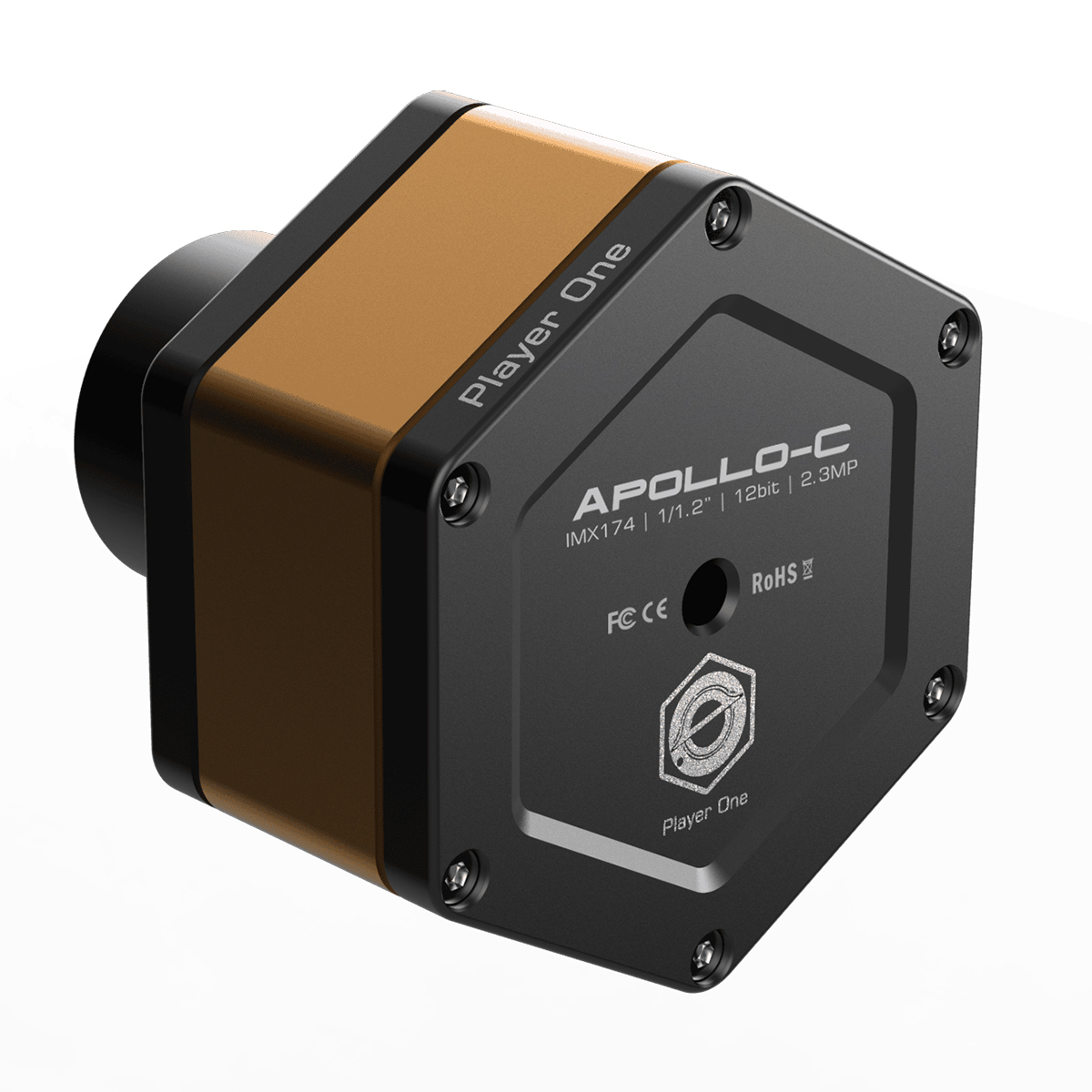
The camera housing itself reflects multiple engineering choices. A metal body provides rigidity and thermal conduction. Chamfered edges reduce weight while maintaining strength. The camera feels solid without being bulky. At roughly 160 grams, the Apollo-C remains easy to balance on compact solar telescopes and small refractors. Its dimensions support lightweight mounts and portable setups.
The Apollo-C supports an unusually wide exposure range. Users can work from microsecond-level exposures to exposures extending up to 2000 seconds. While solar imaging rarely uses long exposures, this flexibility expands the camera’s usefulness.
Short exposure control proves essential. Solar surface contrast, prominences, and planetary features often require precise timing adjustments. High-gain, short-exposure imaging benefits directly from this capability.
The camera supports both 10-bit and 12-bit output modes. Users can prioritise frame rate or tonal depth depending on the target and conditions. This flexibility allows the Apollo-C to adapt across different optical systems and observing goals.

Price and availability
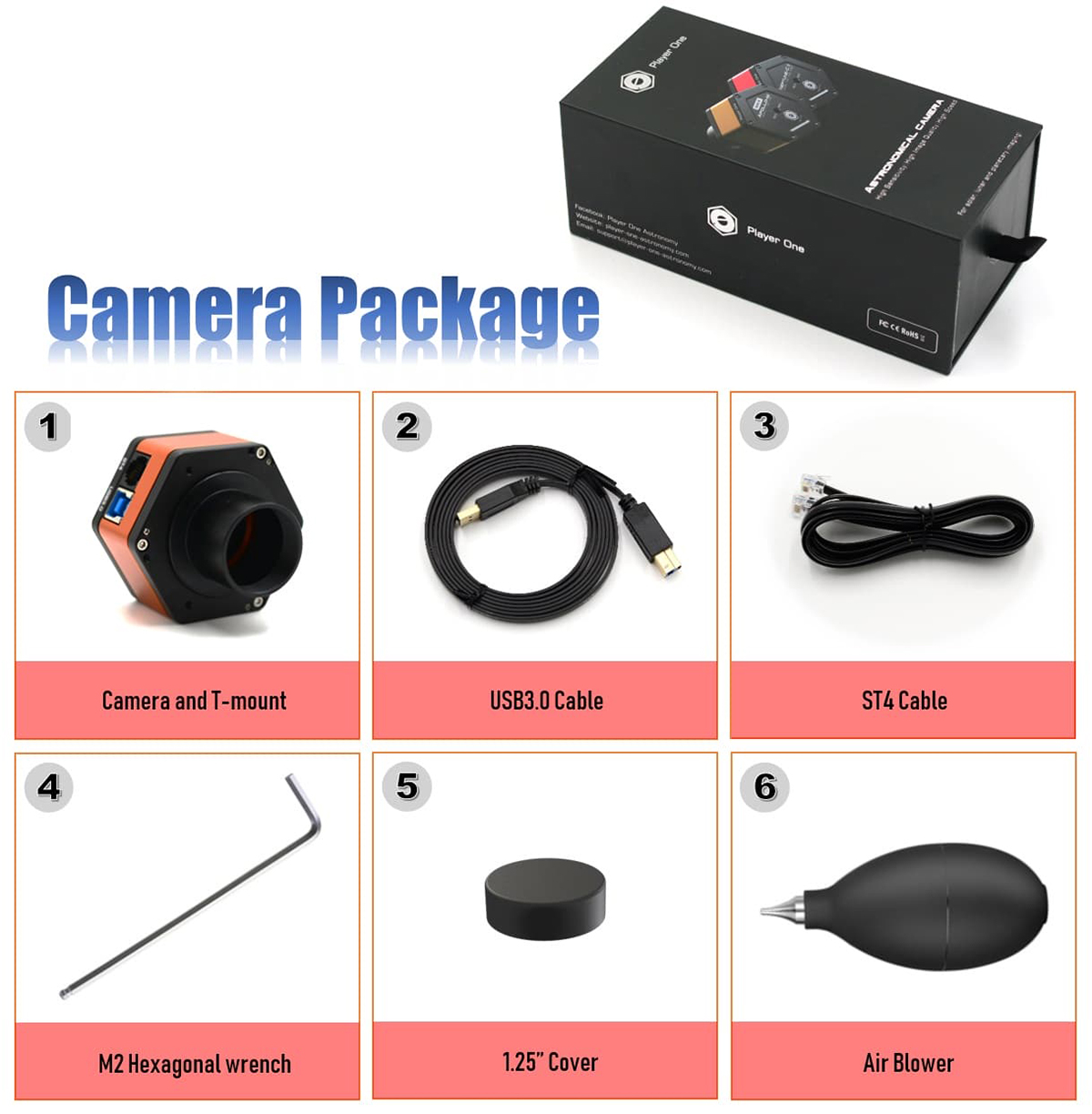
The Player One Apollo-C is priced at $499. Player One also offers Apollo-C with an ACS priced at $568. Both the camera and the bundle are available for ordering via the official Player One website.

The Apollo-C targets serious astrophotographers who understand high-speed imaging. It also remains accessible to committed beginners willing to learn. Educational institutions and observatories benefit from its stability and predictable performance. The global shutter supports consistent data capture for analysis and teaching.
By combining a proven global shutter sensor, internal buffering, passive thermal management, and practical mechanical design, the Apollo-C reflects a mature understanding of solar and planetary imaging needs.
Clear skies!
See more from DIYPhotography.net on Google
Add DIYPhotography.net as a trusted source. This makes
our stories more likely to appear in your Google Search results.
 Add as a preferred source on Google

Soumyadeep Mukherjee
Soumyadeep Mukherjee is an award-winning astrophotographer from India. He has a doctorate degree in Linguistics. His work extends to the sub-genres of nightscape, deep sky, solar, lunar and optical phenomenon photography. He is also a photography educator and has conducted numerous workshops. His works have appeared in over 40 books & magazines including Astronomy, BBC Sky at Night, Sky & Telescope among others, and in various websites including National Geographic, NASA, Forbes. He was the first Indian to win “Astronomy Photographer of the Year” award in a major category.


Join the Discussion
DIYP Comment Policy
Be nice, be on-topic, no personal information or flames.