





















Solar Scintillation Monitor 3: A Smart Tool for Sharp Solar Imaging
Jul 17, 2025
Soumyadeep Mukherjee
Soumyadeep Mukherjee is an award-winning astrophotographer from India. He has a doctorate degree in Linguistics. His work extends to the sub-genres of nightscape, deep sky, solar, lunar and optical phenomenon photography. He is also a photography educator and has conducted numerous workshops. His works have appeared in over 40 books & magazines including Astronomy, BBC Sky at Night, Sky & Telescope among others, and in various websites including National Geographic, NASA, Forbes. He was the first Indian to win “Astronomy Photographer of the Year” award in a major category.
Share:
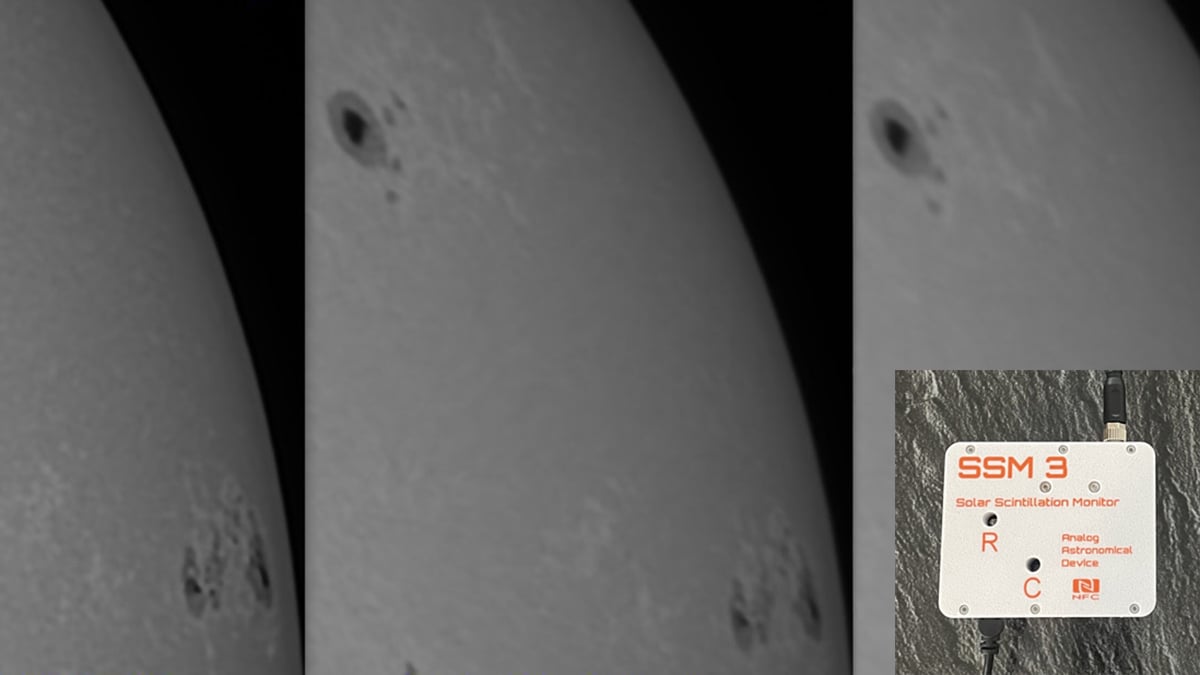
Solar imaging is one of the most challenging areas in amateur astronomy. The Sun appears bright and stable. But the air above us tells a different story. Atmospheric turbulence, commonly called “seeing”, can blur solar features in an instant. For solar observers and imagers, capturing fine details like sunspots, granulation, or flares depends entirely on the steadiness of the air. This is where the Solar Scintillation Monitor (SSM3) comes in. Built by Analog Astronomical Device, the SSM3 offers a simple way to measure and monitor daytime seeing. It helps solar imagers know exactly when conditions are right. It also enables automated capture systems to work smarter. Let’s explore this innovative tool in detail.
What is the Solar Scintillation Monitor?
The SSM3 is a compact, stand-alone device. It measures the quality of daytime seeing by detecting solar scintillation, tiny variations in sunlight intensity caused by turbulence in the lower atmosphere. It turns these rapid fluctuations into a live value of “seeing” measured in arcseconds. That means it can tell you, in real time, how blurry or sharp your solar image would appear. A lower arcsecond value means steadier air and better imaging conditions.
The SSM3 is manufactured by Analog Astronomical Device, a Switzerland-based developer of high-precision astronomical sensors. The earlier models, SSM and SSM2, were also very popular. The SSM3 is the latest and most advanced version. It’s used in observatories and amateur setups around the world.
Why is solar seeing important?
At night, astronomers care a lot about seeing. But daytime seeing can be even worse. The lower atmosphere heats up quickly, causing air to boil and swirl. This distorts incoming light from the Sun. Without knowing the seeing conditions, you may waste time capturing hundreds of blurry solar frames. With the SSM3, you can monitor seeing in real time and only record when it improves. This saves time, storage space, and frustration.
How does it work?
The SSM3 uses a photodiode sensor mounted near the telescope. It points directly at the Sun and records fluctuations in light intensity many times per second. These fluctuations, known as scintillation, are strongest near ground level. That makes this method very sensitive to local turbulence, the same kind that affects your solar telescope. The SSM3 calculates the strength of these fluctuations and converts them into a seeing estimate.
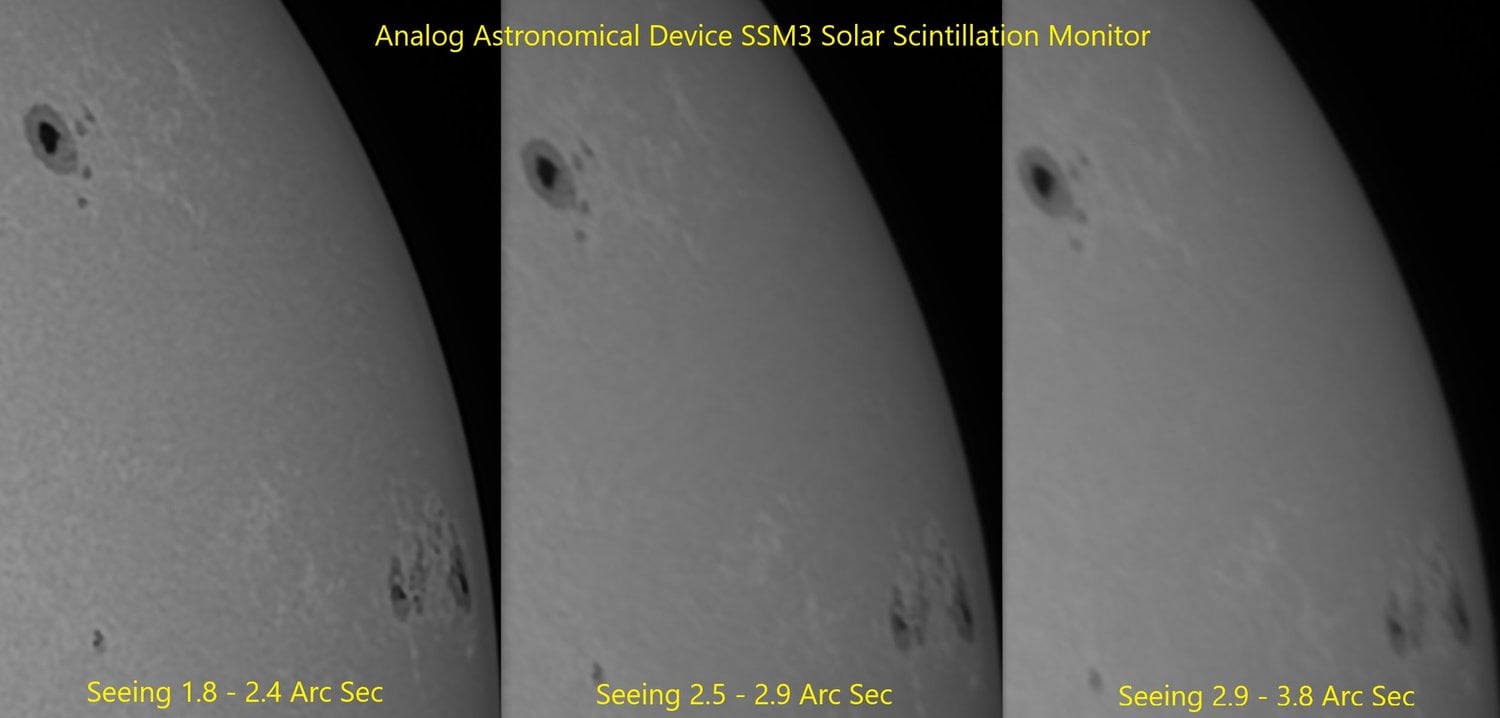
The value is displayed in arcseconds. For example:
- <1.5 arcsec: Excellent seeing
- 1.5–2.5 arcsec: Moderate
- >2.5 arcsec: Poor seeing
Real-time data and automation
One of the best features of the SSM3 is its real-time capability. It provides:
- Live seeing values (updated every second),
- Averaged values over 1 to 29 minutes,
- CSV logging of all data,
- Capture trigger outputs for automation.
You can use the SSM3 with popular solar imaging software such as:
These tools can read the SSM data and automatically trigger or stop image capture based on seeing conditions. For example, you can set a rule like: “Only capture when seeing is better than 2 arcsec.” This automation ensures that your images are taken only during steady periods.
Design and build
- The SSM3 is compact and lightweight. It comes with:
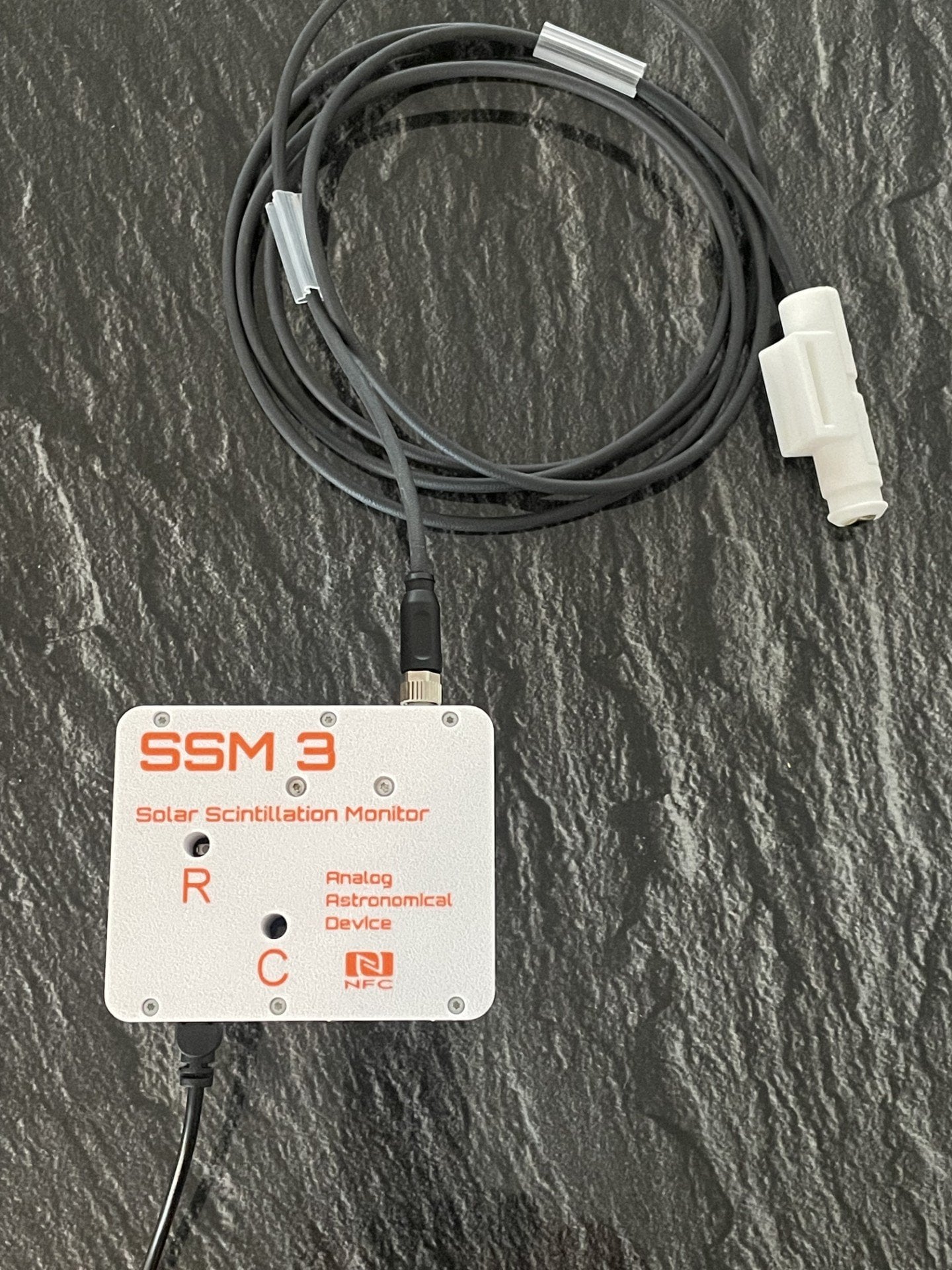
- A weatherproof sensor head with a built-in photodiode,
- A control unit with USB or 12V power options,
- An analog output for guiding automation,
- PC software for monitoring and recording data.
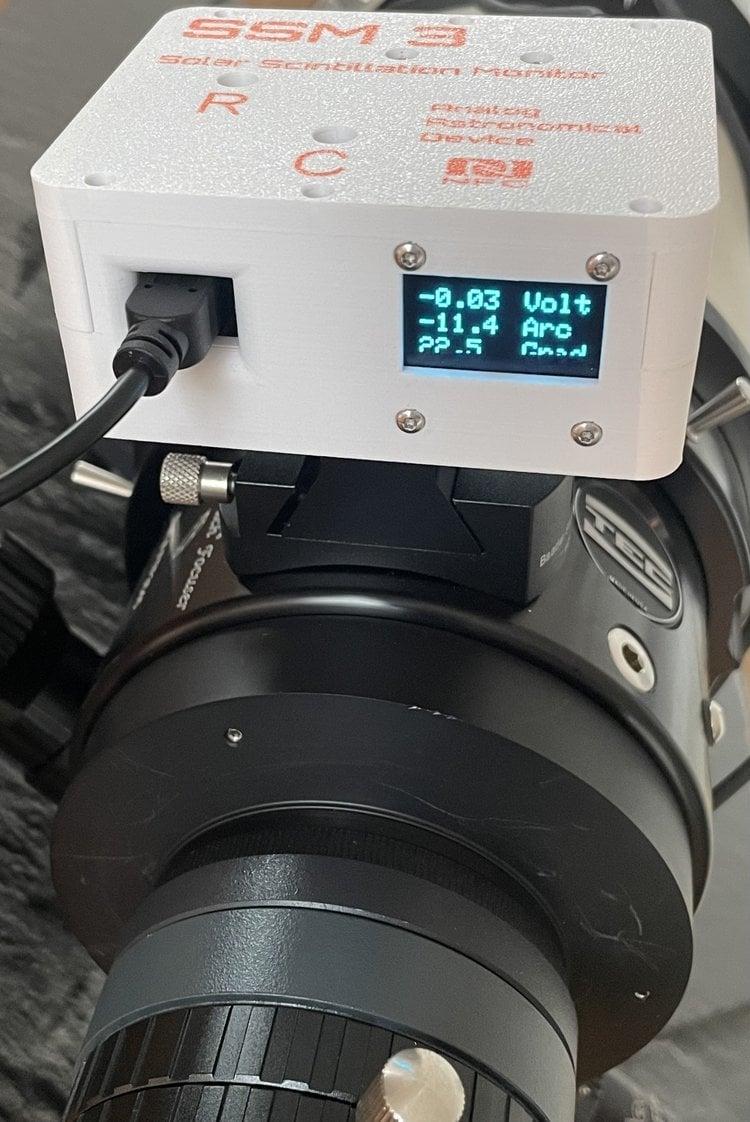
The calibration is straightforward. You adjust a trim potentiometer so the sensor outputs around 1 volt in full sunlight. Once set, it requires very little maintenance. It connects to your PC via USB, consuming less than 200 mA. It also works as a standalone unit using a 6–12V DC supply. This makes it perfect for both fixed observatories and mobile solar setups.
Practical benefits
The SSM3 offers major benefits for solar imagers:
- Capture at the right moment: It tells you when the air is steady. You can watch the value and start imaging only when seeing improves.
- Automate your imaging: When linked to capture software, it controls when to record. That means fewer useless videos and better data quality.
- Compare locations: If you observe from different sites, you can compare seeing quality over time or seasons. This helps you choose the best spots for future sessions.
- Understand your sky: The SSM3 gives insights into daily patterns. Some areas may have good seeing only early in the morning. With long-term data, you’ll know exactly when to image.
Price and availability
The Solar Scintillation Monitor is available to order via the official website. However, no words on its price are disclosed. The pricing is available on request.
The Solar Scintillation Monitor is a smart tool for anyone serious about solar imaging. It takes the guesswork out of “seeing”, saves time, and boosts your imaging quality. And it enables automation that works for you, not against you. Whether you’re chasing sunspots, flares, or high-resolution hydrogen-alpha views, the SSM3 can make your imaging more efficient and more rewarding. For both amateurs and professionals, it brings science-grade monitoring to your backyard.
Clear skies!
See more from DIYPhotography.net on Google
Add DIYPhotography.net as a trusted source. This makes
our stories more likely to appear in your Google Search results.
 Add as a preferred source on Google

Soumyadeep Mukherjee
Soumyadeep Mukherjee is an award-winning astrophotographer from India. He has a doctorate degree in Linguistics. His work extends to the sub-genres of nightscape, deep sky, solar, lunar and optical phenomenon photography. He is also a photography educator and has conducted numerous workshops. His works have appeared in over 40 books & magazines including Astronomy, BBC Sky at Night, Sky & Telescope among others, and in various websites including National Geographic, NASA, Forbes. He was the first Indian to win “Astronomy Photographer of the Year” award in a major category.


Join the Discussion
DIYP Comment Policy
Be nice, be on-topic, no personal information or flames.
One response to “Solar Scintillation Monitor 3: A Smart Tool for Sharp Solar Imaging”
Sir,
The SSM is a DIY project, mainly. I suggest you investigate a bit more the subject.
Look for “DIY Solar Scintillation Seeing Monitor (SSSM) – Blackwater Skies”.
JA