

















The Daystar Quark: A Revolution in Solar Observing
Jul 8, 2025
Soumyadeep Mukherjee
Soumyadeep Mukherjee is an award-winning astrophotographer from India. He has a doctorate degree in Linguistics. His work extends to the sub-genres of nightscape, deep sky, solar, lunar and optical phenomenon photography. He is also a photography educator and has conducted numerous workshops. His works have appeared in over 40 books & magazines including Astronomy, BBC Sky at Night, Sky & Telescope among others, and in various websites including National Geographic, NASA, Forbes. He was the first Indian to win “Astronomy Photographer of the Year” award in a major category.
Share:
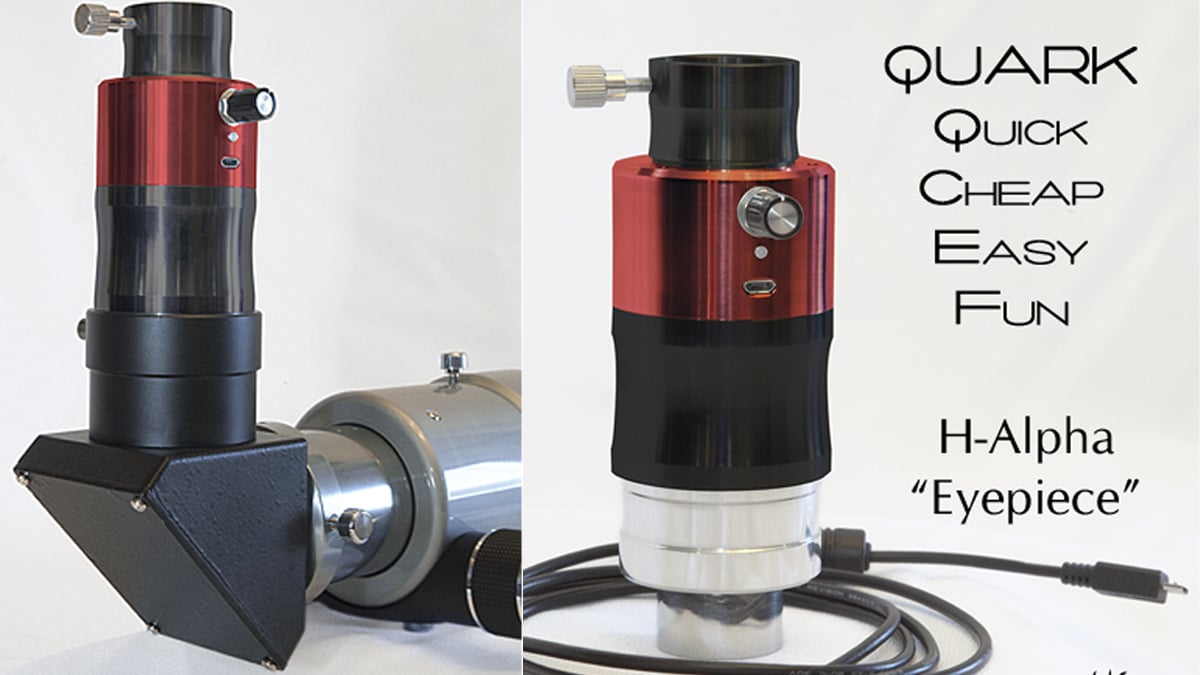
The Sun is the most dynamic object in our sky. It blazes, erupts, and boils with unimaginable energy. But most of this drama stays hidden in plain sight. Regular telescopes with white-light filters reveal only sunspots. To see the Sun’s true personality, its flares, filaments, and prominences, you need an H-alpha filter. Until recently, those filters were bulky and expensive. Dedicated H-alpha telescopes could cost thousands of dollars. That changed with the Daystar Quark. This compact device has revolutionized how amateur astronomers observe the Sun. It allows stunning views through standard refractors. And it does it at a fraction of the cost of traditional solar scopes.
Daystar Quark
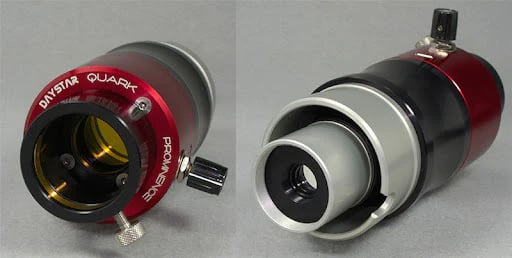
The Daystar Quark is an all-in-one H-alpha filter system. It attaches to your telescope like an eyepiece. You don’t need a dedicated solar telescope. You only need a refractor with an aperture between f/4 and f/9. The Quark combines a telecentric Barlow lens, narrowband filter, and etalon tuner in a single housing. You plug it into a USB power source, let it warm up for about 10 minutes, and you’re ready to observe.
The Quark comes in two main versions:
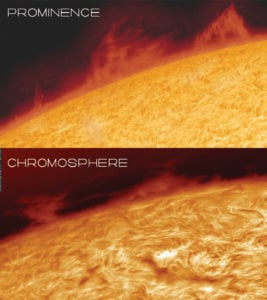
- Chromosphere: shows surface features like filaments, plages, and granulation
- Prominence: emphasizes limb features like solar flares and prominences
The filter uses a narrow bandpass centered around 656.28 nm, the hydrogen-alpha wavelength. This is the most revealing wavelength for solar activity.
How it works
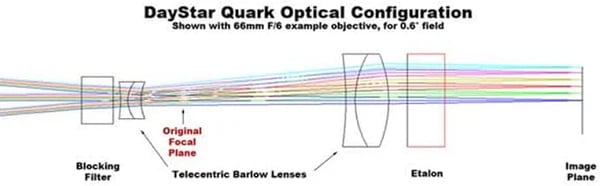
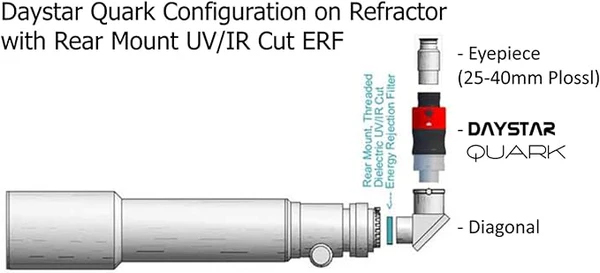
The Daystar Quark sits between your telescope’s diagonal and your eyepiece or camera. It contains a 4.2x telecentric Barlow, which increases the focal ratio to around f/30. This higher ratio is ideal for contrast and resolution in H-alpha imaging. The heart of the system is a heated Fabry–Pérot etalon. It selects a narrow band of light around the H-alpha line. You can fine-tune the wavelength using the built-in electronic dial. This lets you shift the filter ±0.5 Å (angstroms) to bring out different features. You need to power the Quark with a 5V USB source. A typical power bank works fine. The unit has an LED indicator that shows when it has reached the right temperature.
Key features
Here are some of the standout features of the Daystar Quark:
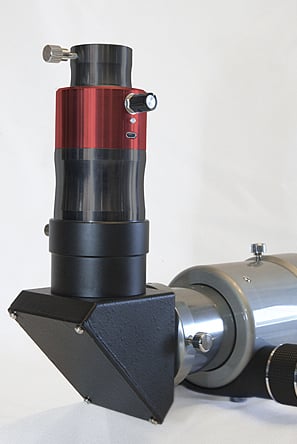
- Plug-and-play design: It fits in a 1.25” or 2” diagonal. No complex installation is required.
- Built-in 4.2x Barlow: Converts f/4–f/8 scopes to the optimal f/30 range automatically.
- Adjustable tuning: You can tweak the wavelength to highlight surface or limb details.
- Battery operated: Works off any USB power bank for 6–8 hours on a single charge.
- Affordable: Priced around $1,295, it’s cheaper than most dedicated H-alpha scopes.
Compatibility and scope requirements
The Quark is designed for refractors only. It is not suitable for reflectors or compound telescopes without additional safety measures. Why? Because reflectors can focus too much heat into the filter. This can damage the internal components. Here are the compatibility guidelines:
- Refractor aperture under 80 mm: You can use the Quark safely without extra filtration.
- Refractor aperture between 80 mm and 150 mm: You need a UV/IR cut filter in front of the objective or a front-mounted Energy Rejection Filter (ERF).
- Aperture above 150 mm: You must use a full-aperture ERF to prevent thermal damage.
Also, the scope must have enough back focus. Most modern refractors are compatible. But check your telescope’s specifications or ask Daystar if unsure.
Observing the chromosphere and prominences
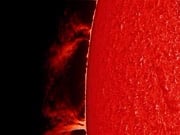
With the Chromosphere version, you see the solar surface in detail. Filaments snake across the disk. Sunspots are surrounded by bright plages. You may even catch spicules flickering along the limb. Granulation appears like boiling lava. The Sun becomes alive. You no longer just observe a glowing disk. You explore its dynamic skin. The narrower bandpass of this model (around 0.4 Å) increases contrast. It’s ideal for high-resolution visual work and imaging.
The Prominence version has a slightly wider bandpass (about 0.7 Å). It captures dramatic outbursts on the limb. You’ll see huge loops of glowing hydrogen lifting off the edge. This version is less suited to surface detail. But it gives you breathtaking views of the Sun’s outer activity. It’s great for public outreach or live demonstrations.
Price and availability
Daystar Quark is available to purchase via the official website and local retailers. Both the chromosphere and prominence models are priced at $1,295.
The Daystar Quark has opened up solar astronomy to a wider audience. You no longer need a $5,000 telescope to see the Sun in H-alpha. For just over $1,000, you can witness flares, prominences, and filaments in stunning detail. Its compact design, built-in Barlow, and electric tuning make it easy to use. Whether you’re a visual observer or an imager, the Quark delivers. However, it’s not without quirks. You need to match it with the right refractor. And you must take care with large apertures. But if you follow the guidelines, you’ll enjoy safe, high-contrast solar views for years.
Clear skies!
See more from DIYPhotography.net on Google
Add DIYPhotography.net as a trusted source. This makes
our stories more likely to appear in your Google Search results.
 Add as a preferred source on Google

Soumyadeep Mukherjee
Soumyadeep Mukherjee is an award-winning astrophotographer from India. He has a doctorate degree in Linguistics. His work extends to the sub-genres of nightscape, deep sky, solar, lunar and optical phenomenon photography. He is also a photography educator and has conducted numerous workshops. His works have appeared in over 40 books & magazines including Astronomy, BBC Sky at Night, Sky & Telescope among others, and in various websites including National Geographic, NASA, Forbes. He was the first Indian to win “Astronomy Photographer of the Year” award in a major category.


Join the Discussion
DIYP Comment Policy
Be nice, be on-topic, no personal information or flames.