























NASA’s ESCAPADE Captures a Family Portrait of Earth and Moon
Jul 24, 2026
Soumyadeep Mukherjee
Soumyadeep Mukherjee is an award-winning astrophotographer from India. He has a doctorate degree in Linguistics. His work extends to the sub-genres of nightscape, deep sky, solar, lunar and optical phenomenon photography. He is also a photography educator and has conducted numerous workshops. His works have appeared in over 40 books & magazines including Astronomy, BBC Sky at Night, Sky & Telescope among others, and in various websites including National Geographic, NASA, Forbes. He was the first Indian to win “Astronomy Photographer of the Year” award in a major category.
Share:
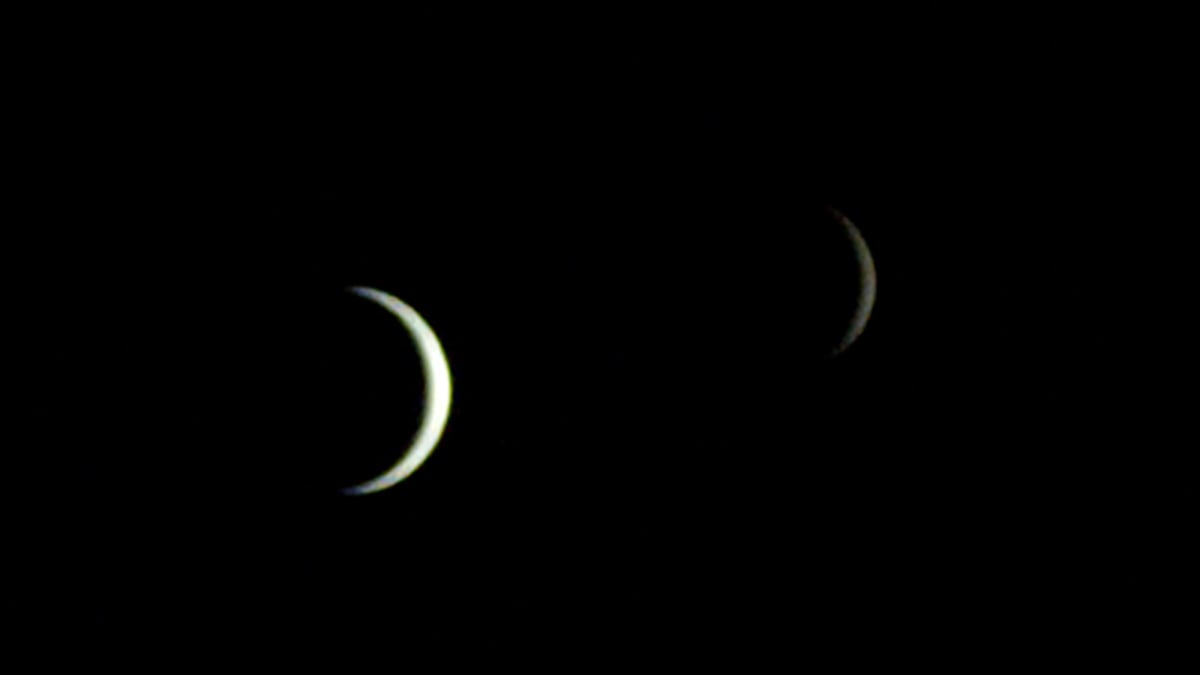
Long before a spacecraft reaches its destination, an equally important phase unfolds in deep space. Scientists test instruments, fine-tune observations, and make sure every system is ready for the mission ahead. NASA‘s ESCAPADE mission, while travelling to Mars, turned one of its cameras toward Earth and the Moon and captured them in both visible light and thermal infrared. The images revealed how differently the two worlds absorb and release heat, highlighting the role of Earth’s atmosphere and oceans while exposing the Moon’s rapid cooling after sunset. And at the same time, the observations confirmed that one of ESCAPADE’s key scientific instruments is performing as expected.
A family portrait: Earth and Moon
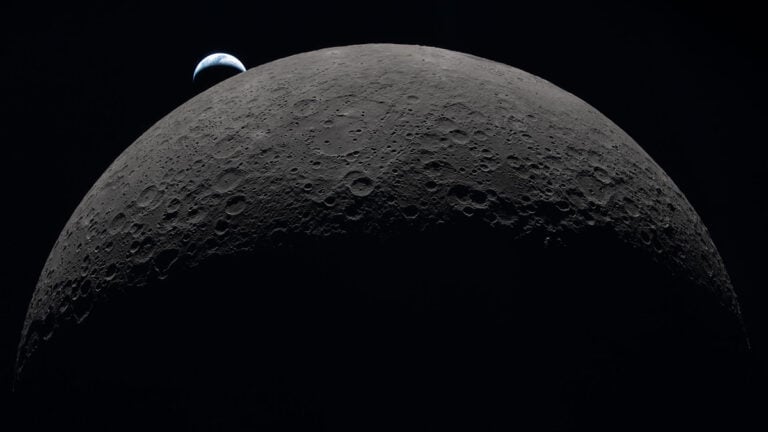
On July 3, 2026, one of NASA’s ESCAPADE spacecraft captured Earth and the Moon while cruising through interplanetary space. At the time, the spacecraft was approximately 584,600 kilometers from Earth and around 186,100 kilometers from the Moon. Those distances may sound enormous, but they allowed both worlds to fit comfortably within the camera’s field of view.
The images came from the spacecraft’s Visible and Infrared Observation System, or VIOS. This instrument records scenes in both visible light and thermal infrared. It allows scientists to compare what objects look like in ordinary sunlight with the heat they naturally emit. That makes VIOS an important scientific tool for the mission’s work at Mars.
From the spacecraft’s position, only about eight percent of the sunlit side of each world faced the camera. As a result, Earth and the Moon appeared as thin crescents. The composition almost resembles a family portrait, with Earth shining brightly while the Moon follows closely beside it.
The infrared image: A different reality
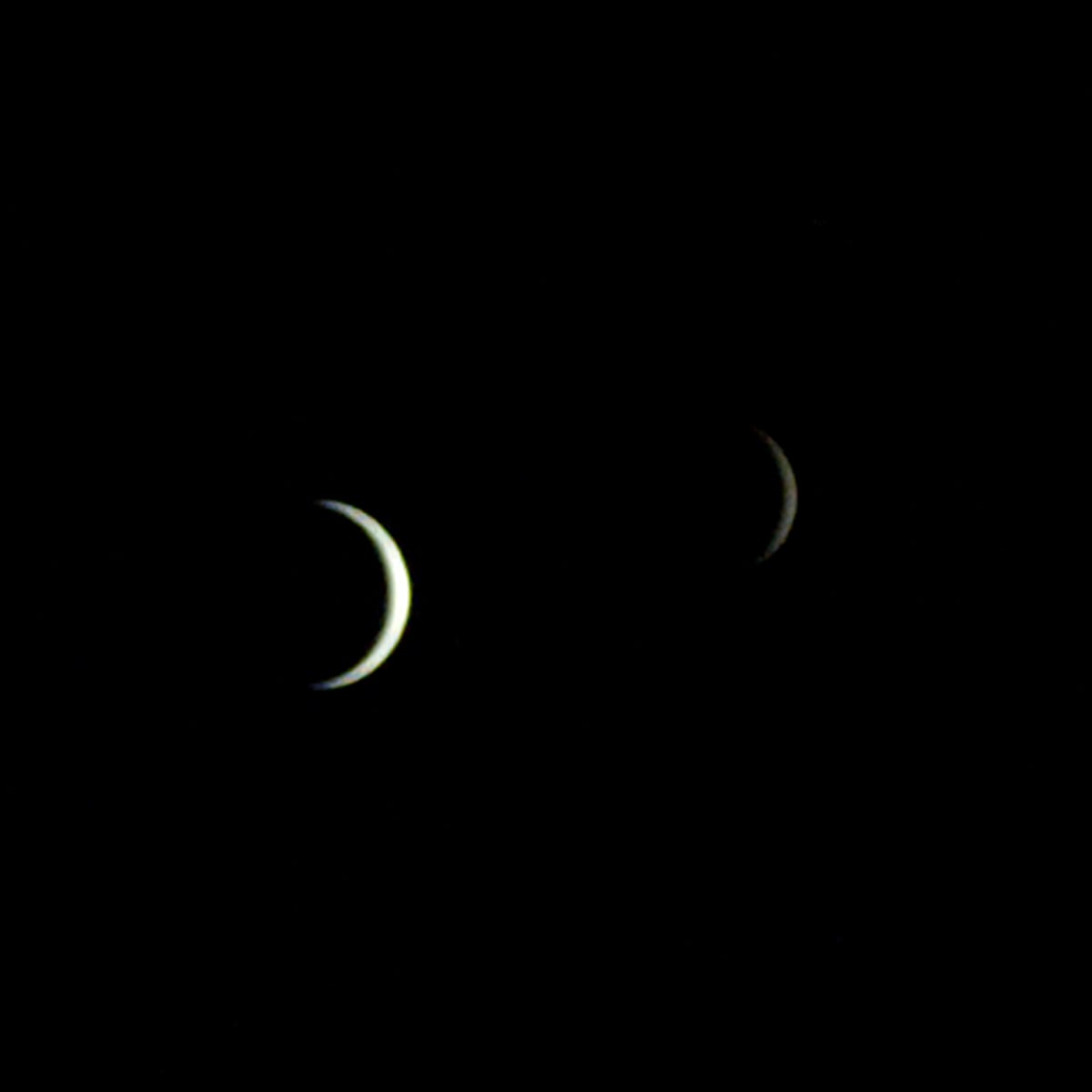
The visible-light image looks exactly as most of us would expect. Earth and the Moon reflect sunlight, producing two bright crescents against the darkness of space. It is the kind of view that closely matches what astronauts or powerful telescopes might see.
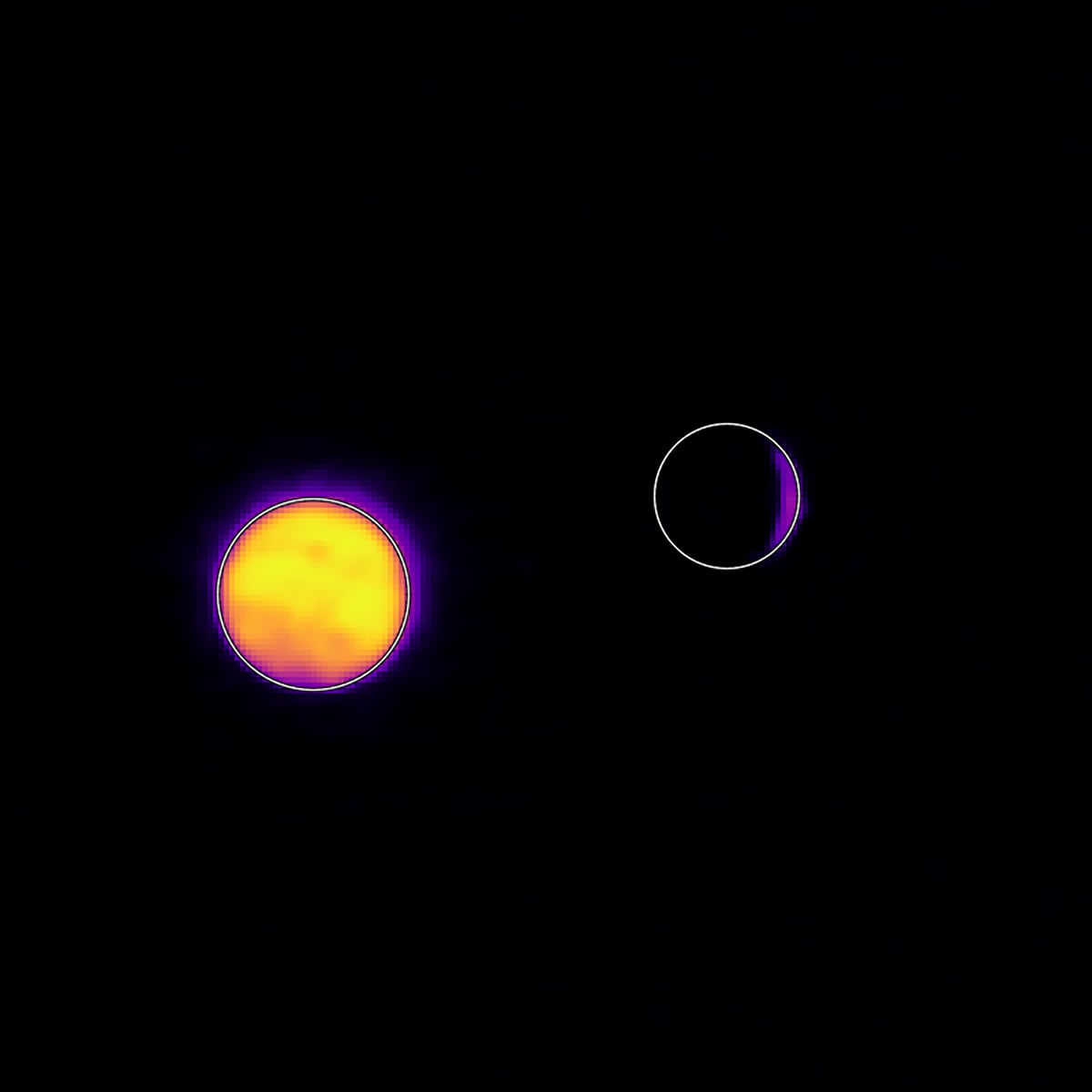
The infrared image looks, however, a little different. Unlike ordinary cameras, infrared instruments detect heat rather than reflected sunlight. Every object with a temperature above absolute zero emits infrared radiation. The amount of heat an object releases depends on its physical properties, atmosphere, and surrounding environment.
Earth appears bright across much of its disk because the planet stores and releases heat continuously. Its atmosphere traps warmth, while the oceans absorb enormous amounts of solar energy during the day and release it gradually after sunset. Land surfaces also retain heat for hours after darkness falls. Even regions experiencing nighttime continue emitting thermal radiation, making much of Earth glow in the infrared image.
The Moon behaves in almost the opposite way. Without a significant atmosphere, it cannot trap heat effectively. It also lacks oceans that could act as massive heat reservoirs. Once sunlight disappears, the lunar surface cools rapidly. Consequently, most of the Moon’s night side becomes extremely cold and emits very little infrared radiation. Only the narrow sunlit crescent remains relatively warm.
ESCAPADE: A mission to understand the Martian atmosphere
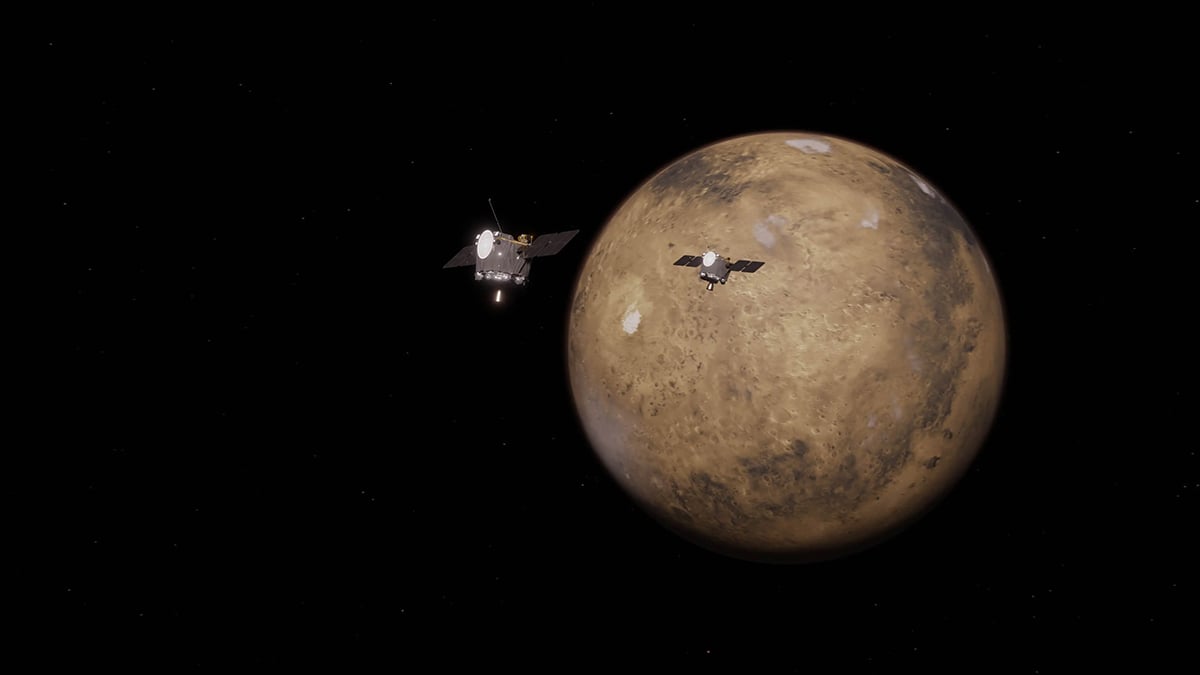
ESCAPADE stands for Escape and Plasma Acceleration and Dynamics Explorers. The mission consists of two identical spacecraft that will work together in orbit around Mars. Their objective is to study how the solar wind interacts with the planet’s atmosphere and magnetic environment.
Billions of years ago, Mars likely possessed a much thicker atmosphere than it does today. Geological evidence suggests that liquid water once flowed across its surface, forming rivers, lakes, and perhaps even shallow seas. Conditions were very different from those found on the planet today.
Scientists believe that the loss of Mars’ global magnetic field exposed the upper atmosphere to charged particles flowing outward from the Sun. Over immense periods of time, those interactions gradually stripped atmospheric gases into space. As the atmosphere became thinner, surface temperatures dropped, liquid water became increasingly unstable, and Mars evolved into the cold, dry world we see today. ESCAPADE aims to understand this process in greater detail.
Clear skies!
See more from DIYPhotography.net on Google
Add DIYPhotography.net as a trusted source. This makes
our stories more likely to appear in your Google Search results.
 Add as a preferred source on Google

Soumyadeep Mukherjee
Soumyadeep Mukherjee is an award-winning astrophotographer from India. He has a doctorate degree in Linguistics. His work extends to the sub-genres of nightscape, deep sky, solar, lunar and optical phenomenon photography. He is also a photography educator and has conducted numerous workshops. His works have appeared in over 40 books & magazines including Astronomy, BBC Sky at Night, Sky & Telescope among others, and in various websites including National Geographic, NASA, Forbes. He was the first Indian to win “Astronomy Photographer of the Year” award in a major category.



Join the Discussion
DIYP Comment Policy
Be nice, be on-topic, no personal information or flames.