




















Hubble Captures A Swarm of Galaxies and A Cosmic Telescope
Jun 23, 2026
Soumyadeep Mukherjee
Soumyadeep Mukherjee is an award-winning astrophotographer from India. He has a doctorate degree in Linguistics. His work extends to the sub-genres of nightscape, deep sky, solar, lunar and optical phenomenon photography. He is also a photography educator and has conducted numerous workshops. His works have appeared in over 40 books & magazines including Astronomy, BBC Sky at Night, Sky & Telescope among others, and in various websites including National Geographic, NASA, Forbes. He was the first Indian to win “Astronomy Photographer of the Year” award in a major category.
Share:
Galaxy clusters sit at the top of the cosmic hierarchy. They represent the largest gravitationally bound structures in the universe and contain enormous amounts of matter packed into relatively small regions of space. Astronomers study them as they preserve information about several major components of the cosmos at once. Within a single cluster, researchers can investigate galaxies, hot intergalactic gas, dark matter, and the gravitational effects on light.
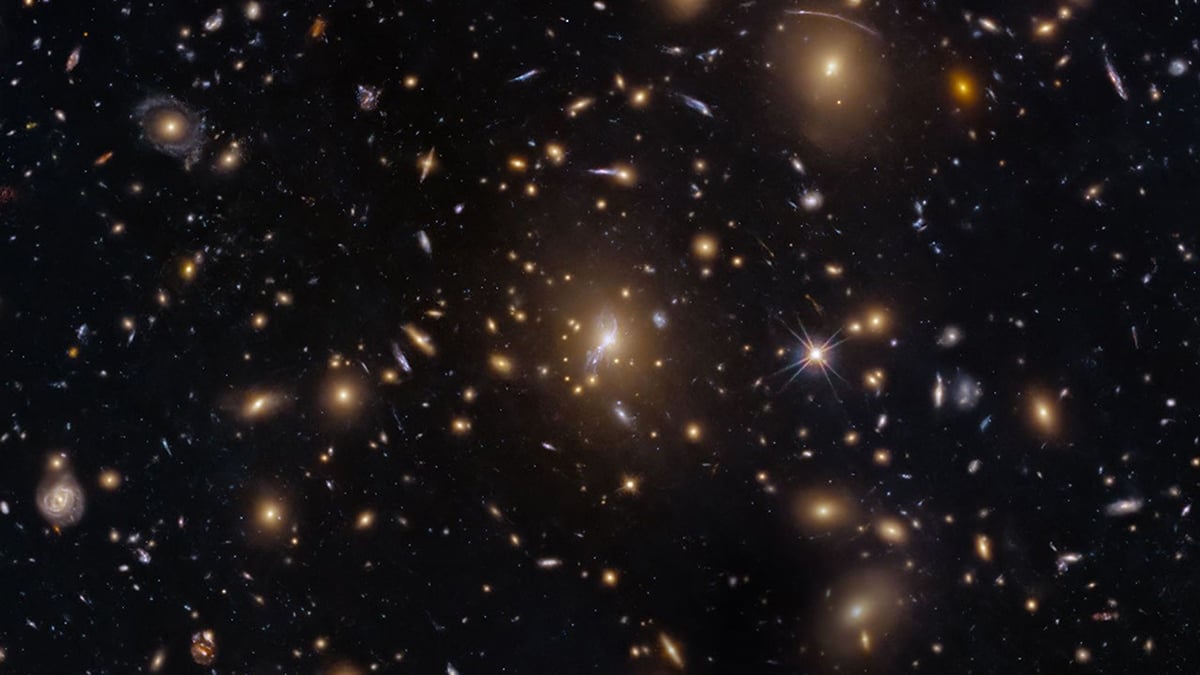
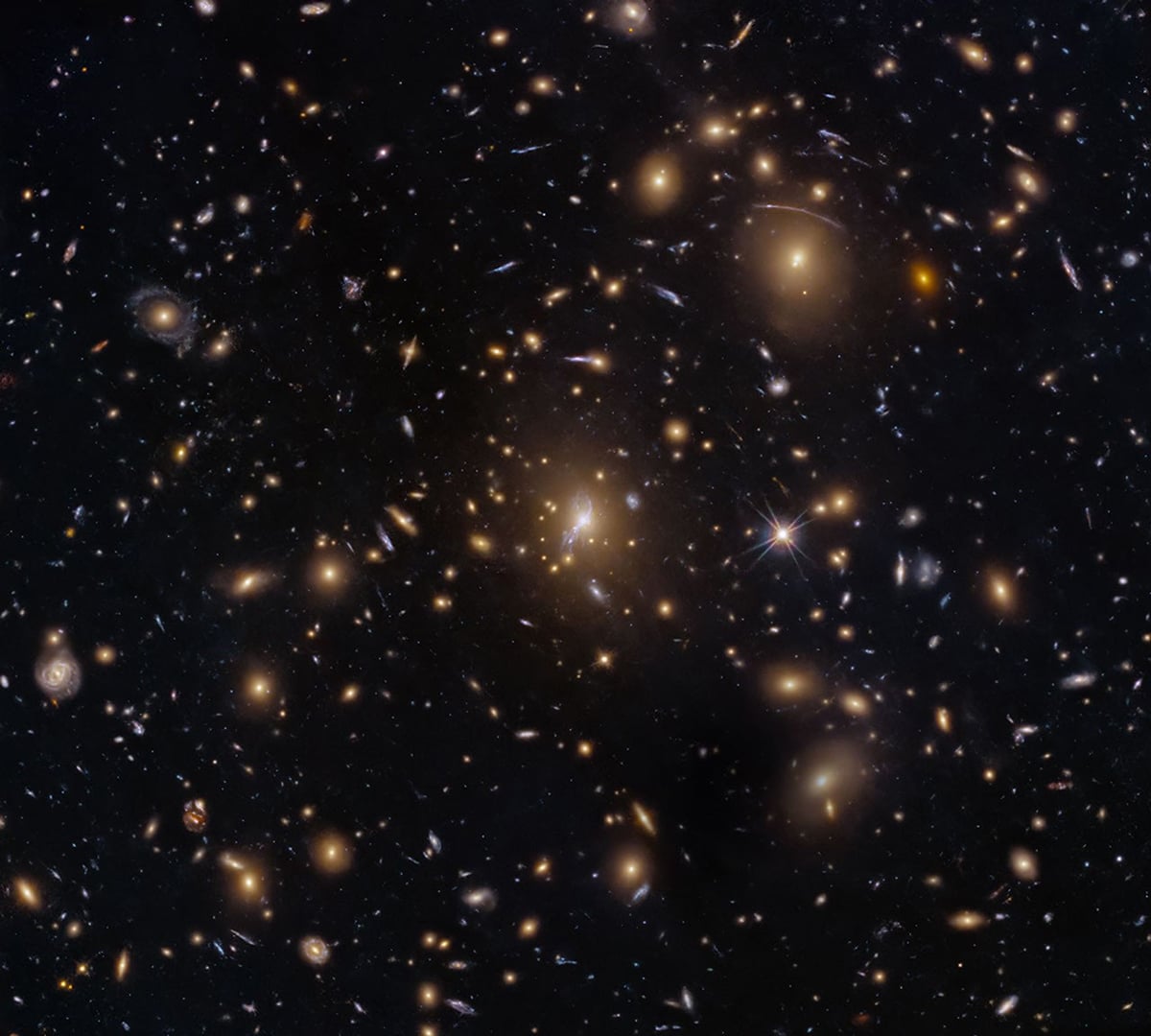
A newly released image from NASA‘s Hubble Space Telescope focuses on the galaxy cluster MACS0329-0211, a massive system populated by dozens of galaxies and threaded with evidence of powerful gravitational lensing. The cluster’s immense gravity bends and magnifies light from even more distant galaxies located far behind it. Consequently, the image records both the cluster itself and a collection of background galaxies whose light has travelled across much of cosmic history.
A dense gathering of galaxies in deep space
MACS0329-0211 is not a single object but an enormous collection of galaxies bound together by gravity. Such clusters form over billions of years as smaller structures merge and accumulate matter. Over time, gravity pulls galaxies into increasingly larger systems until massive clusters emerge. These clusters can contain hundreds or even thousands of galaxies along with vast quantities of hot gas and dark matter.
The Hubble image reveals a remarkable variety of galaxy types. Large elliptical galaxies dominate several regions of the frame. These galaxies appear smooth and featureless because they contain older stellar populations and relatively little gas, which is needed for new star formation. Their stars move in many different directions, creating the rounded shapes visible in the image.
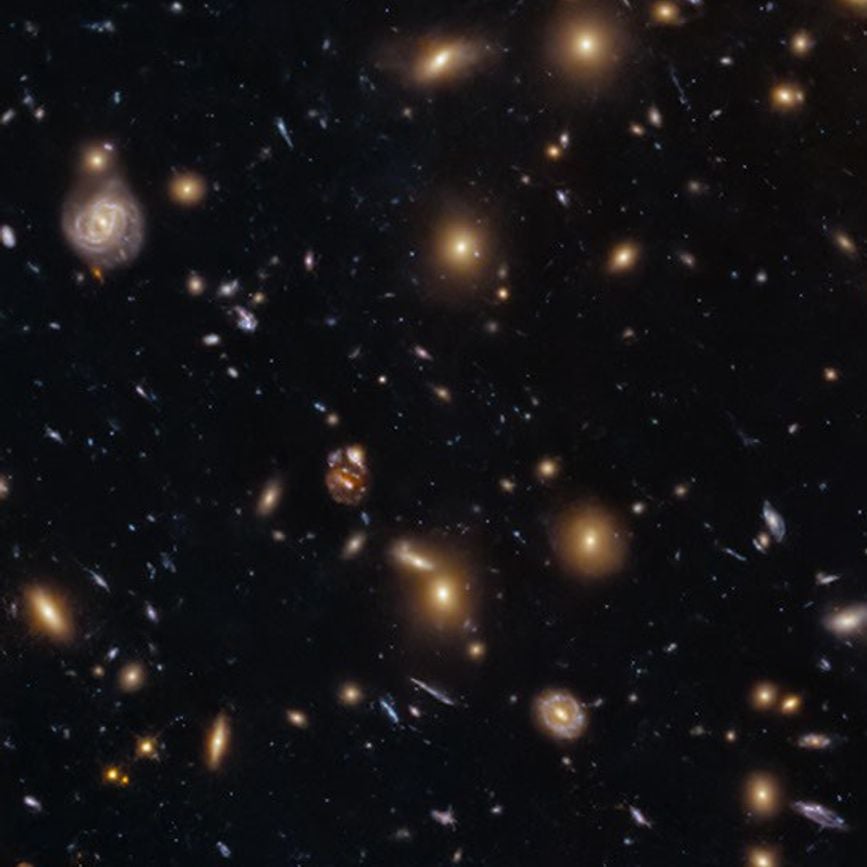
Mixed among them are spiral galaxies. Some face Earth almost directly and display hints of spiral structure. Others appear edge-on and resemble thin streaks of light. These galaxies still contain significant amounts of gas and dust and often continue producing new generations of stars. Their presence highlights the diversity of environments and evolutionary histories within the cluster.
Gravity reveals its power through Gravitational Lensing
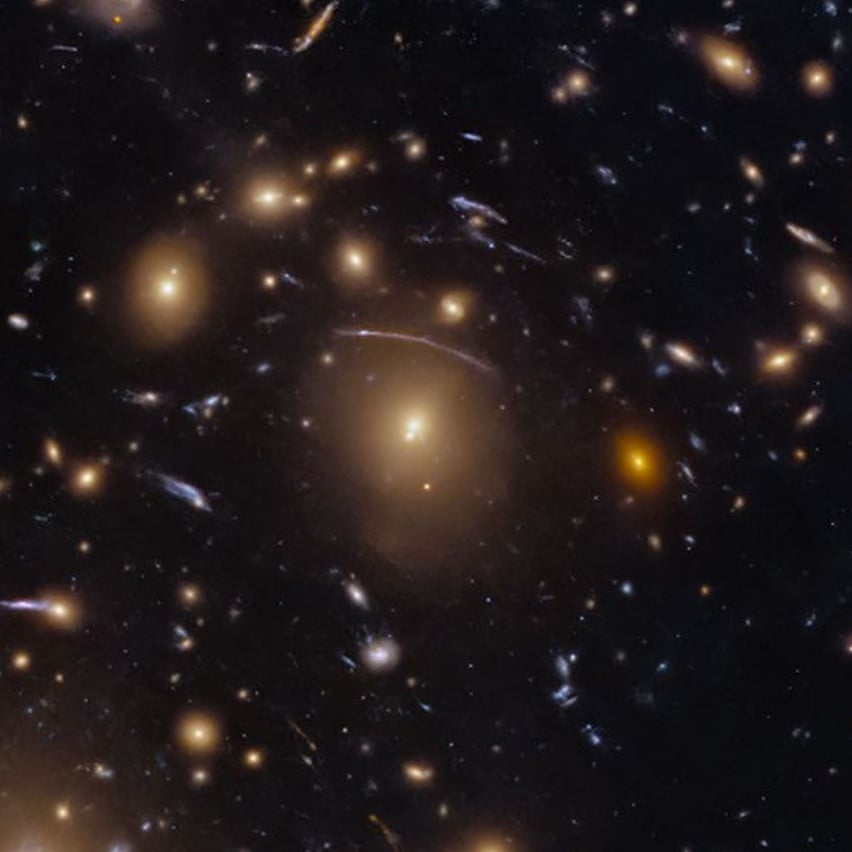
The cluster contains such a large concentration of mass that it noticeably bends the path of light traveling through the region. This effect, known as gravitational lensing, arises from Einstein’s theory of general relativity. According to the theory, mass curves space-time. Light follows those curves as it travels through the universe. In the case of a massive galaxy cluster, the distortion becomes strong enough to alter the appearance of distant background galaxies.
Galaxies located far behind MACS0329-0211 appear stretched, warped, and magnified. Several faint arcs visible throughout the image belong to this category. While they may look like simple curved streaks, they actually represent distant galaxies whose light has been distorted by the cluster’s gravitational field. These distorted arcs allow astronomers to observe galaxies that would otherwise be too faint to study.
The peculiar figure-eight structure near the core
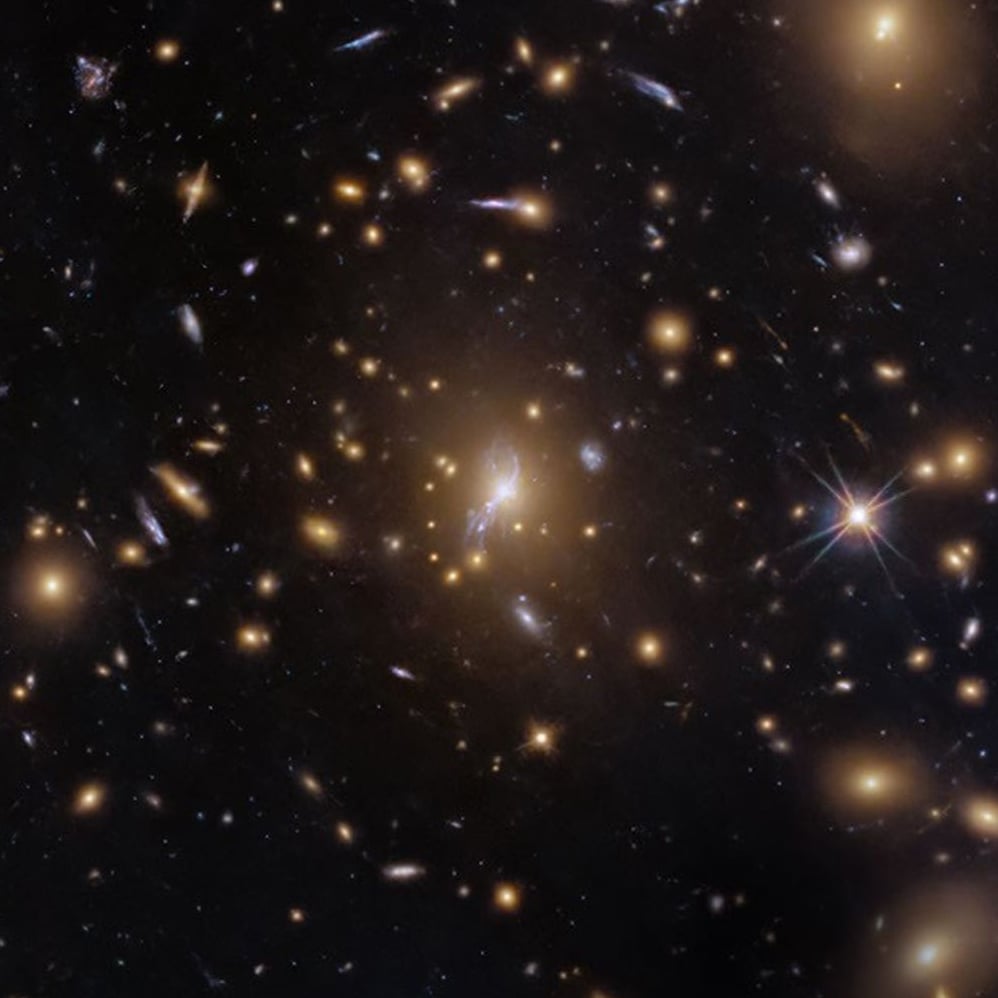
One of the most interesting features of the galaxy cluster resides near the center of the image. There, Hubble recorded a bright structure that resembles a distorted figure eight. Unlike the surrounding galaxies, this object displays an unusual shape that suggests a more complex origin.
Astronomers believe the feature likely represents a distant background galaxy whose appearance has been dramatically altered by gravitational lensing. Instead of seeing the galaxy in its original form, observers see a warped image created by the cluster’s intense gravitational field.
This process becomes particularly important when studying dark matter. Since dark matter neither emits nor reflects light, astronomers cannot observe it directly. However, they can measure its gravitational influence. Lensing features such as the figure-eight structure reveal where mass must be located to produce the observed distortions.
How Hubble produced this detailed view
The observation of MACS0329-0211 forms part of a program targeting X-ray-bright galaxy clusters. These clusters attract attention because they contain vast reservoirs of gas heated to millions of degrees. Such gas emits strongly in X-rays and reveals the presence of deep gravitational wells.
To create the image, astronomers combined observations from Hubble‘s Advanced Camera for Surveys and Wide Field Camera 3. These instruments collected data across visible and infrared wavelengths, allowing researchers to examine multiple aspects of the cluster.
Visible-light observations highlight the galaxies themselves and reveal their shapes and structures. Infrared observations help identify more distant objects whose light has shifted to longer wavelengths during its journey across the expanding universe. By combining these datasets, astronomers gain a more complete picture of both the cluster and the background galaxies affected by lensing.
Clear skies!
See more from DIYPhotography.net on Google
Add DIYPhotography.net as a trusted source. This makes
our stories more likely to appear in your Google Search results.
 Add as a preferred source on Google

Soumyadeep Mukherjee
Soumyadeep Mukherjee is an award-winning astrophotographer from India. He has a doctorate degree in Linguistics. His work extends to the sub-genres of nightscape, deep sky, solar, lunar and optical phenomenon photography. He is also a photography educator and has conducted numerous workshops. His works have appeared in over 40 books & magazines including Astronomy, BBC Sky at Night, Sky & Telescope among others, and in various websites including National Geographic, NASA, Forbes. He was the first Indian to win “Astronomy Photographer of the Year” award in a major category.

Join the Discussion
DIYP Comment Policy
Be nice, be on-topic, no personal information or flames.