


























Magnetic Avalanches: Solar Orbiter Reveals the True Origin of Solar Flares
Jan 21, 2026
Soumyadeep Mukherjee
Soumyadeep Mukherjee is an award-winning astrophotographer from India. He has a doctorate degree in Linguistics. His work extends to the sub-genres of nightscape, deep sky, solar, lunar and optical phenomenon photography. He is also a photography educator and has conducted numerous workshops. His works have appeared in over 40 books & magazines including Astronomy, BBC Sky at Night, Sky & Telescope among others, and in various websites including National Geographic, NASA, Forbes. He was the first Indian to win “Astronomy Photographer of the Year” award in a major category.
Share:
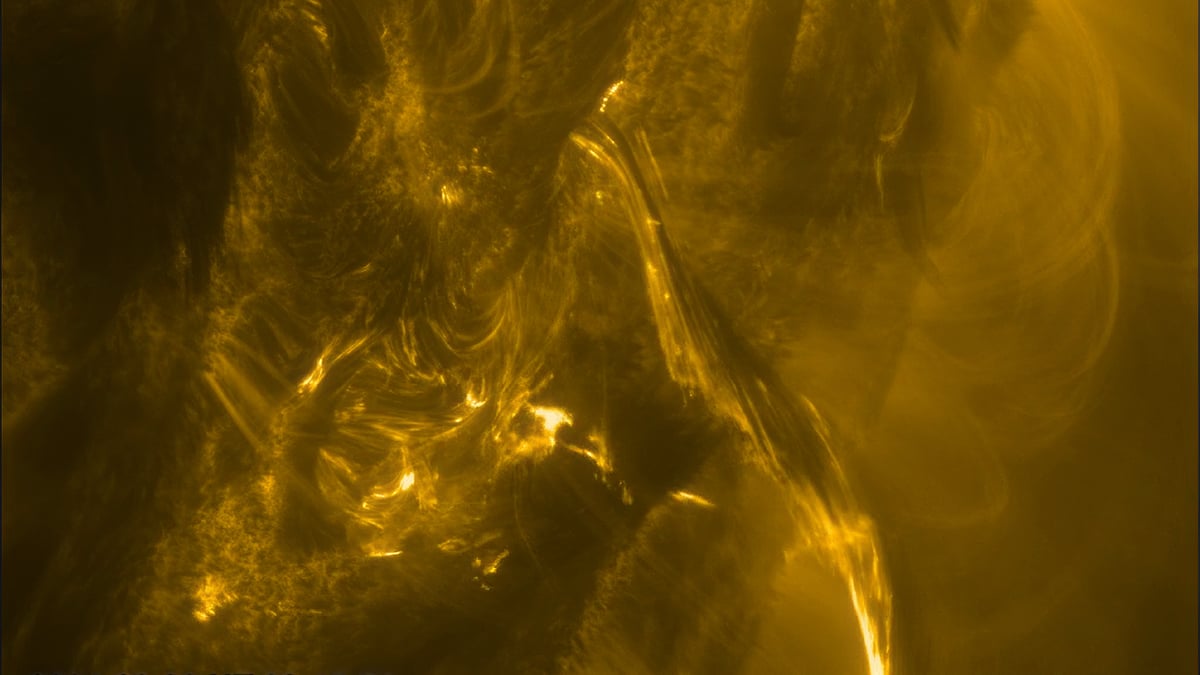
Solar flares represent the most efficient natural process for releasing magnetic energy in the solar system. Within minutes, the Sun converts stored magnetic stress into radiation, heat, and high-energy particles. Despite decades of observation and modeling, the precise mechanism that initiates this rapid energy release remained uncertain. Classical reconnection models explained where energy comes from, but not how small-scale magnetic activity grows into a global flare.
Recent observations from the Solar Orbiter mission have provided a clear answer. Using high-cadence, high-resolution imaging of the solar corona, scientists have observed a flare powered by a cascading sequence of magnetic reconnection events. These events propagate through interconnected magnetic structures in a process described as a magnetic avalanche. This marks the first time such a process has been directly observed in the Sun’s atmosphere.
The magnetic problem at the heart of solar flares
The solar corona exists in a magnetically dominated regime. Plasma follows magnetic field lines. Energy accumulates as these fields twist and shear due to motions in the photosphere below. Over time, this stored energy exceeds the stability threshold of the magnetic system.
Magnetic reconnection offers a pathway for energy release. When oppositely directed field lines break and reconnect, magnetic energy converts into heat and particle motion. However, a single reconnection event cannot account for the scale and speed of major solar flares.
Observations consistently show fragmented emission, evolving loop systems, and delayed flare onsets. These features suggest collective behavior rather than isolated triggers. For years, numerical simulations predicted that reconnection could spread through a magnetic system in a cascading manner. Until now, no instrument had sufficient resolution and cadence to verify this process observationally.

Observing a flare from its earliest stages
On 30 September 2024, Solar Orbiter recorded a major flare during a close solar pass. The spacecraft’s Extreme Ultraviolet Imager captured images every two seconds, resolving coronal structures only a few hundred kilometers wide. This allowed scientists to track the flare from its earliest magnetic reconfiguration to its peak energy release.
The first signatures appeared well before the flare itself. A dark, arch-like filament formed above the solar surface. Nearby, bright magnetic loops emerged and multiplied. With each image, additional strands became visible. These strands twisted and expanded, indicating growing magnetic stress.
Crucially, this buildup persisted for nearly forty minutes. During this phase, the system did not erupt. Instead, it accumulated instability. Small reconnection events occurred sporadically, each releasing a limited amount of energy. However, each event altered the surrounding magnetic environment. Eventually, the system reached a critical state. At that point, reconnection ceased to remain localized.

The onset of a magnetic avalanche
Once the avalanche began, reconnection events multiplied rapidly. Magnetic strands destabilized neighboring strands. Energy release accelerated. The process propagated along pre-existing magnetic connections rather than spreading randomly.
This behavior defines a magnetic avalanche. The flare did not result from a single catastrophic failure. It emerged from the interaction of many small-scale reconnection sites acting collectively.
As the avalanche progressed, plasma temperatures rose sharply. Emission intensified across extreme ultraviolet and X-ray wavelengths. Magnetic structures reorganized in real time. The flare reached peak intensity only after this cascade fully developed.
These observations match long-standing avalanche models proposed in solar physics literature. However, this marks the first time the Sun itself has revealed the process directly.

Energy transport and particle acceleration
As magnetic energy converted into kinetic energy, Solar Orbiter recorded intense particle acceleration. The Spectrometer/Telescope for Imaging X-rays measured a sharp rise in high-energy X-ray emission. This emission traced where energetic electrons impacted denser layers of the solar atmosphere.
Some electrons reached relativistic speeds, approaching half the speed of light. These particles deposited energy rapidly, heating plasma to tens of millions of degrees. This heating produced the bright flare ribbons observed near the solar surface.
At the same time, the spacecraft observed streams of dense plasma descending through the corona. These plasma blobs formed as the heated atmosphere cooled and condensed. The process continued long after the flare peak, revealing how the corona relaxes following a major energy release.
This delayed cooling phase provides critical constraints for flare modeling. It demonstrates that energy transport persists well beyond the impulsive phase.
A multi-layer view of flare evolution
One of the most significant aspects of this observation lies in its vertical coverage. Solar Orbiter did not observe the flare in isolation. It tracked the event across multiple layers of the Sun’s atmosphere.
The SPICE instrument measured temperature evolution and plasma composition. The Polarimetric and Helioseismic Imager mapped changes in the photospheric magnetic field beneath the flare. These data sets established a continuous link between surface magnetic stress and coronal energy release.
After the flare, the instruments recorded gradual magnetic relaxation. Coronal loops settled into simpler configurations. Surface magnetic fields adjusted subtly but measurably. This full atmospheric response confirms that flares restructure the Sun on multiple scales. Such a complete observational chain had never been captured before.

Implications for solar physics and space weather
The confirmation of magnetic avalanches resolves a fundamental question in solar physics. It explains how flares grow from small, distributed processes rather than single triggers. It also explains why flares often show complex timing and structure.
This understanding directly benefits space weather prediction. Avalanche behavior implies that flare-productive regions may show early warning signs through small reconnection activity. Detecting such precursors could improve forecasting accuracy.
Beyond the Sun, this result carries broader relevance. Magnetic reconnection governs plasma behavior throughout the universe. It operates in planetary magnetospheres, accretion disks, and astrophysical jets. Avalanche-driven reconnection may represent a universal energy-release mechanism. Solar Orbiter’s findings, therefore, extend well beyond heliophysics.
Solar Orbiter’s continuing contribution
The Solar Orbiter represents a new generation of solar missions. It combines proximity, resolution, and multi-instrument coordination. Since its launch in 2020, the mission has already transformed views of the solar poles, the solar wind, and coronal dynamics.
Future orbits will further tilt out of the ecliptic plane. This geometry will expose polar magnetic fields in unprecedented detail. Combined with avalanche-scale observations, these data will deepen understanding of the solar magnetic cycle itself. Each new data set refines models of solar behavior. Together, they are building a coherent physical picture of how the Sun stores, transfers, and releases energy.

The discovery of magnetic avalanches marks a conceptual shift. Solar flares no longer appear as sudden, isolated explosions. Now, they emerge as the inevitable outcome of stressed magnetic systems evolving toward instability.
Clear skies!
See more from DIYPhotography.net on Google
Add DIYPhotography.net as a trusted source. This makes
our stories more likely to appear in your Google Search results.
 Add as a preferred source on Google

Soumyadeep Mukherjee
Soumyadeep Mukherjee is an award-winning astrophotographer from India. He has a doctorate degree in Linguistics. His work extends to the sub-genres of nightscape, deep sky, solar, lunar and optical phenomenon photography. He is also a photography educator and has conducted numerous workshops. His works have appeared in over 40 books & magazines including Astronomy, BBC Sky at Night, Sky & Telescope among others, and in various websites including National Geographic, NASA, Forbes. He was the first Indian to win “Astronomy Photographer of the Year” award in a major category.



Join the Discussion
DIYP Comment Policy
Be nice, be on-topic, no personal information or flames.