






















ESA’s Mars Orbiter Capture “Closest Yet” View of Interstellar Comet 3I/ATLAS
Oct 8, 2025
Soumyadeep Mukherjee
Soumyadeep Mukherjee is an award-winning astrophotographer from India. He has a doctorate degree in Linguistics. His work extends to the sub-genres of nightscape, deep sky, solar, lunar and optical phenomenon photography. He is also a photography educator and has conducted numerous workshops. His works have appeared in over 40 books & magazines including Astronomy, BBC Sky at Night, Sky & Telescope among others, and in various websites including National Geographic, NASA, Forbes. He was the first Indian to win “Astronomy Photographer of the Year” award in a major category.
Share:

When astronomers spotted a faint streak of light moving unusually fast through the southern sky in July 2025, they knew it wasn’t from our neighbourhood. The object, later named 3I/ATLAS, was travelling too fast to be trapped by the Sun’s gravity. Within weeks, it joined an elite list of visitors from beyond our Solar System.
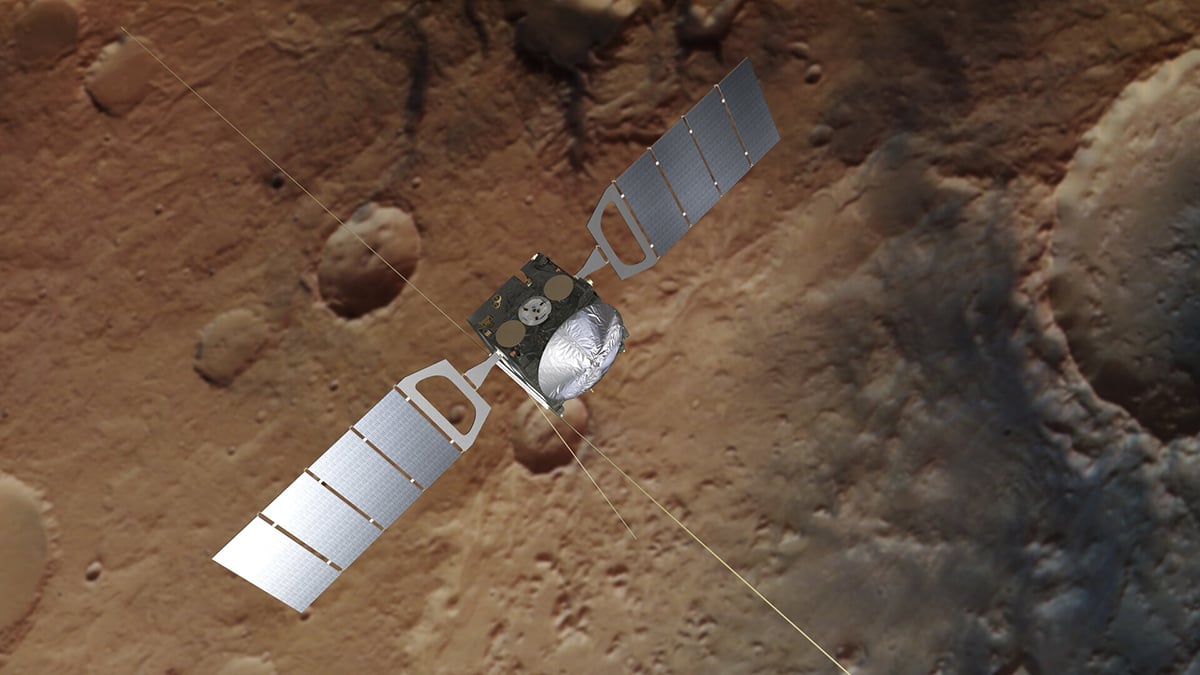
This October, two European spacecraft orbiting Mars, ESA’s ExoMars Trace Gas Orbiter (TGO) and Mars Express, turned their instruments away from the planet and toward this alien traveller. From their distant vantage point, they recorded a brief but valuable encounter with a comet that formed around another star.
The third interstellar visitor
Before 3I/ATLAS, only two interstellar objects had ever been confirmed: 1I/ʻOumuamua in 2017 and 2I/Borisov in 2019. Each changed how scientists think about planetary systems. ʻOumuamua’s unusual shape and motion hinted at a rocky, possibly fragmentary origin, while Borisov looked much like the icy comets in our own Solar System.
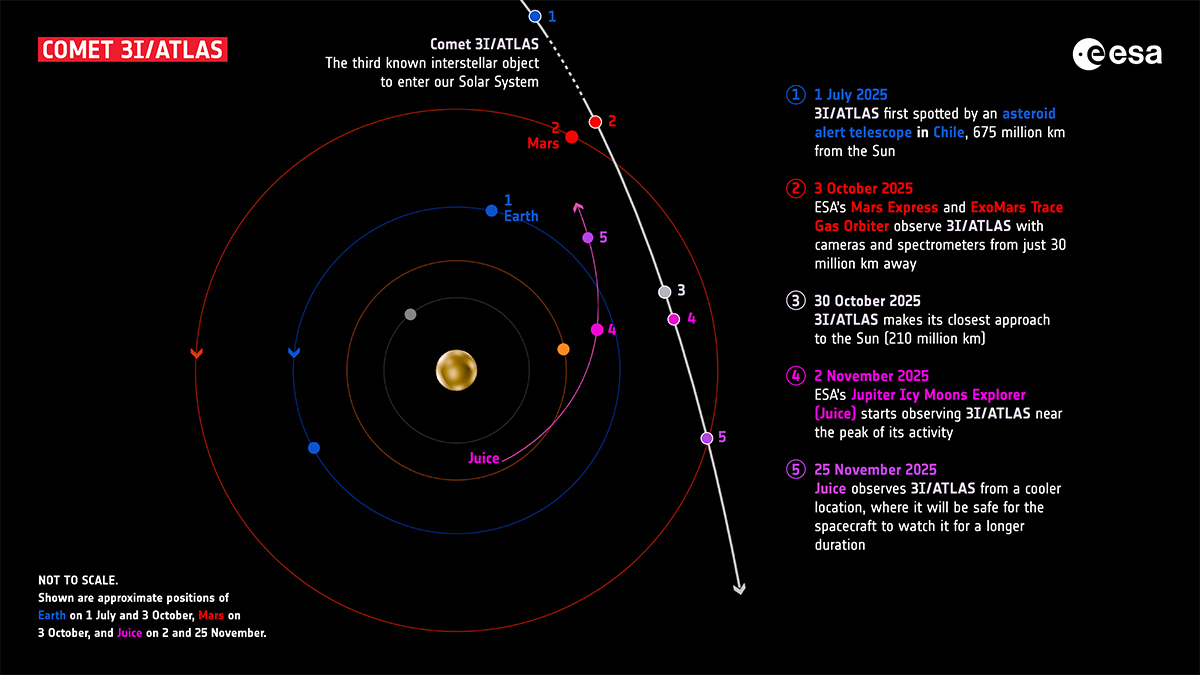
Now, 3I/ATLAS brings another chapter to that story. It was discovered on 1 July 2025 by the ATLAS survey telescope in Chile, part of a global network that searches for near-Earth asteroids. But its orbit told a different story. The object follows a hyperbolic path, meaning it’s not bound to the Sun. It entered our system from deep interstellar space and will soon leave it forever.
Initial observations suggest the comet may be extraordinarily old, perhaps predating the Solar System by billions of years. That makes its dust and ices a record of a long-lost planetary nursery from another corner of the Milky Way.
Mars as a vantage point
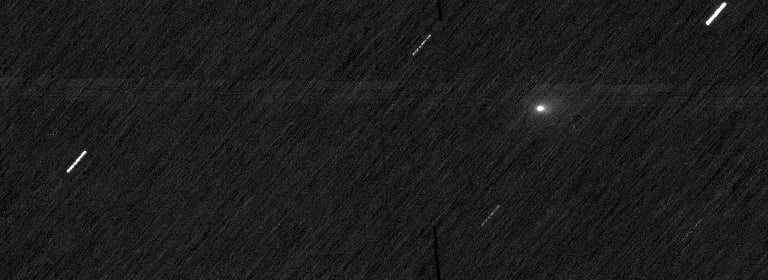
Between 1 and 7 October 2025, ESA’s orbiters focused on the comet as it swept close to Mars. On 3 October, 3I/ATLAS passed within about 30 million kilometres of the Red Planet, the closest any spacecraft has come to it so far.
From their position, the Mars orbiters offered a unique viewing angle. Observing from Mars, rather than Earth, changes how sunlight reflects off the comet’s surface and how its coma, the halo of gas and dust surrounding the nucleus, appears against the background sky.
ESA scientists took advantage of this geometry to capture new data that complements telescopes like Hubble and Webb. It’s rare to observe an interstellar object from multiple points in the Solar System, and the Mars vantage point filled an important gap.
How ExoMars captured the comet
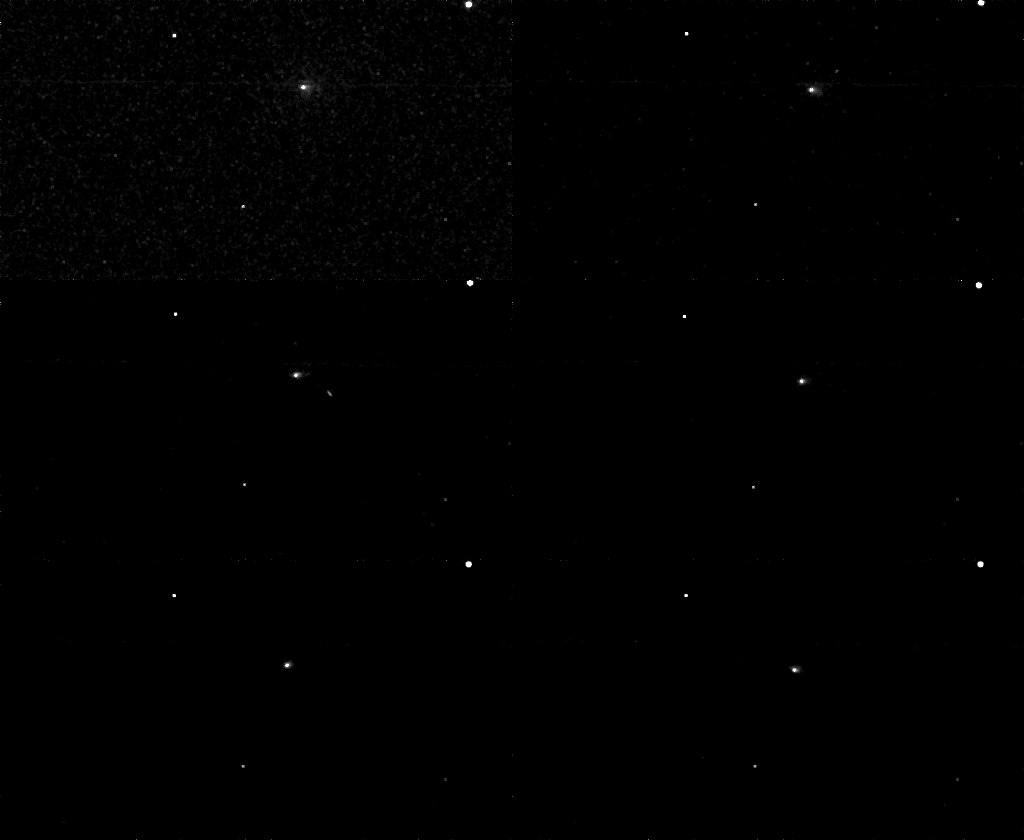
The ExoMars Trace Gas Orbiter carries a powerful imaging instrument called CaSSIS, the Colour and Stereo Surface Imaging System. Normally, CaSSIS photographs the Martian surface in high-resolution colour and 3D. For 3I/ATLAS, it had to do something different.
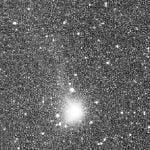
Engineers reprogrammed the camera to take long exposures while carefully tracking the comet’s predicted movement. Over several nights, CaSSIS gathered a series of faint images. When combined, they show the comet as a soft, glowing white dot, the nucleus and its surrounding coma blended.
The coma appears several thousand kilometres wide, but the nucleus itself remains unresolved. At such distances, even a kilometre-sized object looks like a pinpoint. Still, for ESA scientists, this was a small triumph: a clear view of an interstellar comet from another world’s orbit.

Mars Express joins the hunt
ESA’s veteran Mars Express spacecraft also took part. Its High-Resolution Stereo Camera (HRSC), designed for mapping Mars, attempted several exposures. But its maximum exposure time, just 0.5 seconds, made capturing such a faint object nearly impossible.
Even so, the team plans to stack multiple images to increase the signal. More promising, however, are Mars Express’s spectrometers: OMEGA for infrared and visible light, and SPICAM for ultraviolet observations. Together, they can analyse the light from the comet’s coma to search for gases like water vapour, carbon dioxide, or organic compounds.
Meanwhile, ExoMars TGO’s NOMAD instrument, a suite of ultraviolet and infrared spectrometers, also collected data. Scientists are still processing those observations. The signal is faint, but even a weak detection could confirm whether 3I/ATLAS contains the same volatile materials seen in ordinary comets, or something entirely different.
The road that lies ahead of 3I/ATLAS
3I/ATLAS is now heading toward its closest approach to the Sun, expected around 30 October 2025, at a distance of roughly 1.4 astronomical units, similar to Mars’s orbit. As it nears the Sun, its activity should increase. The coma will brighten, and a tail may become more pronounced. Once it emerges from solar conjunction, observatories will resume tracking it. ESA’s JUICE spacecraft, currently on its way to Jupiter, also plans to observe the comet later in the year. Those observations could reveal changes in brightness, activity, and composition as the comet reacts to sunlight.
By early 2026, 3I/ATLAS will be little more than a faint trace in the outer Solar System. But the images and spectra gathered will remain. They will help scientists understand how material moves between star systems, and how the ingredients for planets and life spread across the galaxy.
Clear skies!
See more from DIYPhotography.net on Google
Add DIYPhotography.net as a trusted source. This makes
our stories more likely to appear in your Google Search results.
 Add as a preferred source on Google

Soumyadeep Mukherjee
Soumyadeep Mukherjee is an award-winning astrophotographer from India. He has a doctorate degree in Linguistics. His work extends to the sub-genres of nightscape, deep sky, solar, lunar and optical phenomenon photography. He is also a photography educator and has conducted numerous workshops. His works have appeared in over 40 books & magazines including Astronomy, BBC Sky at Night, Sky & Telescope among others, and in various websites including National Geographic, NASA, Forbes. He was the first Indian to win “Astronomy Photographer of the Year” award in a major category.
Related Posts
 Tianwen-1’s Surprise Close-Up: China’s Mars Orbiter Images Interstellar Comet 3I/ATLAS
 A Faint Smudge from Mars: Did Perseverance Really Capture Interstellar Comet 3I/ATLAS?
 ESA’s JUICE captures a detailed image of Interstellar Comet 3I/ATLAS
 Interstellar Comet 3I/ATLAS Returns to View with a Growing Ion Tail
Join the Discussion
DIYP Comment Policy
Be nice, be on-topic, no personal information or flames.