


























Everybody was All Wrong About this Film Camera. It’s a Gem!
Oct 8, 2025
David Prochnow
Our resident “how-to” project editor, David Prochnow, lives on the Gulf Coast of the United States in Ocean Springs, Mississippi. He brings his expertise at making our photography projects accessible to everyone, from a lengthy stint acting as the Contributing How-To Editor with Popular Science magazine. While you don’t have to actually build each of his projects, reading about these adventures will contribute to your continued overall appreciation of do-it-yourself photography. A collection of David’s best Popular Science projects can be found in the book, “The Big Book of Hacks,” Edited by Doug Cantor.
Share:

Every camera is quirky. From the bottom-loading Leica thread mount cameras to the slide-click light meter switch on the Honeywell Pentax Spotmatic, each camera comes with its own set of pet peccadilloes that endears it to the heart of the photographer. Such is the case with the Rollei 35AF film camera. Yes, it’s quirky, but it’s also one of the great modern film cameras on today’s market. Unfortunately, it has become a lightning rod for criticism and disdain.
Regardless of these perceived personality likes/dislikes, the bottom line for every camera is the quality of its photographs. And in this respect, the Rollei 35AF could be one of the best film cameras that is currently available to modern photographers.
Don’t suffer a brain aneurism from this perceived heresy, let’s consider the four major quirks with the Rollei 35AF that many people are incorrectly citing as faults. Before we begin this in-depth study of these operational peculiarities, however, here is a brief overview of the camera.
In early September 2024, Mint Camera released its highly anticipated 35mm film camera that was a modernization of a classic camera from the 1960s. The Rollei 35AF bears a striking physical resemblance to the Rollei 35 that was released in 1966 (along with the Rollei 35S in 1974 and the Rollei 35T in 1974). And that similarity is intentional, as Mint Camera, in collaboration with Rollei, sought to instill the “highest quality standard” with “features fit for the future of film photography.” As such, they perfected the look and feel of the newest Rollei 35mm film camera in a chrome metal and leather embodiment of the vintage Rollei 35 aesthete. This is a photographer’s camera.

Forged into this physical form is an impressive automatic/manual exposure system, a multifunctional OLED screen that is visible in full sunlight, a built-in flash system, and an autofocus function that is empowered by lidar technology (light detection and ranging; sometimes spelled LIDAR or LiDAR, lidar is the suggested spelling used by the New York Times). It’s use of quality construction materials provides the Rollei 35AF with a reassuring heft that is comfortable to hold and painstakingly simple to operate.
That isn’t to say that the initial release of the Rollei 35AF wasn’t troublesome; it was, in fact, met with a harsh and cynical audience who completely misread the product’s operational quirks labeling them as faults and defects. Now, an attempted soothing balm of explanation will be applied towards the mitigation of these issues.

I’ve Got a Sticky Stroke
A faulty film advance lever is probably the biggest criticism leveled at the Rollei 35AF. While it works perfectly fine for advancing the film and arming the shutter release, it does sound/feel like the camera is tearing itself apart. These sensations are the result of three internal factors. First, the pressure plate that is holding the film smoothly and evenly against the internal light chamber is producing a strong, tight fit on the film path. This excessive pressure, which ensures film flatness, produces a potent resistance against the movement of the film advance lever.

The second factor that results in the dreadful sound as the film advance lever is advanced, is the gearing of the internal sprocket drive. This drive system has two sets of rotating teeth that engage the film’s edge sprocket holes. Again, due to the resistance exerted by the pressure plate, this sprocket drive can make a crunchy sound along with a slight jittery feeling on your thumb. Likewise, the resistance that the pressure plate exerts on the film path also makes the operation of the rewind knob equally stiff and stubborn.
Lastly, the arming of the shutter release button is activated by the movement of the film advance lever. This arming sequence has a slight resistance and an audible “click” when the shutter release button has “popped” back up into its active position. Does the film advance lever have a harsh sound and a difficult movement? Yes, it does. Does this noise and shakiness harm the camera? No, it does not. It’s just the way, this tiny Rollei camera works.

Please note: the film advance gearing mechanism does allow short-stroke “ratcheting” for moving the film and arming the shutter release button. In other words, you don’t need to make one long, strong movement of the lever to prepare the camera for a new photograph; several short strokes will work, also. A word of caution, however, this ratchet technique can be difficult to master. Please practice short strokes without film in the camera before you try it in the field.
A Forced Removal
In a strong second place with the “faulty” film advance lever complaint, is the perceived sloppy, incorrect removal and closing of the camera’s back cover. While it should be obvious and not require any elaboration, the back cover of this camera is a light-tight, channeled and grooved system that cleverly blocks out light without using any messy foam inserts. As such, preparing the back cover for film insertion and removal is a very tight fit. Some careful pressing along the top of the back edge will ensure that the cover slips properly into place.
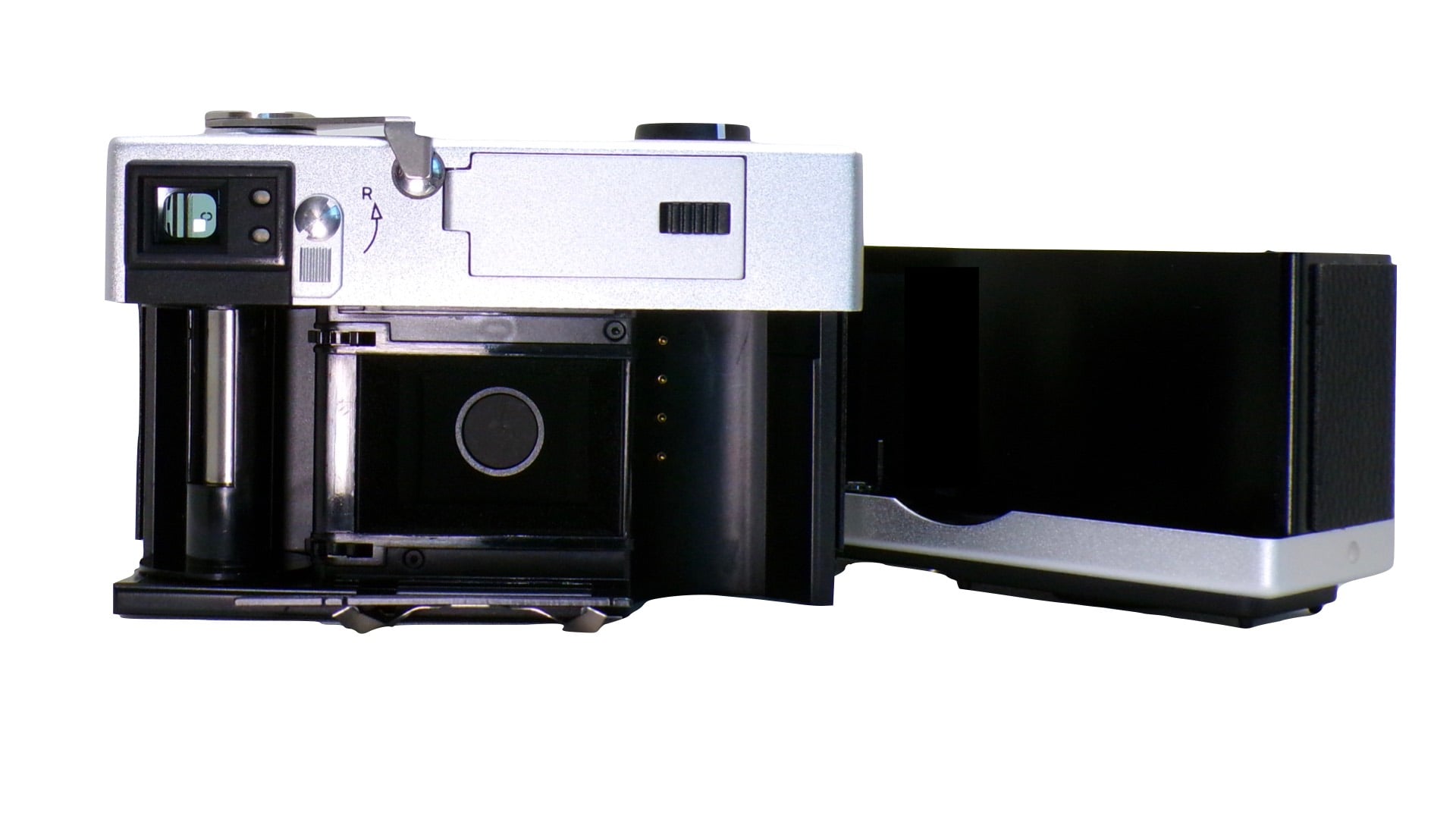
Your best recourse for learning how to successfully remove and replace the camera back is to practice, practice, and practice. There are two significant sticking points that can thwart your easy operation of the back. First, and foremost, the pressure plate is pushing against the back. Yes, this is the same pressure plate that adds resistance to the film advance lever movement. In this case, however, the silver spring bars on the outside of the pressure plate are pushing against the back as you try to slide it into place. Therefore, a slight amount of pressing on the middle of the camera back while sliding it into place can help to compress the pressure plate and ease your installation/removal of the camera back.

Your second, and final, sticking point on the camera back is due to the two small finger slots that slide into the main camera light-tight grooves. These slots are located at the top edge of the back’s two side panels. Carefully, align these slots into the grooves prior to sliding the back up and into the top of the camera body. Again, this is a well-designed system for ensuring that the film is completely isolated from stray light leaks. Well done, Mint Camera and Rollei.
Push, Then Push Some More
If you notice that your photographs are blurry or out of focus, the culprit might be a quirk with the shutter button. While most photographers are well-versed in the “half-press” of the shutter button being an action for initiating the camera’s autofocus system, the Rollei 35AF carries this technique one step further. Following the halfway depression of the shutter release button, you must continue pressing the shutter button further, a lot further, until the exposure is properly made. In fact, you must depress the shutter release slightly beyond the black plastic collar that surrounds the button.

All-in-all, the complete operation of the Rollei 35AF shutter requires two solid robust presses of the shutter button for taking a photograph. A strong fingertip with continued pressure is essential for operating this odd shutter release system.
Thankfully, there are two clearly audible noises that accompany both of the shutter button actions. First, the autofocus system engages a rather noisy motor for moving the lens into focus. This is a “whirring” noise. Once, the focus is fixed, the second audible cue is the movement of the aperture blades and the firing of the shutter. This noise is a very distinct “click.” Once you’ve heard the lens move, followed by the “click” of the exposure, then you’ll know that you’ve captured your image. Just don’t release your shutter finger press or jiggle the camera until you’ve heard the magical: whirr … click.
Get that Grip Right
Finally, our last endearing quirk of the Rollei 35AF relates to how you hold the camera for photography. The small circular glass window on the front of the camera below the flash is the exposure meter cell. Holding the camera with your left hand while using a lazy or sloppy finger placement can obstruct the exposure meter. Oops; your photographs are not going to be properly exposed in Automatic (A) mode unless you keep your fingers away from that meter window.

Yes, the Rollei 35AF is an oddball camera. Despite these anomalies, however, this is a competent camera that will slowly endear itself to your heart. It is remarkable for being a modern 35mm film camera that can handle automatic exposures, as well as manual adjustments with equal aplomb. Couple these two attributes with an incredibly small form factor and you have the ultimate “take everywhere, do everything” film camera. First, though, you’ll have to master a small “handful” of unique operational features that will then make you into a real, bona fide film-slinger that other camera users will envy.
Enjoy.
See more from DIYPhotography.net on Google
Add DIYPhotography.net as a trusted source. This makes
our stories more likely to appear in your Google Search results.
 Add as a preferred source on Google

David Prochnow
Our resident “how-to” project editor, David Prochnow, lives on the Gulf Coast of the United States in Ocean Springs, Mississippi. He brings his expertise at making our photography projects accessible to everyone, from a lengthy stint acting as the Contributing How-To Editor with Popular Science magazine. While you don’t have to actually build each of his projects, reading about these adventures will contribute to your continued overall appreciation of do-it-yourself photography. A collection of David’s best Popular Science projects can be found in the book, “The Big Book of Hacks,” Edited by Doug Cantor.


Join the Discussion
DIYP Comment Policy
Be nice, be on-topic, no personal information or flames.