


















Proba-3’s Artificial Eclipse Delivers the Clearest View of the Sun’s Inner Corona
Jan 23, 2026
Soumyadeep Mukherjee
Soumyadeep Mukherjee is an award-winning astrophotographer from India. He has a doctorate degree in Linguistics. His work extends to the sub-genres of nightscape, deep sky, solar, lunar and optical phenomenon photography. He is also a photography educator and has conducted numerous workshops. His works have appeared in over 40 books & magazines including Astronomy, BBC Sky at Night, Sky & Telescope among others, and in various websites including National Geographic, NASA, Forbes. He was the first Indian to win “Astronomy Photographer of the Year” award in a major category.
Share:

Observing the Sun’s inner corona has long been one of the most persistent technical challenges in solar physics. The region lies just beyond the visible solar photosphere, yet its faint emission is overwhelmed by the Sun’s intense glare. Traditional coronagraphs reduce this brightness, but residual stray light has always limited how close instruments can observe to the solar limb. As a result, scientists have struggled to study the dynamic boundary where the Sun’s magnetic atmosphere transitions into the extended corona.
A few days back, the European Space Agency’s Proba-3 mission overcame this limitation. By flying two spacecraft in precision formation, the mission created the first stable, long-duration artificial solar eclipse in orbit. A newly released animation now reveals the Sun’s inner corona evolving over hours, capturing erupting prominences and faint coronal structures in unprecedented detail. This dataset marks a significant step forward in understanding how the Sun’s outer atmosphere behaves, heats, and expels matter into space.
The inner corona of the sun
The Sun’s corona extends millions of kilometres into space, but the inner corona plays a unique physical role. It acts as the bridge between the Sun’s visible surface and the outer solar wind. Magnetic fields in this region guide plasma motion, store energy, and trigger eruptions that can influence interplanetary space.
One of the central puzzles in solar science remains the coronal heating problem. While the Sun’s surface temperature measures roughly 5,500 degrees Celsius, the corona exceeds one million degrees. This inversion contradicts basic thermal expectations. Researchers suspect magnetic reconnection, wave heating, and turbulence contribute to this temperature rise, but direct evidence remains incomplete.
Studying this region has proven difficult because scattered sunlight masks faint coronal emission. Natural solar eclipses briefly remove this glare, but they occur rarely and last only minutes. Space-based coronagraphs improve on this, yet internal light scattering still limits their view of the innermost structures. Proba-3 addresses this gap by separating the occulter from the imaging instrument in physical space.

How Proba-3 creates a stable eclipse in space
Proba-3 operates as a dual-satellite system. One spacecraft carries a precisely shaped occulting disc designed to block the Sun. The second carries the ASPIICS coronagraph, positioned roughly 150 metres behind the first. When the two spacecraft align, the occulter casts a clean shadow across the imaging instrument.
This geometry drastically reduces stray light. As a result, the coronagraph can observe extremely close to the solar limb while maintaining high contrast.
Maintaining this formation requires remarkable precision. The satellites rely on laser ranging, star trackers, autonomous guidance software, and continuous micro-thruster adjustments. Their relative position must remain accurate within millimetres. Any misalignment would degrade the eclipse effect.
This level of formation flying had never been sustained before in orbit. Although ESA designed Proba-3 partly as a technology demonstration, the mission has already proven its scientific value.

A new view of the inner corona
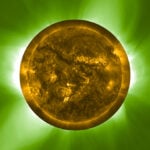
The animation released by ESA merges two complementary data streams. NASA’s Solar Dynamics Observatory provides the bright solar disc, offering context and scale. Proba-3 supplies the faint inner corona, rendered in a soft yellow tone that matches visible-light scattering by coronal electrons.
Unlike static eclipse images, this sequence tracks the corona over several hours. The structures shift gradually. Streamers stretch outward. Bright arcs evolve along magnetic boundaries. Most notably, three large solar prominences rise and erupt from the Sun’s edge.
Each prominence contains dense plasma suspended above the surface by magnetic fields. Although cooler than the surrounding corona, these structures remain extremely hot by terrestrial standards. When the magnetic configuration destabilises, the trapped plasma accelerates outward into space.
Proba-3 records this entire process without interruption. The resulting dataset preserves temporal continuity, allowing scientists to examine cause-and-effect relationships rather than isolated snapshots.

Prominences, magnetic fields, and coronal response
Solar prominences serve as natural tracers of magnetic field behaviour. Their shape reflects field geometry, the motion reveals magnetic stress, and their eruption marks a magnetic reconfiguration. In Proba-3’s imagery, prominence eruptions do not occur in isolation. Each event disturbs the surrounding coronal structures. Nearby streamers shift, and brightness patterns change. Density structures ripple outward.
These responses suggest strong coupling between local magnetic loops and the broader coronal environment. Earlier missions hinted at this interaction, but lacked the continuous coverage needed to track it in detail.
Visible-light coronagraphy also offers an advantage over extreme-ultraviolet imaging. It traces electron density rather than temperature alone. This enables researchers to estimate mass flow, measure density gradients, and track plasma displacement with greater accuracy. Proba-3, therefore, provides both structural and quantitative insight into how solar material moves during eruptive events.

Closing a long-standing observational gap
Most solar missions focus on either the Sun’s surface or the far-outer corona. Instruments that image the photosphere capture sunspots, flares, and magnetic fields at high resolution. Meanwhile, traditional space coronagraphs observe the outer corona where coronal mass ejections propagate.
The inner corona, however, remained poorly sampled. It represents the transition zone where magnetic energy converts into kinetic and thermal energy. Without sustained observations in this region, models of coronal heating and solar wind acceleration remained incomplete.
Proba-3 fills this missing observational layer. Its external occulting design allows imaging closer to the Sun’s edge than previous coronagraphs. This reveals faint structures that were previously lost in glare. As a result, scientists can now test theoretical predictions against direct visual evidence.

Proba-3 does not operate in isolation. It complements several other major solar missions. NASA’s Parker Solar Probe measures particles and magnetic fields directly within the outer corona. ESA’s Solar Orbiter observes the Sun from unique orbital angles, including polar perspectives. Ground-based observatories such as the Daniel K. Inouye Solar Telescope resolve fine surface details at unprecedented spatial resolution.
Clear skies!
See more from DIYPhotography.net on Google
Add DIYPhotography.net as a trusted source. This makes
our stories more likely to appear in your Google Search results.
 Add as a preferred source on Google

Soumyadeep Mukherjee
Soumyadeep Mukherjee is an award-winning astrophotographer from India. He has a doctorate degree in Linguistics. His work extends to the sub-genres of nightscape, deep sky, solar, lunar and optical phenomenon photography. He is also a photography educator and has conducted numerous workshops. His works have appeared in over 40 books & magazines including Astronomy, BBC Sky at Night, Sky & Telescope among others, and in various websites including National Geographic, NASA, Forbes. He was the first Indian to win “Astronomy Photographer of the Year” award in a major category.


Join the Discussion
DIYP Comment Policy
Be nice, be on-topic, no personal information or flames.