


















A Bat in the Sky: ESO Releases New Image of the RCW 94/95 Nebulae
Nov 1, 2025
Soumyadeep Mukherjee
Soumyadeep Mukherjee is an award-winning astrophotographer from India. He has a doctorate degree in Linguistics. His work extends to the sub-genres of nightscape, deep sky, solar, lunar and optical phenomenon photography. He is also a photography educator and has conducted numerous workshops. His works have appeared in over 40 books & magazines including Astronomy, BBC Sky at Night, Sky & Telescope among others, and in various websites including National Geographic, NASA, Forbes. He was the first Indian to win “Astronomy Photographer of the Year” award in a major category.
Share:
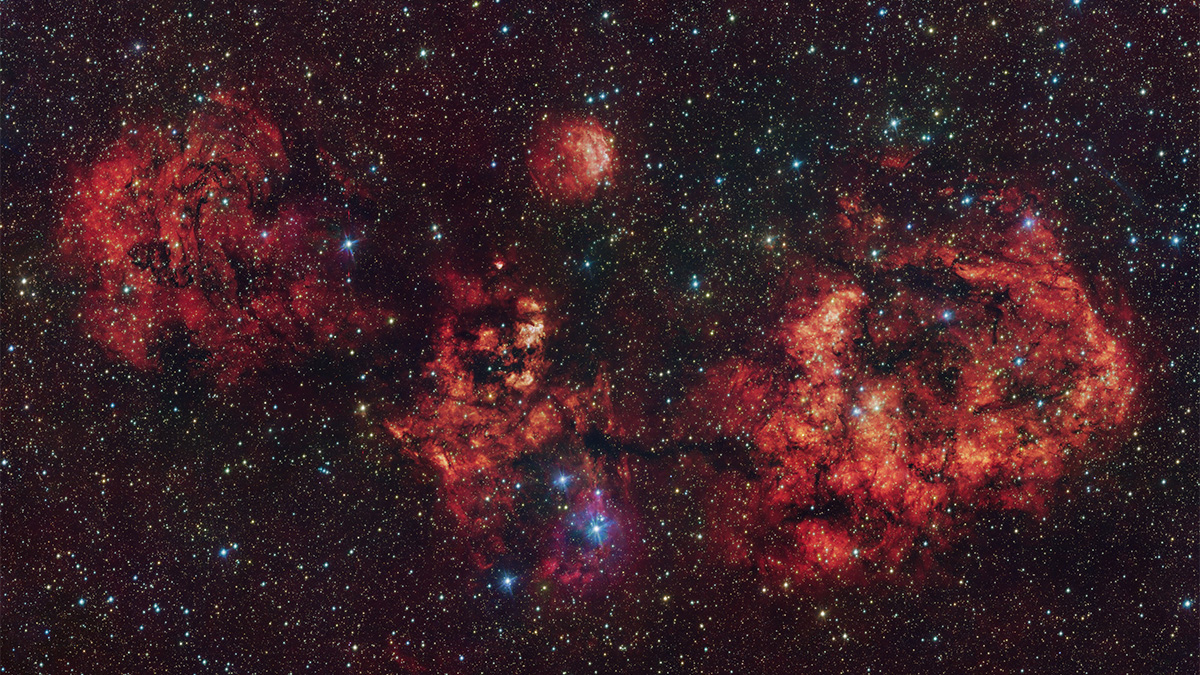
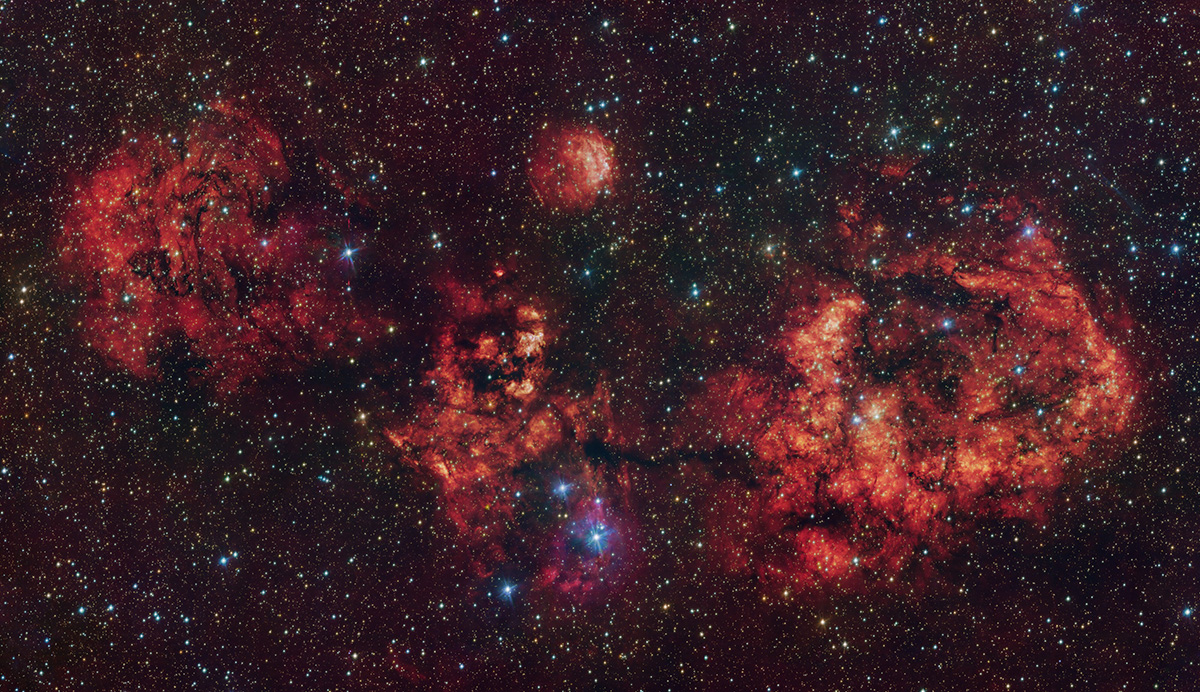
The European Southern Observatory (ESO) has released a new image that looks straight out of a Halloween story. A glowing red cloud spreads across space, shaped like a bat flying through the dark. But this is no spooky myth. It’s a real region of the Milky Way, two vast clouds of gas and dust known as RCW 94 and RCW 95. Captured in visible and infrared light from Chile’s Paranal Observatory, the image reveals the restless beauty of star formation at a scale few telescopes can match.
A new look at familiar skies
RCW 94 and RCW 95 lie within our galaxy, in a busy part of the southern Milky Way. These nebulae are regions of glowing hydrogen gas, shaped by young, massive stars. To the naked eye, they are invisible. But to ESO’s cameras, they blaze with light and structure.
The new image combines data from two world-class survey telescopes: the VLT Survey Telescope (VST) and the Visible and Infrared Survey Telescope for Astronomy (VISTA). Both are located at Paranal in northern Chile, one of the driest and clearest places on Earth.
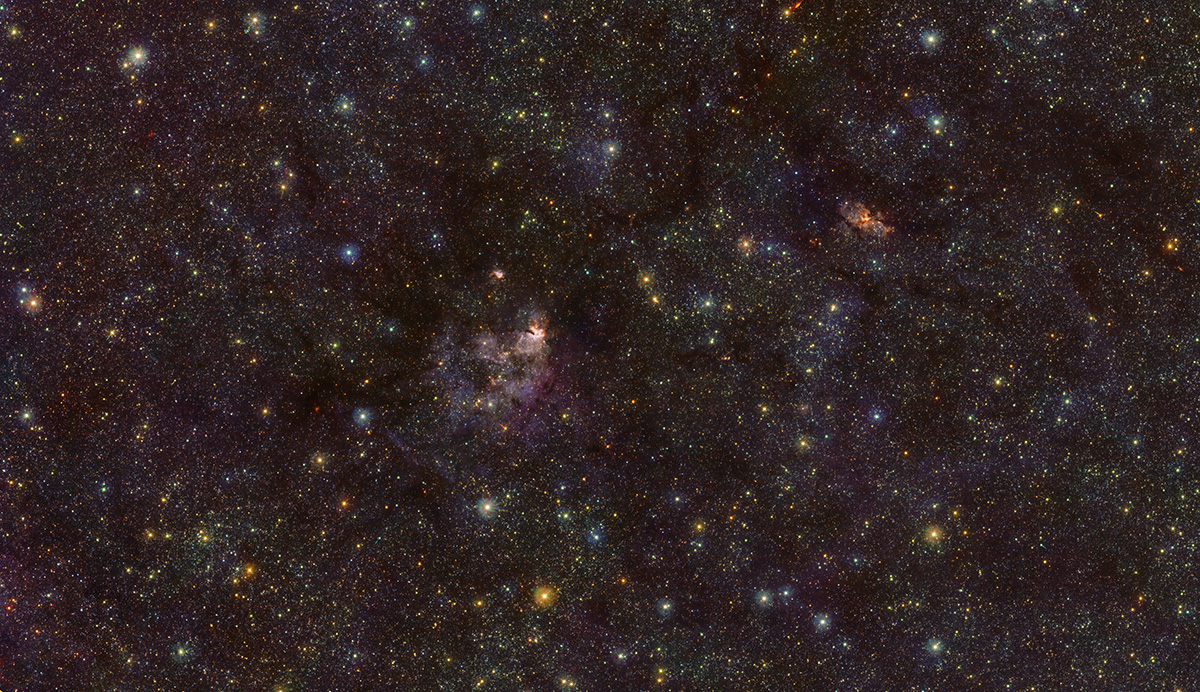
The VST captured the nebulae in visible light, highlighting the bright red hydrogen emissions. VISTA added an infrared view that reveals stars and filaments hidden behind the dust. When the two images are blended, they create a layered portrait, one that shows what human eyes can see and what lies beyond.
The cosmic bat
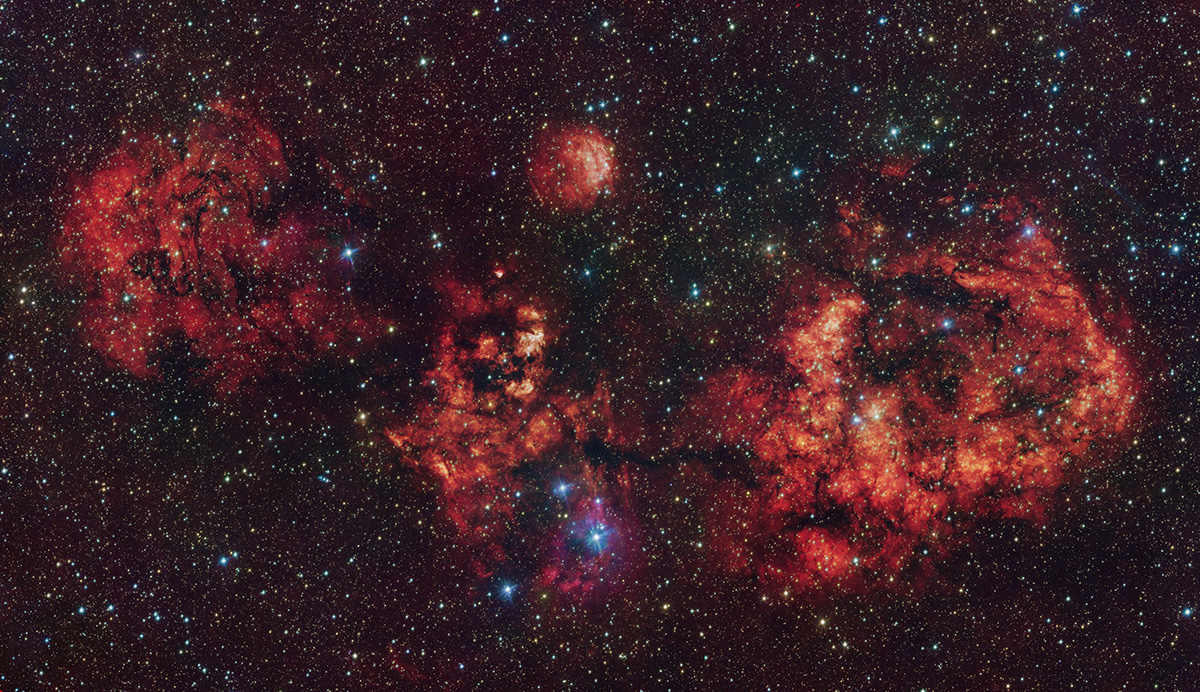
At first glance, the cloud looks eerily familiar. Two broad red wings seem to stretch outward, while a darker center resembles a bat’s body. This pattern isn’t a trick or an artistic addition; it’s how the nebula really appears in visible light.
The “right wing” corresponds to RCW 94, while the central region, containing denser gas and dust, is RCW 95. The glowing gas outlines the areas where young stars have carved out cavities in their surroundings. Ultraviolet light from these stars ionizes the surrounding hydrogen gas, causing it to glow. The dark lanes are thick dust clouds, which block visible light and give the nebula its haunting shape.
When seen in infrared, the image changes. The dark wings become more transparent. Stars emerge from behind the veil of dust. It demonstrates how much of our galaxy remains hidden in visible light.
What’s really happening inside
RCW 94 and RCW 95 are H II regions, vast zones of ionized hydrogen gas. These regions are nurseries of star formation. Young, hot stars pump out ultraviolet radiation that excites the gas around them. As the electrons and protons recombine, they emit light, most strongly at the hydrogen-alpha wavelength.
That familiar red glow you see in the image comes from this process. It’s a sign of energy and change. Inside the nebulae, stars are being born, while radiation and stellar winds shape their surroundings.
Dust plays its part, too. It absorbs and scatters light, making parts of the cloud appear dark. But in infrared light, dust becomes nearly transparent. Infrared imaging allows astronomers to see embedded clusters, stars that are still forming, or newly born. That’s why combining visible and infrared views gives such a complete picture of what’s going on.
The instruments behind the image
The VST and VISTA are both dedicated survey telescopes, designed to map large sections of the sky. The VST has a 2.6-meter mirror and a wide field of view, making it ideal for capturing large nebulae. Its OmegaCAM instrument can record enormous mosaics, each with billions of pixels.
VISTA, on the other hand, works in the infrared. Its 4.1-meter mirror collects longer wavelengths of light, which penetrate dust and reveal cooler objects. Together, these two instruments complement each other perfectly, one seeing what the eye can, the other seeing what the eye cannot.
Visible light shows where gas is actively glowing. Infrared reveals hidden stars and dust structures. Radio and submillimeter observations, taken by other observatories, can even show the cold molecular clouds where future stars will form. By combining all of these, scientists can understand how regions like RCW 94/95 evolve over millions of years.
A vast and busy neighborhood
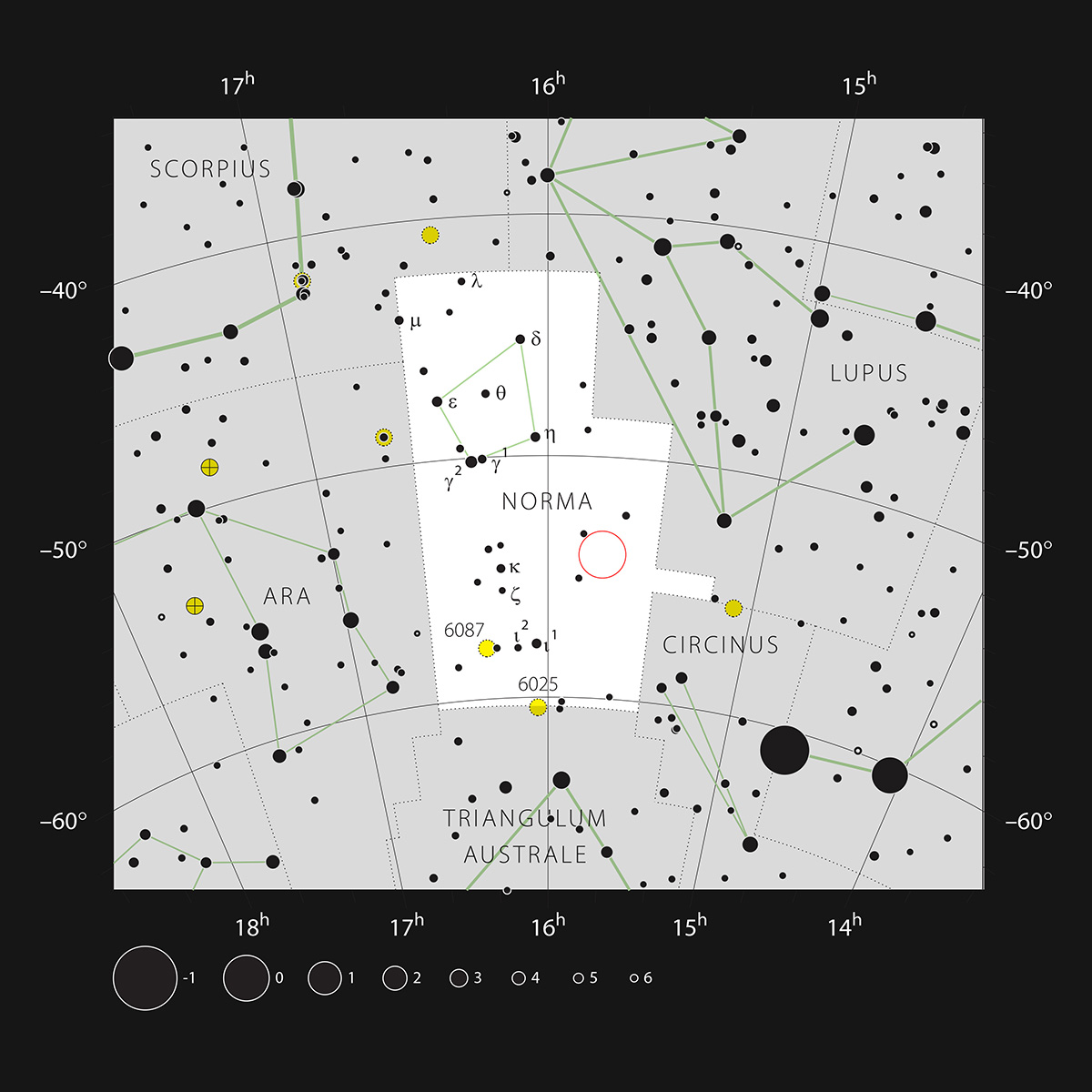
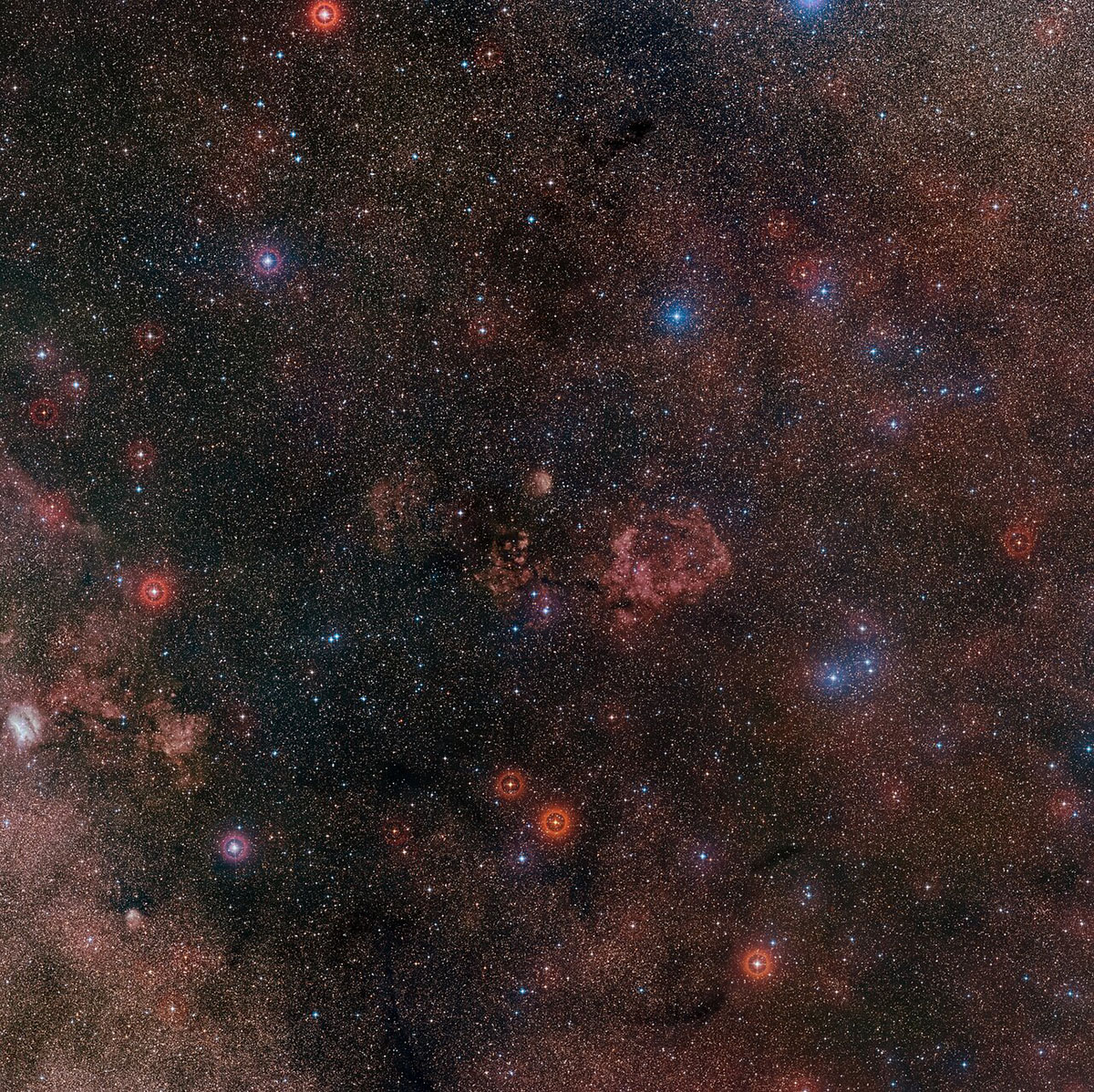
The field shown in ESO’s release is huge, several degrees across, or about four times the width of the full Moon. The nebulae lie within the Norma arm of the Milky Way, one of the galaxy’s major spiral arms. This region is crowded with gas clouds, young clusters, and dark filaments. In the ESO image, the density of background stars is striking. The Milky Way’s disk runs through the frame, filling it with points of light. Between them, the red arcs of gas stand out like veins of glowing fire. The contrast between the warm hydrogen and the cooler dust gives the whole image its structure.
RCW 94 and RCW 95 are not famous targets like Orion or Carina. Yet they hold the same scientific and visual importance. They show how star formation reshapes the galaxy. They highlight how ultraviolet radiation interacts with gas and dust. These nebulae sit tens of thousands of light-years away, still well within our Milky Way. That distance means the light we see today began its journey before humans existed. Yet the processes happening there are timeless: stars forming, clouds glowing, dust shifting under radiation.
Clear skies!
See more from DIYPhotography.net on Google
Add DIYPhotography.net as a trusted source. This makes
our stories more likely to appear in your Google Search results.
 Add as a preferred source on Google

Soumyadeep Mukherjee
Soumyadeep Mukherjee is an award-winning astrophotographer from India. He has a doctorate degree in Linguistics. His work extends to the sub-genres of nightscape, deep sky, solar, lunar and optical phenomenon photography. He is also a photography educator and has conducted numerous workshops. His works have appeared in over 40 books & magazines including Astronomy, BBC Sky at Night, Sky & Telescope among others, and in various websites including National Geographic, NASA, Forbes. He was the first Indian to win “Astronomy Photographer of the Year” award in a major category.

Join the Discussion
DIYP Comment Policy
Be nice, be on-topic, no personal information or flames.