
























JWST Detects Massive Black Holes Growing Ahead of Host Galaxies
May 27, 2026
Soumyadeep Mukherjee
Soumyadeep Mukherjee is an award-winning astrophotographer from India. He has a doctorate degree in Linguistics. His work extends to the sub-genres of nightscape, deep sky, solar, lunar and optical phenomenon photography. He is also a photography educator and has conducted numerous workshops. His works have appeared in over 40 books & magazines including Astronomy, BBC Sky at Night, Sky & Telescope among others, and in various websites including National Geographic, NASA, Forbes. He was the first Indian to win “Astronomy Photographer of the Year” award in a major category.
Share:
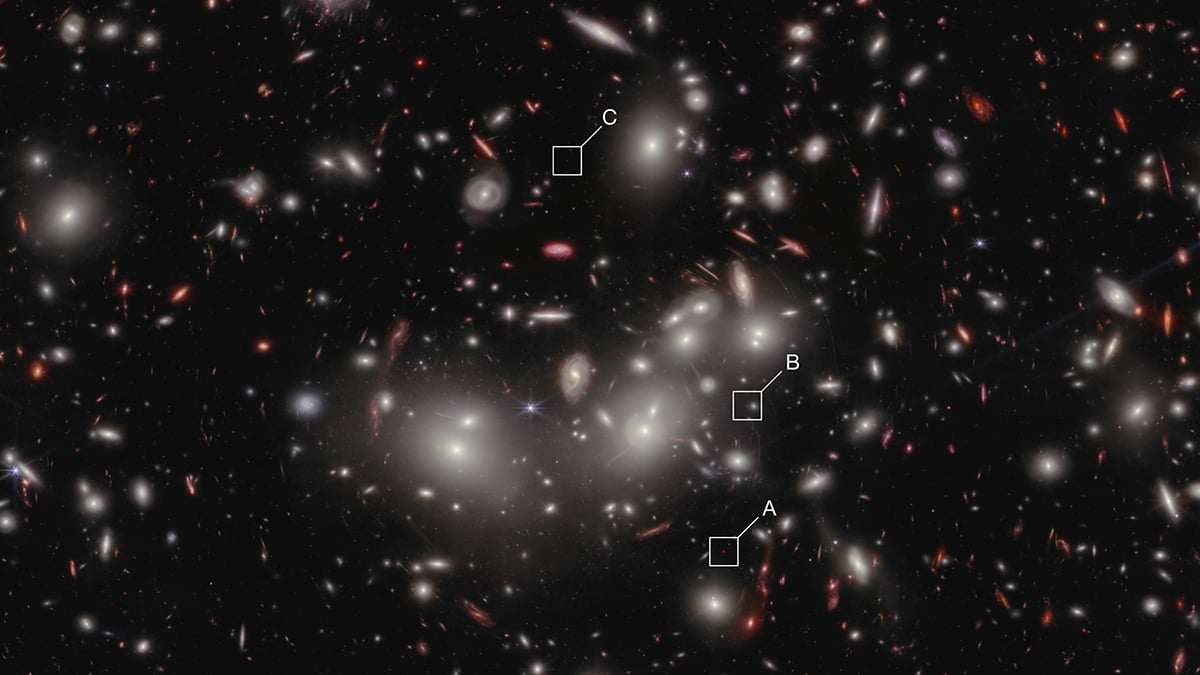
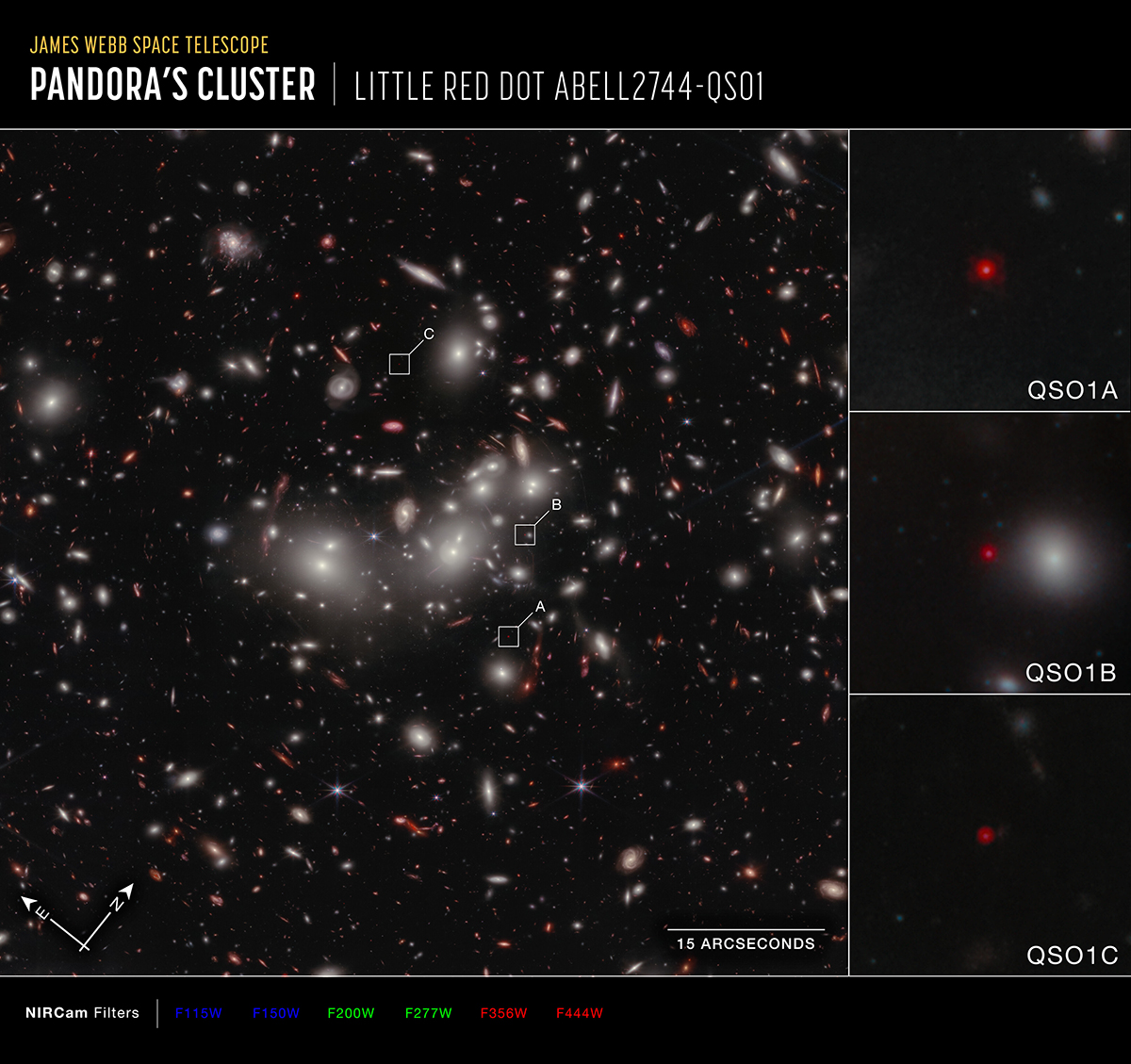
The James Webb Space Telescope has identified one of the strongest pieces of evidence that giant black holes formed extremely early in cosmic history. Astronomers studying a distant object known as Abell2744-QSO1 found a rapidly growing supermassive black hole inside a compact young galaxy that existed less than a billion years after the Big Bang. The discovery is forcing researchers to re-examine how black holes and galaxies evolved during the universe’s earliest stages.
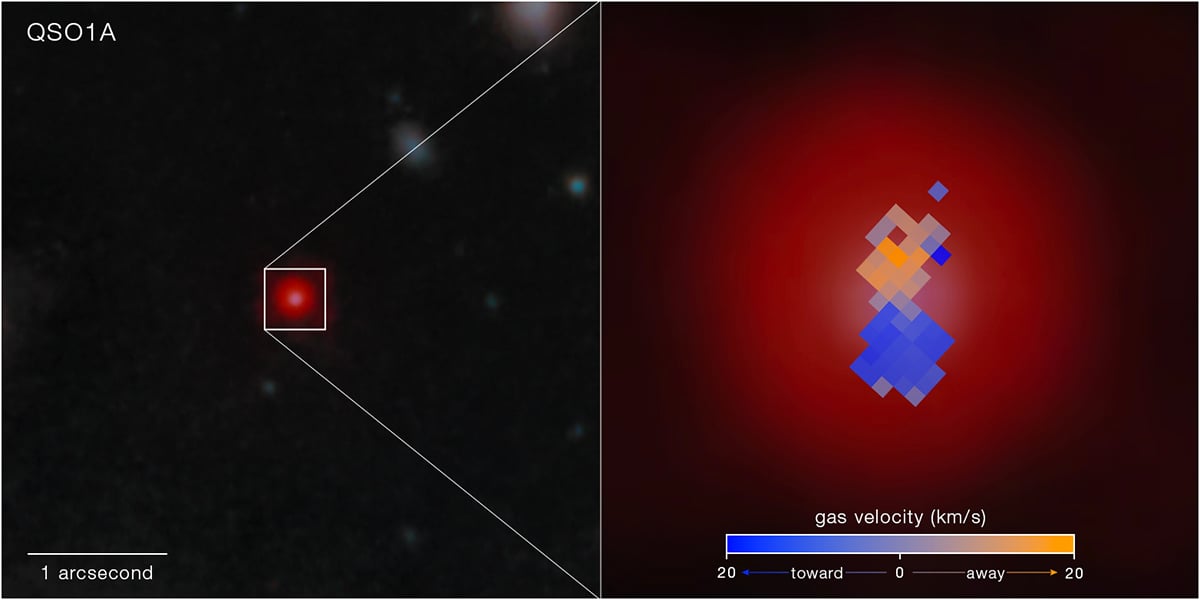
The observations came from JWST’s infrared instruments, which can study galaxies that formed during the first few hundred million years of cosmic history. Researchers analyzed gas motion near the center of Abell2744-QSO1 and discovered signs of an actively feeding black hole with a mass estimated at around 50 million times the mass of the Sun. The surrounding galaxy, however, appears surprisingly small and chemically rudimentary.
A more developed Black Hole than the galaxy
One of the most important aspects of the discovery involves the condition of the surrounding galaxy itself. JWST’s observations suggest that Abell2744-QSO1 remains chemically young despite hosting a rapidly growing black hole.
Astronomers use the term metallicity to describe the abundance of elements heavier than hydrogen and helium inside galaxies. These heavier elements form inside stars through nuclear fusion and later spread into space through stellar winds and supernova explosions. As galaxies evolve, repeated generations of stars gradually enrich the surrounding gas with heavier elements.
The JWST observations indicate that Abell2744-QSO1 contains extremely low metallicity. Researchers estimate that the galaxy possesses less than 0.5% of the Sun’s metal abundance. That makes it one of the most chemically rudimentary galactic environments yet observed.
In nearby galaxies, astronomers usually observe a close relationship between stellar mass and black hole mass. Larger galaxies host larger black holes, while smaller galaxies contain smaller ones. Decades of observations supported the idea that galaxies and their central black holes evolved together over billions of years. However, Abell2744-QSO1 does not fit within that picture.
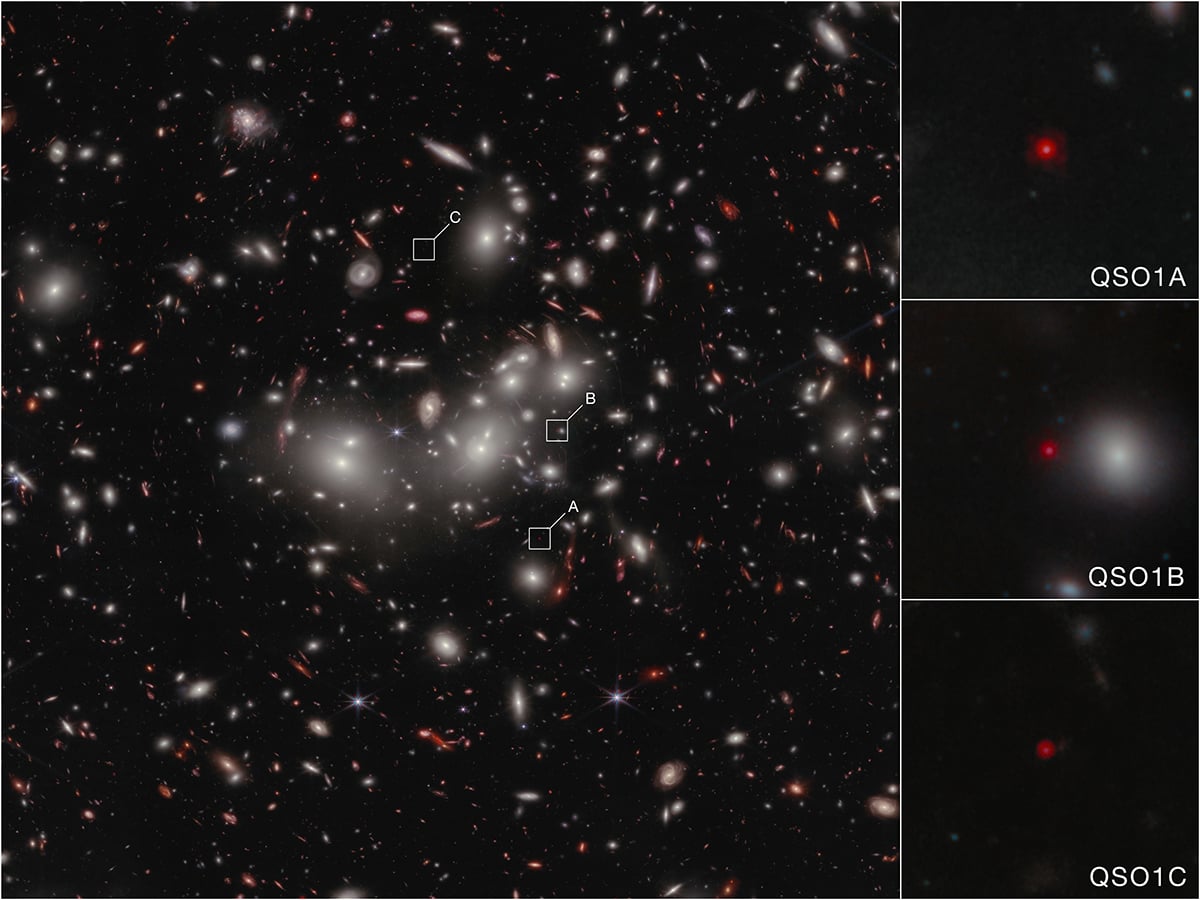
Three Little Red Dots
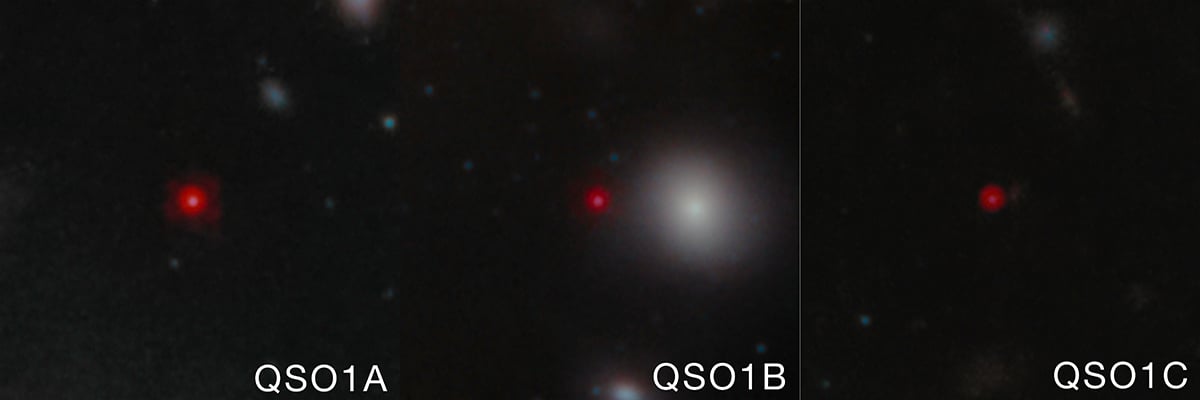
The JWST observations identified three separate Little Red Dot systems within the same field of view. Researchers labelled them as Abell 2744-QSO1, Abell 2744-QSO2, and Abell 2744-QSO3. All three appear compact, red, and unusually bright in infrared wavelengths.
Abell2744-QSO1 became the most important target because JWST detected strong evidence for an actively feeding supermassive black hole. Spectroscopic measurements showed fast-moving gas orbiting the central region, which allowed researchers to estimate the black hole’s mass. The host galaxy itself still appears chemically rudimentary and relatively compact, making the system especially unusual.
The second object, Abell2744-QSO2, looks somewhat different. JWST detected signs of active growth there as well, although the galaxy appears more evolved compared to QSO1. Researchers found stronger evidence for ongoing star formation and a slightly richer chemical environment. That suggests the galaxy may have progressed further in its evolutionary history.
Meanwhile, Abell2744-QSO3 appears even more mature. The object contains a more developed stellar structure and shows stronger signs of chemical enrichment from previous generations of stars. Its infrared emission still points toward black hole activity, but the balance between the galaxy and its central black hole looks closer to what astronomers observe in later cosmic epochs.
Reviving interest in Direct-Collapse Black Holes
Astronomers have debated the origin of supermassive black holes for decades. Standard black hole formation models begin with massive stars. When those stars exhaust their nuclear fuel, they collapse and leave behind stellar-mass black holes containing only a few times the Sun’s mass. Over long periods, those black holes grow by accreting gas and merging with other black holes.
The early universe may not have been old enough for ordinary stellar remnants to grow into giant black holes through standard processes alone. Researchers already faced this issue after discovering distant quasars containing billion-solar-mass black holes less than a billion years after the Big Bang.
In the case of Abell2744-QSO1, the black hole appears too massive compared to the surrounding galaxy for standard stellar-seed growth to fully explain the observations. One leading possibility involves direct-collapse black holes. In this scenario, enormous clouds of primordial hydrogen gas collapse almost entirely into black holes without first forming normal stars. Such a process could produce black hole seeds containing tens of thousands or even hundreds of thousands of solar masses very early in cosmic history.
Clear skies!
See more from DIYPhotography.net on Google
Add DIYPhotography.net as a trusted source. This makes
our stories more likely to appear in your Google Search results.
 Add as a preferred source on Google

Soumyadeep Mukherjee
Soumyadeep Mukherjee is an award-winning astrophotographer from India. He has a doctorate degree in Linguistics. His work extends to the sub-genres of nightscape, deep sky, solar, lunar and optical phenomenon photography. He is also a photography educator and has conducted numerous workshops. His works have appeared in over 40 books & magazines including Astronomy, BBC Sky at Night, Sky & Telescope among others, and in various websites including National Geographic, NASA, Forbes. He was the first Indian to win “Astronomy Photographer of the Year” award in a major category.

Join the Discussion
DIYP Comment Policy
Be nice, be on-topic, no personal information or flames.