




















NASA’s James Webb Reveals the Hidden Heart of Centaurus A
Jul 9, 2026
Soumyadeep Mukherjee
Soumyadeep Mukherjee is an award-winning astrophotographer from India. He has a doctorate degree in Linguistics. His work extends to the sub-genres of nightscape, deep sky, solar, lunar and optical phenomenon photography. He is also a photography educator and has conducted numerous workshops. His works have appeared in over 40 books & magazines including Astronomy, BBC Sky at Night, Sky & Telescope among others, and in various websites including National Geographic, NASA, Forbes. He was the first Indian to win “Astronomy Photographer of the Year” award in a major category.
Share:

The James Webb Space Telescope has spent the past four years exploring the distant universe. Its cameras have captured some of the earliest galaxies ever seen and helped astronomers study how the cosmos evolved after the Big Bang. And now it seems to be on a roll. The latest observation provides one of the clearest views yet of how galaxies evolve after major mergers.
For its recent image, JWST has photographed Centaurus A, one of the closest active galaxies to Earth. Although astronomers have studied this galaxy for decades, many of its most interesting features have remained concealed behind dense clouds of dust. The latest observations reveal intricate dust structures, active star-forming regions, warm molecular gas, and the complex environment surrounding the galaxy’s supermassive black hole.
An ancient collision shaping the galaxy
Centaurus A lies roughly 12 million light-years away in the constellation Centaurus. By the looks of it, it hardly resembles a typical elliptical galaxy. A broad band of dark dust stretches across its bright central bulge, creating one of the most recognizable silhouettes in modern astronomy.
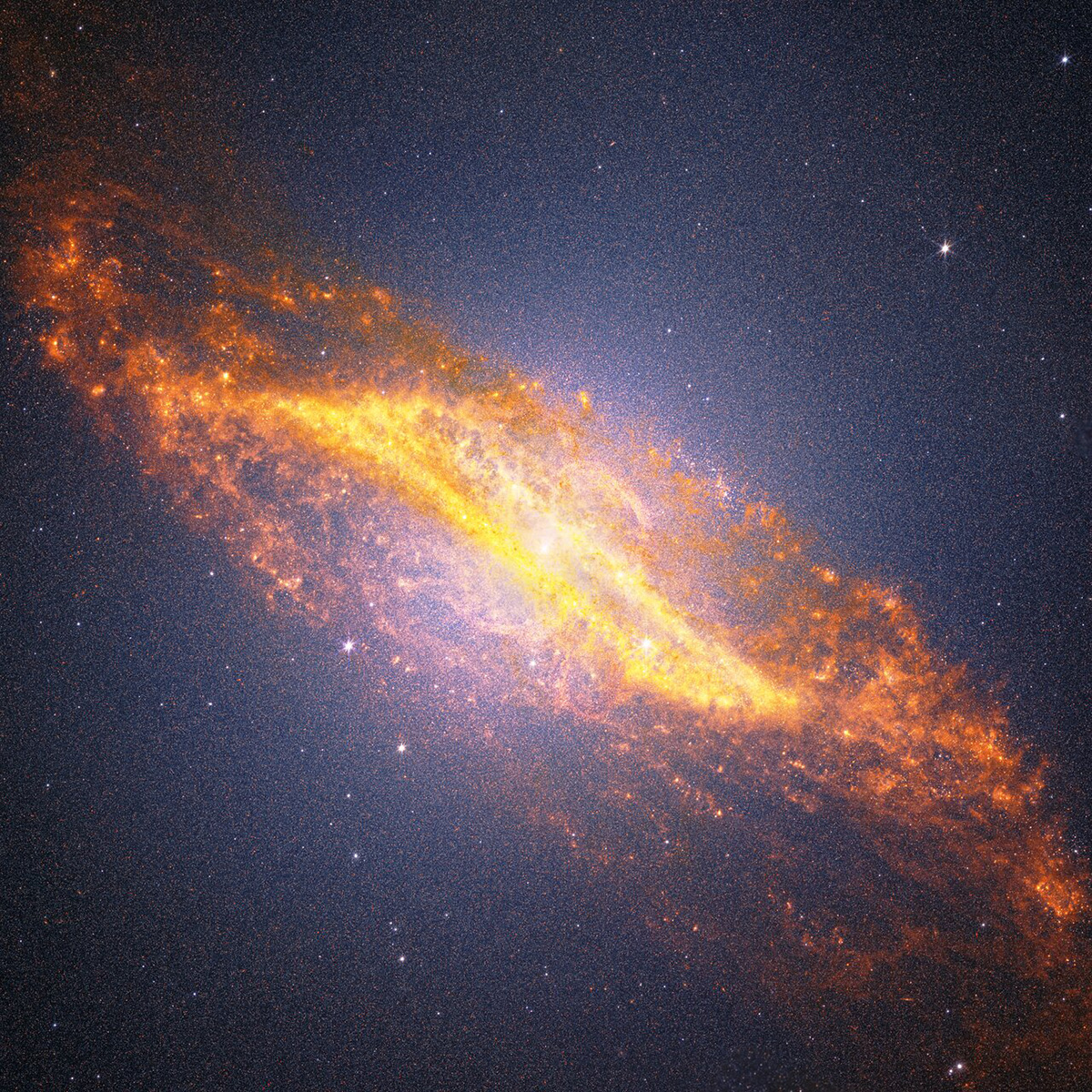
Astronomers believe that Centaurus A formed through a collision between a massive elliptical galaxy and a smaller spiral galaxy around two billion years ago. The merger did not end with one galaxy swallowing the other. The impact scattered gas and dust throughout the larger system, leaving behind the thick dust lane that still dominates the galaxy’s appearance.
Over time, gravity began reorganizing the disrupted material. Some of the gas settled into rotating structures near the galaxy’s center. Dense clouds collapsed under their own gravity and gave birth to new generations of stars. Other material continued drifting through the galaxy, slowly responding to the gravitational pull of the merged system. Even after two billion years, the galaxy has not reached complete stability. The merger continues to influence its internal structure.
JWST sees what visible-light telescopes cannot
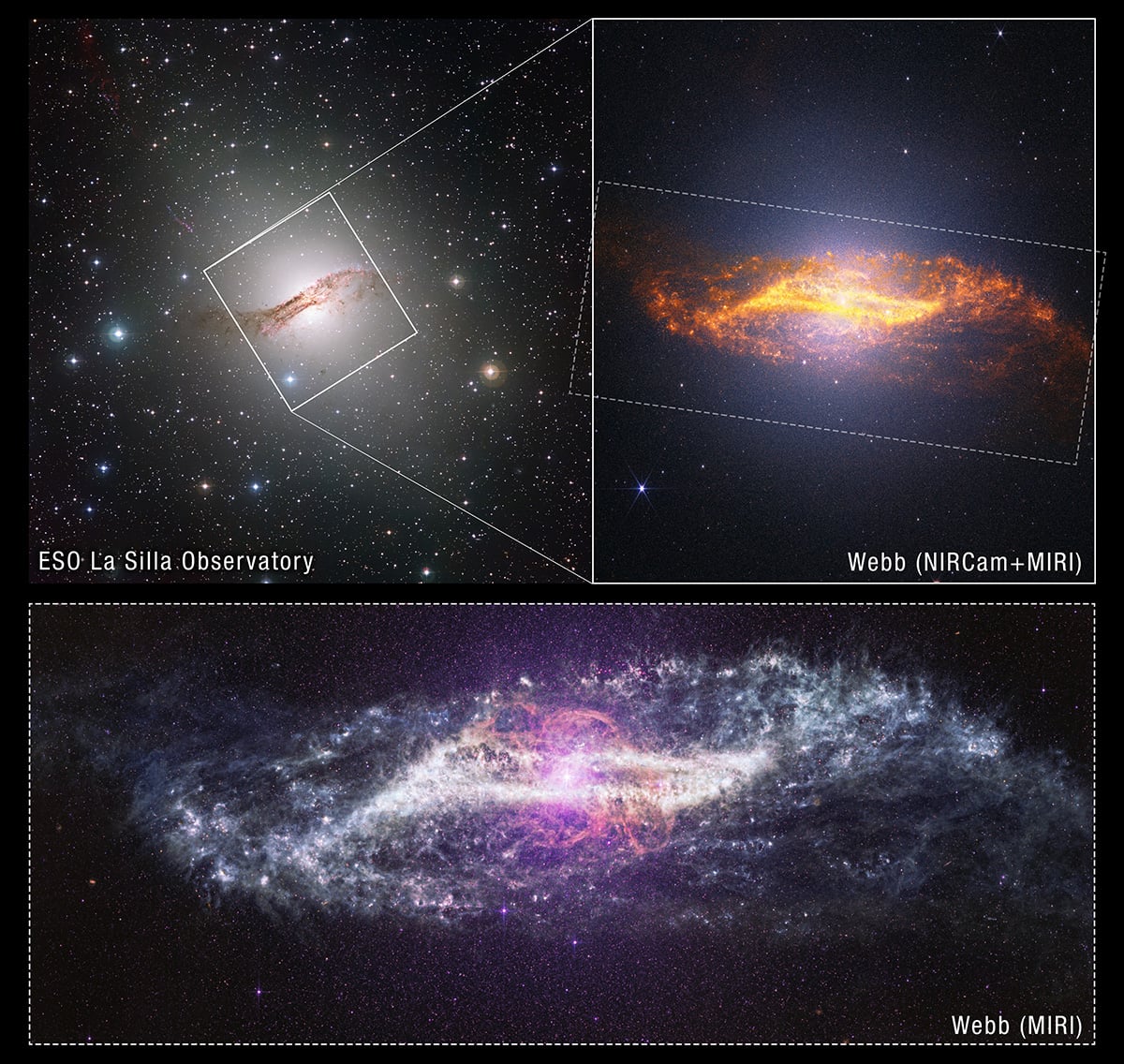
For decades, the thick dust lane running across Centaurus A has limited what astronomers could observe. Even powerful optical telescopes struggled to see through the dense material. Visible light simply cannot penetrate many of these dusty regions, leaving much of the galaxy’s interior hidden from view.
JWST combines exceptional sensitivity with high spatial resolution, making it uniquely suited for studying dusty galaxies. Its Near-Infrared Camera (NIRCam) records light at wavelengths that pass through much of the obscuring dust. Meanwhile, the Mid-Infrared Instrument (MIRI) detects the glow from warm dust itself, revealing structures that optical telescopes cannot detect.
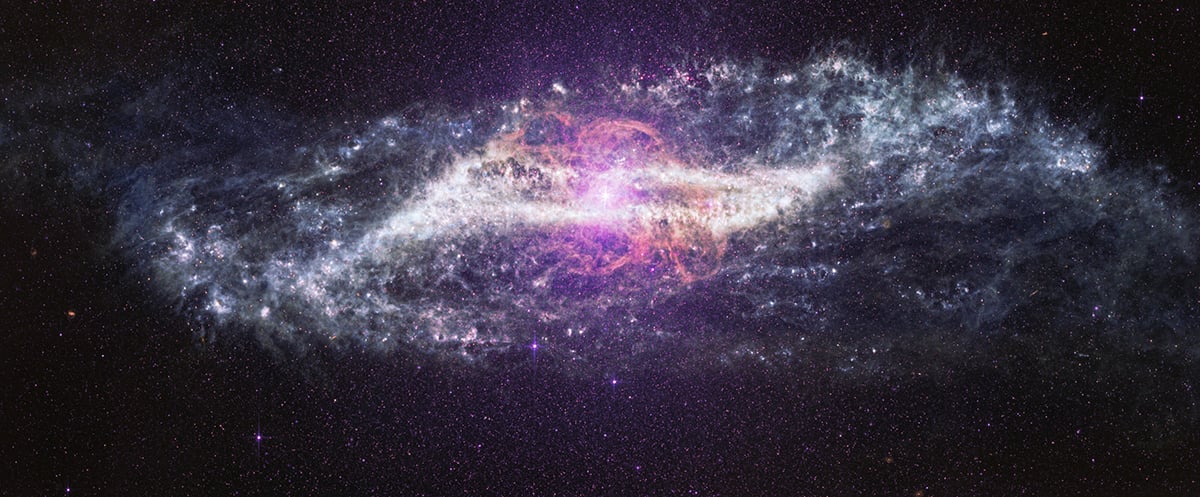
Thousands of previously hidden stars also emerge across the field. Many of them lie within or behind the dust lane, where visible-light observations could not detect them. Their appearance helps astronomers reconstruct the galaxy’s stellar population more accurately and understand how stars are distributed throughout the system.
The images also show bright patches of warm dust associated with active star-forming regions. These areas contain dense molecular clouds where gravity continues to transform gas into young stars. Some regions appear relatively calm, while others show intense activity, illustrating that the galaxy is evolving at different rates across its enormous structure.
An active black hole: An unexpected structure
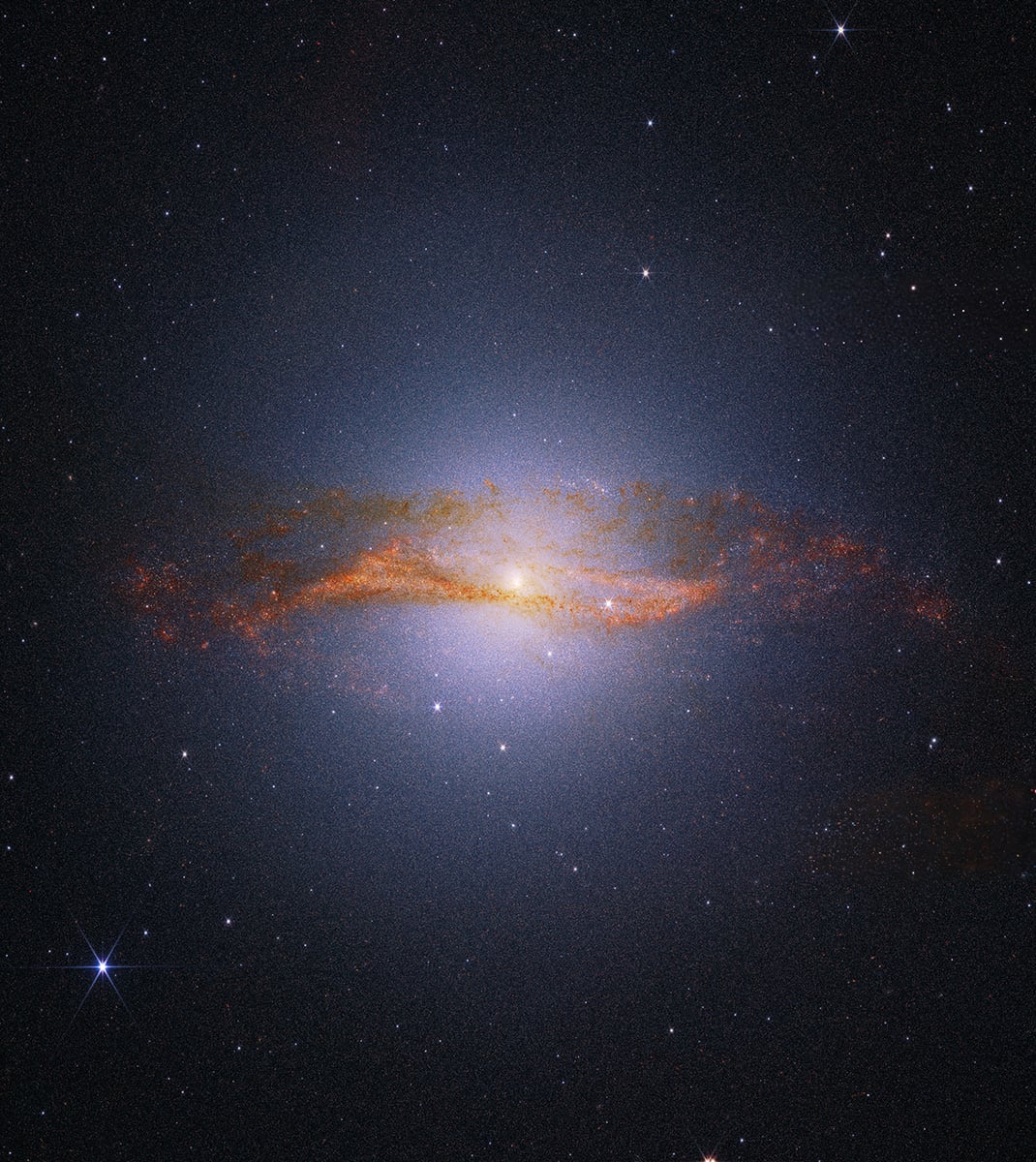
Hidden within the dense central region lies another source of intense activity. Like most large galaxies, Centaurus A hosts a supermassive black hole at its core. Unlike the relatively quiet black hole at the center of the Milky Way, however, this one actively consumes surrounding material.
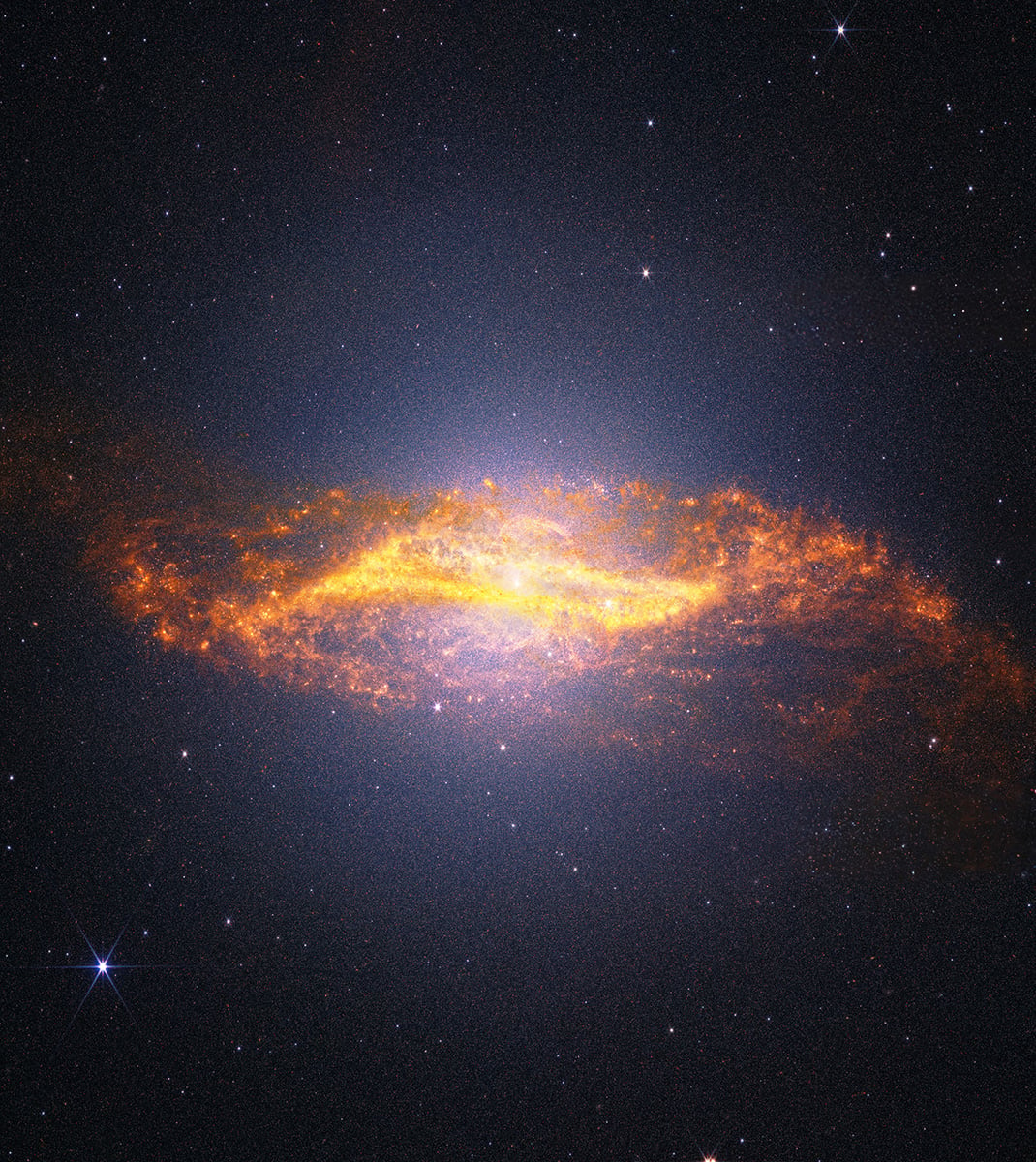
The telescope detected a warped disk of warm molecular hydrogen surrounding the active nucleus. Such disks often serve as reservoirs of gas that gradually feed the central black hole. At the same time, James Webb observed fast-moving ionized gas flowing through the region. These observations suggest that material is constantly circulating around the galaxy’s center.
Although JWST answered several long-standing questions about Centaurus A, it also revealed something astronomers did not expect. Near the galaxy’s nucleus, the telescope detected a distinct S-shaped structure glowing in the mid-infrared. The feature stands out against the surrounding dust, but its origin remains uncertain.
Researchers suspect that the structure is connected to the galaxy’s active nucleus. The supermassive black hole constantly releases energy as it accretes gas from its surroundings. That energy can disturb nearby clouds, compress gas into dense filaments, or drive powerful outflows through the galaxy. The newly discovered structure may represent one stage of that interaction.
Clear skies!
See more from DIYPhotography.net on Google
Add DIYPhotography.net as a trusted source. This makes
our stories more likely to appear in your Google Search results.
 Add as a preferred source on Google

Soumyadeep Mukherjee
Soumyadeep Mukherjee is an award-winning astrophotographer from India. He has a doctorate degree in Linguistics. His work extends to the sub-genres of nightscape, deep sky, solar, lunar and optical phenomenon photography. He is also a photography educator and has conducted numerous workshops. His works have appeared in over 40 books & magazines including Astronomy, BBC Sky at Night, Sky & Telescope among others, and in various websites including National Geographic, NASA, Forbes. He was the first Indian to win “Astronomy Photographer of the Year” award in a major category.

Join the Discussion
DIYP Comment Policy
Be nice, be on-topic, no personal information or flames.