























ESO’s VLT Reveals an Unexpected Shock Wave from a Dead Star
Jan 13, 2026
Soumyadeep Mukherjee
Soumyadeep Mukherjee is an award-winning astrophotographer from India. He has a doctorate degree in Linguistics. His work extends to the sub-genres of nightscape, deep sky, solar, lunar and optical phenomenon photography. He is also a photography educator and has conducted numerous workshops. His works have appeared in over 40 books & magazines including Astronomy, BBC Sky at Night, Sky & Telescope among others, and in various websites including National Geographic, NASA, Forbes. He was the first Indian to win “Astronomy Photographer of the Year” award in a major category.
Share:
White dwarfs represent one of the most stable and predictable endpoints of stellar evolution. After exhausting nuclear fuel, stars with masses similar to the Sun shed their outer layers and leave behind a dense, compact core. This remnant no longer supports fusion. It cools passively over time. For decades, astronomers have treated white dwarfs as dynamically quiet objects. They serve as laboratories for studying cooling physics, magnetic fields, and stellar remnants. They do not, however, significantly shape their surroundings.
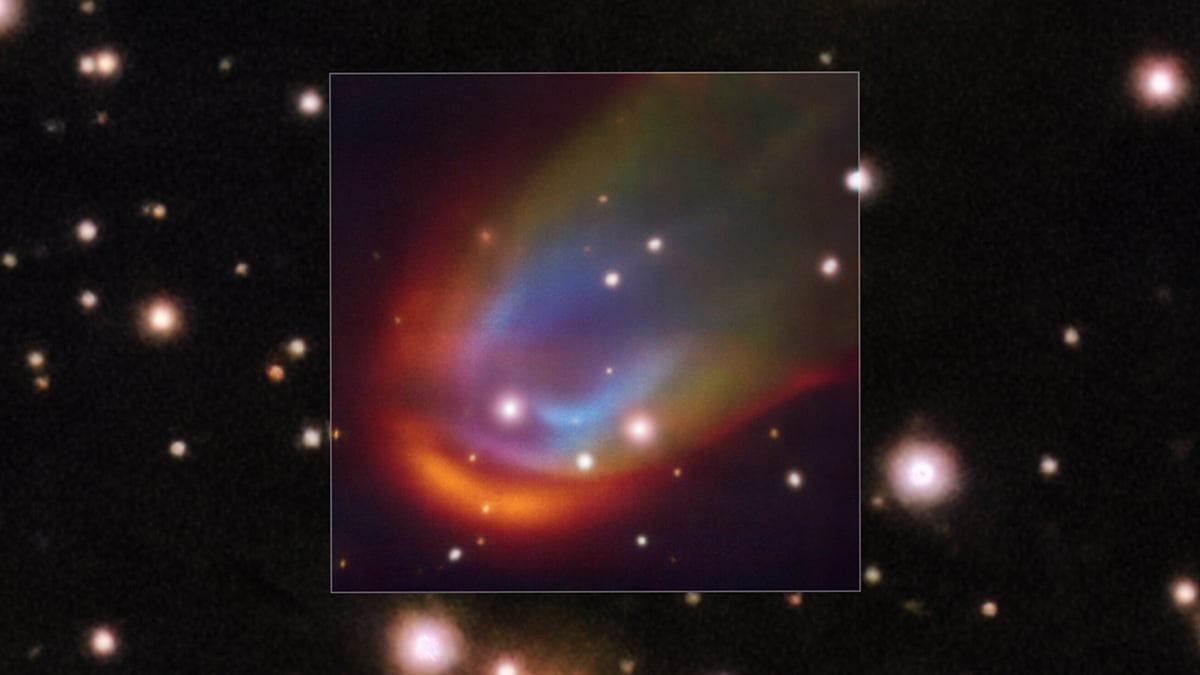
That assumption now faces a serious challenge. New observations from the European Southern Observatory’s Very Large Telescope reveal a large, structured shock wave around a white dwarf system called RX J0528.6+2838. The feature resembles a classic bow shock. Such structures normally arise from powerful stellar winds or high-velocity motion through dense gas. Neither condition should apply to this system. Yet, the shock persists, and it appears to be enduring. This unexpected detection forces astronomers to reconsider how dead stars interact with their environment. It also suggests that magnetic and binary effects may remain influential far later in stellar evolution than previously assumed.
RX J0528.6+2838: A system that looked ordinary
RX J0528.6+2838 lies roughly 730 light-years from Earth. It belongs to a binary system composed of a white dwarf and a Sun-like companion star. Systems like this are not rare. Astronomers have studied thousands of them across the Milky Way. Most show modest activity. Some exhibit accretion signatures or periodic variability. Few attract special attention.
Prior observations of RX J0528.6+2838 revealed nothing extreme. The white dwarf showed no strong outbursts. Astronomers detected no clear accretion disk. The system did not behave like an energetic binary. Based on existing data, it appeared calm.
That context makes the discovery especially striking. The shock wave surrounding the system did not emerge from targeted searches for peculiar phenomena. Instead, astronomers identified it while examining detailed spectroscopic data. The feature stood out because it should not have been there at all.

VLT and MUSE reveal the unexpected
The discovery came from observations with ESO’s Very Large Telescope in Chile. Astronomers used the MUSE instrument, one of the most powerful optical spectrographs currently operating. MUSE combines imaging and spectroscopy into a single dataset. It allows researchers to map both structure and motion across extended objects.
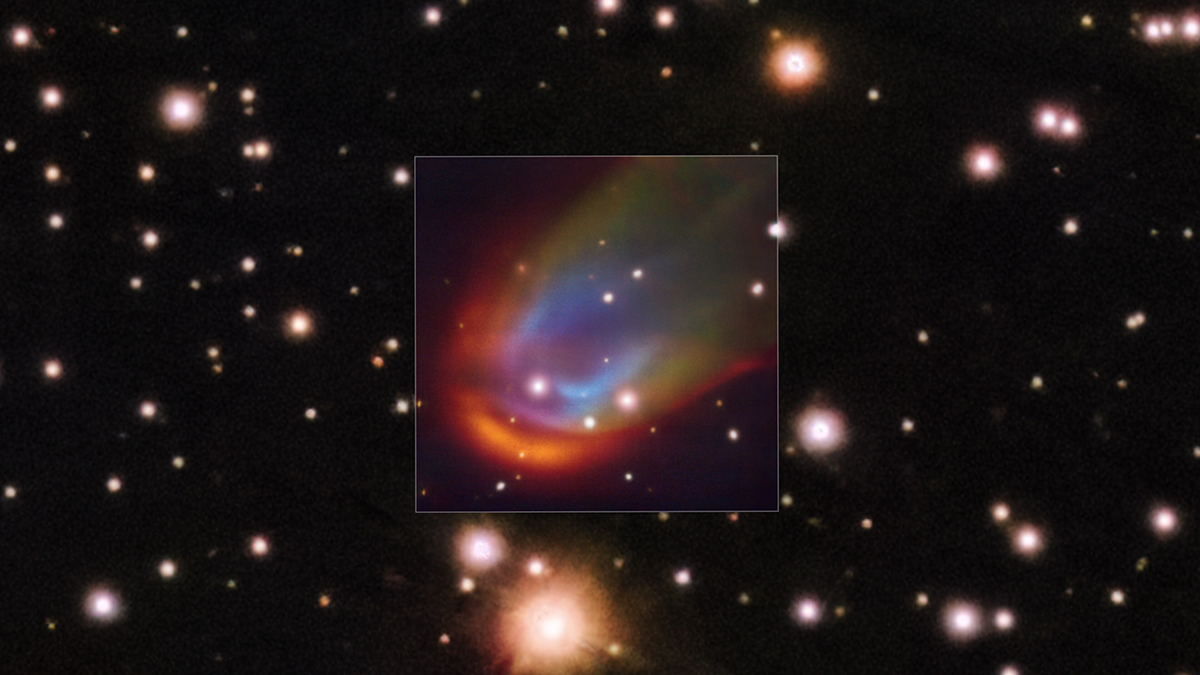
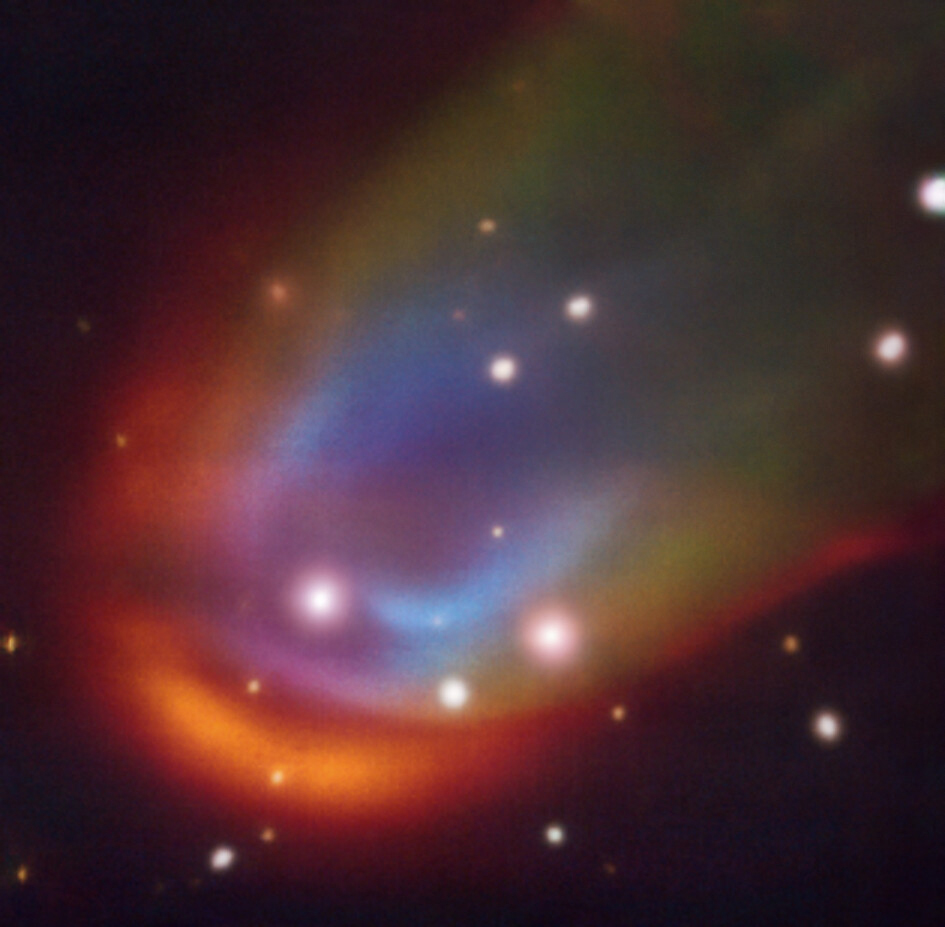
When astronomers processed the MUSE data, they noticed a curved arc of glowing gas surrounding the white dwarf system. The structure extended ahead of the system’s motion through space. Its geometry matched that of a bow shock. Emission lines from hydrogen, oxygen, and nitrogen traced heated interstellar gas compressed by an advancing front.
The clarity of the structure left little doubt. This was not background emission. It was physically associated with RX J0528.6+2838. The system was interacting with the interstellar medium in a sustained and organized way. Such interactions usually require momentum input. That requirement immediately raised questions about the energy source.
Why a white dwarf should not drive a bow shock
Bow shocks form when fast stellar winds or strong outflows collide with surrounding gas. Massive stars create them easily. Their winds carry enormous momentum. Runaway stars can also produce shocks as they move rapidly through dense regions of space.
White dwarfs lack both conditions. They produce no fusion-driven winds. Their luminosities remain low. Their gravitational fields are strong, but gravity alone cannot push material outward. In most cases, white dwarfs simply drift through space.
Binary systems can complicate the picture. If material flows from a companion star, accretion can release energy. Accretion disks can drive jets or winds. However, RX J0528.6+2838 shows no evidence of such a disk. Observations do not reveal the spectral or photometric signatures associated with disk-driven outflows.
This absence deepens the puzzle. The bow shock requires sustained energy. Yet the usual mechanisms appear unavailable.
Magnetic fields as a possible driver
One key property offers a possible clue. The white dwarf in RX J0528.6+2838 appears to host a strong magnetic field. Magnetic white dwarfs represent a distinct subclass. Their fields can exceed millions of times Earth’s magnetic strength. Such fields strongly influence how matter moves near the star.
In magnetic systems, material from a companion does not always form a disk. Instead, magnetic field lines can capture the gas and funnel it directly onto the white dwarf’s surface. This process, known from polars and related systems, alters both geometry and energy release.
Astronomers now suspect that magnetically guided accretion may power a weak but continuous outflow. Although less dramatic than disk-driven jets, such an outflow could still interact with the interstellar medium. Over long timescales, it could inflate a bow shock.
This explanation remains tentative. Still, it fits several observed features. It accounts for the absence of a disk. It also provides a sustained energy source consistent with the shock’s apparent age.
Evidence for a long-lived structure
The size and shape of the shock offer further insight. Models suggest that the structure did not form recently. Instead, it likely developed over hundreds or thousands of years. The bow shock appears stable rather than transient.
A long lifetime implies continuous energy input. Short bursts cannot maintain such a feature. This fact strengthens the case for a persistent mechanism tied to the system’s basic properties.
If magnetic accretion sustains the outflow, it would mean that some white dwarfs remain dynamically influential far longer than assumed. That conclusion would challenge standard evolutionary timelines.
The importance of modern observational tools
This discovery would have been difficult without modern instrumentation. MUSE provided spatial and spectral detail in a single observation. It allowed astronomers to isolate emission from the shock and distinguish it from unrelated background structures.
Future facilities will push this further. ESO’s Extremely Large Telescope will offer higher resolution and sensitivity. It could probe similar systems at greater distances. It could also resolve finer shock structures.
Space-based observatories may complement this work. Ultraviolet and X-ray data could reveal high-energy processes linked to magnetic accretion. Together, these tools will test whether RX J0528.6+2838 is unique or representative.
Despite the progress, many questions remain open. Astronomers do not yet know the exact mass-loss rate required to sustain the shock. They do not know how common such features are. They also do not know whether past evolutionary stages contributed to the structure. Answering these questions will require follow-up observations and improved models. Theoretical work must now incorporate scenarios once considered unlikely.
Clear skies!
See more from DIYPhotography.net on Google
Add DIYPhotography.net as a trusted source. This makes
our stories more likely to appear in your Google Search results.
 Add as a preferred source on Google

Soumyadeep Mukherjee
Soumyadeep Mukherjee is an award-winning astrophotographer from India. He has a doctorate degree in Linguistics. His work extends to the sub-genres of nightscape, deep sky, solar, lunar and optical phenomenon photography. He is also a photography educator and has conducted numerous workshops. His works have appeared in over 40 books & magazines including Astronomy, BBC Sky at Night, Sky & Telescope among others, and in various websites including National Geographic, NASA, Forbes. He was the first Indian to win “Astronomy Photographer of the Year” award in a major category.



Join the Discussion
DIYP Comment Policy
Be nice, be on-topic, no personal information or flames.