
























Gemini North Captures a Color Image of a Comet Breaking into Pieces
Sep 6, 2026
Soumyadeep Mukherjee
Soumyadeep Mukherjee is an award-winning astrophotographer from India. He has a doctorate degree in Linguistics. His work extends to the sub-genres of nightscape, deep sky, solar, lunar and optical phenomenon photography. He is also a photography educator and has conducted numerous workshops. His works have appeared in over 40 books & magazines including Astronomy, BBC Sky at Night, Sky & Telescope among others, and in various websites including National Geographic, NASA, Forbes. He was the first Indian to win “Astronomy Photographer of the Year” award in a major category.
Share:
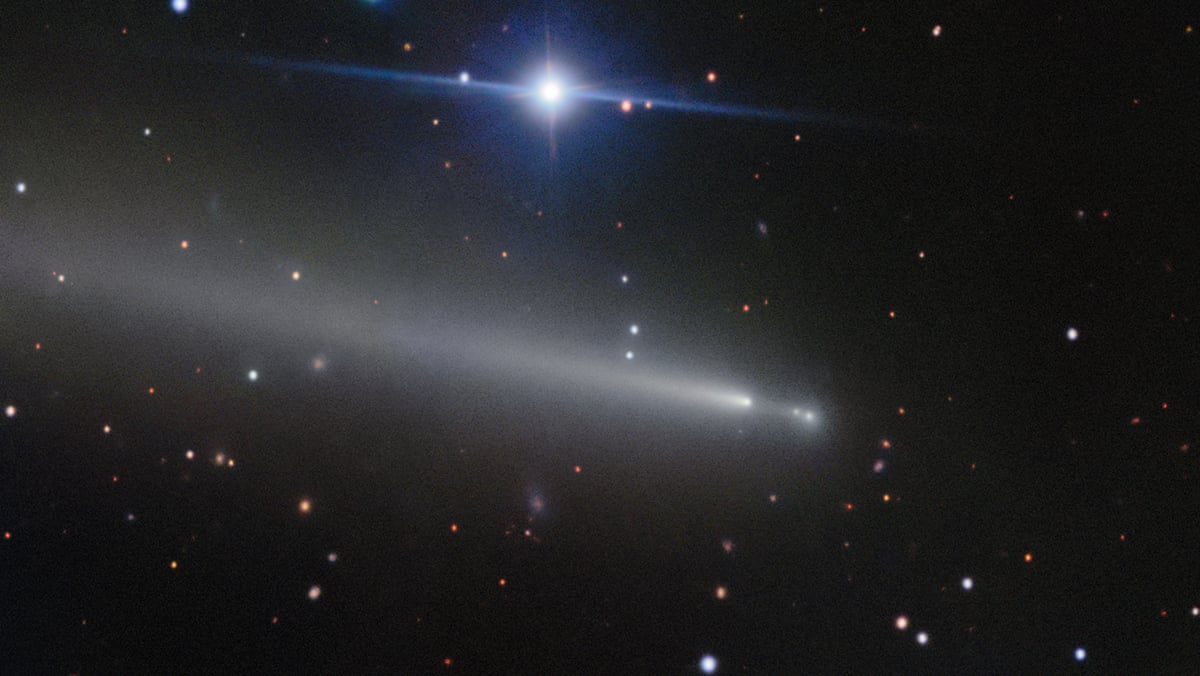
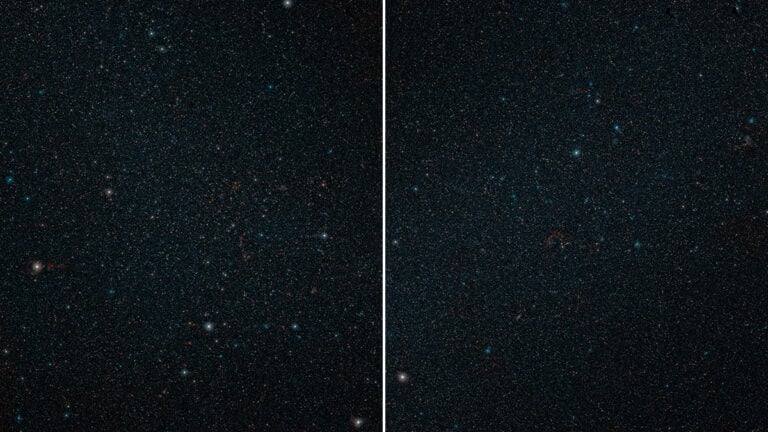
We now have a new color image of the comet C/2025 K1. NSF NOIRLab released the image on September 2, 2026. Although recently released, the image is not a recent one. Gemini North observed the comet on December 24, 2025. By the time Gemini photographed it, C/2025 K1 had already broken apart after passing close to the Sun.
Earlier observations had identified a parent body and many fragments. One of those fragments was no longer visible in the December observations. The photograph captures a stage of the breakup, but the color adds another piece to the story. Astronomers measured the comet’s light through several optical filters and found that its fragments have unusually blue colors.
A comet fragmented after perihelion
C/2025 K1 was discovered in May 2025 by the ATLAS survey. Its orbit suggested that it came from the Oort Cloud, a distant population of icy bodies surrounding the Solar System. The comet then moved into the inner Solar System and passed perihelion on October 8, reaching about 0.33 astronomical units from the Sun.
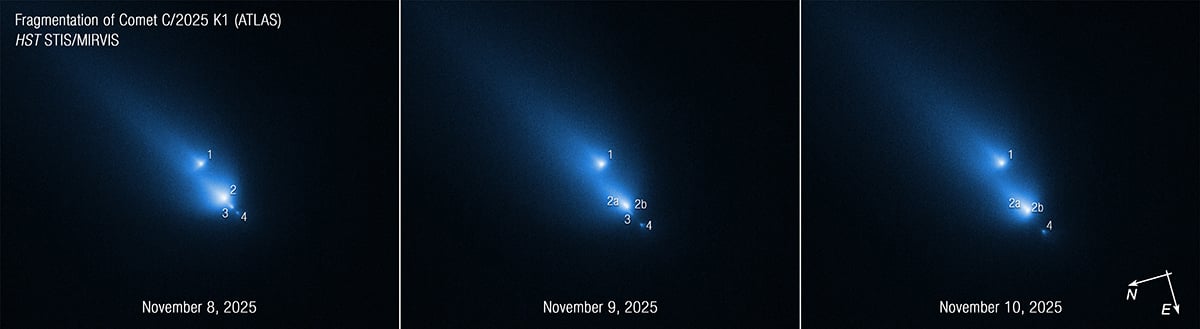
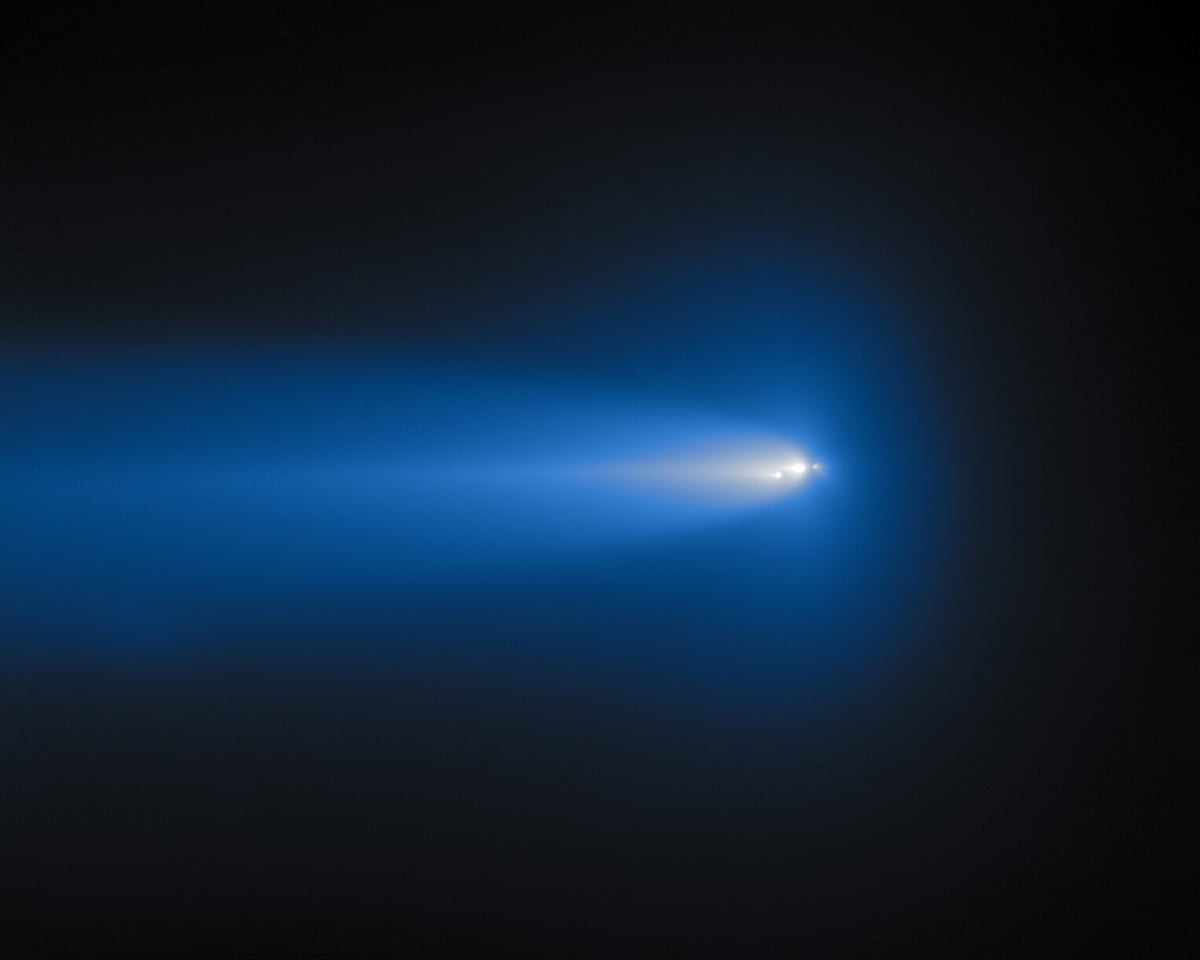
By early November, observers noticed a significant change in the comet. The coma became more active, and the nucleus began to show signs of fragmentation. Hubble observed the comet on November 8, 9, and 10, giving astronomers a detailed look at the breakup soon after it began.
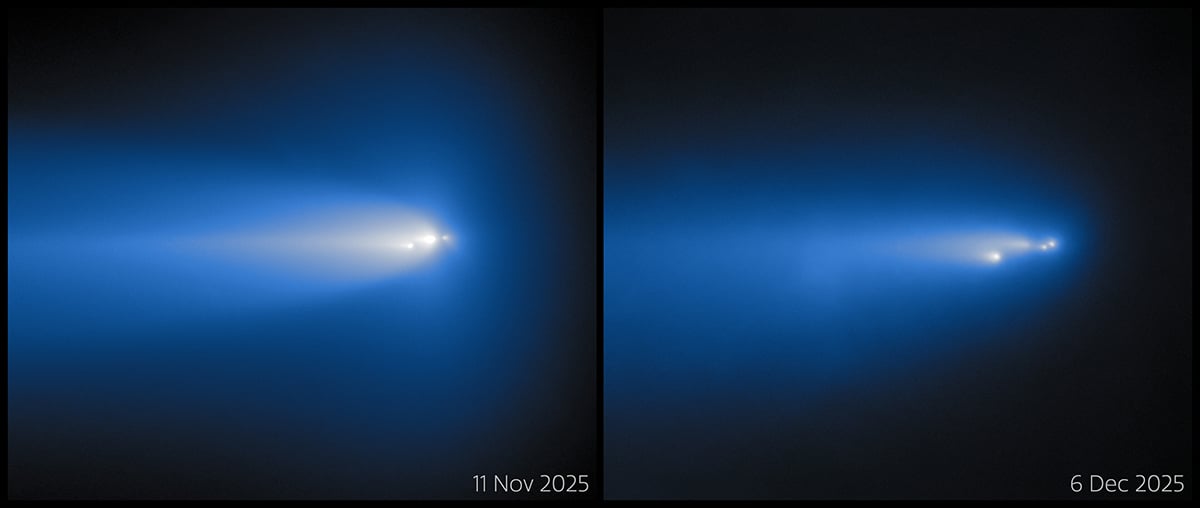
The Gemini observations came later in the sequence. The telescope observed K1 on December 6 and again on December 24. A separate observing run with the ARC 3.5-meter telescope at Apache Point Observatory took place on December 8. These observations provided a useful view of what remained after several weeks of continued activity.
By December 24, astronomers could identify the parent body and fragments C and D in the Gemini color data. Another fragment, designated E, was also detected in the wider observing campaign. Fragment B, which had been seen during the earlier observations, could no longer be found at its expected position.
Gemini used three filters to build the color
The color in the new image came from separate observations through the g, r and i filters on Gemini North’s Gemini Multi-Object Spectrograph, or GMOS. These filters transmit different portions of visible light, with central wavelengths of approximately 465, 622 and 771 nanometres.
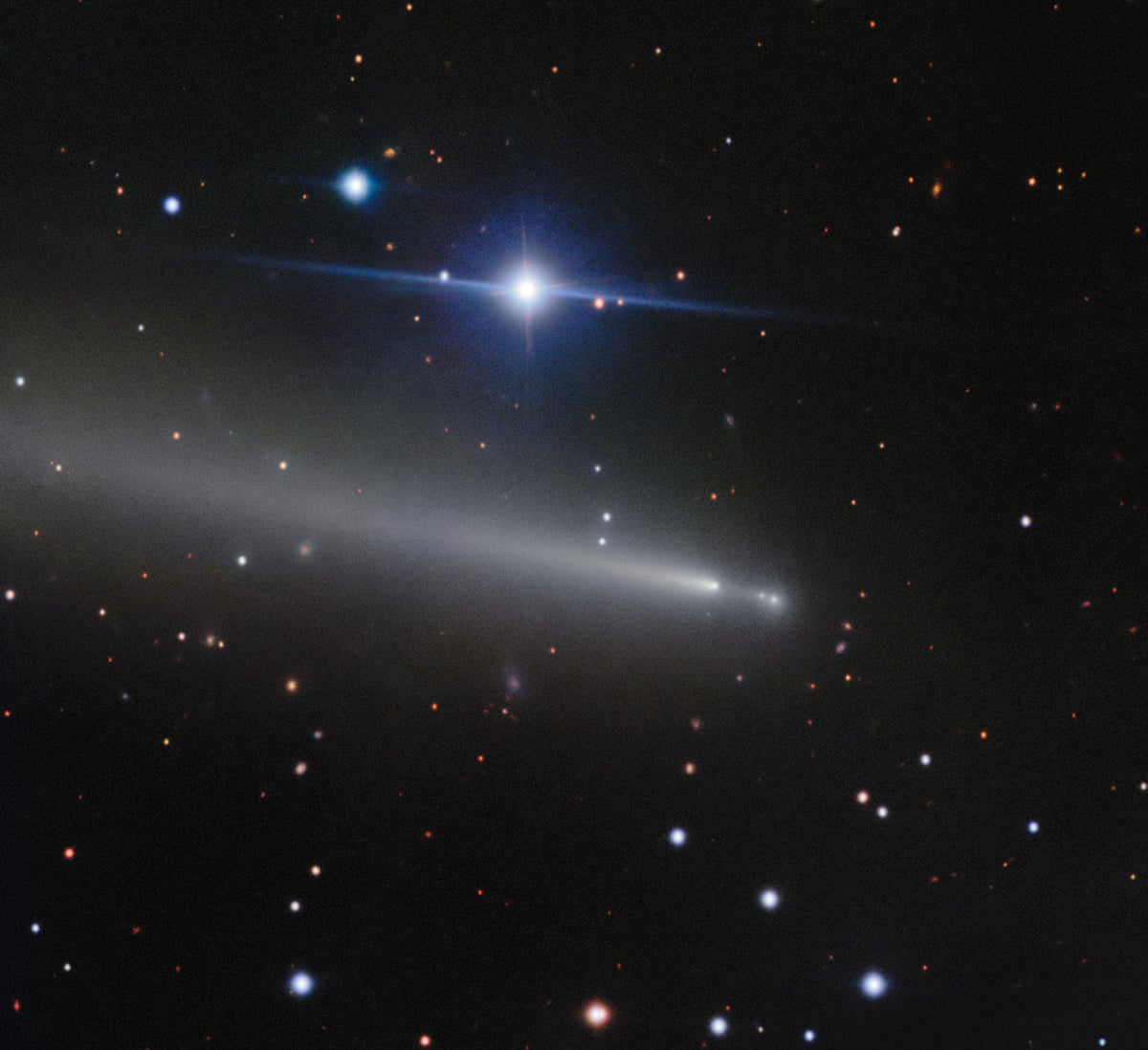
The December 24 observations used exposures ranging from three to 30 seconds. Seeing was about 0.6 arcseconds, which is quite good for ground-based observations. Gemini’s 8.1-meter primary mirror also gives the telescope considerable light-gathering power, which matters when the target is a faint, diffuse comet several tens of millions of kilometers away.
The process is familiar to anyone who has worked with a monochrome astronomy camera and separate filters. Instead of recording red, green, and blue information simultaneously, the telescope collects separate images through each filter. The individual frames can then be combined to create a color representation.

The blue color may tell us what the breakup exposed
Comets contain a mixture of volatile ices, dust, and other material. The surface changes when a comet approaches the Sun. Solar heating drives some volatile compounds into space, while dust and less volatile material can accumulate on or near the surface. The material exposed underneath can have different physical properties from the material that has already spent time exposed to sunlight.
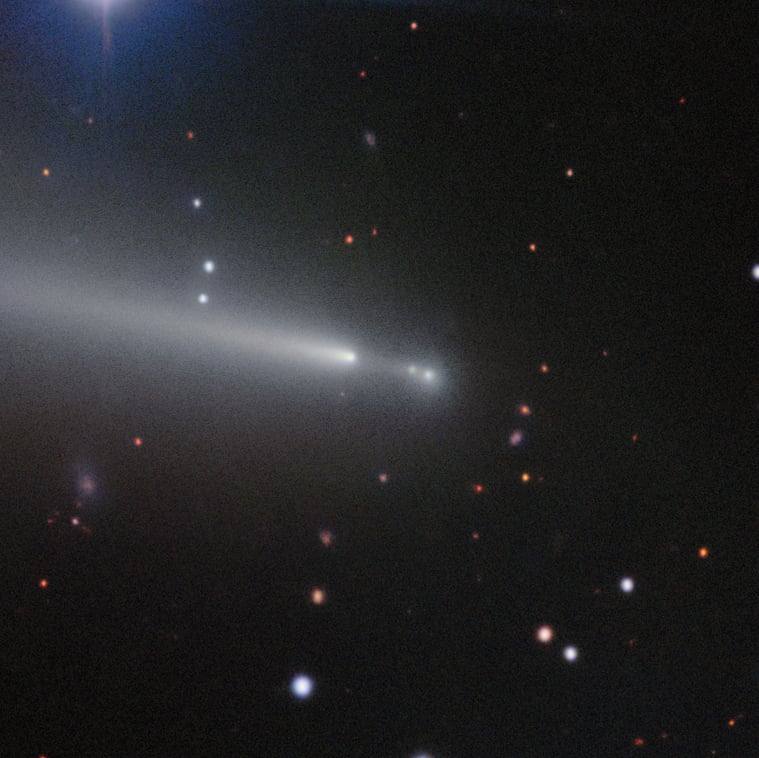
NOIRLab suggests that the blue color seen in C/2025 K1 may be related to fresh ice exposed by the fragmentation. It is an attractive explanation, particularly because the blue measurements come from the comet’s fragments rather than being confined to the surrounding tail.
The research team has been cautious about the interpretation. The observations show that the comet is unusually blue, but they do not identify a single substance as the cause. Dust grain size can affect the way sunlight is scattered, and changes in the composition or distribution of dust can alter the measured colors. Gas emission can also influence measurements made through broad optical filters.
Clear skies!
See more from DIYPhotography.net on Google
Add DIYPhotography.net as a trusted source. This makes
our stories more likely to appear in your Google Search results.
 Add as a preferred source on Google

Soumyadeep Mukherjee
Soumyadeep Mukherjee is an award-winning astrophotographer from India. He has a doctorate degree in Linguistics. His work extends to the sub-genres of nightscape, deep sky, solar, lunar and optical phenomenon photography. He is also a photography educator and has conducted numerous workshops. His works have appeared in over 40 books & magazines including Astronomy, BBC Sky at Night, Sky & Telescope among others, and in various websites including National Geographic, NASA, Forbes. He was the first Indian to win “Astronomy Photographer of the Year” award in a major category.


Join the Discussion
DIYP Comment Policy
Be nice, be on-topic, no personal information or flames.