

















ESO’s MOONS Sees First Light: Revealing Hidden Stars and Galaxies
Sep 5, 2026
Soumyadeep Mukherjee
Soumyadeep Mukherjee is an award-winning astrophotographer from India. He has a doctorate degree in Linguistics. His work extends to the sub-genres of nightscape, deep sky, solar, lunar and optical phenomenon photography. He is also a photography educator and has conducted numerous workshops. His works have appeared in over 40 books & magazines including Astronomy, BBC Sky at Night, Sky & Telescope among others, and in various websites including National Geographic, NASA, Forbes. He was the first Indian to win “Astronomy Photographer of the Year” award in a major category.
Share:
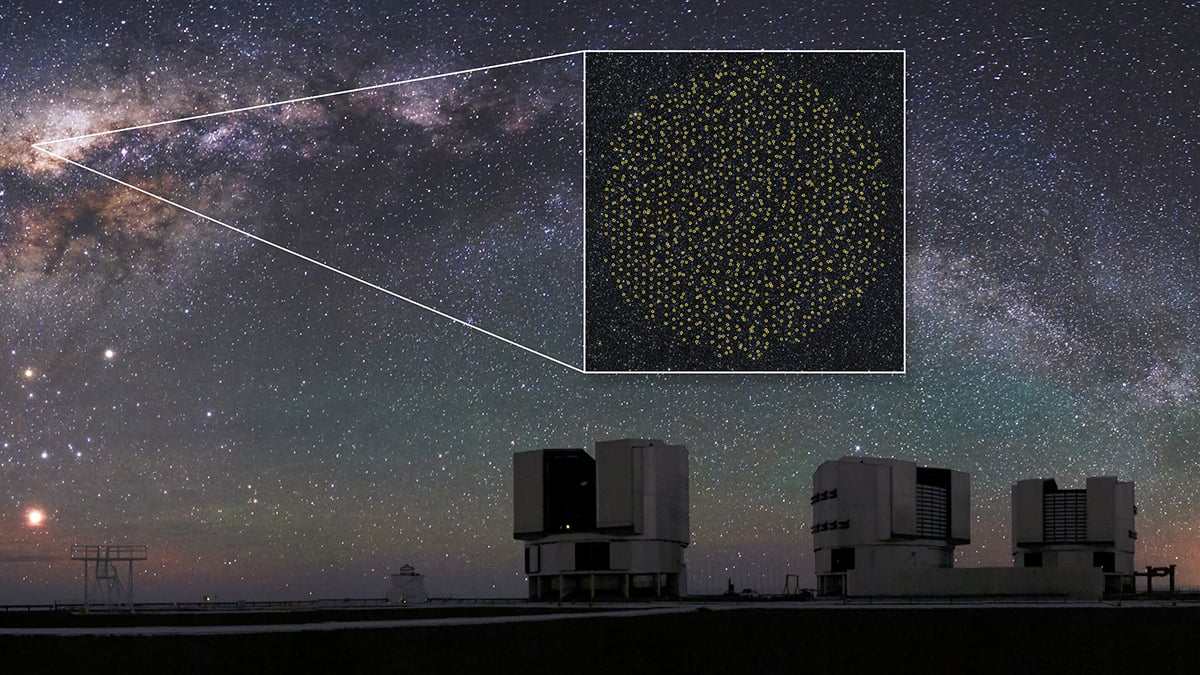
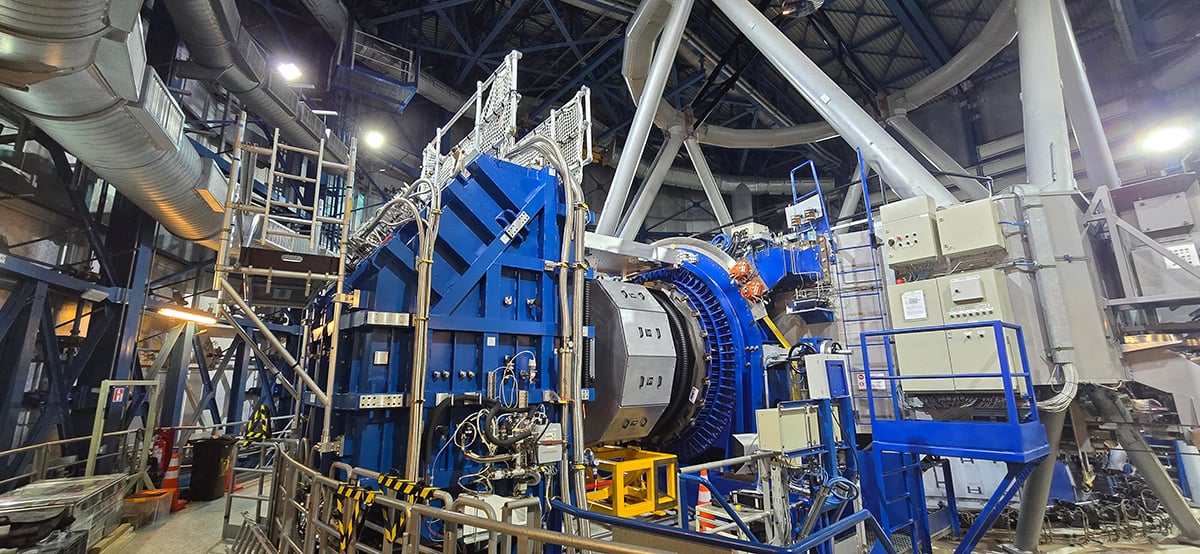
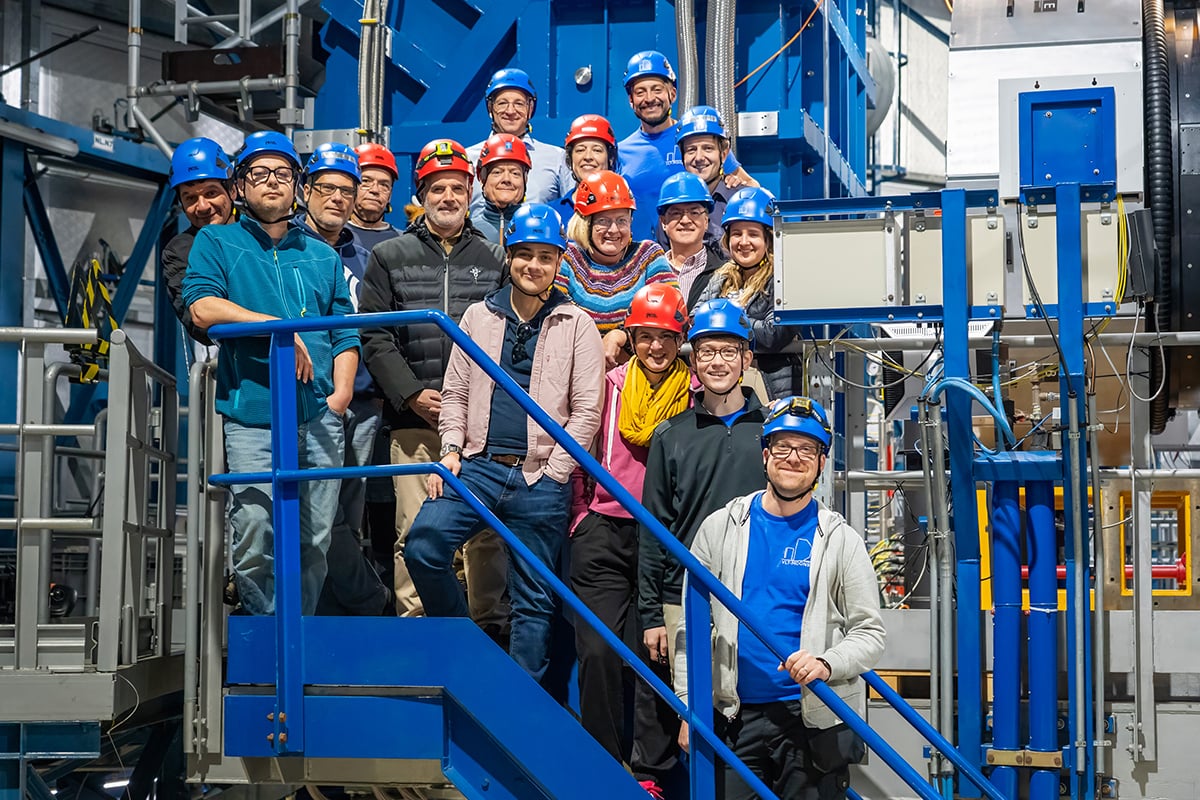
The Very Large Telescope has gained a new way to study the stars. At ESO’s Paranal Observatory in Chile, the Multi-Object Optical and Near-infrared Spectrograph, or MOONS, has made its first observations of the night sky. The event, known as First Light, is the beginning of on-sky work for one of the most complex instruments to be added to the VLT.
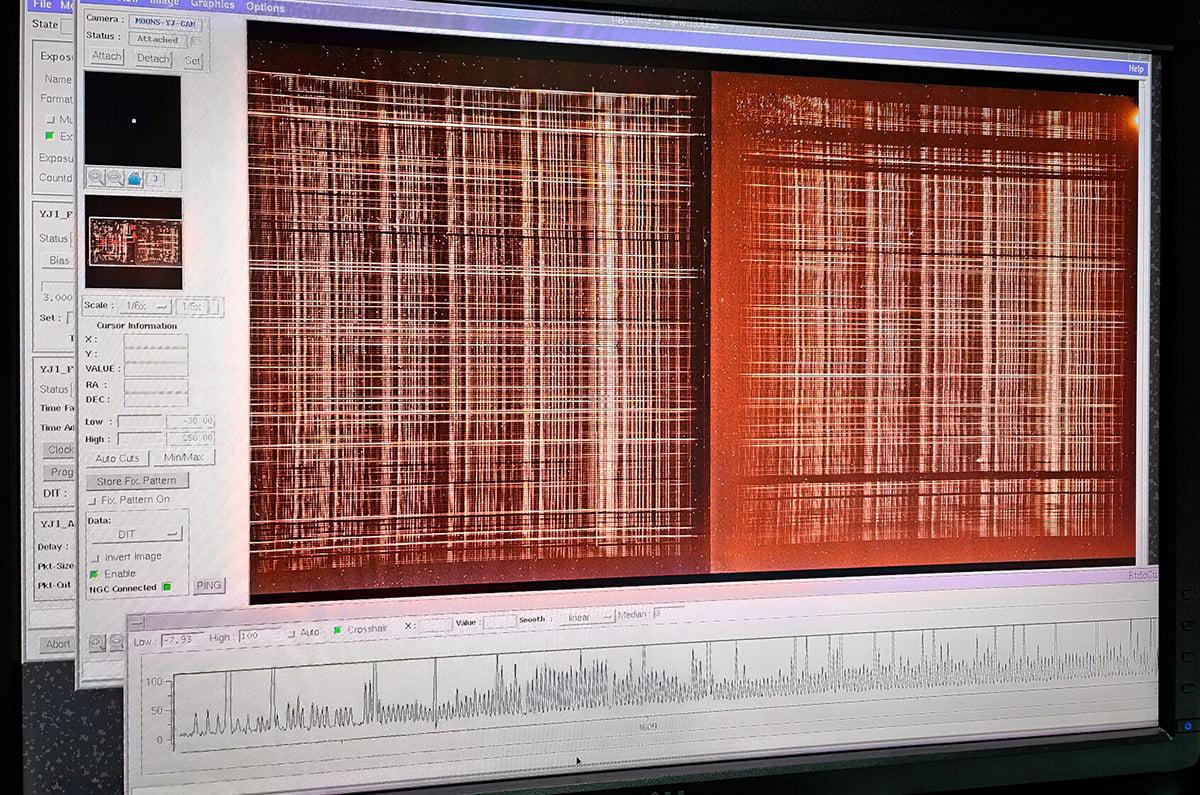
A telescope can collect large amounts of light, but astronomers still need to separate that light into useful measurements. Spectroscopy does this by spreading light according to wavelength. MOONS collects these spectra from hundreds of objects at the same time. It uses around 1,000 optical fibers, each controlled by a robotic positioner, and these fibers can be placed on individual stars and galaxies within the telescope’s field of view.
MOONS: Collecting spectra on a huge scale
MOONS collects light from individual targets through its optical fibres and sends that light to spectrographs. Inside a spectrograph, optical components separate the incoming light according to wavelength. The detector then records the resulting spectrum. Astronomers get a measurement of how the object’s light is distributed across a range of wavelengths.
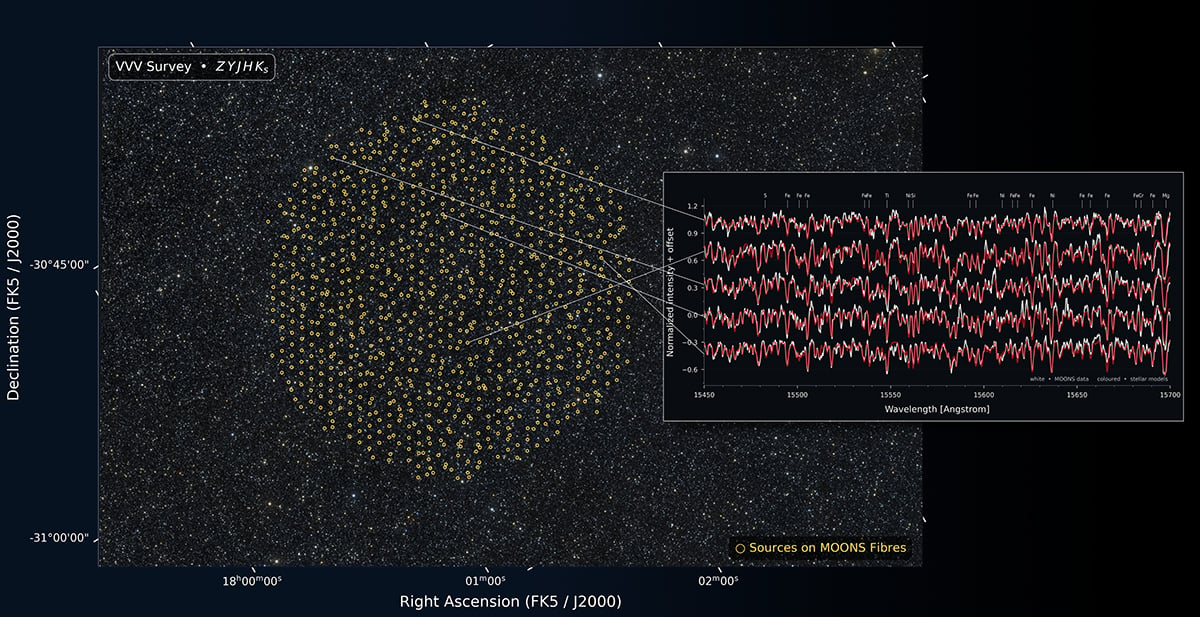
For a photographer, the difference is similar to the distinction between recording an image and analysing the light that produced it. An astrophotograph tells you where the photons landed and how bright different parts of the scene are. A spectrum gives you another dimension to work with. It shows how that light is distributed across wavelengths.
The scale of MOONS is what makes it particularly useful for surveys. Astronomers can spend considerable observing time obtaining a spectrum from a single faint object. MOONS can collect many spectra in the same exposure because its fibers can target large numbers of objects simultaneously. The instrument has two spectrographs, with each receiving light from 500 fibers.
First Light targets the Milky Way’s dusty plane
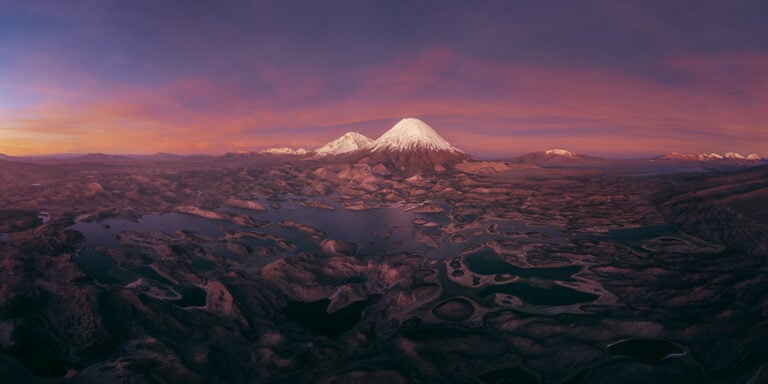
The choice of the Milky Way for MOONS’ First Light observations was closely tied to one of the instrument’s major strengths. Much of our Galaxy is difficult to study in visible light because of the interstellar dust sitting between Earth and distant stars. Dark dust lanes can cut across images of the Milky Way and obscure stars behind them.
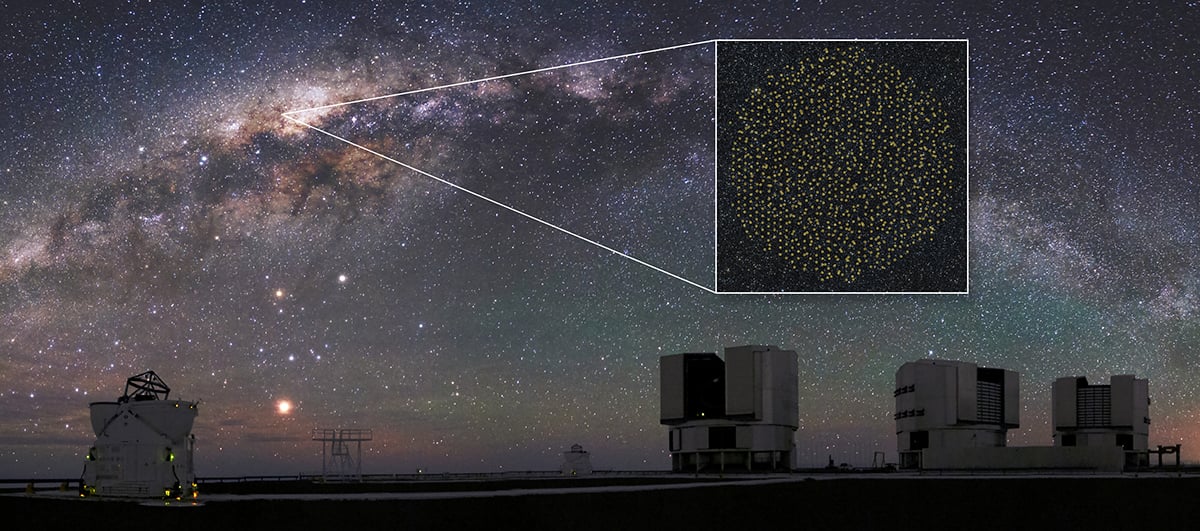
The dust, however, does not block every wavelength equally. Visible light is affected strongly, while near-infrared wavelengths can pass through some dusty regions more effectively. This makes infrared observations useful for investigating parts of the Galaxy that are difficult to see in ordinary optical images.
The spectra can reveal the chemical composition of individual stars and measure their motions. Those measurements become especially valuable when astronomers combine them for large numbers of stars. Stars that formed in different environments can carry different chemical signatures. Their motions can also reveal how they are distributed within the Galaxy.
MOONS will study distant galaxies
The near-infrared capability will allow MOONS to look much farther beyond the Milky Way. Distant galaxies provide astronomers with another reason to work at longer wavelengths because the expansion of the Universe shifts their light towards the red end of the spectrum.
This effect is called cosmological redshift. As light travels through an expanding Universe, its wavelength becomes stretched. The farther away a galaxy is, the greater the redshift generally becomes. Spectral features that originally appeared at shorter wavelengths can move into the near-infrared by the time the light reaches Earth.
MOONS then separates that light by wavelength and records the resulting spectra. Astronomers will use these measurements to study the properties of galaxies across cosmic history. Their spectra can provide information about motion, chemical composition, and star formation. Looking at large populations also allows researchers to compare galaxies at different distances, giving them a way to investigate how galaxies have changed over time.
Clear skies!
See more from DIYPhotography.net on Google
Add DIYPhotography.net as a trusted source. This makes
our stories more likely to appear in your Google Search results.
 Add as a preferred source on Google

Soumyadeep Mukherjee
Soumyadeep Mukherjee is an award-winning astrophotographer from India. He has a doctorate degree in Linguistics. His work extends to the sub-genres of nightscape, deep sky, solar, lunar and optical phenomenon photography. He is also a photography educator and has conducted numerous workshops. His works have appeared in over 40 books & magazines including Astronomy, BBC Sky at Night, Sky & Telescope among others, and in various websites including National Geographic, NASA, Forbes. He was the first Indian to win “Astronomy Photographer of the Year” award in a major category.

Join the Discussion
DIYP Comment Policy
Be nice, be on-topic, no personal information or flames.