























NASA Captures the Disintegration of Comet MAPS Near the Sun
Apr 26, 2026
Soumyadeep Mukherjee
Soumyadeep Mukherjee is an award-winning astrophotographer from India. He has a doctorate degree in Linguistics. His work extends to the sub-genres of nightscape, deep sky, solar, lunar and optical phenomenon photography. He is also a photography educator and has conducted numerous workshops. His works have appeared in over 40 books & magazines including Astronomy, BBC Sky at Night, Sky & Telescope among others, and in various websites including National Geographic, NASA, Forbes. He was the first Indian to win “Astronomy Photographer of the Year” award in a major category.
Share:
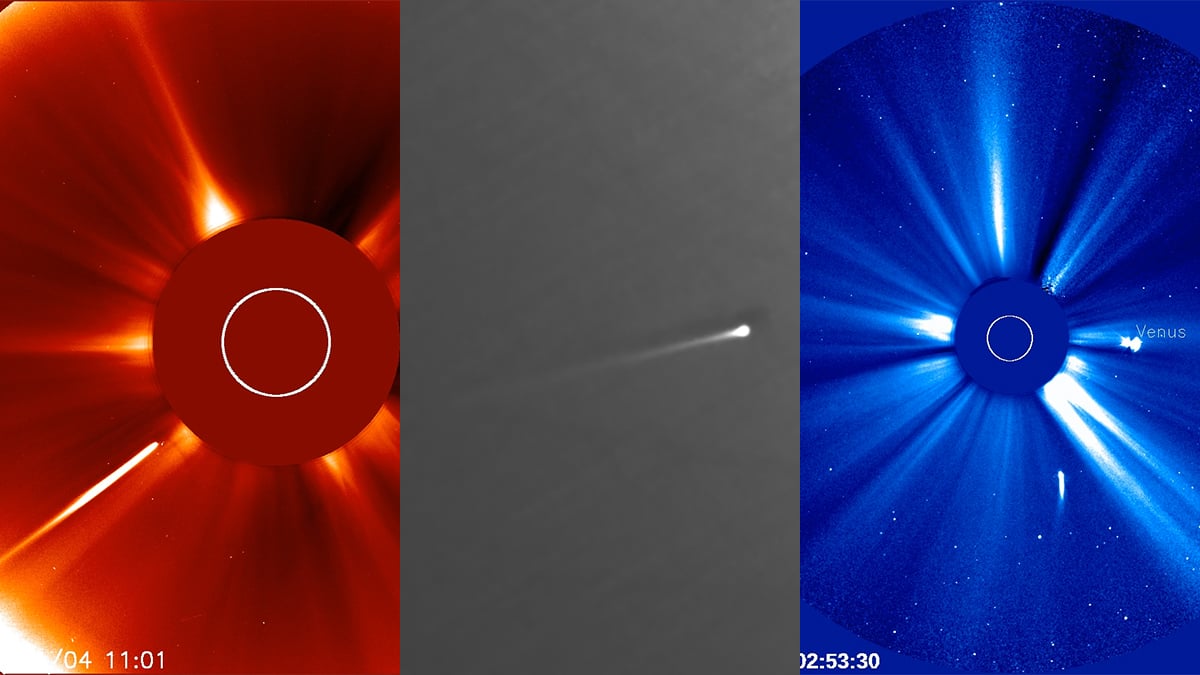
In April 2026, a small sungrazing comet offered astronomers a rare and well-documented case of how fragile bodies behave near the Sun. The object, C/2026 A1 (MAPS), followed a steep trajectory that carried it deep into the Sun’s outer atmosphere. Its path brought it into a region where intense heat, radiation, and gravity act together over very short timescales.
Since the comet was discovered months before its closest approach, scientists had sufficient time to prepare their observations. This early detection proved important. It allowed continuous tracking as the comet moved inward. Telescopes monitored its brightness and structure, while spacecraft followed its path against the bright solar background.
The comet C/2026 A1 (MAPS)
C/2026 A1 (MAPS) belongs to the Kreutz sungrazers, a well-studied family of comets that share a common origin. These objects are fragments of a much larger parent comet that broke apart many centuries ago. The pieces spread along similar orbits, and many of them continue to return toward the Sun.
This shared history affects their physical structure. Most Kreutz comets are small and weakly bound. They often contain cracks and fractures from earlier breakups. Over time, repeated heating and cooling cycles weaken them further. By the time they return for another solar pass, many are already fragile.
MAPS was no exception. Initial observations indicated a small nucleus, approximately a few hundred meters in diameter. The size of a comet strongly influences survival. Larger comets have stronger gravity, which helps hold their structure together, while smaller comets lack this advantage.
In addition, the composition of these objects plays a role. Comets are made of ice mixed with dust and rocky material. As they approach the Sun, the ice begins to sublimate, turning into gas. This process can create jets and outflows, which further stress the nucleus.
Coordinated observations from heliophysics missions
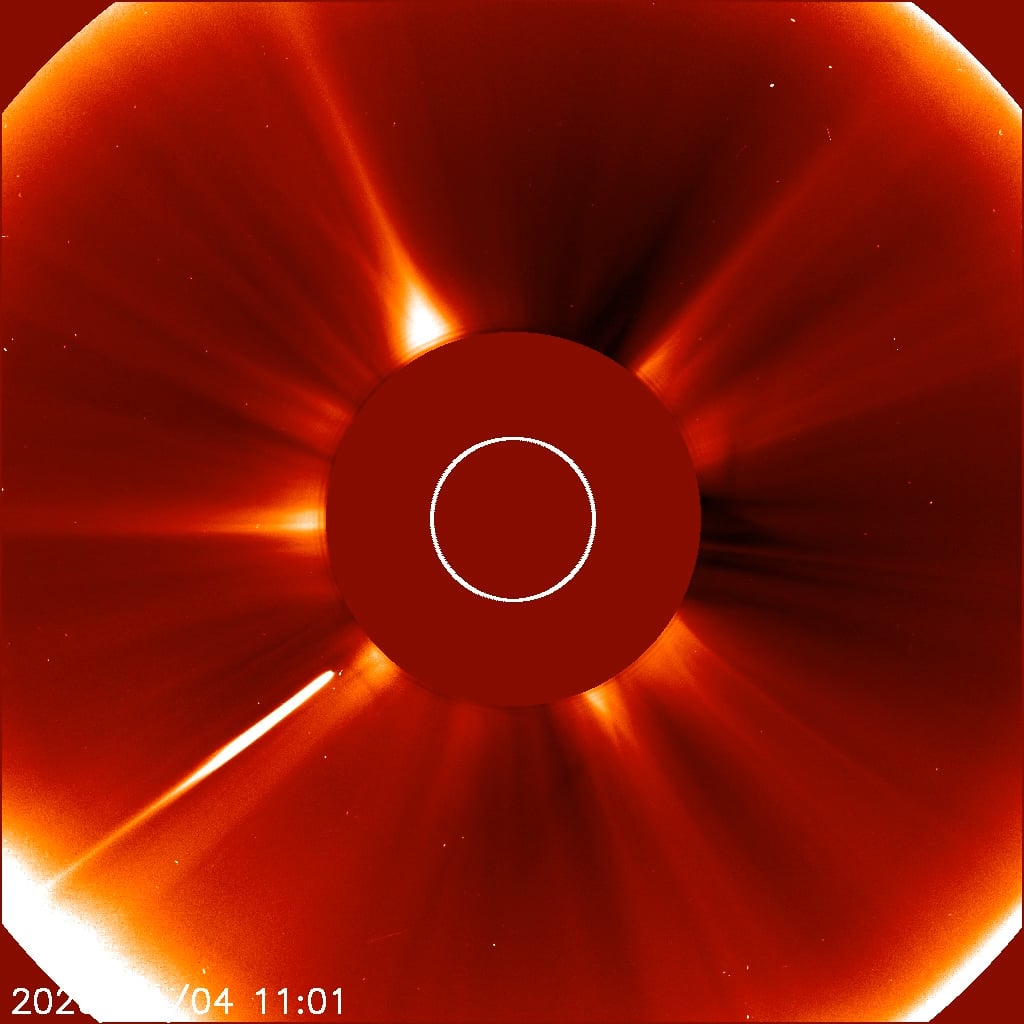
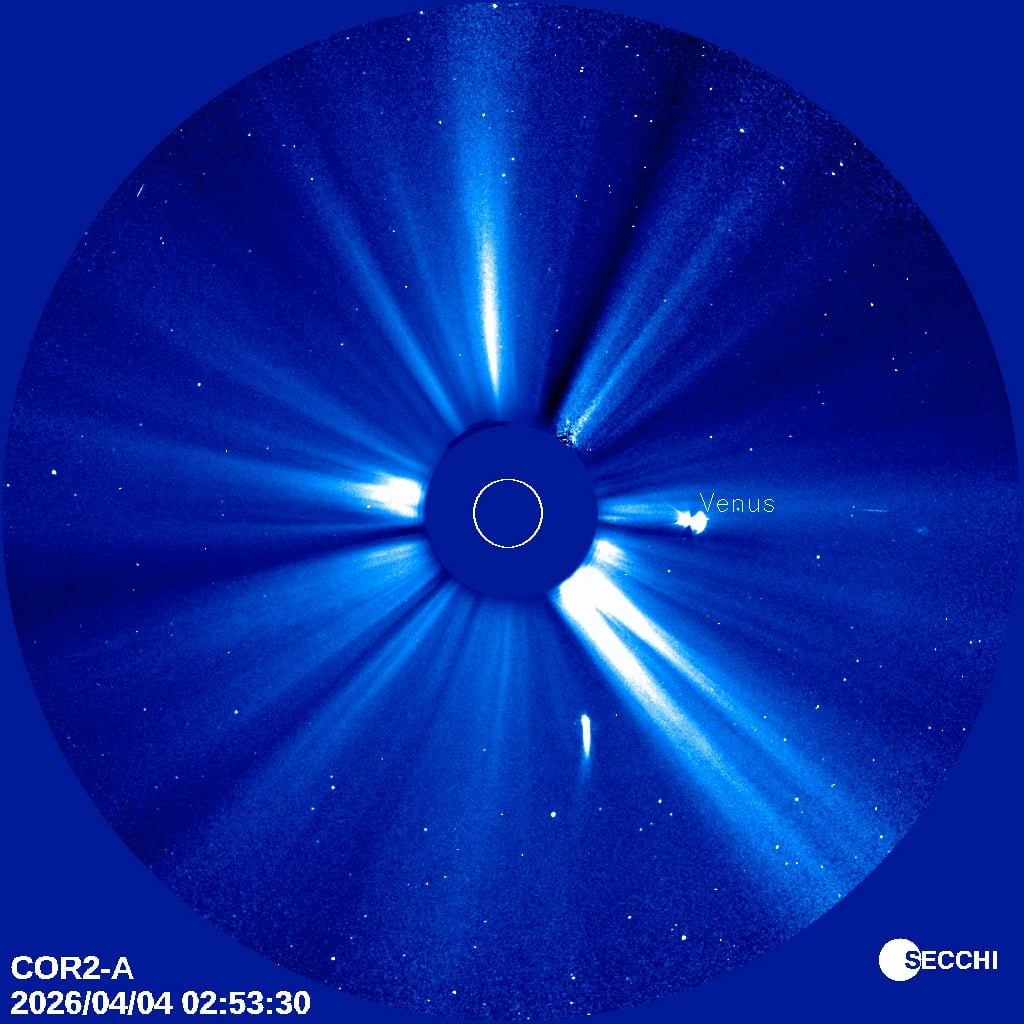
The final approach of MAPS was tracked by several NASA spacecraft, each providing a different view of the event. This coordination made it possible to study the comet in much greater detail than usual.
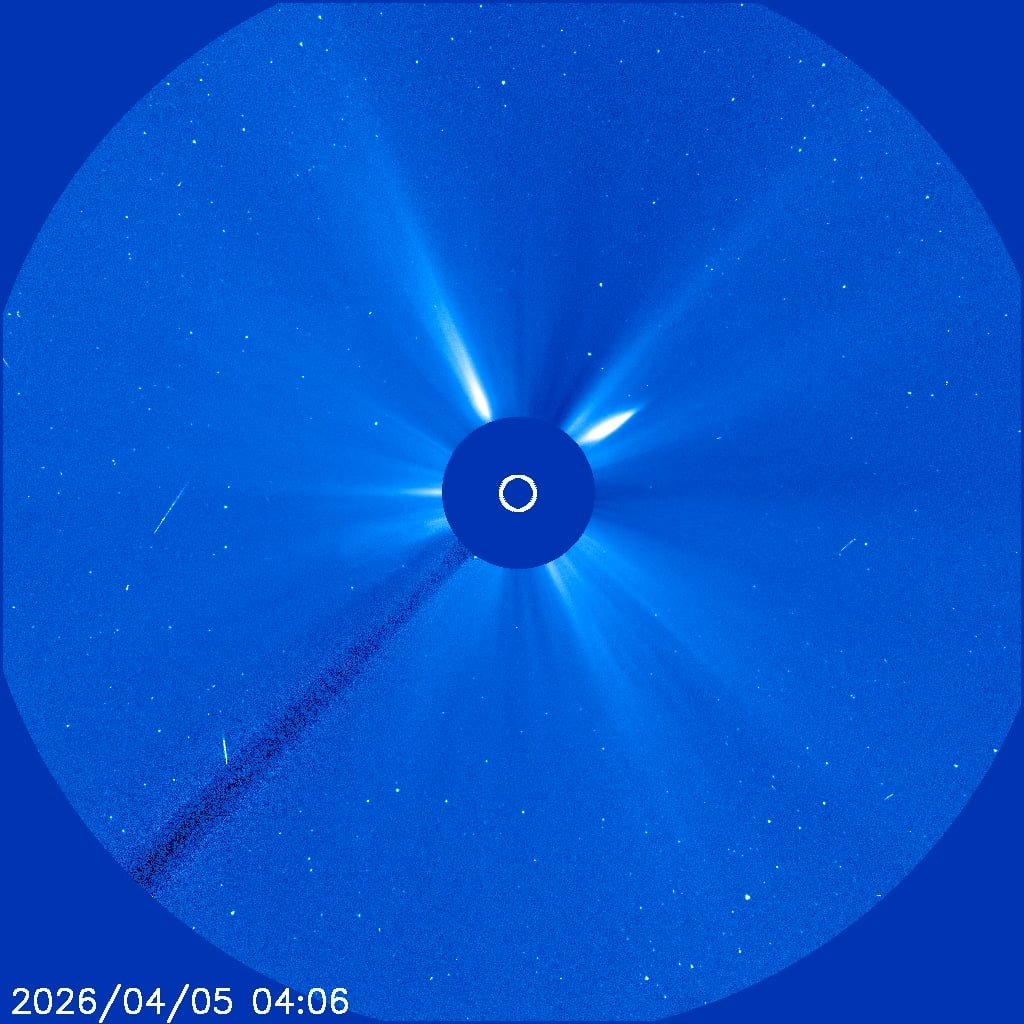
The most continuous observations came from SOHO. This mission has detected thousands of sungrazing comets over the years. Its coronagraph blocks the Sun’s bright disk, allowing faint objects nearby to become visible. In SOHO’s field of view, MAPS appeared as a bright, compact object with a thin tail. As it moved inward, it maintained a stable appearance. This suggested that the nucleus was still intact during the early stages of the approach. The brightness did not drop sharply, and the shape remained well defined.
At the same time, STEREO observed the comet from a different angle. This perspective revealed more about the comet’s motion in space. Rather than falling straight toward the Sun, the comet followed a curved trajectory around it. This path matched predictions based on its orbital parameters.
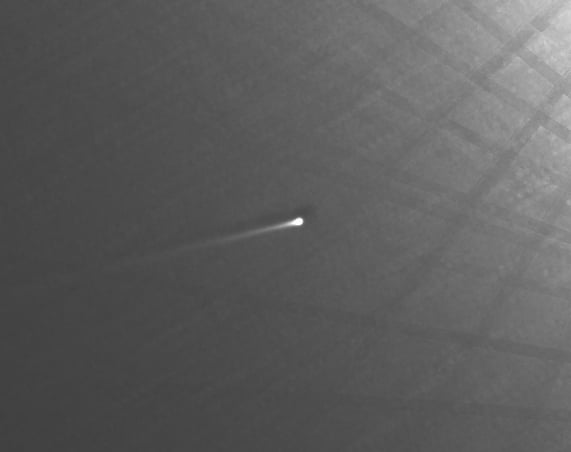
Another mission, PUNCH, provided additional context. It captured the comet in the days leading up to its final approach. These images showed the structure of the comet before it entered the most extreme region near the Sun.
Temporal sequence of fragmentation
The breakup of MAPS happened over a short period, but the sequence can be reconstructed with reasonable accuracy. Before the comet moved behind the coronagraph, it still appeared intact. There were no strong signs of gradual fading or slow fragmentation.
This suggests that the nucleus remained stable until very late in its approach. However, the absence of a central core after re-emergence tells a different story. The fragmentation must have occurred during the period when the comet was hidden from direct view.
Based on timing and position, scientists estimate that the breakup occurred several hours before perihelion. This means the comet did not survive long enough to reach its closest point as a solid object. After the breakup, the debris continued along the same trajectory. The material spread out, forming a faint and elongated cloud. Over time, this cloud became less visible as it expanded and dispersed.
Importantly, no compact fragment was detected. This indicates that the nucleus disintegrated into many small fragments and dust. This type of complete disruption is common among smaller sungrazers.
Physical drivers of disintegration
The disintegration of MAPS can be explained by a combination of physical processes that act together near the Sun. Each of these processes alone can stress a comet, but together they create an extreme environment.
The first factor is heat. As the comet approaches the Sun, its surface temperature rises rapidly. Ice inside the nucleus begins to sublimate at a high rate. This produces gas that builds pressure within the structure. At the same time, solar radiation adds further energy. This increases the rate of sublimation and weakens the bonds between particles in the nucleus. The surface becomes more active, and material begins to escape more easily.
Another important factor is tidal stress. The Sun’s gravity pulls more strongly on the near side of the comet than on the far side. This difference creates a stretching force. For a solid object, this may not be enough to cause damage. For a weak and fractured comet, it can be critical.
The final stage likely involved rapid fragmentation into small pieces, followed by vaporization or dispersal into dust. This explains why no solid core was seen after the event.
Clear skies!
See more from DIYPhotography.net on Google
Add DIYPhotography.net as a trusted source. This makes
our stories more likely to appear in your Google Search results.
 Add as a preferred source on Google

Soumyadeep Mukherjee
Soumyadeep Mukherjee is an award-winning astrophotographer from India. He has a doctorate degree in Linguistics. His work extends to the sub-genres of nightscape, deep sky, solar, lunar and optical phenomenon photography. He is also a photography educator and has conducted numerous workshops. His works have appeared in over 40 books & magazines including Astronomy, BBC Sky at Night, Sky & Telescope among others, and in various websites including National Geographic, NASA, Forbes. He was the first Indian to win “Astronomy Photographer of the Year” award in a major category.

Join the Discussion
DIYP Comment Policy
Be nice, be on-topic, no personal information or flames.