




















NASA’s PUNCH Reveals its First Images of Huge Solar Eruptions
Jun 18, 2025
Soumyadeep Mukherjee
Soumyadeep Mukherjee is an award-winning astrophotographer from India. He has a doctorate degree in Linguistics. His work extends to the sub-genres of nightscape, deep sky, solar, lunar and optical phenomenon photography. He is also a photography educator and has conducted numerous workshops. His works have appeared in over 40 books & magazines including Astronomy, BBC Sky at Night, Sky & Telescope among others, and in various websites including National Geographic, NASA, Forbes. He was the first Indian to win “Astronomy Photographer of the Year” award in a major category.
Share:
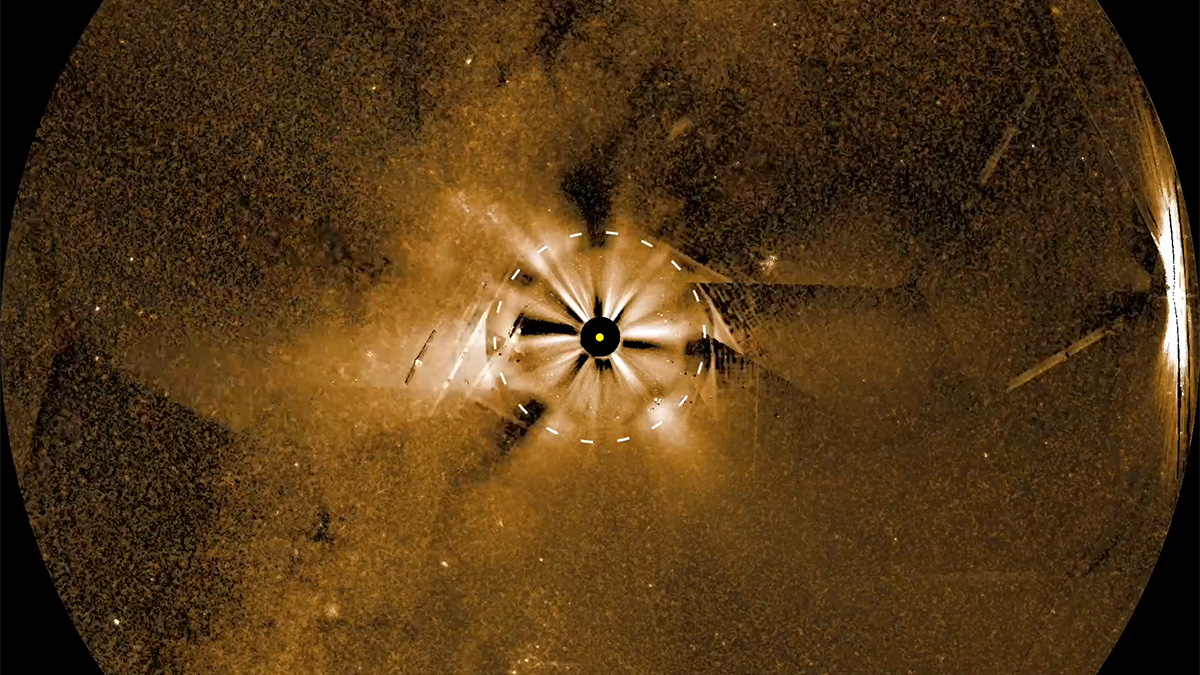
In June 2025, NASA released the first images from its new solar mission, PUNCH. The mission captured massive eruptions from the Sun known as coronal mass ejections (CMEs). These visuals are among the most detailed ever recorded of the Sun’s outer atmosphere. They offer new ways to understand how solar storms travel through space. PUNCH stands for Polarimeter to Unify the Corona and Heliosphere. It consists of four small satellites. Together, they work like one large camera. They observe how solar material moves from the Sun into the solar system. This zone is called the heliosphere. The images released in June were taken in late May and early June 2025. The visuals show enormous plumes of solar plasma. These clouds of charged particles burst from the Sun and travel outward.
What Is PUNCH?
PUNCH is a NASA mission led by the Southwest Research Institute (SwRI). It launched in April 2025. The goal is to study how the Sun’s outer atmosphere becomes the solar wind. This wind affects everything in the solar system, including Earth.
The four satellites form a “virtual telescope.” Each satellite carries a different camera. Together, they capture a continuous view of solar material as it leaves the corona. This allows scientists to study solar storms in 3D. Before PUNCH, scientists had to rely on multiple, distant missions to track these events. Three of the PUNCH satellites carry wide-field imagers. These cameras track particles as they travel far from the Sun. The fourth satellite carries a narrow-field imager. This one zooms in on the solar corona. Together, they provide a full picture—from the base of the eruption to the edge of the heliosphere.
First images: A major step forward
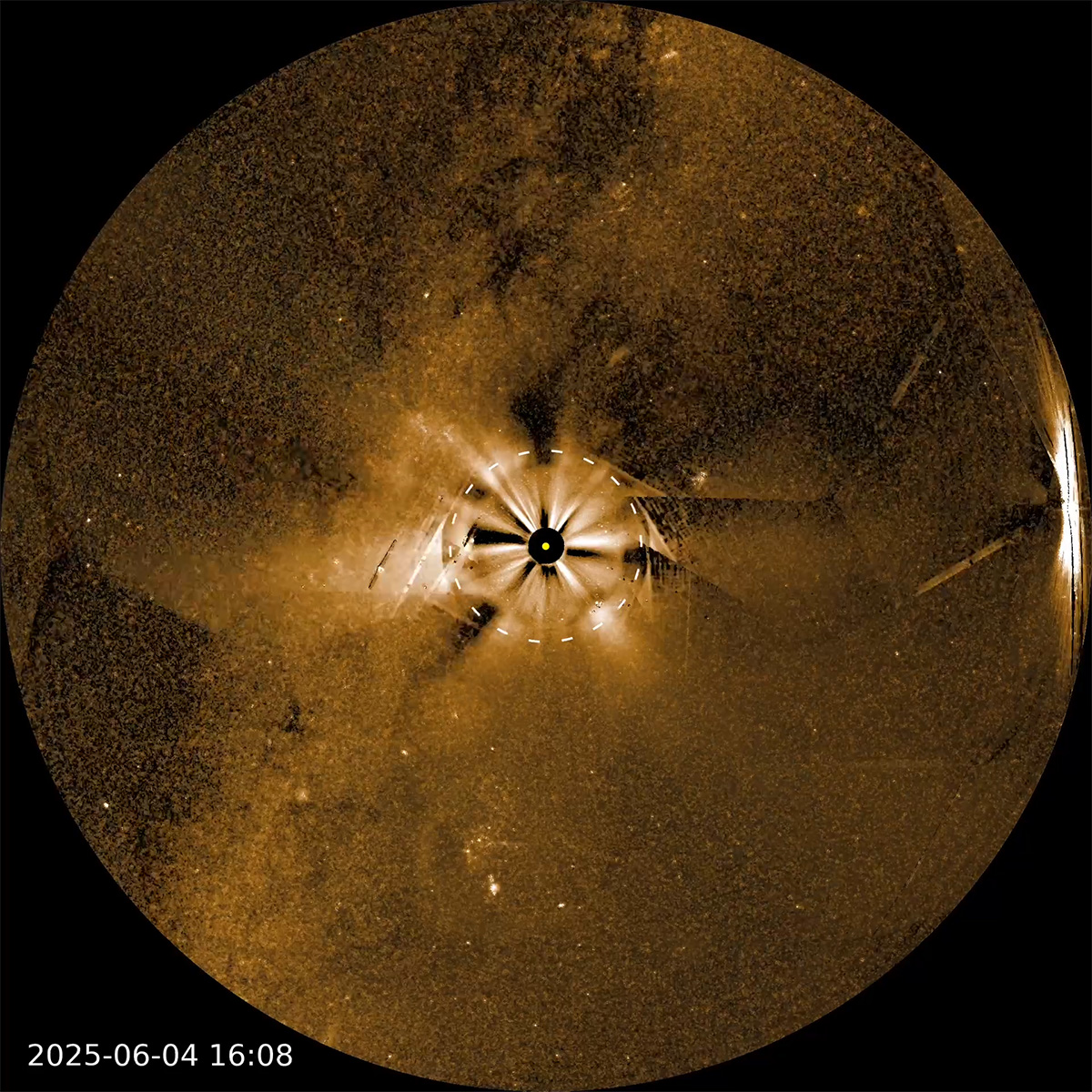
The first images released by NASA are both beautiful and important. They show the Sun with a black disk over it. This is not an error. It’s a technique called occulting. It blocks the Sun’s bright light, making faint features visible. The sequence begins on May 25 and continues into early June 2025. It shows a CME as it bursts outward. The eruption spreads in all directions. It even travels toward the spacecraft.
One of the most striking features is the appearance of planets and stars. Venus and Jupiter appear in the frame. You can also see the Pleiades star cluster and the Orion constellation. These reference points help scientists understand direction and scale. The images were taken while the satellites were still calibrating. That means the quality will only get better in the coming months.
Early results look promising
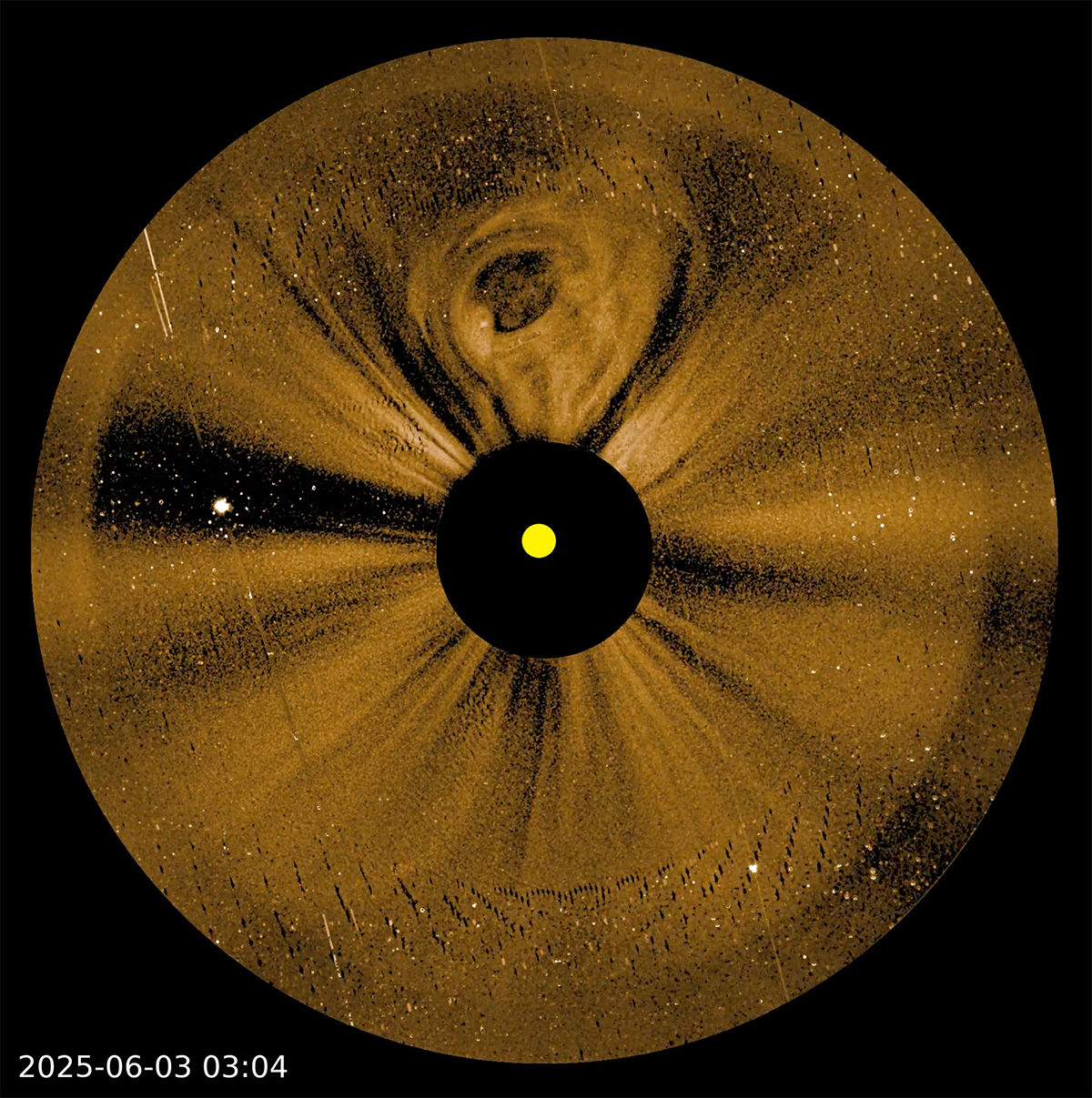
Even before full calibration, PUNCH is delivering useful data. The June images showed a CME on June 3 in detail. The narrow-field camera captured the structure of the eruption. The wide-field imagers tracked it across the sky. The CME showed clear loops and streamers. These are common features in solar eruptions. Scientists can now track how these features change over time. This helps them understand the forces at work. NASA scientists say the mission is operating as expected. Calibration will continue through the next few months. Once complete, the mission will enter its science phase.
NASA’s PUNCH mission is off to a strong start. Its first images show the power and beauty of our Sun. More importantly, they show that we now have the tools to track solar storms in detail. This will help us protect satellites, astronauts, and life on Earth. It will also help us understand the invisible forces shaping our solar system. The Sun may be 93 million miles away. But with missions like PUNCH, we are getting closer to knowing its secrets every day.
Clear skies!
See more from DIYPhotography.net on Google
Add DIYPhotography.net as a trusted source. This makes
our stories more likely to appear in your Google Search results.
 Add as a preferred source on Google

Soumyadeep Mukherjee
Soumyadeep Mukherjee is an award-winning astrophotographer from India. He has a doctorate degree in Linguistics. His work extends to the sub-genres of nightscape, deep sky, solar, lunar and optical phenomenon photography. He is also a photography educator and has conducted numerous workshops. His works have appeared in over 40 books & magazines including Astronomy, BBC Sky at Night, Sky & Telescope among others, and in various websites including National Geographic, NASA, Forbes. He was the first Indian to win “Astronomy Photographer of the Year” award in a major category.



Join the Discussion
DIYP Comment Policy
Be nice, be on-topic, no personal information or flames.