

























These Four Images Celebrate NASA’s Neil Gehrels Swift Observatory
Oct 10, 2026
Soumyadeep Mukherjee
Soumyadeep Mukherjee is an award-winning astrophotographer from India. He has a doctorate degree in Linguistics. His work extends to the sub-genres of nightscape, deep sky, solar, lunar and optical phenomenon photography. He is also a photography educator and has conducted numerous workshops. His works have appeared in over 40 books & magazines including Astronomy, BBC Sky at Night, Sky & Telescope among others, and in various websites including National Geographic, NASA, Forbes. He was the first Indian to win “Astronomy Photographer of the Year” award in a major category.
Share:
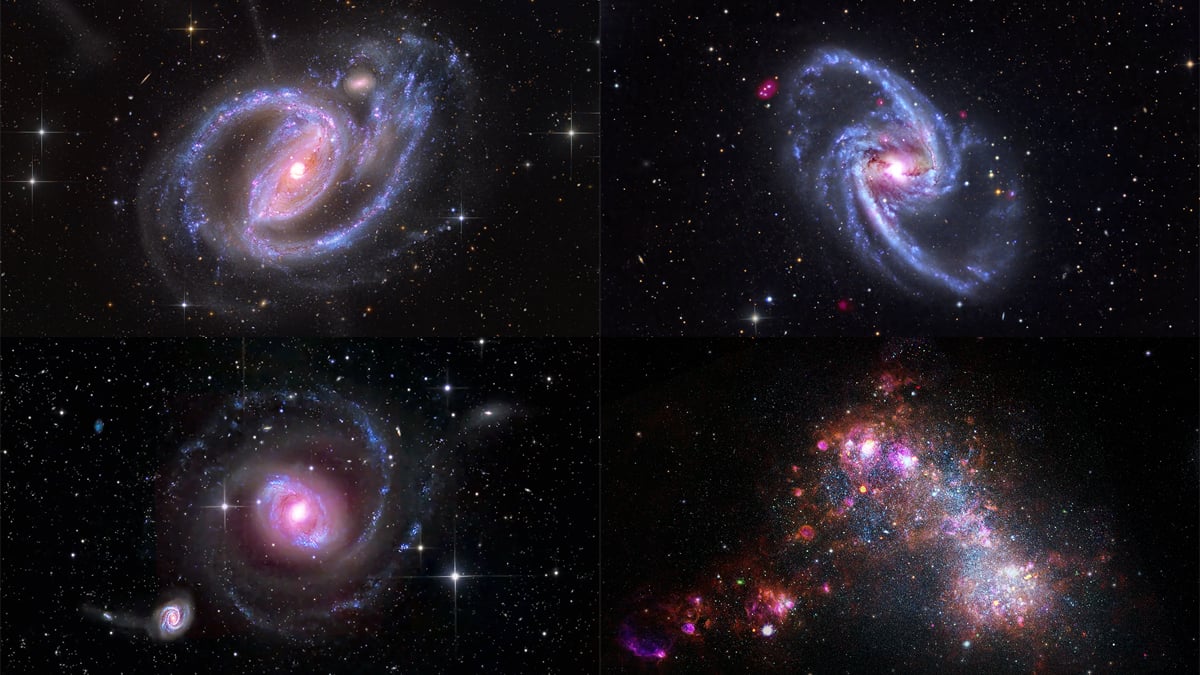
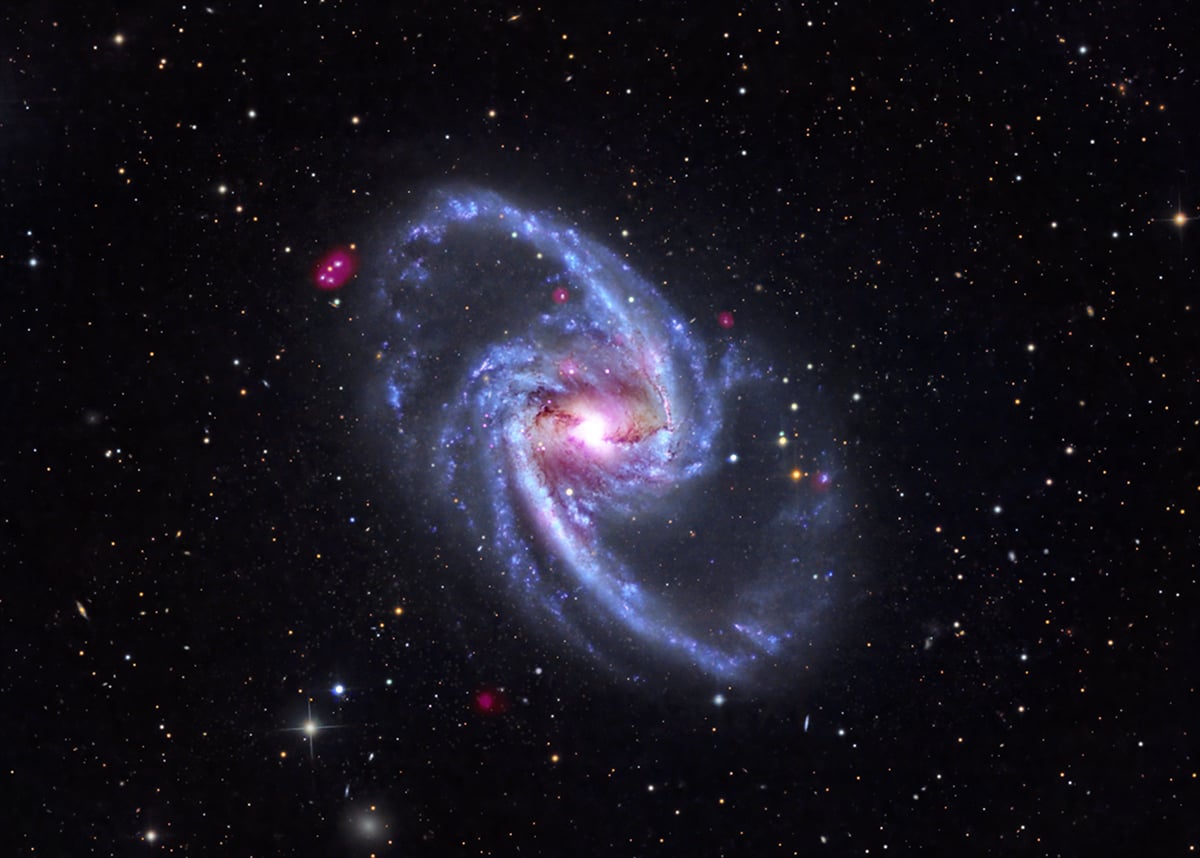
NASA has released four composite images celebrating the Neil Gehrels Swift Observatory as the spacecraft approaches the end of its mission in orbit. The collection features the Small Magellanic Cloud and three spiral galaxies: NGC 1097, NGC 4151, and NGC 1365. The images combine observations from several telescopes, including Chandra and Swift, to show these objects in X-ray, ultraviolet, and visible light.
NASA’s Swift Observatory
NASA launched the Neil Gehrels Swift Observatory on November 20, 2004, with a particular challenge: catching gamma-ray bursts before their afterglows faded. These brief explosions release intense bursts of gamma radiation. Some last only fractions of a second, while others continue for several minutes.
Swift carries three instruments to observe these events. Its Burst Alert Telescope detects gamma rays and helps locate new bursts. The X-Ray Telescope examines their X-ray emissions, while the Ultraviolet/Optical Telescope observes ultraviolet and visible light.
The mission eventually became useful for studying many other cosmic objects, including supernovae, variable stars, and black holes. Its observations have helped astronomers investigate how stars die, how black holes consume surrounding material, and how energetic sources change over time.
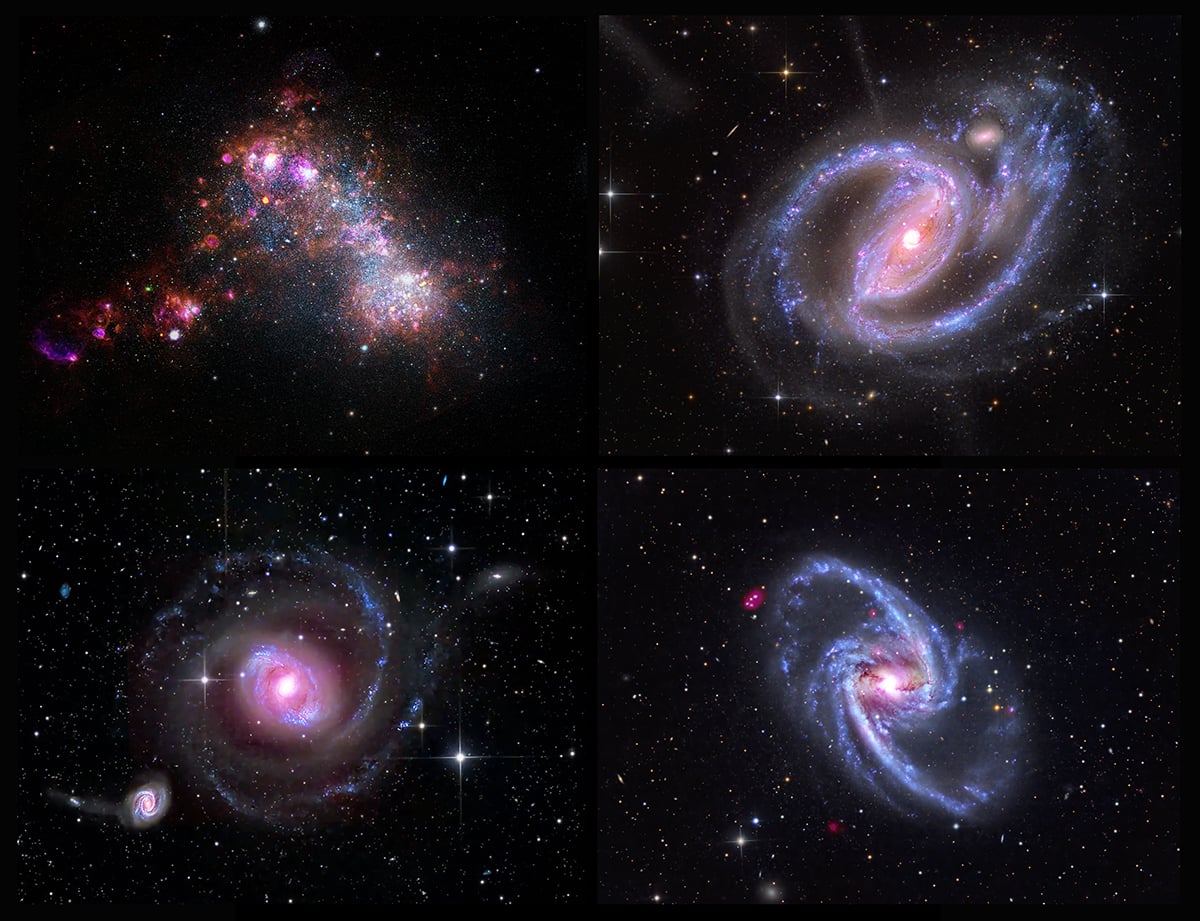
The Small Magellanic Cloud
The first image features the Small Magellanic Cloud, a dwarf galaxy roughly 200,000 light-years from Earth. It orbits the Milky Way and gives astronomers a relatively nearby place to investigate stars, gas, and dust beyond our own galaxy. Its proximity also makes it easier to study individual sources than in many distant galaxies.
This composite draws on observations from five facilities. Swift provides ultraviolet data, while Chandra and the European Space Agency‘s XMM-Newton contribute X-rays. Infrared observations from NASA’s retired Spitzer Space Telescope and ESA’s Herschel Space Observatory reveal cooler material. Optical data from the Cerro Tololo Inter-American Observatory in Chile complete the image.
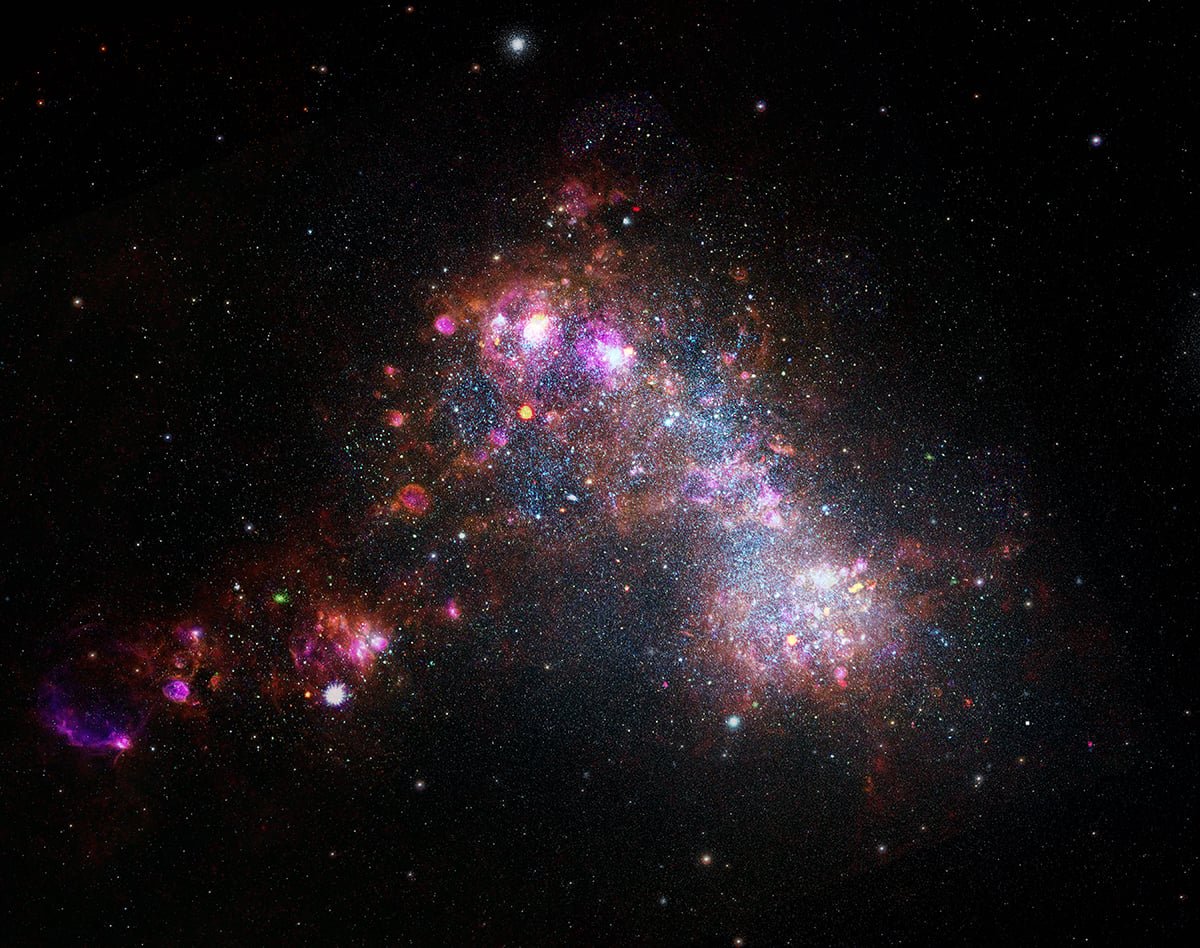
NGC 1097: A supermassive black hole at work
NGC 1097 is a spiral galaxy about 45 million light-years away in the constellation Fornax. Its center contains a supermassive black hole with an estimated mass of around 140 million Suns. Although a black hole emits no light from within its event horizon, the material falling towards it can produce intense radiation.
Gas drawn towards a black hole can form a hot accretion flow. As the material spirals inward, it heats to millions of degrees and emits X-rays. Chandra can detect this radiation, allowing astronomers to study the region around the black hole without seeing the black hole itself.
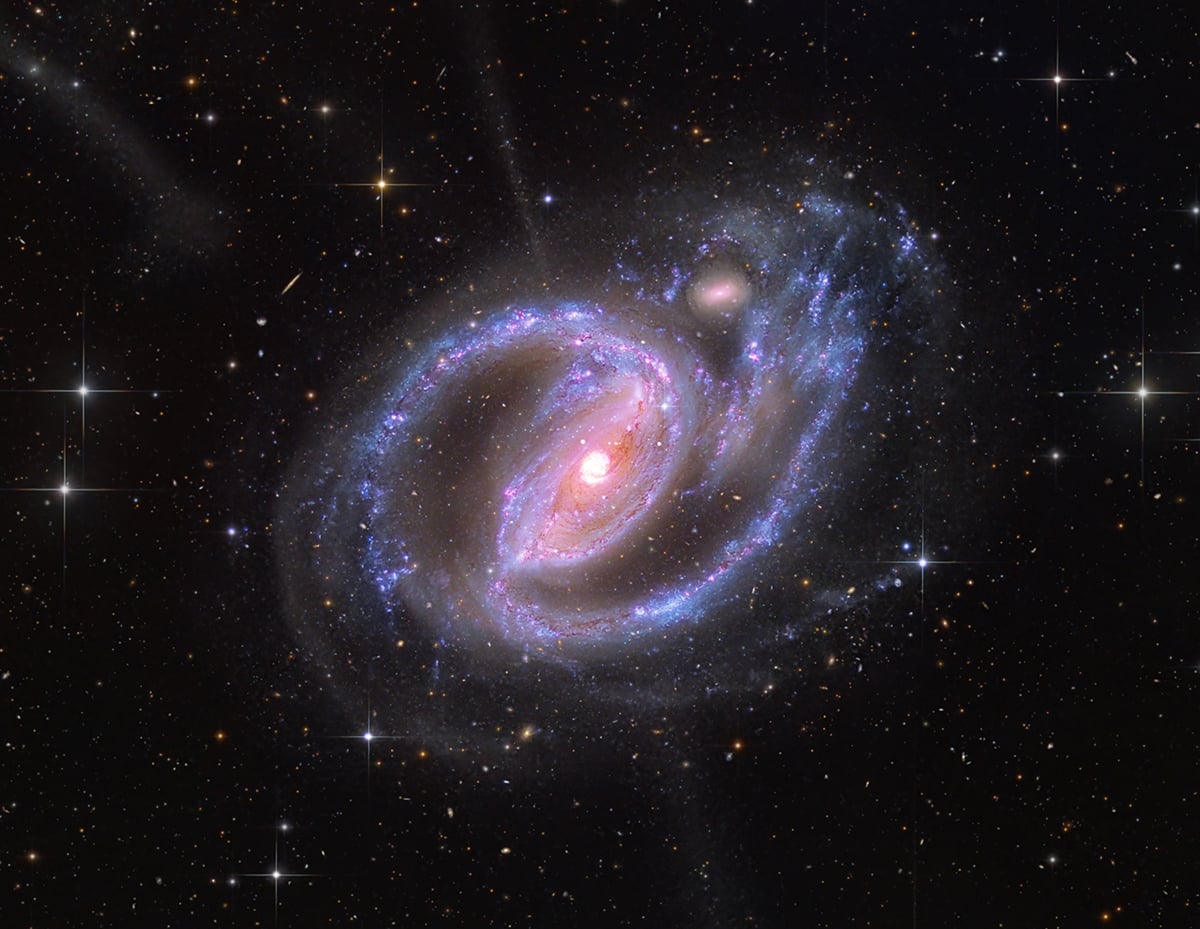
NGC 4151 reveals an active galactic nucleus
NGC 4151 is another spiral galaxy with a growing supermassive black hole at its center. Astronomers classify its bright central region as an active galactic nucleus, or AGN. Material falling towards the black hole releases energy and produces radiation across several wavelengths.
Chandra detected X-ray emission associated with an outburst powered by the black hole. Swift’s ultraviolet and X-ray observations add information about the same region, while an optical photograph by astrophotographer Mark Hanson shows the galaxy’s wider structure.
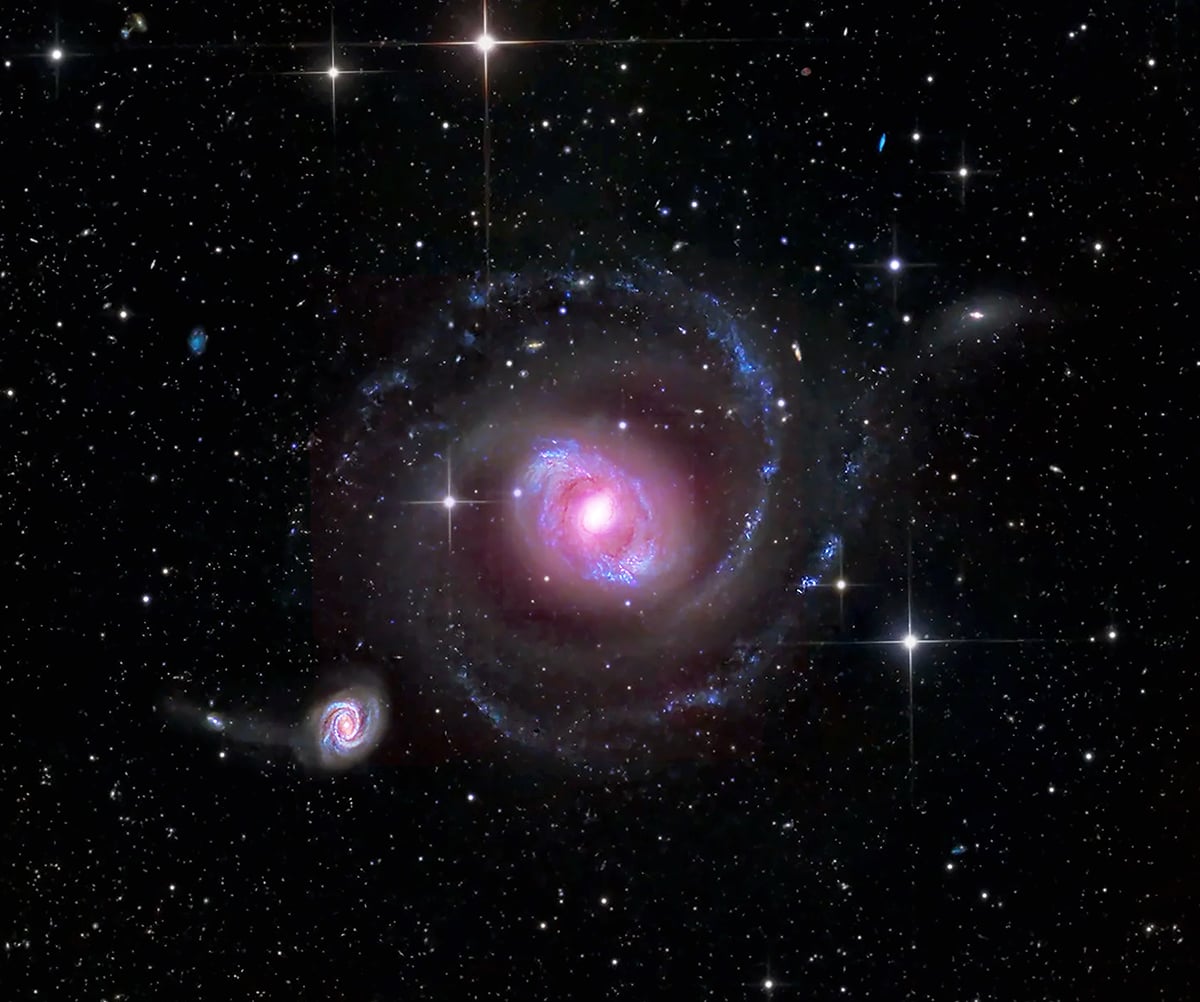
NGC 1365: An active galaxy
NGC 1365 lies about 56 million light-years away in the constellation Fornax. It is a barred spiral galaxy, with a central bar of stars and gas extending across its inner region. Like NGC 4151, it hosts an active galactic nucleus powered by material streaming towards a supermassive black hole.
The image lets astronomers compare the galaxy’s spiral structure with the energetic activity near its center. Optical observations show the distribution of stars, while ultraviolet and X-ray data reveal different sources of radiation. These measurements help researchers examine the galaxy from several perspectives.
Clear skies!
See more from DIYPhotography.net on Google
Add DIYPhotography.net as a trusted source. This makes
our stories more likely to appear in your Google Search results.
 Add as a preferred source on Google

Soumyadeep Mukherjee
Soumyadeep Mukherjee is an award-winning astrophotographer from India. He has a doctorate degree in Linguistics. His work extends to the sub-genres of nightscape, deep sky, solar, lunar and optical phenomenon photography. He is also a photography educator and has conducted numerous workshops. His works have appeared in over 40 books & magazines including Astronomy, BBC Sky at Night, Sky & Telescope among others, and in various websites including National Geographic, NASA, Forbes. He was the first Indian to win “Astronomy Photographer of the Year” award in a major category.




Join the Discussion
DIYP Comment Policy
Be nice, be on-topic, no personal information or flames.