























This Strange Image Shows How Our Moon Looks in Gamma Rays
Sep 4, 2026
Soumyadeep Mukherjee
Soumyadeep Mukherjee is an award-winning astrophotographer from India. He has a doctorate degree in Linguistics. His work extends to the sub-genres of nightscape, deep sky, solar, lunar and optical phenomenon photography. He is also a photography educator and has conducted numerous workshops. His works have appeared in over 40 books & magazines including Astronomy, BBC Sky at Night, Sky & Telescope among others, and in various websites including National Geographic, NASA, Forbes. He was the first Indian to win “Astronomy Photographer of the Year” award in a major category.
Share:
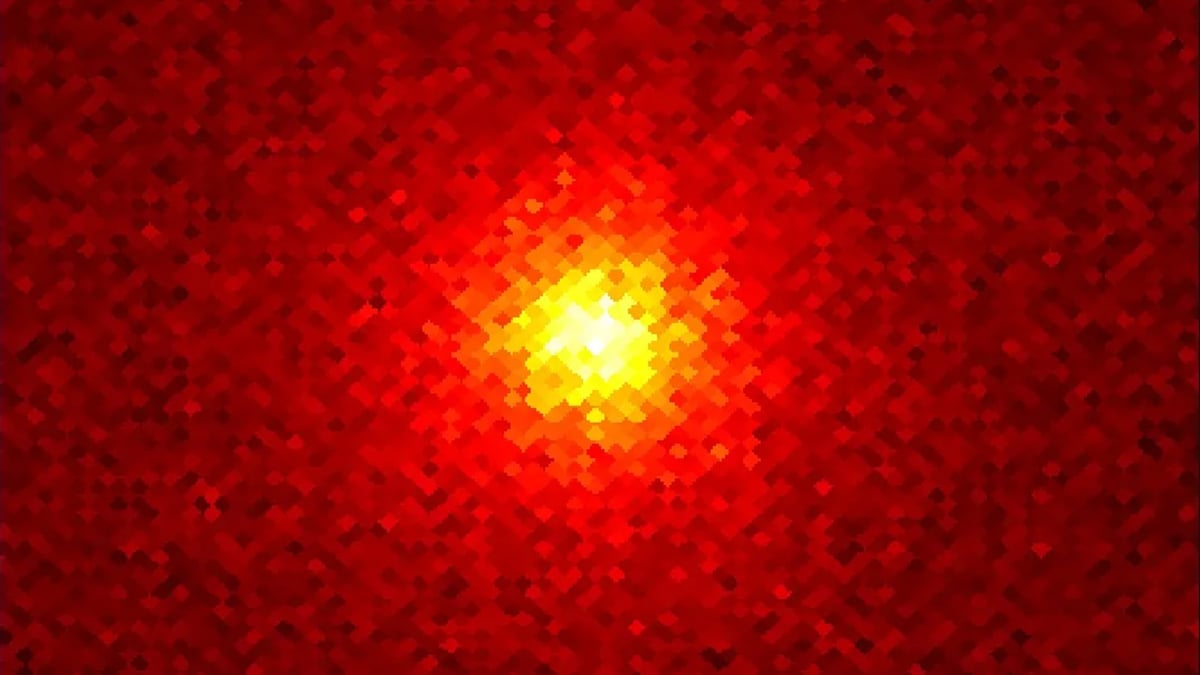
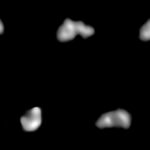
We are used to seeing the Moon as a bright disk against a dark sky. With a telescope, its familiar face becomes more detailed. Craters, mountains, and long shadows emerge along the terminator. A good camera and a steady atmosphere can reveal even finer structure. But that is only one version of the Moon. The image captured by the Fermi Gamma-ray Space Telescope looks very different. It shows a fuzzy, concentrated glow, which is even brighter than the Sun.
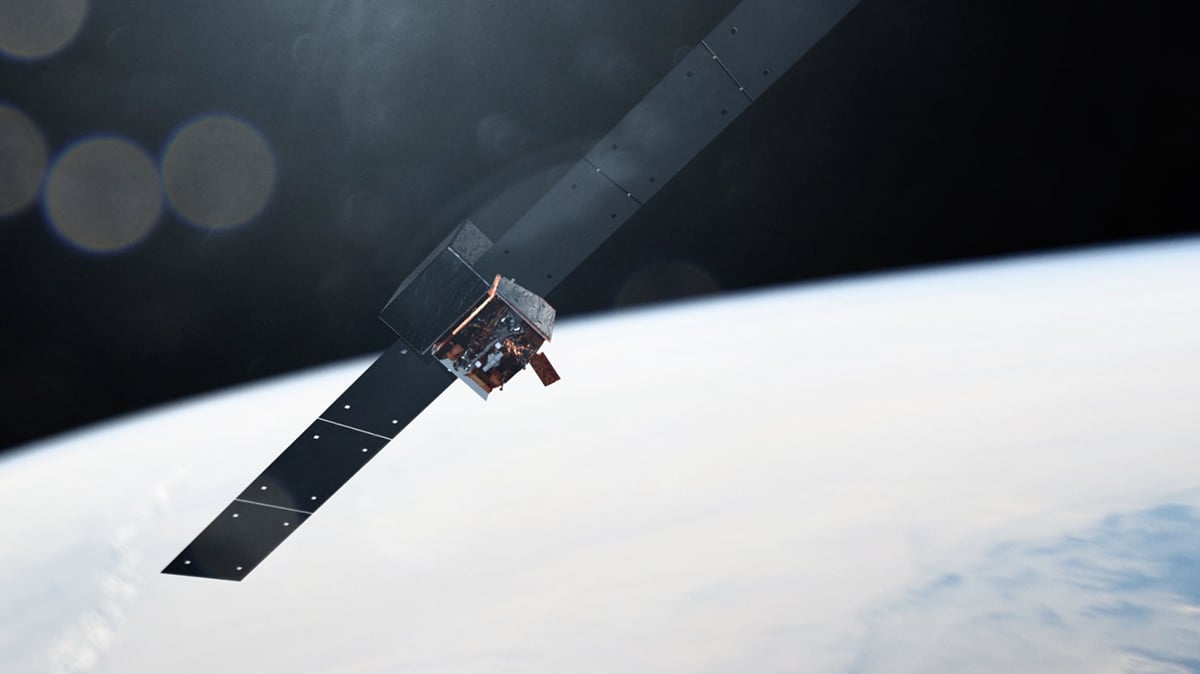
The difference is because of the wavelength. Fermi’s Large Area Telescope, or LAT, observes gamma rays, which have vastly more energy than visible light. The particular images NASA released contain gamma rays above 31 million electron volts. That is more than 10 million times the energy of visible-light photons.
The Moon becomes a glow, not a disk
Fermi cannot resolve the lunar surface in visible light. Its gamma-ray observations are not detailed enough to show the Moon’s disk clearly, let alone individual craters or mountains. LAT records gamma-ray events coming from the Moon’s direction.
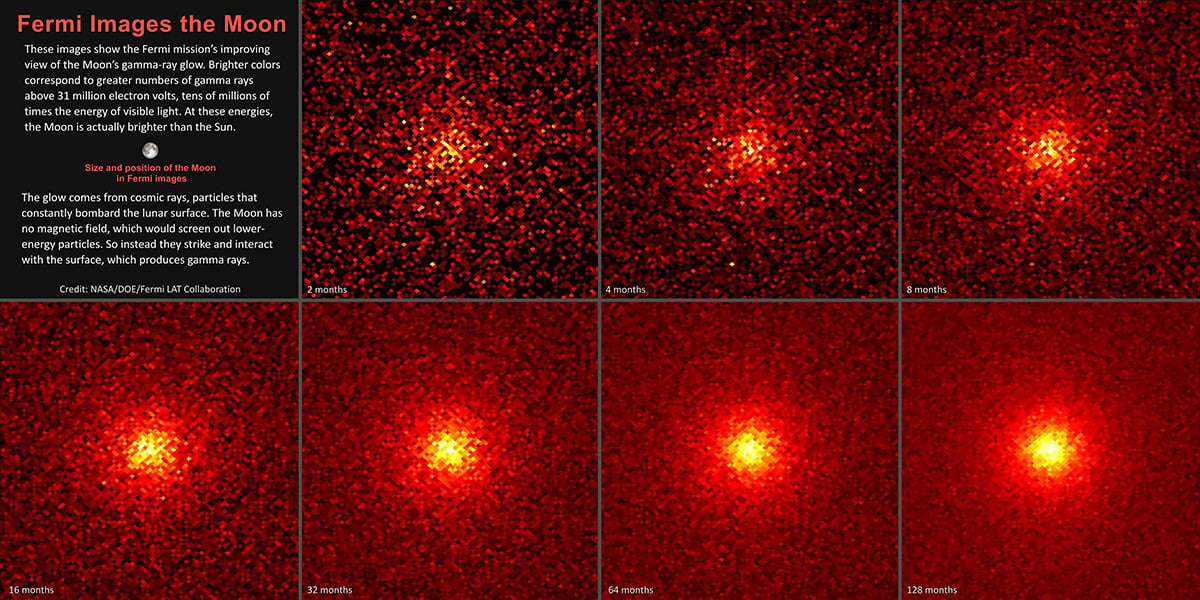
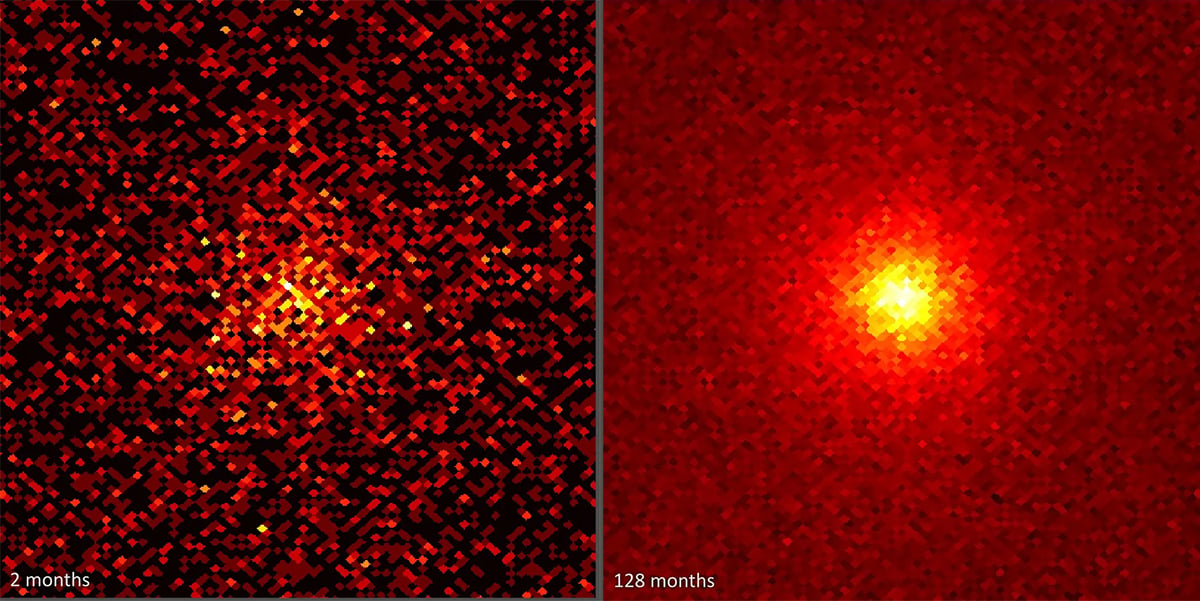
The NASA graphic presents a series of 5-by-5-degree images centered on the Moon. The first images contain relatively little data, while later versions become increasingly defined. The observing period grows from just two months to 128 months, or about 10.7 years.
That progression will look familiar to anyone who has worked with astronomical imaging. And that is perhaps the most photography-friendly part of NASA’s visualization. A single short exposure can contain plenty of noise and very little useful signal. Stack enough exposures, however, and the underlying signal becomes easier to distinguish. Fermi’s lunar images work on a much larger scale and with a very different detector, but the basic idea of accumulating observations is familiar to astrophotographers.
The gamma-ray Moon would always look full
There is another difference between the familiar Moon and Fermi’s version. The Moon’s visible phases happen because we see different portions of its sunlit hemisphere as it orbits Earth. At full Moon, the hemisphere facing us is illuminated. At new Moon, the illuminated side faces mostly away from us.
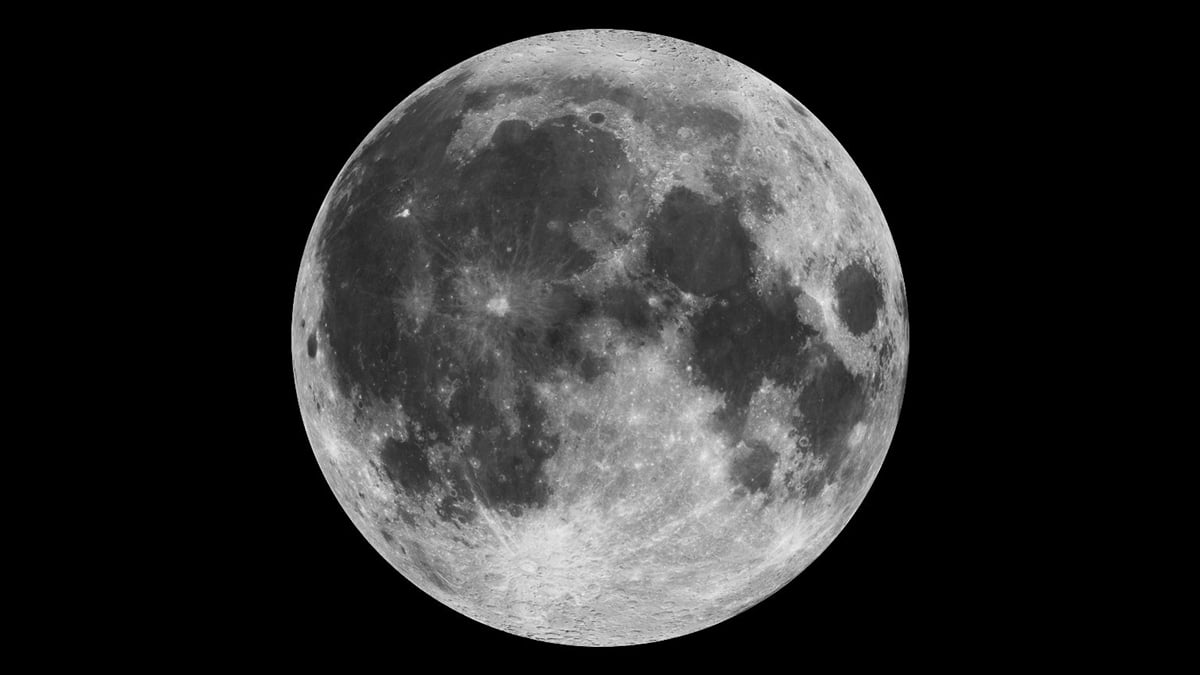
Gamma rays produced by cosmic rays do not depend on reflected sunlight in the same way. And as a result, the gamma-ray Moon does not go through the familiar monthly cycle of phases. At these energies, it would always appear full.
This feature alone can make the gamma-ray image look strange when compared with ordinary lunar photography. A photographer planning a lunar shoot might choose a particular phase because changing illumination reveals different terrain.
The gamma-ray Moon can outshine the Sun
There is one detail in the image that sounds almost counterintuitive: at the gamma-ray energies shown here, the Moon is brighter than the Sun. This comparison, however, applies to gamma rays above 31 million electron volts, the energy range used for these images. It does not mean that the Moon is generally more luminous than the Sun.
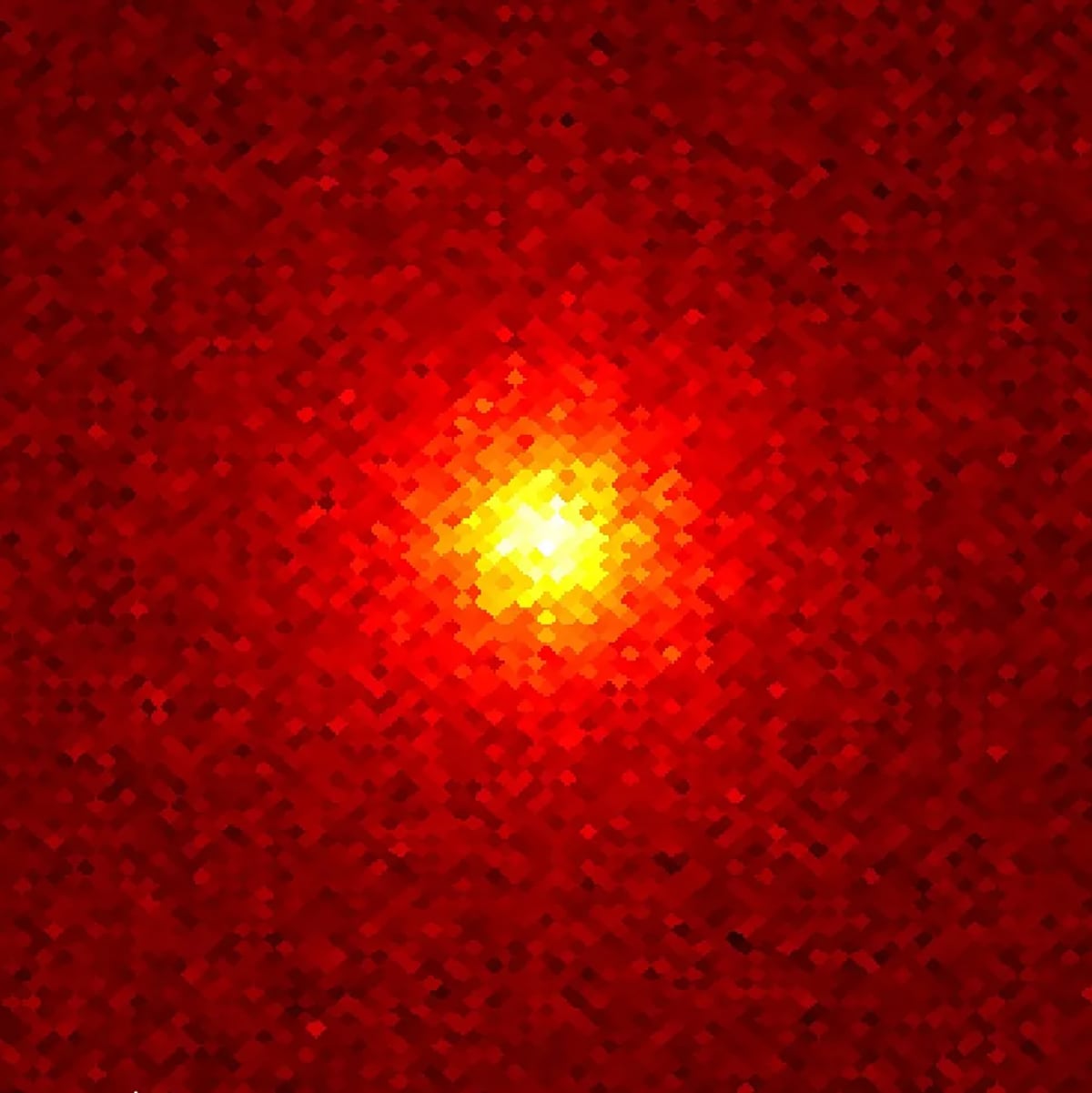
In visible light, of course, the Sun completely dominates the Moon. The brightness also changes at higher gamma-ray energies. Above about 1 billion electron volts, the Sun becomes brighter than the Moon.
The Sun has a powerful magnetic field that prevents many lower-energy cosmic rays from reaching its surface and atmosphere. Higher-energy particles can penetrate that magnetic shield, allowing them to produce gamma rays that escape the Sun and reach Fermi. The Moon lacks this kind of magnetic shielding, so lower-energy cosmic rays can reach its surface much more easily.
Clear skies!
See more from DIYPhotography.net on Google
Add DIYPhotography.net as a trusted source. This makes
our stories more likely to appear in your Google Search results.
 Add as a preferred source on Google

Soumyadeep Mukherjee
Soumyadeep Mukherjee is an award-winning astrophotographer from India. He has a doctorate degree in Linguistics. His work extends to the sub-genres of nightscape, deep sky, solar, lunar and optical phenomenon photography. He is also a photography educator and has conducted numerous workshops. His works have appeared in over 40 books & magazines including Astronomy, BBC Sky at Night, Sky & Telescope among others, and in various websites including National Geographic, NASA, Forbes. He was the first Indian to win “Astronomy Photographer of the Year” award in a major category.


Join the Discussion
DIYP Comment Policy
Be nice, be on-topic, no personal information or flames.