
























Solar Eclipse on Mars: Perseverance Captures Phobos Crossing the Sun
Aug 19, 2026
Soumyadeep Mukherjee
Soumyadeep Mukherjee is an award-winning astrophotographer from India. He has a doctorate degree in Linguistics. His work extends to the sub-genres of nightscape, deep sky, solar, lunar and optical phenomenon photography. He is also a photography educator and has conducted numerous workshops. His works have appeared in over 40 books & magazines including Astronomy, BBC Sky at Night, Sky & Telescope among others, and in various websites including National Geographic, NASA, Forbes. He was the first Indian to win “Astronomy Photographer of the Year” award in a major category.
Share:
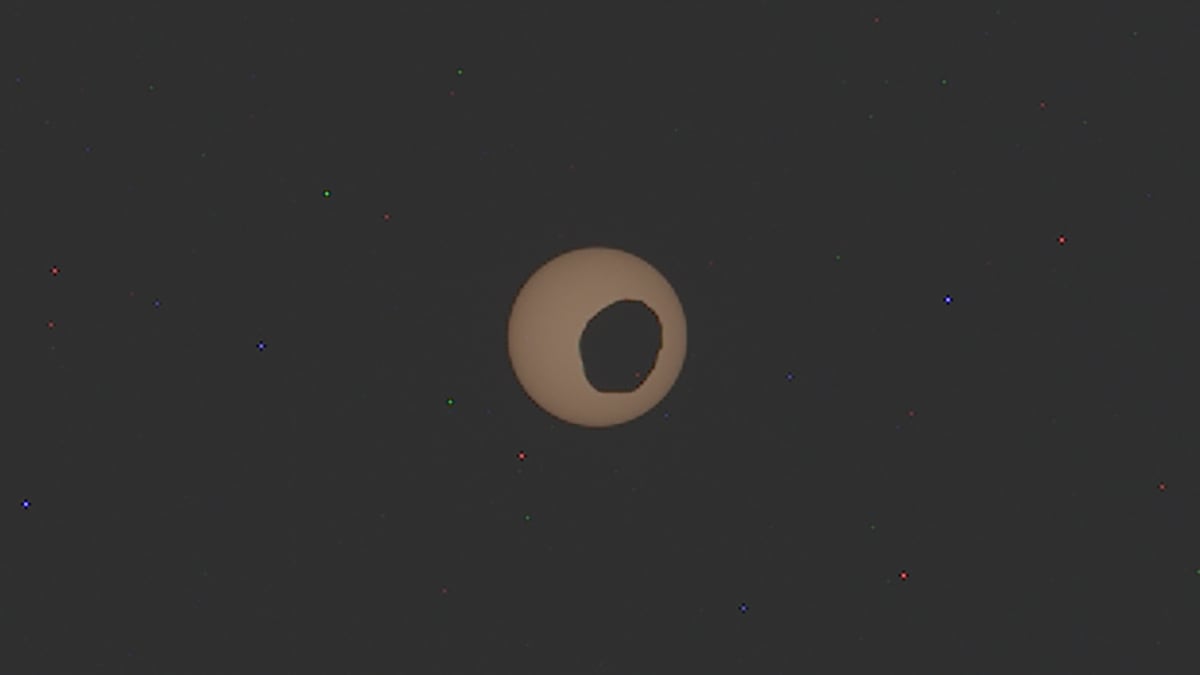
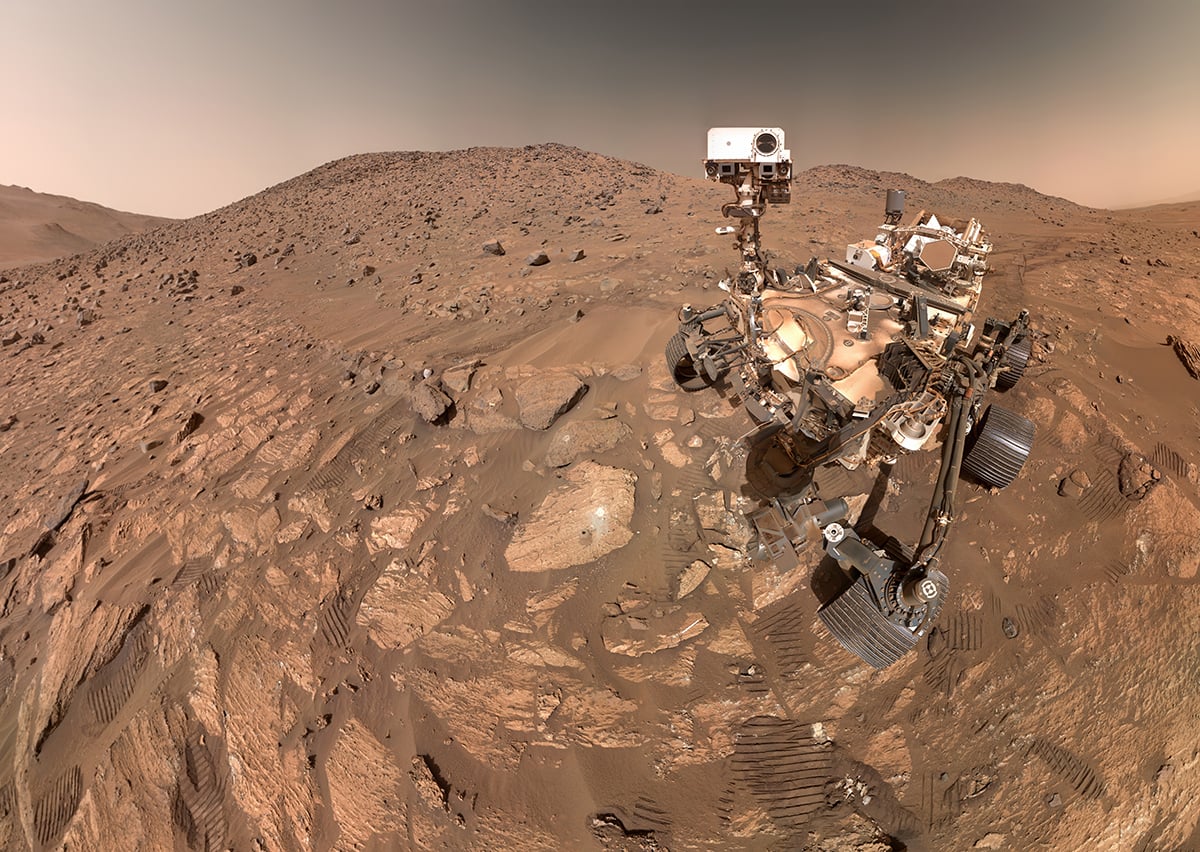
Just one day after a total solar eclipse crossed parts of Earth, NASA’s Perseverance rover watched an eclipse of its own from Mars. On August 13, 2026, the rover’s Mastcam-Z camera captured the Martian moon Phobos passing across the Sun. The observation shows how different an eclipse looks from another planet.
The event was photographed from the surface of Mars by Perseverance, which has been exploring Jezero Crater since February 2021. Unlike Earth’s Moon, Phobos cannot completely cover the Sun. It is much smaller in the Martian sky, so the event is better described as a transit or annular eclipse. The new image was captured on the Martian surface just one day after millions of people on Earth watched the August 12 total solar eclipse.
Perseverance catches Phobos during a solar transit
For Perseverance, the August 13 observation was another addition to a growing record of Martian eclipses. The rover has photographed Phobos crossing the Sun before, giving scientists repeated observations of the moon from the surface of Mars. Those earlier images provide useful comparisons because the exact shape and position of Phobos can be measured against the solar disk.
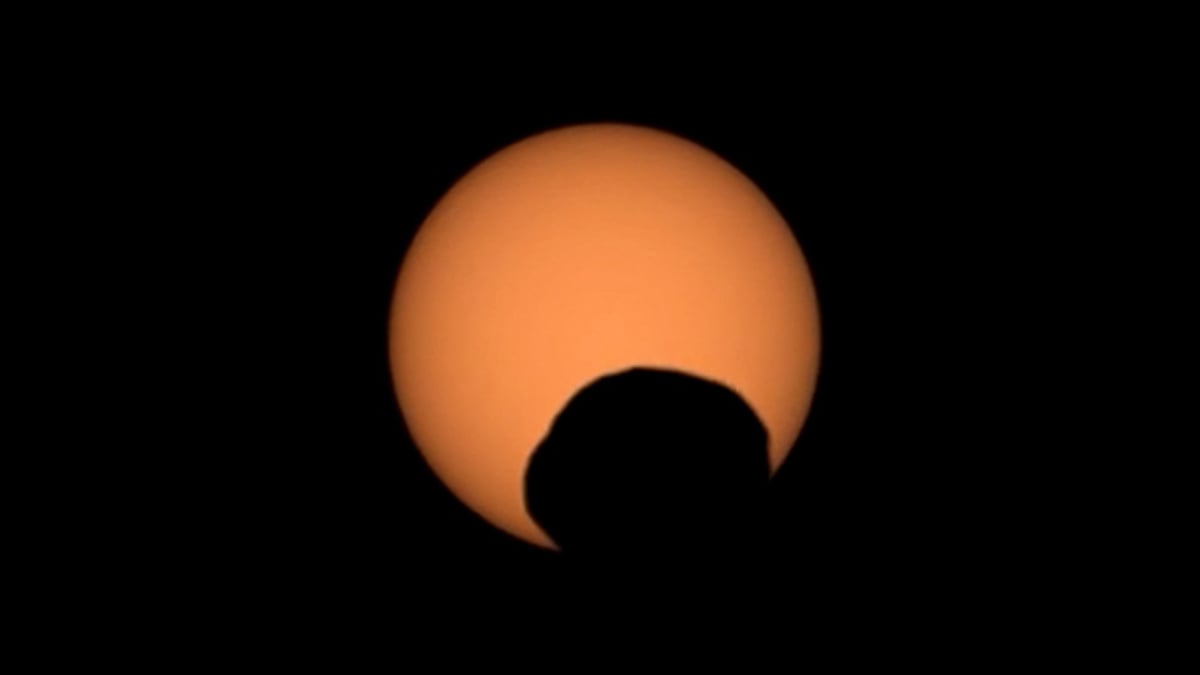
The basic geometry is pretty straightforward: Phobos passes between the rover and the Sun, blocking a small portion of the Sun’s apparent disk. Since Phobos looks much smaller than the Sun from Mars, it cannot produce the complete darkness associated with a total solar eclipse on Earth. The event is instead seen as a small dark object moving across the Sun.
Phobos measures roughly 27 kilometres along its longest dimension. Its irregular shape also means that its silhouette is not perfectly circular. Mountains, ridges and other variations along its surface affect the outline seen against the Sun. That makes a transit useful for studying the moon’s shape as well as its orbit.
You can also explore the sequence of eclipse images captured by Perseverance.
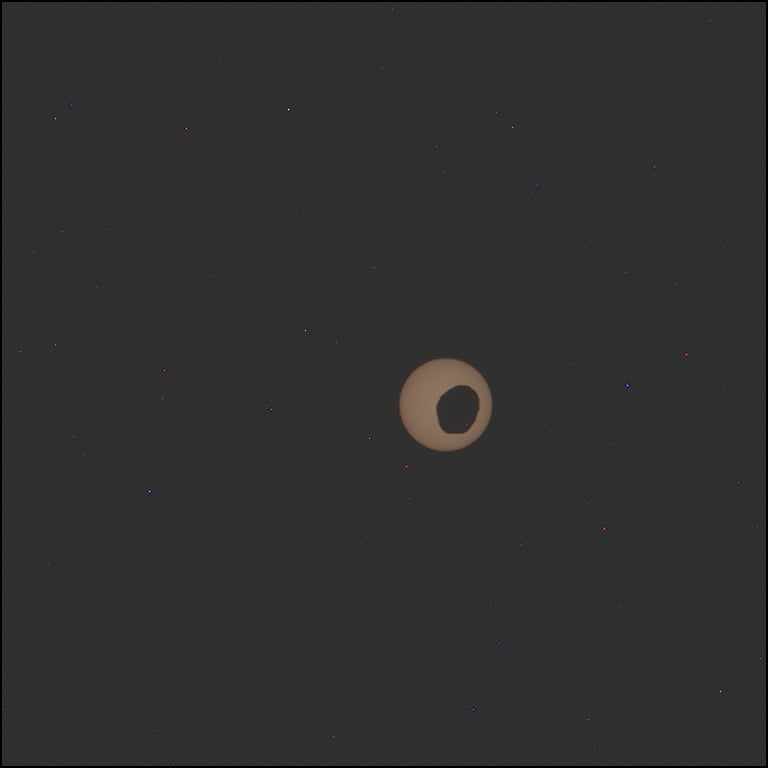
Phobos cannot produce a total eclipse on Mars
Earth’s total solar eclipses depend on an unusual coincidence of apparent sizes. The Moon is about 400 times smaller than the Sun in diameter, but it is also roughly 400 times closer to Earth. As a result, the two objects appear almost the same size in Earth’s sky.
Mars has no equivalent arrangement. Phobos is far too small to produce totality. Phobos appears about one-third the size of Earth’s Moon when viewed from directly overhead on Mars. It therefore leaves much of the solar disk exposed during a transit. The moon’s orbit adds another complication. Phobos travels around Mars in less than eight hours, making it one of the fastest-orbiting natural satellites in the Solar System. Its orbital speed is about 2.1 kilometers per second.
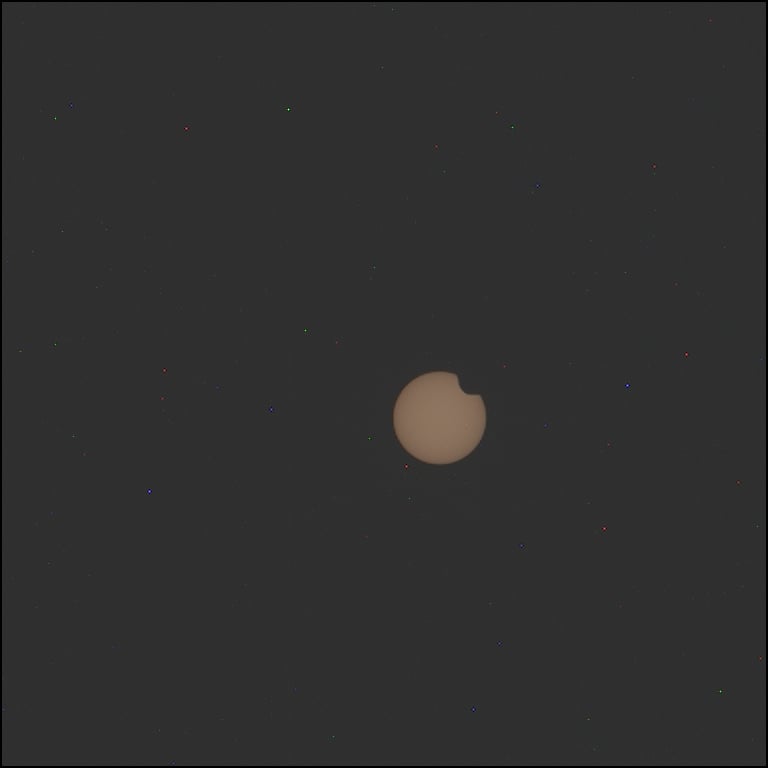
The August 13 event was consequently brief. Phobos moves across the Sun quickly, so a camera has to capture the right sequence at the right moment. Perseverance’s imaging system is well-suited to this type of observation, as it can record sequences and doesn’t rely on a single still photograph.
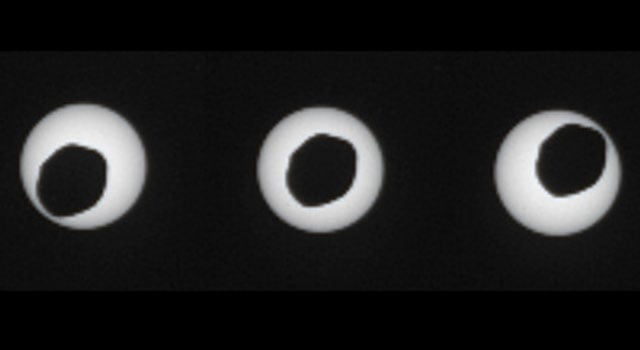
A view of the Martian sky with Mastcam-Z
The rover used its Mastcam-Z imaging system to observe the eclipse. Mounted on Perseverance’s remote sensing mast, Mastcam-Z consists of two colour cameras with zoom capability. The system can focus on distant targets and capture both still images and video.
Solar observations require additional protection because the Sun is an extremely bright target. Mastcam-Z has dedicated solar filters that reduce the amount of light reaching its detectors. NASA designed these filters for observations of the Sun and solar-system objects passing across it. The left camera’s filter transmits about 0.0001 percent of incoming light, while the right camera’s filter transmits about 0.001 percent.
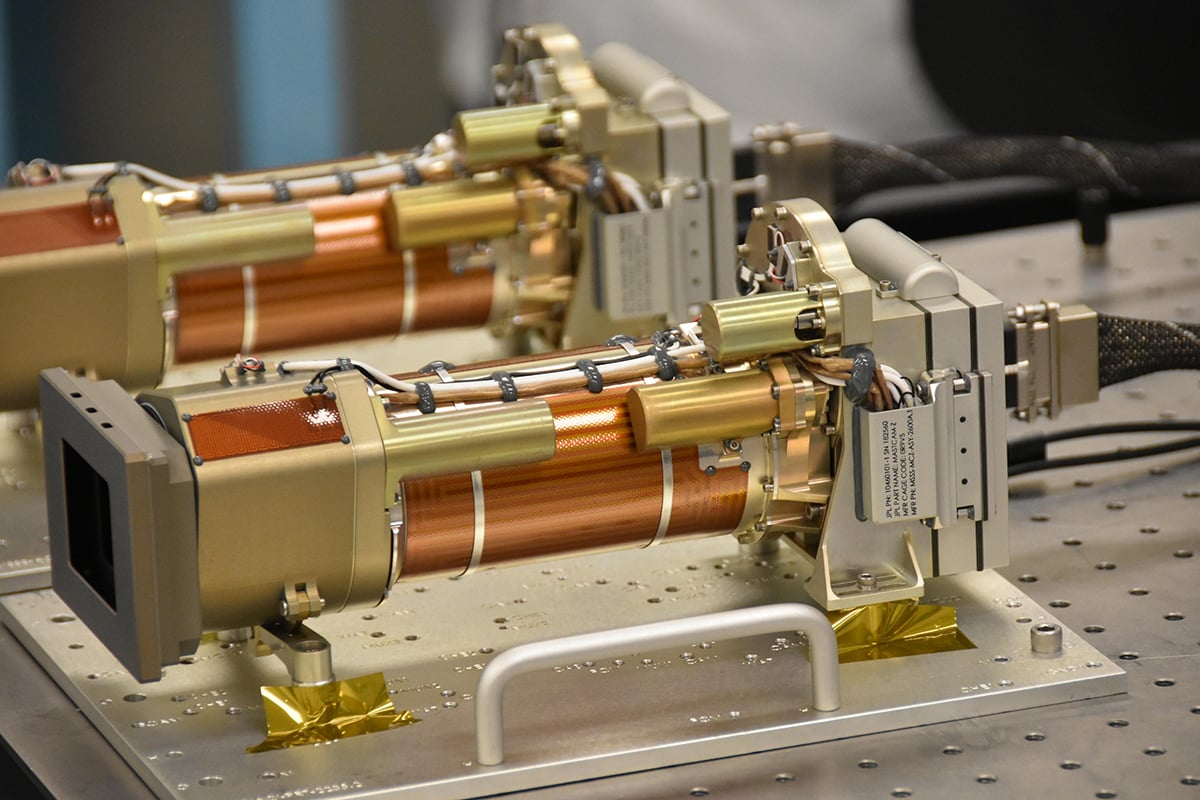
Those filters have allowed Perseverance to observe the Sun repeatedly during its mission. They have also made Mastcam-Z a useful instrument for studying Phobos and Deimos. The rover’s cameras can capture the moons as they pass across the Sun and record their silhouettes in enough detail for scientists to analyse.
The instrument’s stereo configuration provides another advantage for ordinary surface work. Its two cameras view scenes from slightly different positions, allowing researchers to build three-dimensional information about the landscape. For solar observations, however, the cameras can work as high-resolution telescopic imagers.
Clear skies!
See more from DIYPhotography.net on Google
Add DIYPhotography.net as a trusted source. This makes
our stories more likely to appear in your Google Search results.
 Add as a preferred source on Google

Soumyadeep Mukherjee
Soumyadeep Mukherjee is an award-winning astrophotographer from India. He has a doctorate degree in Linguistics. His work extends to the sub-genres of nightscape, deep sky, solar, lunar and optical phenomenon photography. He is also a photography educator and has conducted numerous workshops. His works have appeared in over 40 books & magazines including Astronomy, BBC Sky at Night, Sky & Telescope among others, and in various websites including National Geographic, NASA, Forbes. He was the first Indian to win “Astronomy Photographer of the Year” award in a major category.
Related Posts
 Perseverance Captures Earth Passing Behind Phobos from Mars
 NASA’s Perseverance rover captures video of 1.2 miles tall dust devil on Mars
 Satellite images capture crossing paths of totality in 2017 and 2024 North American solar eclipses
 Eclipse on Demand: ESA creates Artificial Solar Eclipse in Space
Join the Discussion
DIYP Comment Policy
Be nice, be on-topic, no personal information or flames.