











ESA’s Hera Photographs Asteroid Didymos With Three Different Cameras
Nov 17, 2026
Soumyadeep Mukherjee
Soumyadeep Mukherjee is an award-winning astrophotographer from India. He has a doctorate degree in Linguistics. His work extends to the sub-genres of nightscape, deep sky, solar, lunar and optical phenomenon photography. He is also a photography educator and has conducted numerous workshops. His works have appeared in over 40 books & magazines including Astronomy, BBC Sky at Night, Sky & Telescope among others, and in various websites including National Geographic, NASA, Forbes. He was the first Indian to win “Astronomy Photographer of the Year” award in a major category.
Share:
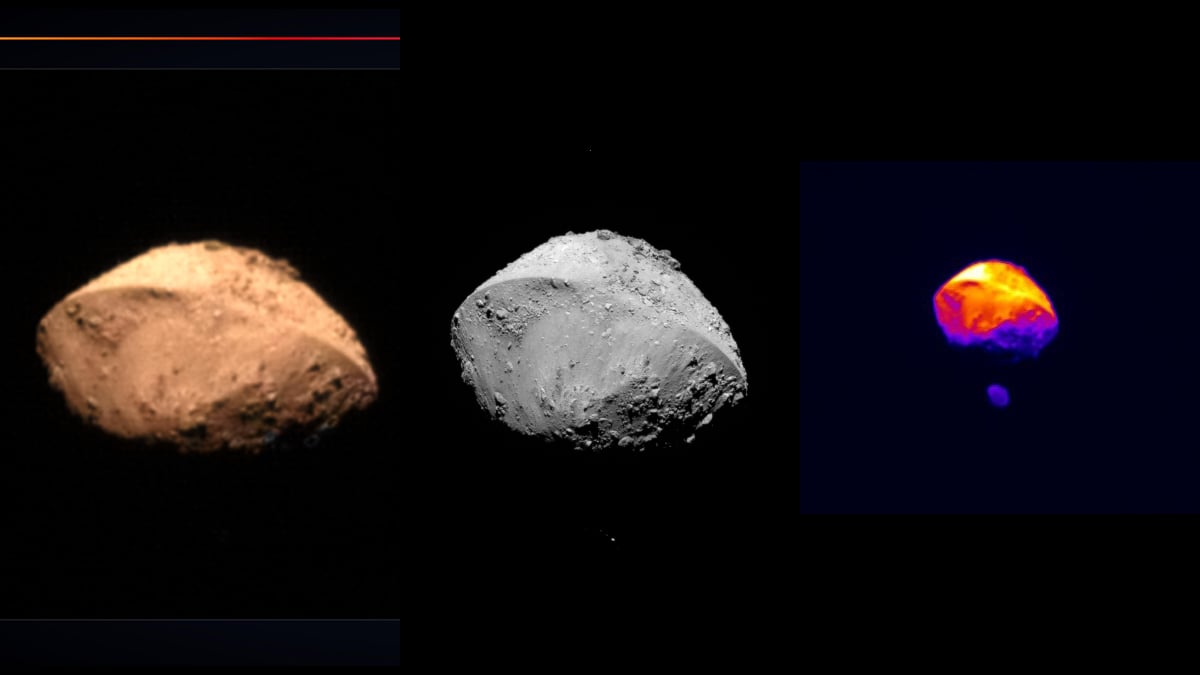
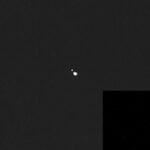
The European Space Agency‘s Hera spacecraft has photographed the asteroid Didymos from just 28.5 kilometers away. The new images show its rocky surface, prominent equatorial ridge, and smaller companion, Dimorphos. Interestingly, Hera captured the same region using three different imaging technologies, each revealing details the others cannot record.
The Asteroid Framing Camera: Visible-light image
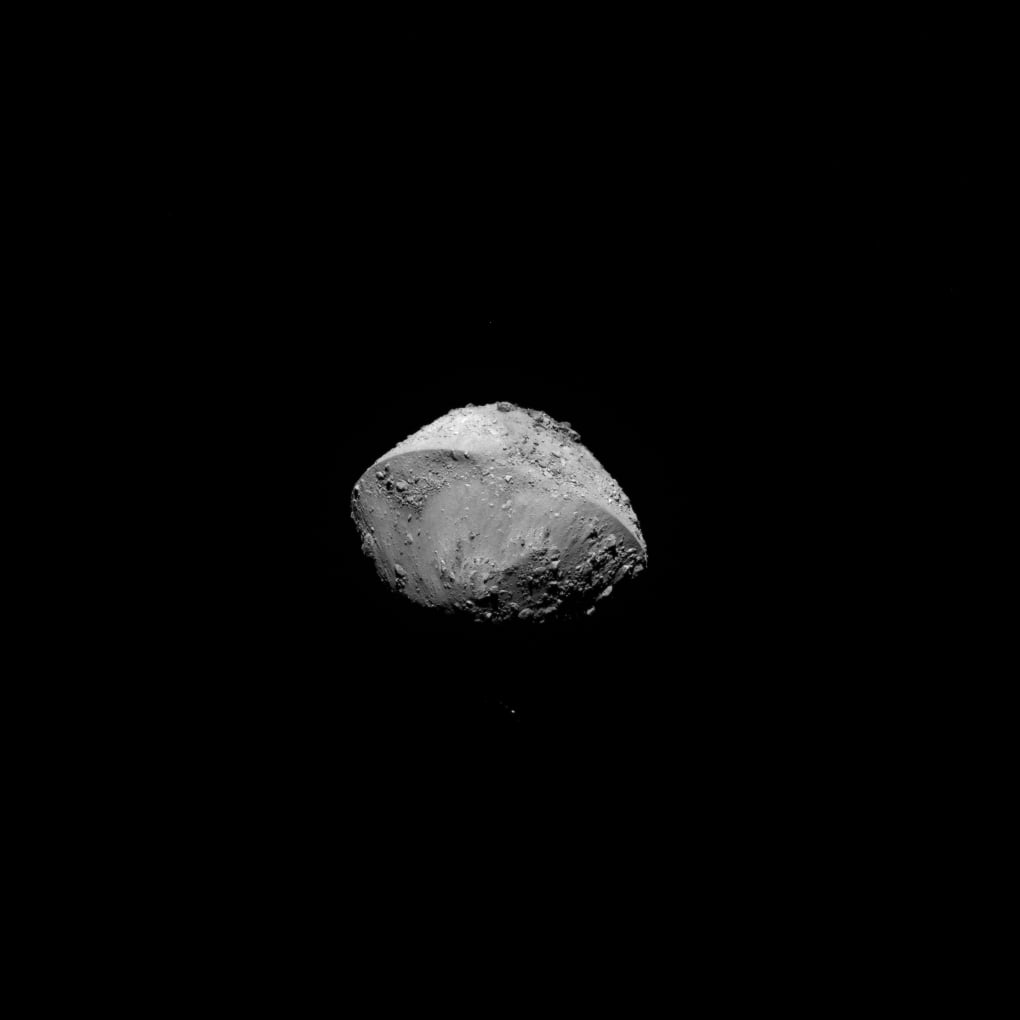
Hera’s Asteroid Framing Camera (AFC) provides the conventional view of Didymos. It records monochrome visible-light images and serves two key purposes: to use its observations to navigate around the asteroids, and to allow scientists to study the images to map their surfaces.
The latest AFC image was taken from approximately 28.5 kilometres away. It delivers a spatial resolution of around 2.7 metres per pixel. Researchers can use this view to examine the larger geological features across Didymos and identify regions that deserve closer attention during the mission.
Visible-light images are useful for studying the shape and arrangement of surface features. A large boulder, for example, may cast a shadow that reveals its height and position. Researchers can also compare images taken from different viewing angles to build three-dimensional models of the asteroid.
HyperScout H: 25 different spectral bands
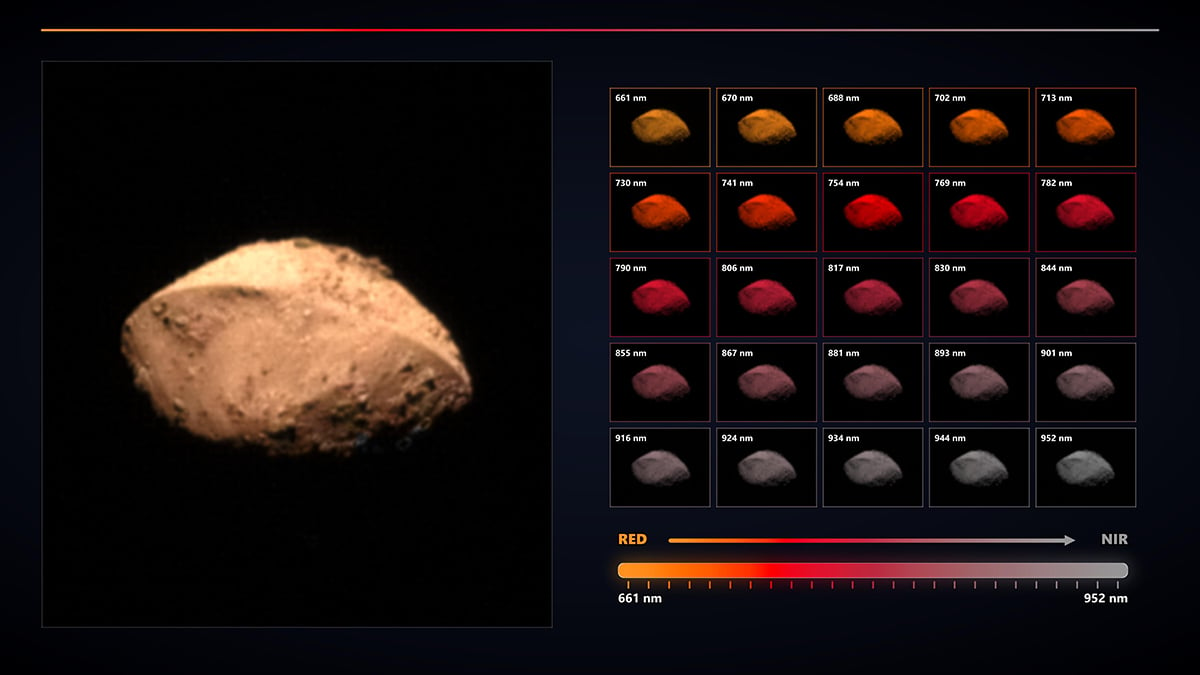
Hera’s HyperScout H instrument gives researchers another way to study the asteroid surface. It observes Didymos across 25 spectral bands, starting in the visible red part of the spectrum and extending into the near-infrared. Some of these wavelengths fall beyond the range of human vision.
HyperScout H works as an imaging spectrometer. It measures how much sunlight the asteroid reflects at different wavelengths. These measurements produce spectral signatures that scientists can compare with laboratory observations of minerals and meteorite samples.
Different minerals interact with sunlight in different ways. Some absorb particular wavelengths, while others reflect them more strongly. These variations can help researchers distinguish materials that might look almost identical in an ordinary photograph.
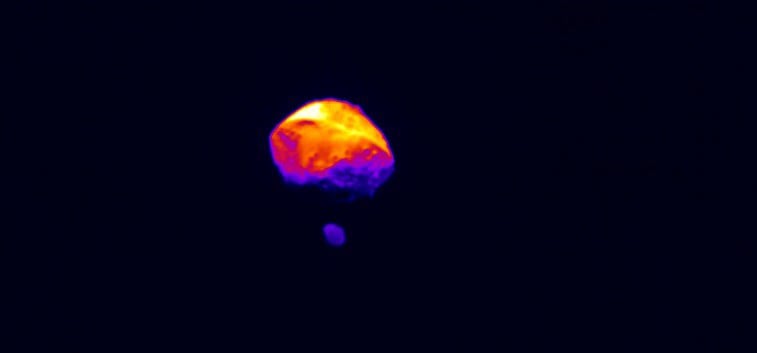
Thermal Infrared Imager: Bringing shadowed Dimorphos into view
The Thermal Infrared Imager (TIRI) gives Hera a view that the other cameras cannot provide. Japan’s Aerospace Exploration Agency (JAXA) supplied and operates this instrument. Instead of recording reflected sunlight, TIRI measures thermal infrared radiation from the asteroid surfaces.
The 151-metre moonlet appears almost entirely in shadow in the visible-light and multispectral observations. Only a small portion receives direct sunlight. Yet the thermal infrared image shows the entire object.
TIRI can detect radiation from the asteroid even when sunlight does not illuminate its surface. This makes thermal imaging useful when examining shadowed regions. It also allows scientists to measure temperature differences across different parts of the asteroid.
Clear skies!
See more from DIYPhotography.net on Google
Add DIYPhotography.net as a trusted source. This makes
our stories more likely to appear in your Google Search results.
 Add as a preferred source on Google

Soumyadeep Mukherjee
Soumyadeep Mukherjee is an award-winning astrophotographer from India. He has a doctorate degree in Linguistics. His work extends to the sub-genres of nightscape, deep sky, solar, lunar and optical phenomenon photography. He is also a photography educator and has conducted numerous workshops. His works have appeared in over 40 books & magazines including Astronomy, BBC Sky at Night, Sky & Telescope among others, and in various websites including National Geographic, NASA, Forbes. He was the first Indian to win “Astronomy Photographer of the Year” award in a major category.
Join the Discussion
DIYP Comment Policy
Be nice, be on-topic, no personal information or flames.