









Satellites Photograph the ISS and Hubble in Orbit: A Rare View
Nov 17, 2026
Soumyadeep Mukherjee
Soumyadeep Mukherjee is an award-winning astrophotographer from India. He has a doctorate degree in Linguistics. His work extends to the sub-genres of nightscape, deep sky, solar, lunar and optical phenomenon photography. He is also a photography educator and has conducted numerous workshops. His works have appeared in over 40 books & magazines including Astronomy, BBC Sky at Night, Sky & Telescope among others, and in various websites including National Geographic, NASA, Forbes. He was the first Indian to win “Astronomy Photographer of the Year” award in a major category.
Share:
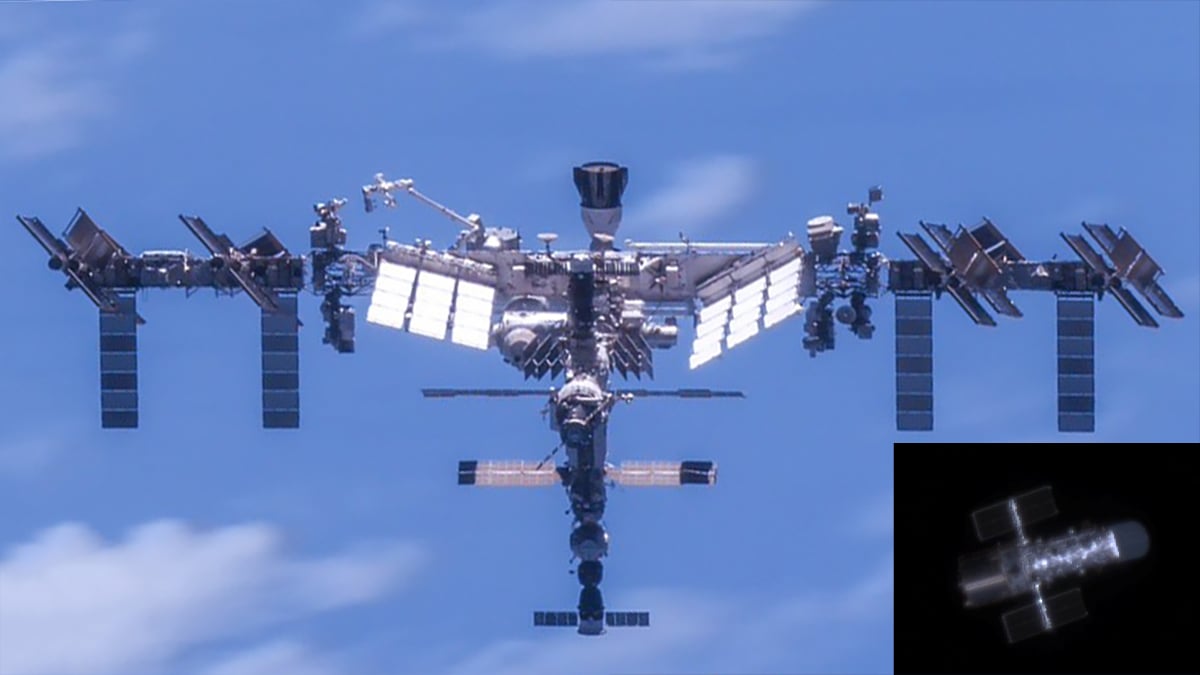
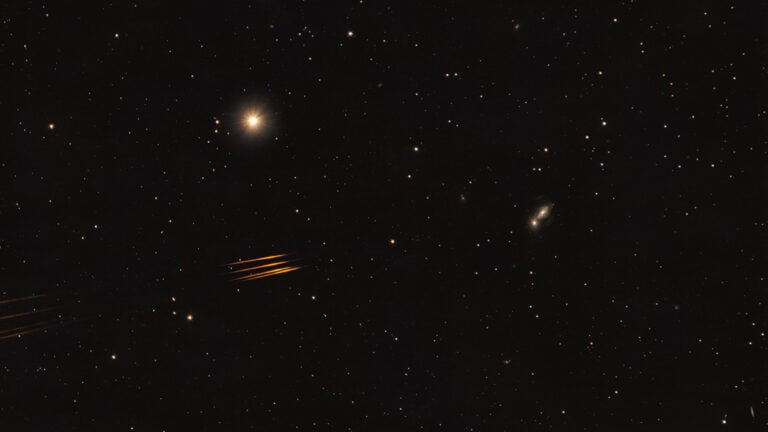
The International Space Station and the Hubble Space Telescope have spent decades working in orbit. We usually see them in photographs taken from Earth, from spacecraft visiting them, or by astronauts looking out of their windows. Recently, however, Australian space technology company HEO shared two photographs that offered a different viewpoint. Both images showed spacecraft from the perspective of another satellite.
Turning Earth-observation Satellites Towards Space
Most commercial imaging satellites spend their working lives looking towards Earth. Their cameras record cities, agricultural land, coastlines, forests, and other features. Customers use those images to monitor changes on the ground, assess damage after natural disasters, and follow activity at important locations.
HEO, on the other hand, develops software that helps partner satellites photograph objects in orbit. Its non-Earth imaging system identifies suitable observation opportunities, coordinates image collection and analyses the resulting photographs.
BlackSky is one of its partners. The US company operates satellites that collect high-resolution images of locations on Earth. Through its agreement with HEO, those spacecraft can also turn their cameras towards selected objects in orbit.
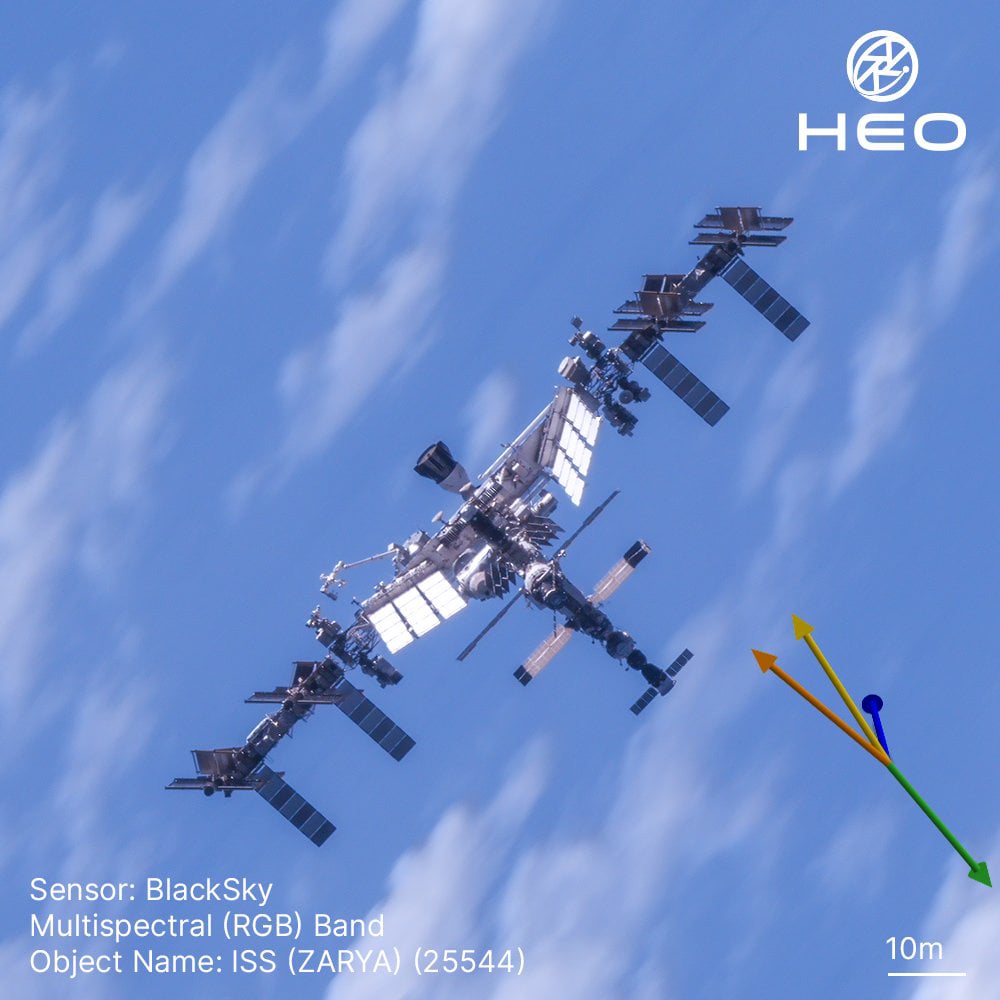
A BlackSky satellite captures the International Space Station
HEO captured the ISS photograph last week. The image shows the station from above, with its large solar arrays extending from the central structure. Earth forms the background, with the coast of French Guiana visible below. HEO credited a BlackSky satellite with capturing the scene.
Engineering at its finest. The International Space Station, imaged in orbit above the coast of French Guiana. https://t.co/Ff0Us1DgAM
— HEO (@heospace) November 9, 2026
The viewpoint makes the photograph unusual and interesting. People watching the ISS from Earth usually see a bright point moving across the night sky. Astronauts aboard the station see its modules, solar arrays, and visiting spacecraft from much closer range. This image offers neither perspective. It shows the entire station from another spacecraft travelling in orbit.
The ISS circles Earth at roughly 28,000 kilometers per hour. The BlackSky satellite also follows its own orbital path, so the distance and viewing angle between the two spacecraft change throughout the encounter. HEO needs to predict when the station will appear in the camera’s field of view and coordinate the observation around that opportunity.
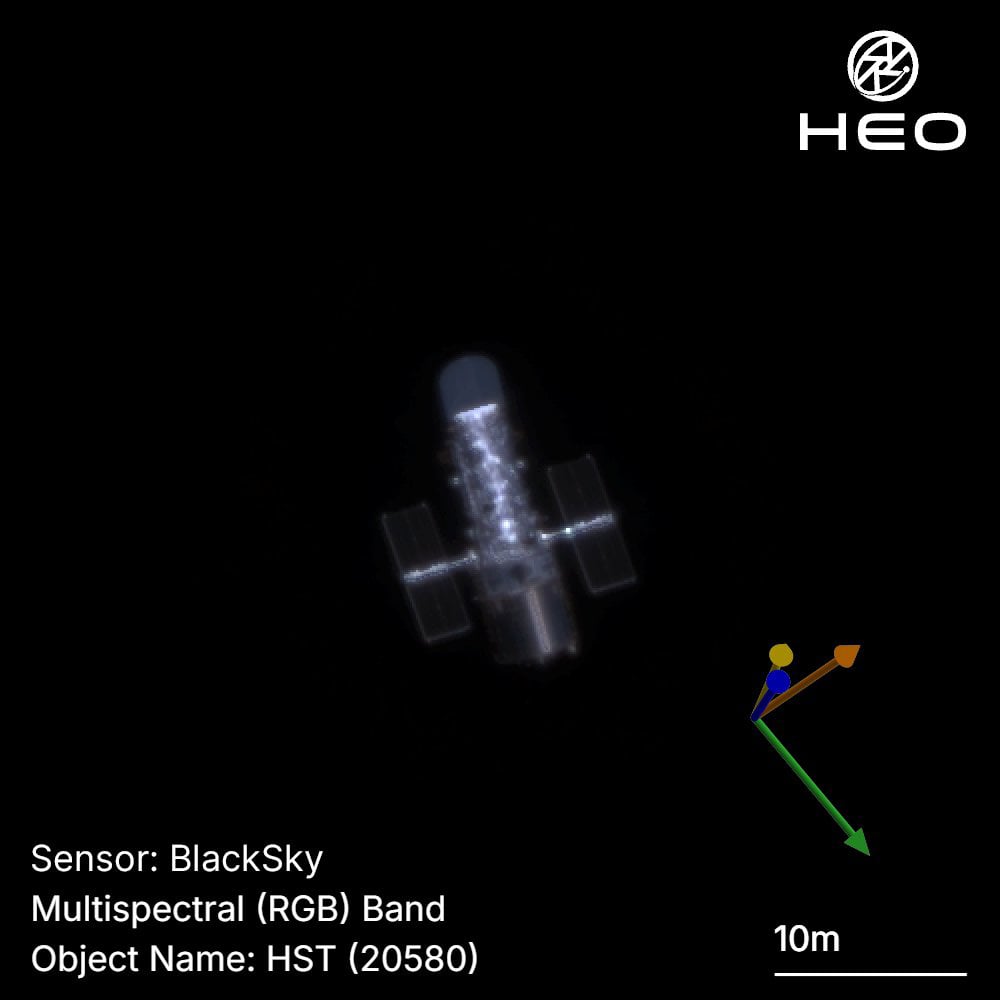
Hubble appears in another image
HEO’s next photograph featured Hubble. The image shows the Hubble Space Telescope with its aperture door open. Hubble uses this door to protect its telescope when it is not observing. When the door opens, light can enter the telescope and reach its scientific instruments.
Hubble at work. This non-Earth image captures the Hubble Space Telescope with its aperture door open. Our attitude analysis reveals Hubble was pointing towards tile CLUTCH-TARGET-GC, part of the CLUTCH (COSMOS Legacy UV-Optical Treasury Campaign with Hubble) programme. Public records show that Hubble was observing its target at this time. By combining close-up imagery with attitude analysis, HEO can reveal not just a spacecraft’s configuration, but what it is doing.
— HEO (@heospace) November 11, 2026
HEO also added an analysis of Hubble’s orientation to its post. The company’s attitude analysis indicated that the telescope was pointing towards an observing tile identified as CLUTCH-TARGET-GC. That target belongs to the CLUTCH programme, whose full name is COSMOS Legacy UV-Optical Treasury Campaign with Hubble.
Clear skies!
See more from DIYPhotography.net on Google
Add DIYPhotography.net as a trusted source. This makes
our stories more likely to appear in your Google Search results.
 Add as a preferred source on Google

Soumyadeep Mukherjee
Soumyadeep Mukherjee is an award-winning astrophotographer from India. He has a doctorate degree in Linguistics. His work extends to the sub-genres of nightscape, deep sky, solar, lunar and optical phenomenon photography. He is also a photography educator and has conducted numerous workshops. His works have appeared in over 40 books & magazines including Astronomy, BBC Sky at Night, Sky & Telescope among others, and in various websites including National Geographic, NASA, Forbes. He was the first Indian to win “Astronomy Photographer of the Year” award in a major category.


Join the Discussion
DIYP Comment Policy
Be nice, be on-topic, no personal information or flames.