




















Hubble and Gemini North Telescope Shows Three Views of Jupiter
Oct 14, 2026
Soumyadeep Mukherjee
Soumyadeep Mukherjee is an award-winning astrophotographer from India. He has a doctorate degree in Linguistics. His work extends to the sub-genres of nightscape, deep sky, solar, lunar and optical phenomenon photography. He is also a photography educator and has conducted numerous workshops. His works have appeared in over 40 books & magazines including Astronomy, BBC Sky at Night, Sky & Telescope among others, and in various websites including National Geographic, NASA, Forbes. He was the first Indian to win “Astronomy Photographer of the Year” award in a major category.
Share:
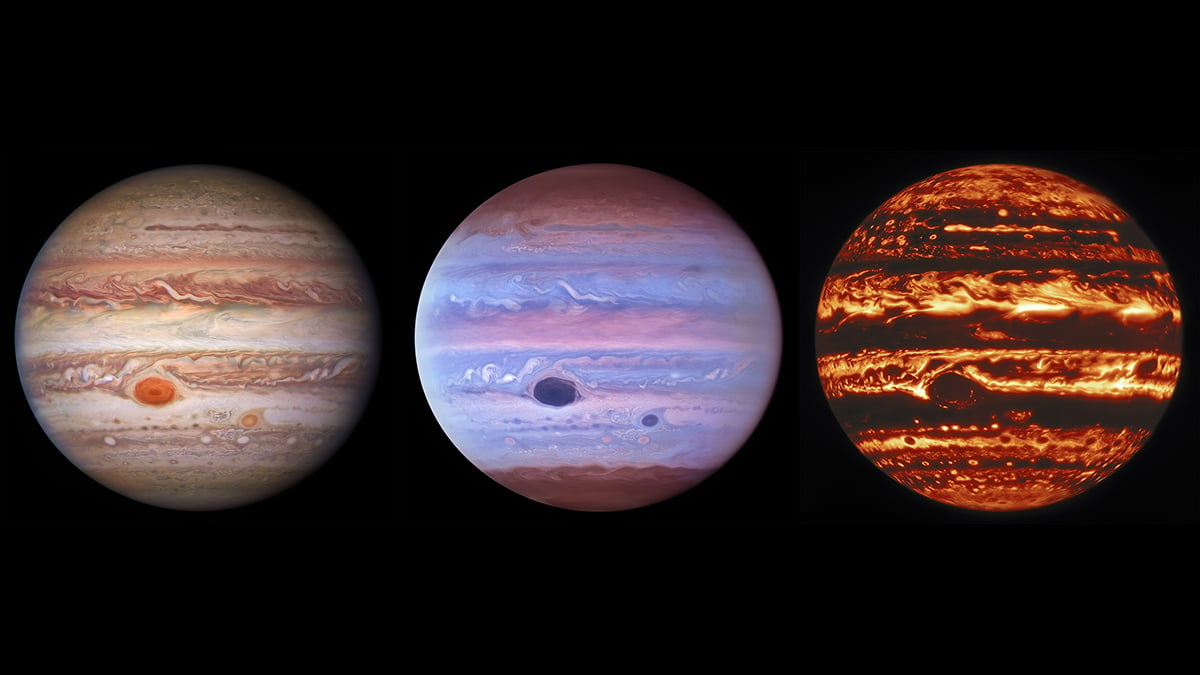
Jupiter’s Great Red Spot appears very different when astronomers observe it in visible, ultraviolet, and infrared light. The reddish storm that stands out in an ordinary photograph appears dark in Hubble’s ultraviolet image. In Gemini North’s near-infrared view, the same storm appears dark again. Each of the telescopes records a different part of the light coming from its atmosphere.
Three images released by NSF NOIRLab show that the choice of wavelength affects our view of Jupiter. NASA’s Hubble Space Telescope captured the visible-light and ultraviolet images, and the Gemini North telescope in Hawaii recorded the infrared view.
A familiar appearance in visible light
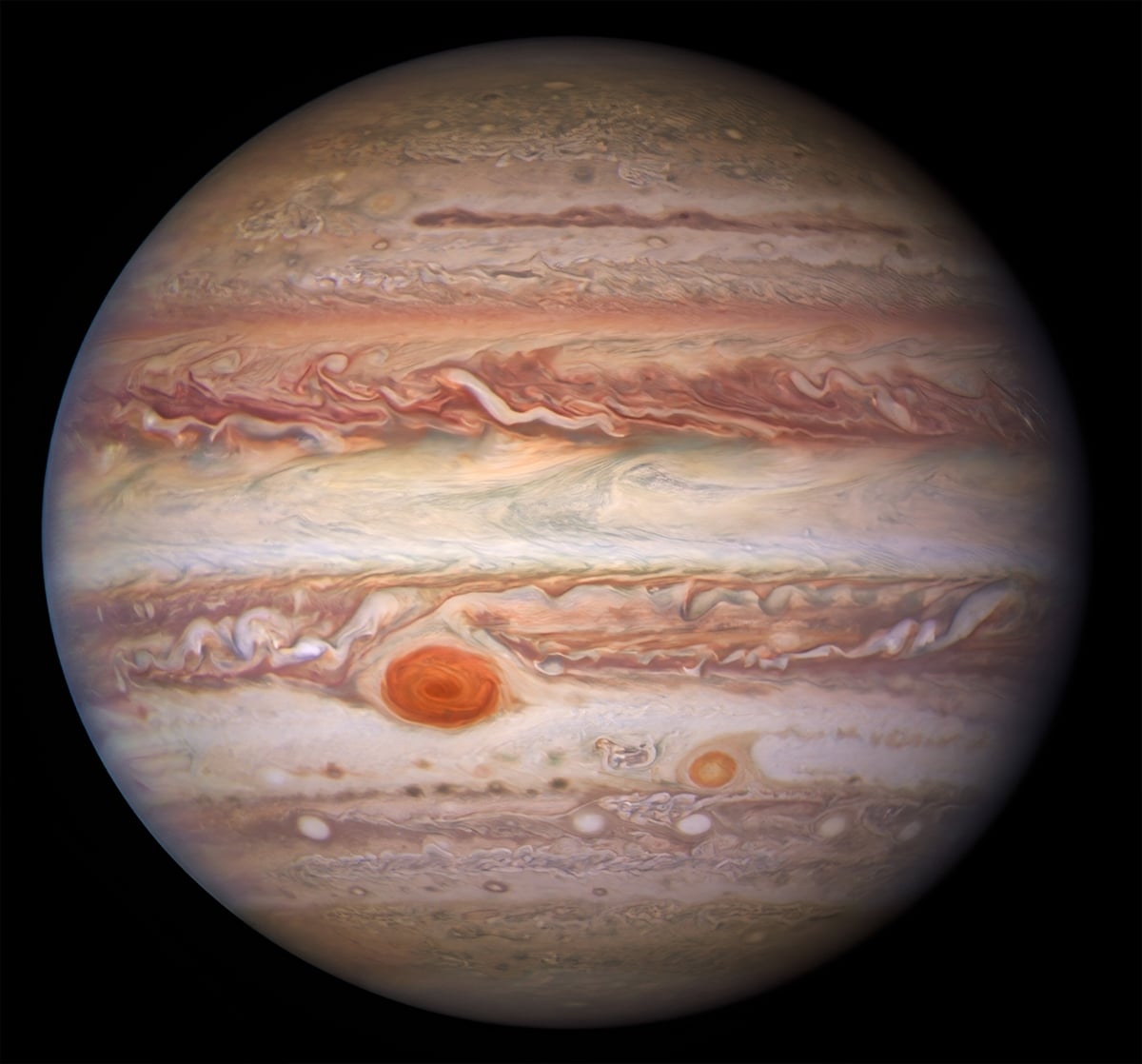
Hubble’s visible-light image shows the Jupiter most people recognize. Broad, alternating bands wrap around the planet, with pale zones separating darker belts. The Great Red Spot stands out in the southern hemisphere, surrounded by smaller swirls and changing cloud patterns.
Jupiter rotates once in about ten hours. The rapid spin helps drive strong east-west jet streams, which divide the atmosphere into bands moving at different speeds. The bright zones often contain high-altitude ammonia-ice clouds, while darker belts can reveal different cloud structures and deeper atmospheric layers.
The Great Red Spot is the most conspicuous storm in this image. It is a vast anticyclonic system that has persisted for centuries, although its size and shape have changed. Winds circulate around its center, and smaller atmospheric features interact with the surrounding cloud bands.
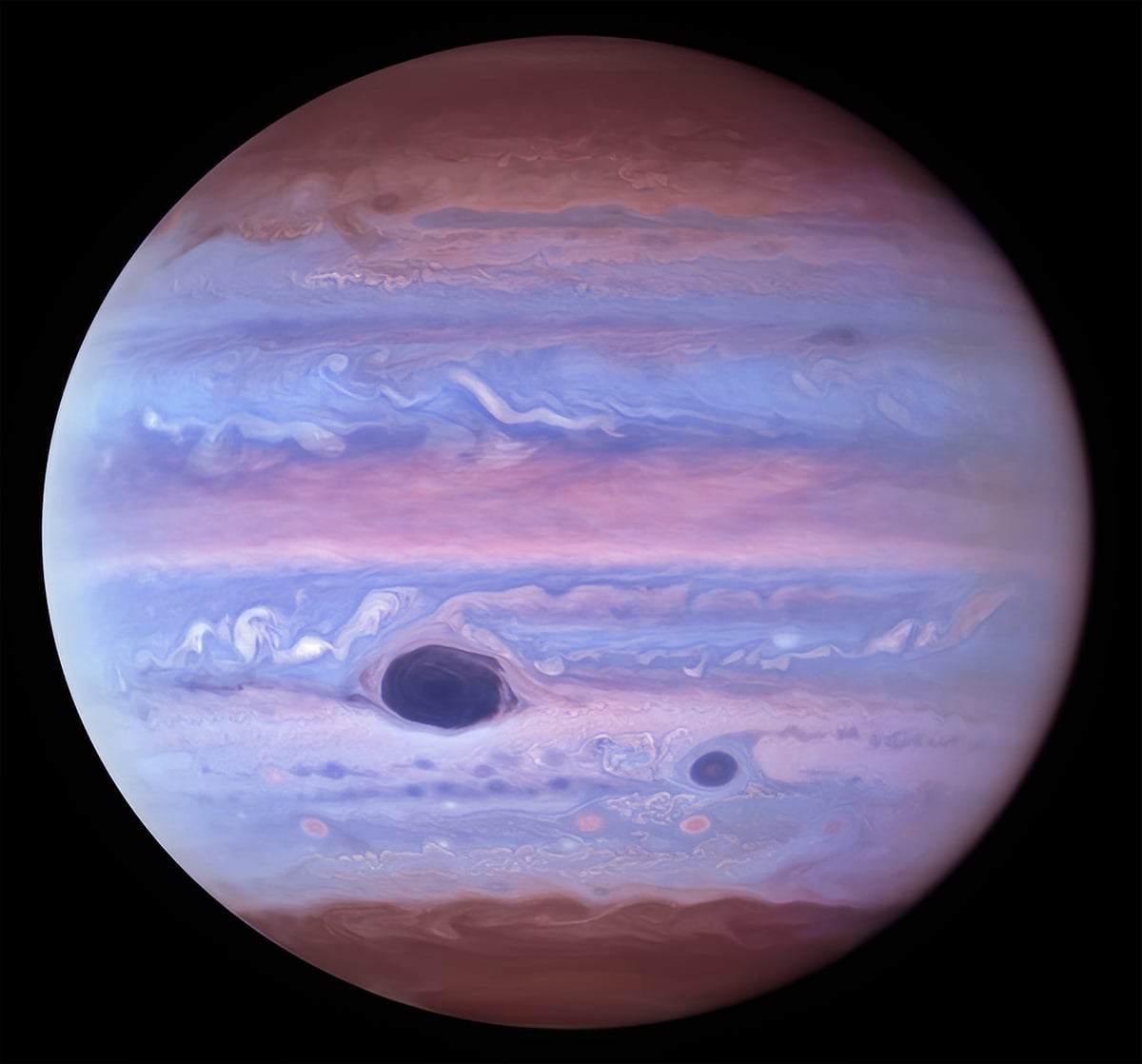
The Great Red Spot looks dark in ultraviolet light
Hubble’s ultraviolet image shows a different appearance of Jupiter’s cloud systems. The Great Red Spot, which appears reddish in visible light, looks dark in this view. The difference is because of the way atmospheric particles interact with ultraviolet radiation.
Ultraviolet wavelengths are shorter than visible wavelengths. Particles in the upper atmosphere can absorb or scatter this radiation, changing the brightness of different regions. Haze above Jupiter’s clouds absorbs ultraviolet light, and the Great Red Spot contains high-altitude haze that contributes to its dark appearance in the image.
The polar regions also show distinctive structures in ultraviolet observations. Jupiter has reddish, wavy polar hazes that absorb ultraviolet light. Their distribution provides clues about the particles in the upper atmosphere and the processes that move them around the planet. Hubble can also observe ultraviolet emissions from Jupiter’s auroras, which form when charged particles interact with gases near the poles.
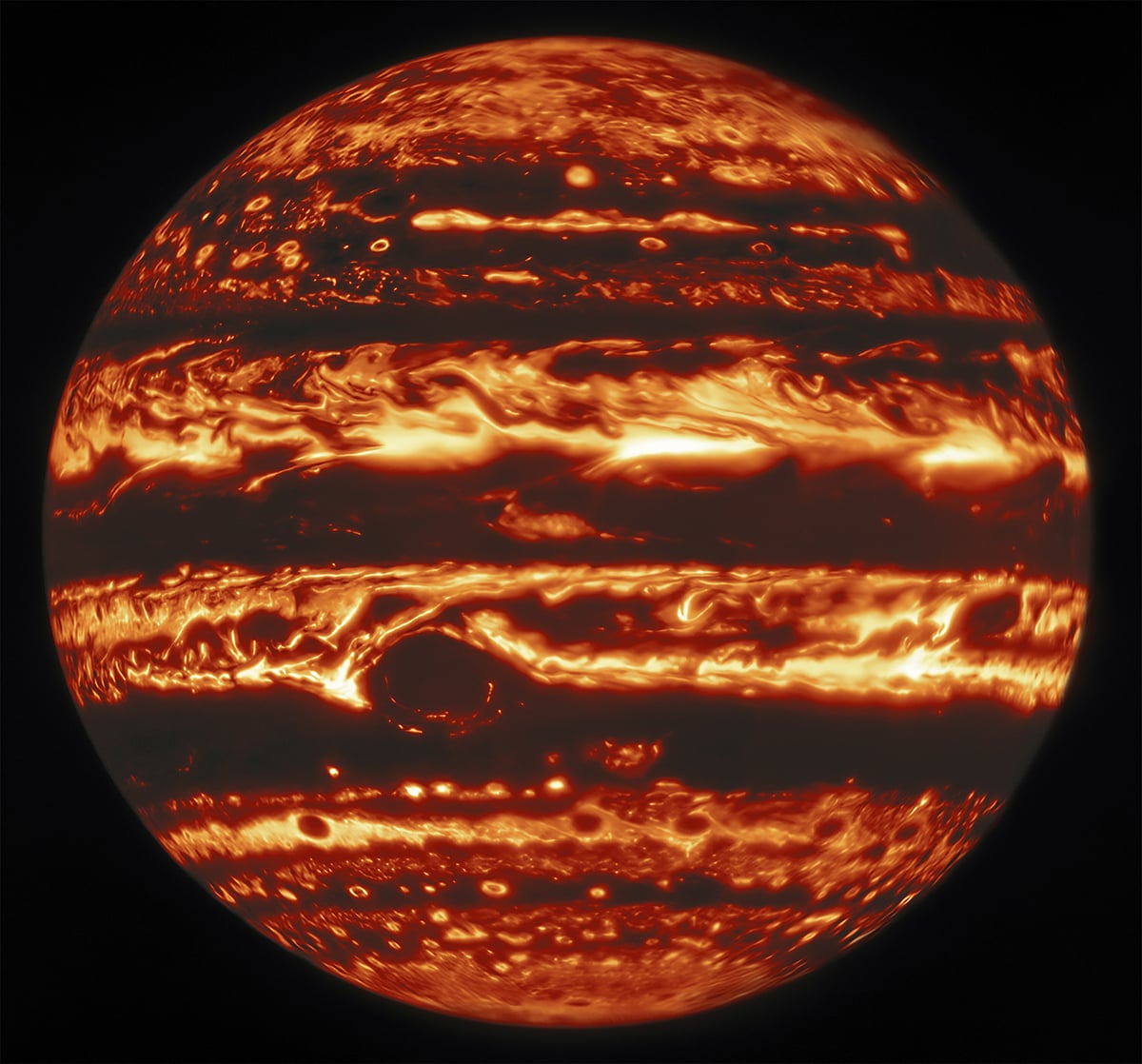
Gemini North reveals Jupiter in near-infrared light
The Gemini North image gives us another view of Jupiter’s atmosphere. Although the human eye cannot see infrared radiation, specialized instruments can record it and turn the measurements into an image. The resulting image highlights atmospheric structures that may look different in visible light, including features associated with high-altitude clouds and haze.
Near-infrared images can record sunlight reflected by Jupiter’s clouds and haze. They do not necessarily show the planet’s own heat. The Gemini image uses near-infrared observations to reveal differences in the atmosphere’s cloud opacity and the distribution of haze at different altitudes.
Gemini North’s adaptive optics system corrects for distortions caused by turbulence in Earth’s atmosphere. This technology sharpens ground-based images and allows astronomers to examine small details on Jupiter. The telescope’s observations have helped researchers follow changing features around the Great Red Spot and investigate cloud structures that are difficult to interpret from visible-light images alone.
Clear skies!
See more from DIYPhotography.net on Google
Add DIYPhotography.net as a trusted source. This makes
our stories more likely to appear in your Google Search results.
 Add as a preferred source on Google

Soumyadeep Mukherjee
Soumyadeep Mukherjee is an award-winning astrophotographer from India. He has a doctorate degree in Linguistics. His work extends to the sub-genres of nightscape, deep sky, solar, lunar and optical phenomenon photography. He is also a photography educator and has conducted numerous workshops. His works have appeared in over 40 books & magazines including Astronomy, BBC Sky at Night, Sky & Telescope among others, and in various websites including National Geographic, NASA, Forbes. He was the first Indian to win “Astronomy Photographer of the Year” award in a major category.


Join the Discussion
DIYP Comment Policy
Be nice, be on-topic, no personal information or flames.