























JWST and Hubble Find Massive Star Clusters Emerge Faster Than Expected
May 8, 2026
Soumyadeep Mukherjee
Soumyadeep Mukherjee is an award-winning astrophotographer from India. He has a doctorate degree in Linguistics. His work extends to the sub-genres of nightscape, deep sky, solar, lunar and optical phenomenon photography. He is also a photography educator and has conducted numerous workshops. His works have appeared in over 40 books & magazines including Astronomy, BBC Sky at Night, Sky & Telescope among others, and in various websites including National Geographic, NASA, Forbes. He was the first Indian to win “Astronomy Photographer of the Year” award in a major category.
Share:
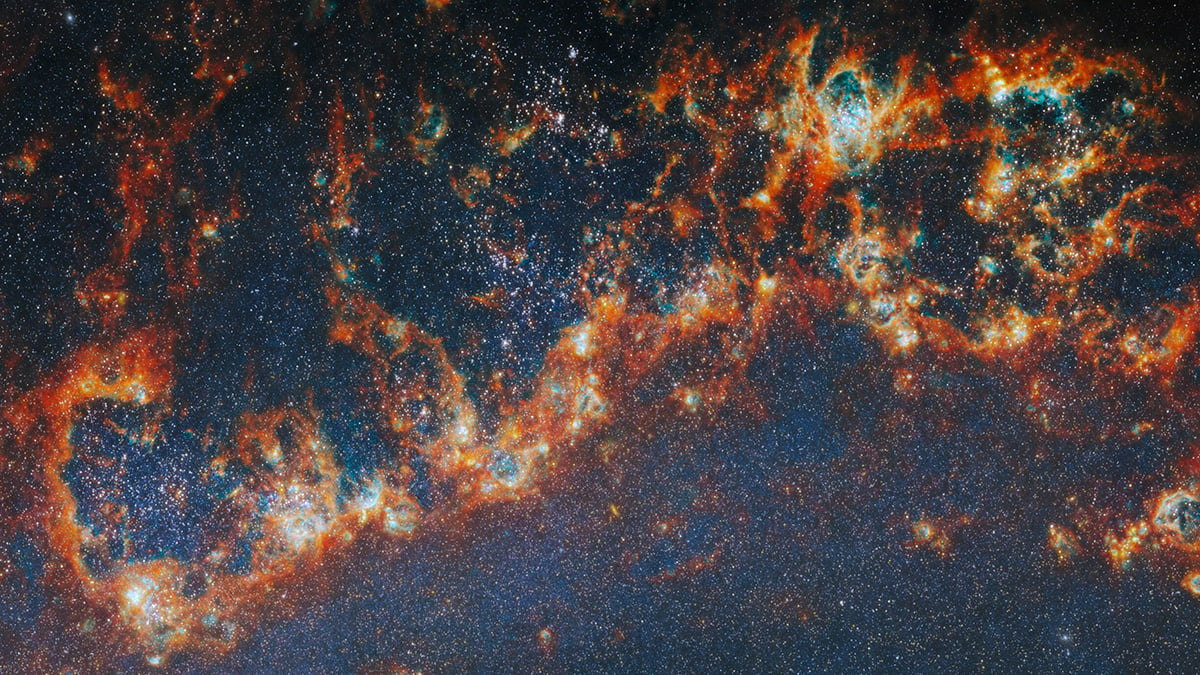
Astronomers have long treated embedded star clusters as one of the most difficult phases of stellar evolution to observe. Young clusters form within dense molecular clouds, which are filled with cold gas and dust. These clouds absorb visible light and hide newly formed stars during the earliest stages of their evolution. As a result, researchers struggled for decades to determine how quickly young clusters disrupt their natal environments and emerge into view.
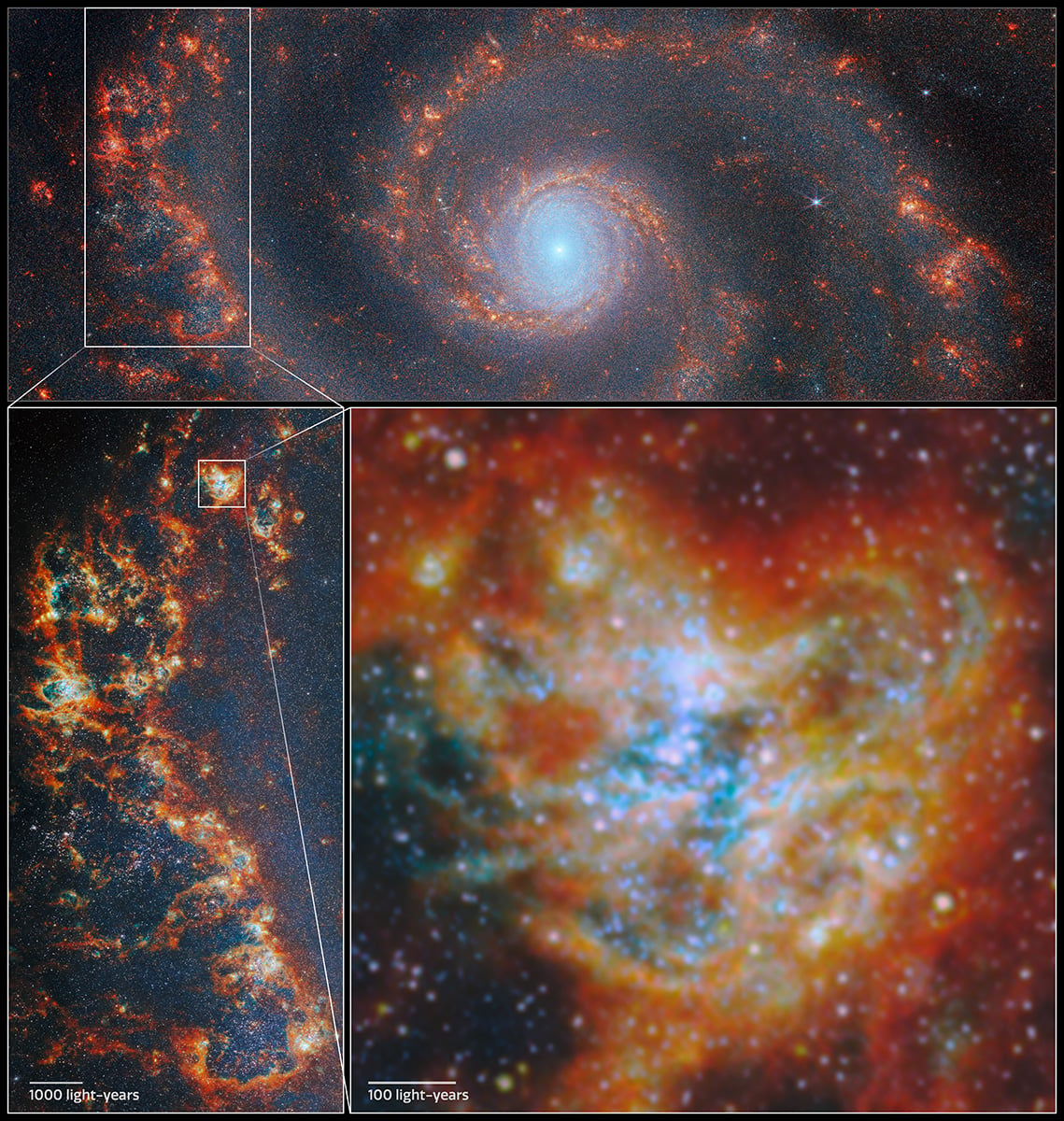
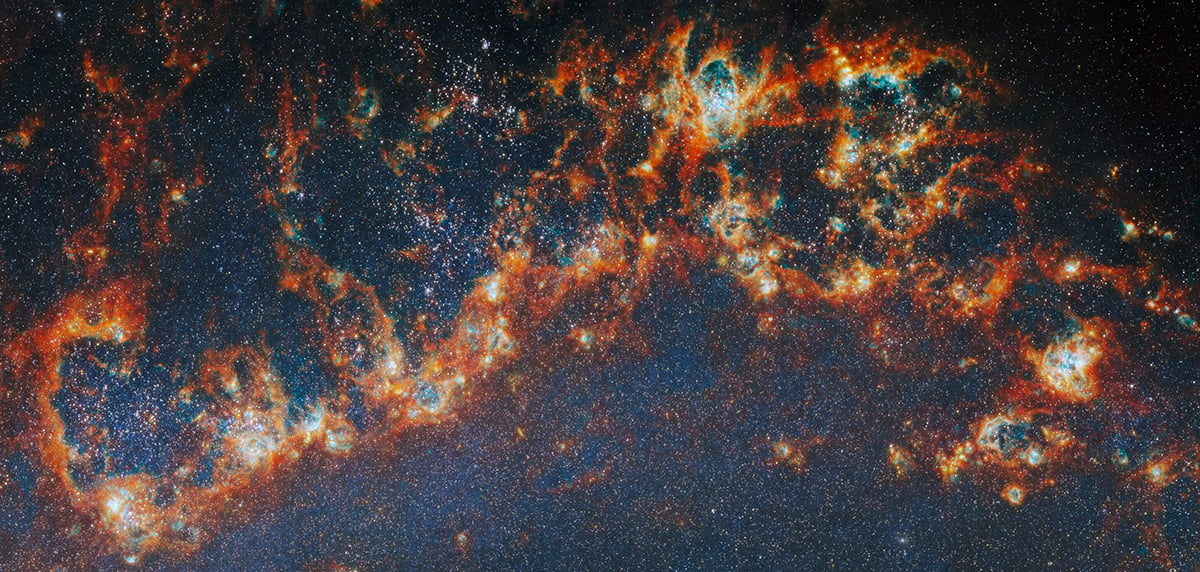
New observations from the James Webb Space Telescope and the Hubble Space Telescope have provided one of the clearest answers yet. A large international team studying nearly 9,000 young star clusters across four nearby galaxies has found that the most massive clusters disperse their surrounding gas much faster than expected. The observations come from the FEAST program, short for Feedback in Emerging extrAgalactic Star clusTers. Researchers combined infrared data from JWST with visible-light observations from Hubble to build an evolutionary sequence of young star clusters at different stages of development.
A look inside the hidden star-forming regions
Star formation begins deep inside giant molecular clouds. These clouds contain vast reservoirs of hydrogen gas mixed with dust grains and trace heavier elements. Gravity gradually compresses denser pockets within the cloud until protostars begin to form. Over time, large groups of stars emerge together, producing what astronomers call star clusters.
However, these young systems remain buried inside dusty environments during the earliest stages of their lives. Visible light from newborn stars cannot easily escape through the dense cloud. Earlier observatories could identify exposed clusters after the gas dispersed, but they struggled to study clusters while they remained embedded.
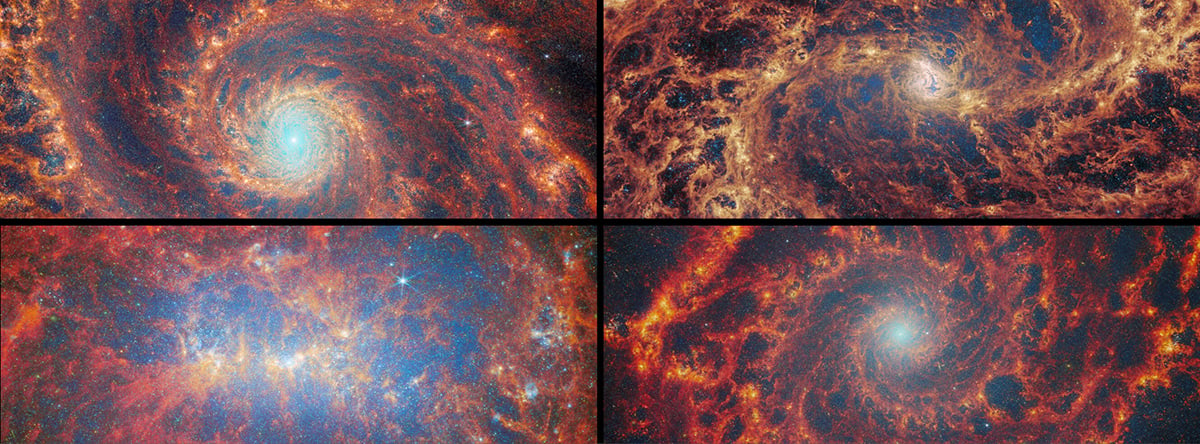
Infrared wavelengths penetrate dust much more effectively than visible light. JWST uses this advantage to observe deeply obscured regions with exceptional sensitivity and resolution. For this study, astronomers selected four nearby galaxies with active star formation: Messier 51, Messier 83, NGC 4449, and NGC 628
These galaxies contain thousands of young stellar systems spread across spiral arms and dense star-forming complexes. JWST observed embedded clusters hidden within dusty clouds, while Hubble traced older exposed clusters visible in optical wavelengths.
Massive clusters dispersing their birth clouds quickly
One of the central goals of the FEAST program involved measuring how long clusters remain embedded inside their natal clouds. Astronomers expected massive clusters to require substantial time to clear away surrounding material because they often form inside dense environments rich in gas and dust.
However, the observations revealed the opposite trend. The most massive clusters emerged from their birth clouds in about five million years. Smaller clusters required closer to seven or eight million years to complete the same process. Although the numerical difference appears modest, the effect carries major implications for stellar evolution.
Massive stars evolve rapidly and inject enormous amounts of energy into their surroundings almost immediately after formation. Young O-type and B-type stars emit intense ultraviolet radiation capable of ionizing nearby hydrogen gas. At the same time, they generate powerful stellar winds that move outward at high velocities.
These winds and radiation fields push against the surrounding molecular cloud. Over time, the cloud fragments and disperses, allowing visible light to escape. JWST observations show that this clearing process begins surprisingly early in the life of massive clusters.
Stellar feedback controlling the pace of galactic evolution
Galaxies contain enormous quantities of cold gas, yet only a small fraction converts into stars. Without regulatory mechanisms, galaxies would exhaust their gas reservoirs much faster than observations suggest. Astronomers have long suspected that stellar feedback acts as one of the main controls on star formation.
Young stars reshape their environment through several mechanisms. Ultraviolet radiation heats and ionizes nearby gas. Stellar winds inject momentum into the surrounding cloud. Later, supernova explosions drive shockwaves through the interstellar medium and distribute heavy elements across the galaxy.
The new JWST and Hubble observations reveal that massive clusters begin to influence their surroundings at very early stages. As a result, feedback may suppress nearby star formation sooner than earlier models assumed.
This has important consequences for galaxy evolution simulations. Many numerical models rely on assumptions about how efficiently feedback removes gas from star-forming regions. Faster gas dispersal changes how quickly molecular clouds collapse, fragment, and produce subsequent generations of stars.
The findings may also help explain why some galaxies experience short bursts of intense star formation followed by quieter periods. If massive clusters rapidly disrupt their natal environments, they could temporarily shut down star formation in nearby regions.
JWST and Hubble complement each other perfectly
The study also highlights the growing scientific partnership between JWST and Hubble. Although JWST has received enormous attention for its infrared capabilities, Hubble remains one of the most productive observatories in astronomy. The two telescopes operate at different wavelengths and often reveal complementary aspects of the same object.
JWST excels at observing dusty embedded structures invisible in optical light. Hubble provides high-resolution observations of exposed stellar populations and ionized gas visible at shorter wavelengths.
For the FEAST program, this combination proved essential. JWST identified clusters still hidden inside molecular clouds, while Hubble traced older clusters that had already emerged from their natal material. By combining both datasets, astronomers effectively reconstructed an evolutionary timeline for thousands of clusters.
Clear skies!
See more from DIYPhotography.net on Google
Add DIYPhotography.net as a trusted source. This makes
our stories more likely to appear in your Google Search results.
 Add as a preferred source on Google

Soumyadeep Mukherjee
Soumyadeep Mukherjee is an award-winning astrophotographer from India. He has a doctorate degree in Linguistics. His work extends to the sub-genres of nightscape, deep sky, solar, lunar and optical phenomenon photography. He is also a photography educator and has conducted numerous workshops. His works have appeared in over 40 books & magazines including Astronomy, BBC Sky at Night, Sky & Telescope among others, and in various websites including National Geographic, NASA, Forbes. He was the first Indian to win “Astronomy Photographer of the Year” award in a major category.
Join the Discussion
DIYP Comment Policy
Be nice, be on-topic, no personal information or flames.