
















Rubin Observatory Captured Interstellar Comet 3I/ATLAS Before Its Discovery
Feb 11, 2026
Soumyadeep Mukherjee
Soumyadeep Mukherjee is an award-winning astrophotographer from India. He has a doctorate degree in Linguistics. His work extends to the sub-genres of nightscape, deep sky, solar, lunar and optical phenomenon photography. He is also a photography educator and has conducted numerous workshops. His works have appeared in over 40 books & magazines including Astronomy, BBC Sky at Night, Sky & Telescope among others, and in various websites including National Geographic, NASA, Forbes. He was the first Indian to win “Astronomy Photographer of the Year” award in a major category.
Share:

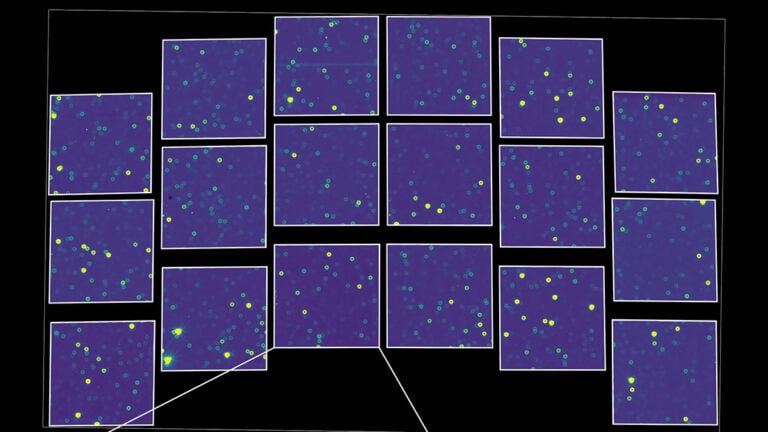
The NSF–DOE Vera C. Rubin Observatory recorded interstellar comet 3I/ATLAS in wide-field commissioning data approximately ten days before its official discovery. Astronomers later identified the object in archived Rubin exposures after ATLAS announced the comet on 1 July 2025. The Rubin image, released by NSF–NOIRLab as Image of the Week, provides an earlier astrometric and photometric data point that extends the comet’s observational arc. That extension improves orbital solutions and supports early activity modeling. More importantly, the detection shows that Rubin’s survey system can capture faint, fast-moving interstellar objects within routine sky coverage.
Discovery and the interstellar confirmation
The Asteroid Terrestrial-impact Last Alert System (ATLAS) detected the comet on 1 July 2025 from Chile. Observers initially cataloged it as C/2025 N1 (ATLAS). Soon after, orbital calculations revealed a strongly hyperbolic trajectory. That result immediately signaled that the object was not gravitationally bound to the Sun.
Astronomers refined the orbit using follow-up observations from multiple facilities. The eccentricity remained well above one. Therefore, the Minor Planet Center assigned the object the designation 3I, marking it as the third confirmed interstellar object. The earlier visitors, 1I/‘Oumuamua in 2017 and 2I/Borisov in 2019, had already reshaped understanding of small-body populations beyond the Solar System. Consequently, the appearance of 3I/ATLAS triggered rapid global coordination.
While observers collected new data, researchers also examined archival survey images. They projected the comet’s path backward across recent sky coverage. This process led directly to Rubin Observatory’s commissioning dataset.

Rubin’s commissioning data captured the comet
At the time of the comet’s inbound passage, the Vera C. Rubin Observatory was conducting engineering and system validation observations. Even during commissioning, the Simonyi Survey Telescope and the LSST Camera were operating at full optical depth. The system repeatedly imaged large areas of the southern sky to test image quality, tracking precision, and calibration pipelines.
After ATLAS announced the discovery, astronomers checked Rubin’s recent exposures along the predicted trajectory. They identified a faint, moving source consistent with 3I/ATLAS roughly ten days before 1 July 2025. That identification relied on positional consistency across sequential images and on matching brightness evolution.
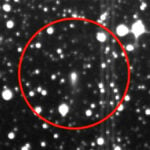
NSF–NOIRLab later released one of those frames publicly. The image does not isolate the comet dramatically. Instead, it shows the object embedded within a dense stellar background. However, careful inspection reveals a slightly diffuse appearance. That subtle fuzziness indicates the presence of a coma. In other words, the comet was already active at the time Rubin recorded it.
Although ATLAS retains official discovery credit, Rubin’s earlier detection extends the comet’s recorded timeline inside the Solar System. That extension carries measurable scientific value.

The contribution of the Rubin image
First, the earlier detection lengthens the observational arc. In orbital mechanics, even a small extension improves solution stability. Each additional astrometric point reduces uncertainty in key parameters such as eccentricity and inbound velocity. Consequently, Rubin’s data strengthened confirmation of the comet’s interstellar origin.
Second, the image provides an independent brightness measurement. Comets brighten as solar heating increases sublimation. By comparing Rubin’s earlier photometry with later observations, astronomers can model the rate of activity growth. That modeling constrains volatile content and dust production efficiency.
Third, the detection confirms that the comet was already developing a coma well before discovery. The diffuse structure visible in the Rubin frame indicates ongoing gas and dust release. Therefore, the comet likely began significant activity at a larger heliocentric distance than initially assumed.

Rubin Observatory’s survey design
The Vera C. Rubin Observatory was built to conduct the ten-year Legacy Survey of Space and Time (LSST). The survey will repeatedly image the southern sky with high cadence and unprecedented depth. The LSST Camera, one of the largest digital cameras ever constructed for astronomy, covers nearly ten square degrees per exposure. That wide field allows rapid, repeated coverage of vast areas of the sky.
Moreover, the system processes data quickly and flags transient or moving objects. Engineers designed Rubin specifically to detect near-Earth asteroids, distant trans-Neptunian objects, variable stars, and transient events. Interstellar objects fall naturally within that detection framework.
The 3I/ATLAS image shows this capability. Rubin did not intentionally target the comet. Instead, the telescope captured it during routine operations. Later, astronomers retrieved the data efficiently and confirmed the detection. This workflow represents the core philosophy of modern survey astronomy: observe broadly, archive systematically, and analyze dynamically.
As LSST transitions into full science operations, Rubin will discover millions of Solar System objects. Its depth and cadence will likely increase the frequency of early detections for rare interstellar visitors. Early detection matters because it provides more time for spectroscopic and thermal follow-up before perihelion.

Further reading
Right from the discovery of the interstellar comet 3I/ATLAS, DIYP has published several articles on its photographs and features. Here is the list of articles:
- A New Visitor from the Stars: Comet 3I/ATLAS
- Gemini North Photographs the Interstellar Comet 3I/ATLAS
- Hubble’s Sharpest Portrait of a Visitor from the Stars: Comet 3I/ATLAS
- JWST Reveals the Secrets of Interstellar Comet 3I/ATLAS in New Images
- SPHEREx Maps the Carbon Dioxide Breath of Interstellar Comet 3I/ATLAS
- Gemini South Photographs Anti-Solar Tail of 3I/ATLAS
- Interstellar Comet 3I/ATLAS: Gemini South Images Reveal a Growing Tail
- Interstellar Comet 3I/ATLAS through Many Eyes: All Images so Far
- A Faint Smudge from Mars: Did Perseverance Really Capture Interstellar Comet 3I/ATLAS?
- ESA’s Mars Orbiter Capture “Closest Yet” View of Interstellar Comet 3I/ATLAS
- Comet 3I/ATLAS Returns: Astronomer Photographs it after Perihelion
- Tianwen-1’s Surprise Close-Up: China’s Mars Orbiter Images Interstellar Comet 3I/ATLAS
- Interstellar Comet 3I/ATLAS Returns to View with a Growing Ion Tail
- NASA Shares Eight New Images of Interstellar Comet 3I/ATLAS
- Hubble Space Telescope Revisits Interstellar Comet 3I/ATLAS
- ESA’s JUICE captures a detailed image of Interstellar Comet 3I/ATLAS
- X-Ray Images of 3I/ATLAS: XRISM and XMM-Newton Captures Interstellar Comet
- Gemini North Reveals Green Glow in Interstellar Comet 3I/ATLAS
- NASA’s TESS Tracks Interstellar Comet 3I/ATLAS in Its Final Act

Clear skies!
See more from DIYPhotography.net on Google
Add DIYPhotography.net as a trusted source. This makes
our stories more likely to appear in your Google Search results.
 Add as a preferred source on Google

Soumyadeep Mukherjee
Soumyadeep Mukherjee is an award-winning astrophotographer from India. He has a doctorate degree in Linguistics. His work extends to the sub-genres of nightscape, deep sky, solar, lunar and optical phenomenon photography. He is also a photography educator and has conducted numerous workshops. His works have appeared in over 40 books & magazines including Astronomy, BBC Sky at Night, Sky & Telescope among others, and in various websites including National Geographic, NASA, Forbes. He was the first Indian to win “Astronomy Photographer of the Year” award in a major category.

Join the Discussion
DIYP Comment Policy
Be nice, be on-topic, no personal information or flames.