





















Comet Lemmon (C/2025 A6) Images so far: How to Find and Photograph it
Oct 15, 2025
Soumyadeep Mukherjee
Soumyadeep Mukherjee is an award-winning astrophotographer from India. He has a doctorate degree in Linguistics. His work extends to the sub-genres of nightscape, deep sky, solar, lunar and optical phenomenon photography. He is also a photography educator and has conducted numerous workshops. His works have appeared in over 40 books & magazines including Astronomy, BBC Sky at Night, Sky & Telescope among others, and in various websites including National Geographic, NASA, Forbes. He was the first Indian to win “Astronomy Photographer of the Year” award in a major category.
Share:

Every few years, the night sky offers something truly special, something unpredictable and alive. This time, it’s Comet Lemmon (C/2025 A6), a long-period comet that has steadily grown brighter since early 2025. Found by the Mount Lemmon Survey in Arizona, this icy traveler is now on a sunward journey that could make it one of the most exciting naked-eye comets in recent memory.
Comet C/2025 A6, known simply as Comet Lemmon, arrived in discovery images early in 2025. It then surprised astronomers by brightening faster than expected. Now it offers a rare viewing and photography opportunity for skywatchers in the Northern Hemisphere.
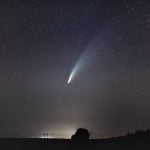
A clear portrait of Comet Lemmon
Comet Lemmon is a long-period comet discovered by the Mount Lemmon Survey on January 3, 2025. At discovery, it was faint and distant, but it carried a very elongated orbit. Its inbound orbital period is roughly fourteen centuries, making this visitation rare in human terms. The comet will swing closest to the Sun (perihelion) on 8 November 2025, at about 0.53 AU from the Sun. Its closest approach to Earth happens on 21 October 2025, at roughly 0.60 AU. These dates define the best observing window.
Comets are volatile by nature. They can break, brighten suddenly, or fade. Predictions evolve as observers collect more data. Still, current orbital data come from the Minor Planet Center and JPL ephemerides, which astronomers use to plan observations.
How does a comet tail change? It depends on the comet. The ion tail of Comet C/2025 A6 (Lemmon) has been changing markedly, as detailed in the featured image sequenced over five days between September 25 and October 3 (left to right) from Texas, USA. On some days, the comet's ion… pic.twitter.com/h7RnhoOGBV
— Astronomy Picture of the Day (@apod) October 7, 2025
When and where to look for the comet
The comet brightened through late September and October. Observers first saw it in the predawn sky. By mid-October, it moved into evening skies for many northern observers. Its path carries it across constellations that place it well above typical horizon haze for observers at mid- and high-northern latitudes. That favors Europe, North America, and northern Asia.
On 21 October 2025, Comet Lemmon will make its closest approach to Earth. Around that date, its solar elongation will be about 42 degrees, so it will sit well separated from the Sun after sunset. In late October and early November, the comet crosses the celestial equator and becomes more accessible to southern observers as well. Ephemerides and live position tools give exact coordinates for your location. Use JPL, the Minor Planet Center, or reliable live trackers for nightly charts before you head out.
Currently, the comet is positioned near the Ursa Major constellation. Its movement will take it near the Bootes constellation during its closest approach to Earth. And by early November, it will be positioned near the Ophiuchus constellation.
I woke up early to capture Comet "C/2025 A6 (Lemmon)" before sunrise. But it's starting to rise higher in the evening each day after sunset and will be much brighter near the end of the month. I used my Celestron RASA telescope, ZWO ASI533MC camera, and an Antlia L-Filter. pic.twitter.com/jzyoX0hR9m
— Chuck's Astrophotography (@chucksastropho1) October 15, 2025
What to expect visually
Brightness forecasts vary. Some professional analyses and public observatories estimate the comet could reach around magnitude +3.5 to +4.5 at peak. That range puts it near naked-eye visibility under dark skies and easily visible with binoculars. Photographs already show a distinct coma and a dust tail. We can expect the comet’s appearance to change day to day as solar wind and sunlight affect its gas and dust. Remember, comets are unpredictable. Observers should plan for binocular and camera work first, and naked-eye viewing as a bonus. Keep checking live magnitude reports and community observations for the latest behavior.
A wider view of Comet C/2025 A6 (Lemmon) from the morning of Oct. 5th from my backyard in New Hampshire. #Astrophotography #comet pic.twitter.com/bNPlKue6rL
— NebulaPhotos (@NebulaPhotos) October 15, 2025
How to photograph Comet Lemmon
Comet photography divides naturally into two goals: wide-field scenic shots that show the comet and landscape, and telephoto or telescope work that captures structure in the coma and tails.
For wide-field comet landscapes:
- Use a DSLR or mirrorless camera on a sturdy tripod.
- A fast wide lens between 24mm and 50mm gives a pleasing field with a landscape context.
- Expose between 10 and 30 seconds, depending on focal length and sky brightness. Use the 500 (or N/500) rule to limit star trails or use a star tracker.
- Set ISO between 800 and 3200, depending on your camera’s noise performance and on the lighting conditions.
- Focus at infinity using live view and a bright star.
- Shoot RAW. Blend foreground and sky in post if needed.

For telephoto or small-scope images:
- Use a 200–600mm lens or a small refractor.
- Track the comet. A simple equatorial mount with autoguiding helps immensely.
- Stack short exposures (30 seconds each) to keep the coma and tail sharp. Align on the comet during post-processing, not stars, to reveal faint tail structure.
If you lack a tracker, use a wide-field setup and record many short exposures and align them on the comet in software during stacking. That method preserves tail detail. These techniques are standard among comet photographers and work well on rapidly moving objects.

Framing and composition tips
Comets look best when framed with something familiar. Mountains, trees, desert silhouettes, or even old structures can add depth and emotion to your photo. Try scouting your location in advance and plan where the comet will appear. Apps like PhotoPills and Stellarium help visualize that. The most dramatic shots often come during twilight, when the sky still has some color and the comet is bright enough to stand out. As the sky darkens fully, switch to longer exposures for maximum detail.
#PPOD: Comet Meets Aurora 🌠
— The SETI Institute (@SETIInstitute) October 15, 2025
Comet C/2025 A6 (Lemmon) is brightening fast! Discovered in January by the Mount Lemmon Survey, it swings closest to Earth on October 21 and reaches perihelion on November 8—about 79 million kilometers from the Sun. Currently around magnitude 5.4,… pic.twitter.com/J64FpPH4M8
Comet Lemmon offers both visual and photographic rewards. It presents a good target for binocular users, DSLR photographers, and small observatories. Its path and proximity to Earth make it especially favorable for northern observers in late October and early November 2025. Plan sessions with both wide and telephoto setups. And above all, get out under dark skies while the comet still brightens.
The tree is not in danger. That's because the comet pictured just above it, Comet C/2025 A6 (Lemmon), is far in the distance, well away from the Earth. Comet Lemmon now continues to brighten as it arcs through the inner Solar System, even though it has passed its nearest to the… pic.twitter.com/buUIARTdAY
— Astronomy Picture of the Day (@apod) October 14, 2025
Clear skies!
See more from DIYPhotography.net on Google
Add DIYPhotography.net as a trusted source. This makes
our stories more likely to appear in your Google Search results.
 Add as a preferred source on Google

Soumyadeep Mukherjee
Soumyadeep Mukherjee is an award-winning astrophotographer from India. He has a doctorate degree in Linguistics. His work extends to the sub-genres of nightscape, deep sky, solar, lunar and optical phenomenon photography. He is also a photography educator and has conducted numerous workshops. His works have appeared in over 40 books & magazines including Astronomy, BBC Sky at Night, Sky & Telescope among others, and in various websites including National Geographic, NASA, Forbes. He was the first Indian to win “Astronomy Photographer of the Year” award in a major category.

Join the Discussion
DIYP Comment Policy
Be nice, be on-topic, no personal information or flames.