



















Inside NGC 3370: Hubble’s New Portrait of a Cosmic Benchmark
Oct 20, 2025
Soumyadeep Mukherjee
Soumyadeep Mukherjee is an award-winning astrophotographer from India. He has a doctorate degree in Linguistics. His work extends to the sub-genres of nightscape, deep sky, solar, lunar and optical phenomenon photography. He is also a photography educator and has conducted numerous workshops. His works have appeared in over 40 books & magazines including Astronomy, BBC Sky at Night, Sky & Telescope among others, and in various websites including National Geographic, NASA, Forbes. He was the first Indian to win “Astronomy Photographer of the Year” award in a major category.
Share:
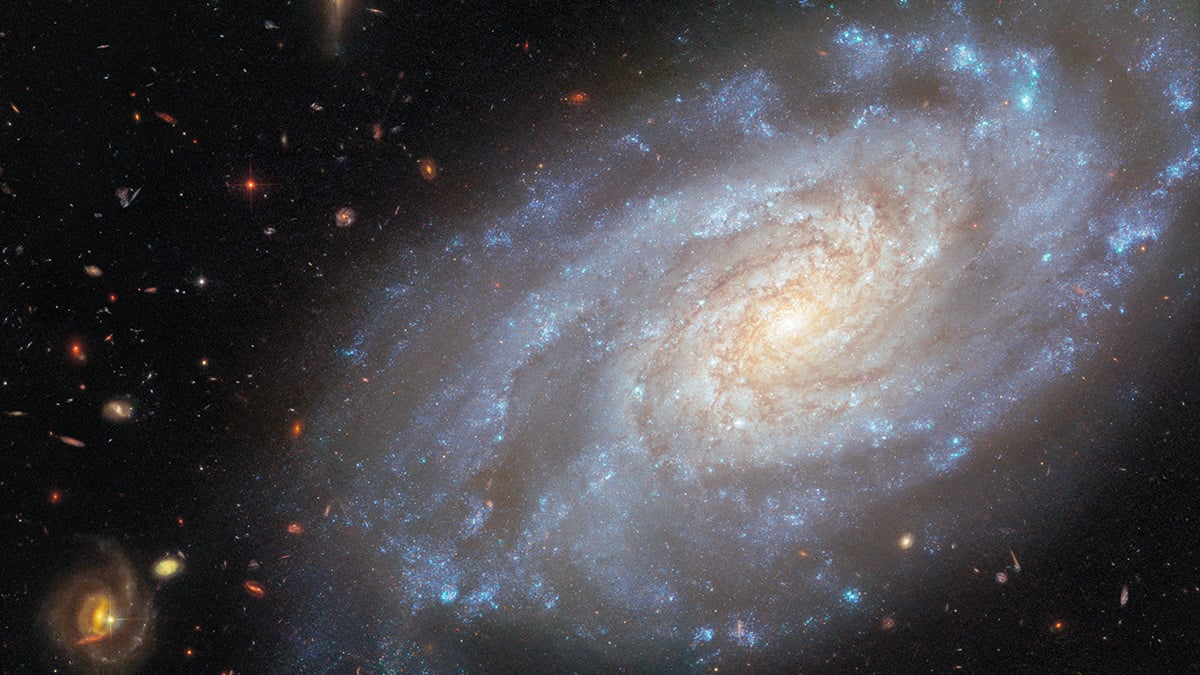
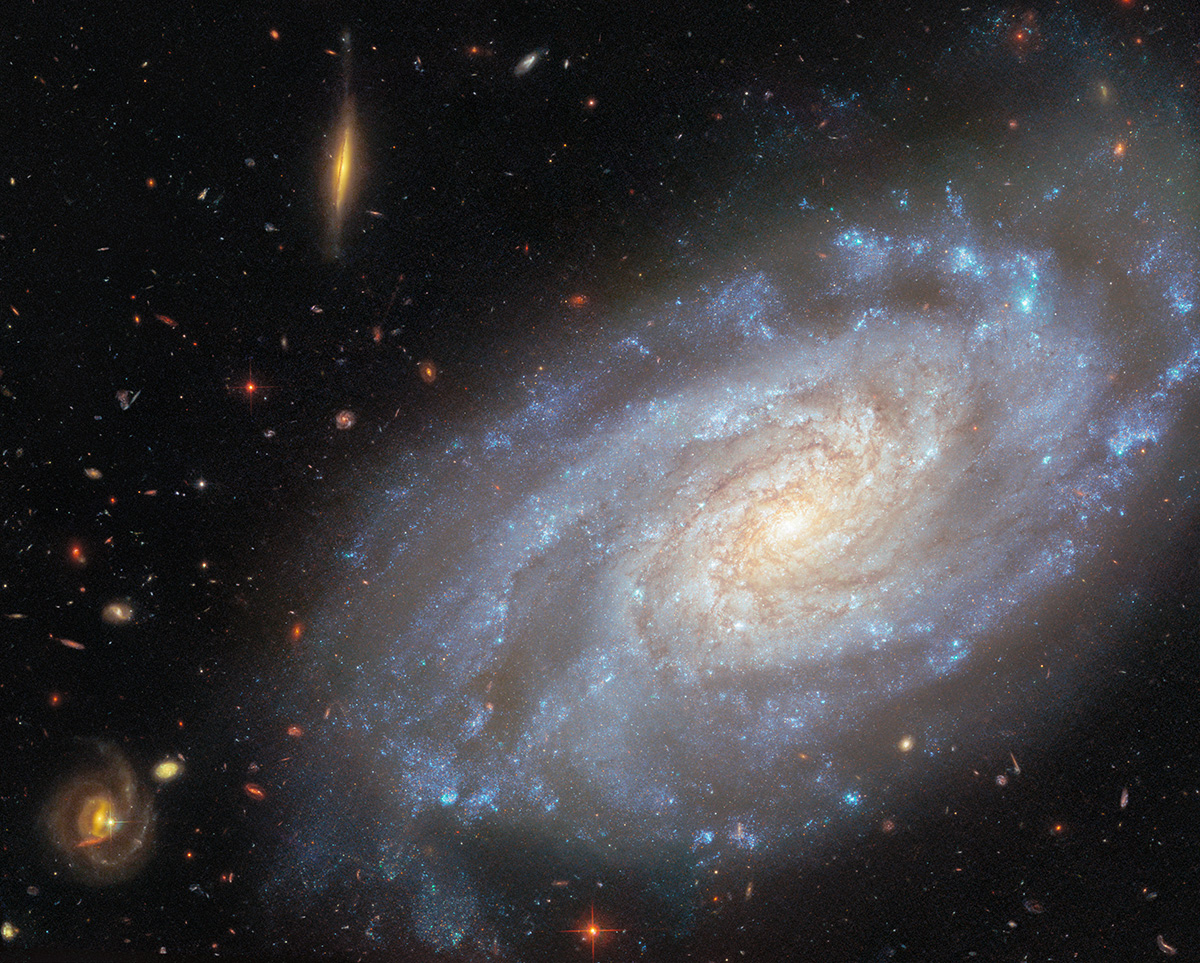
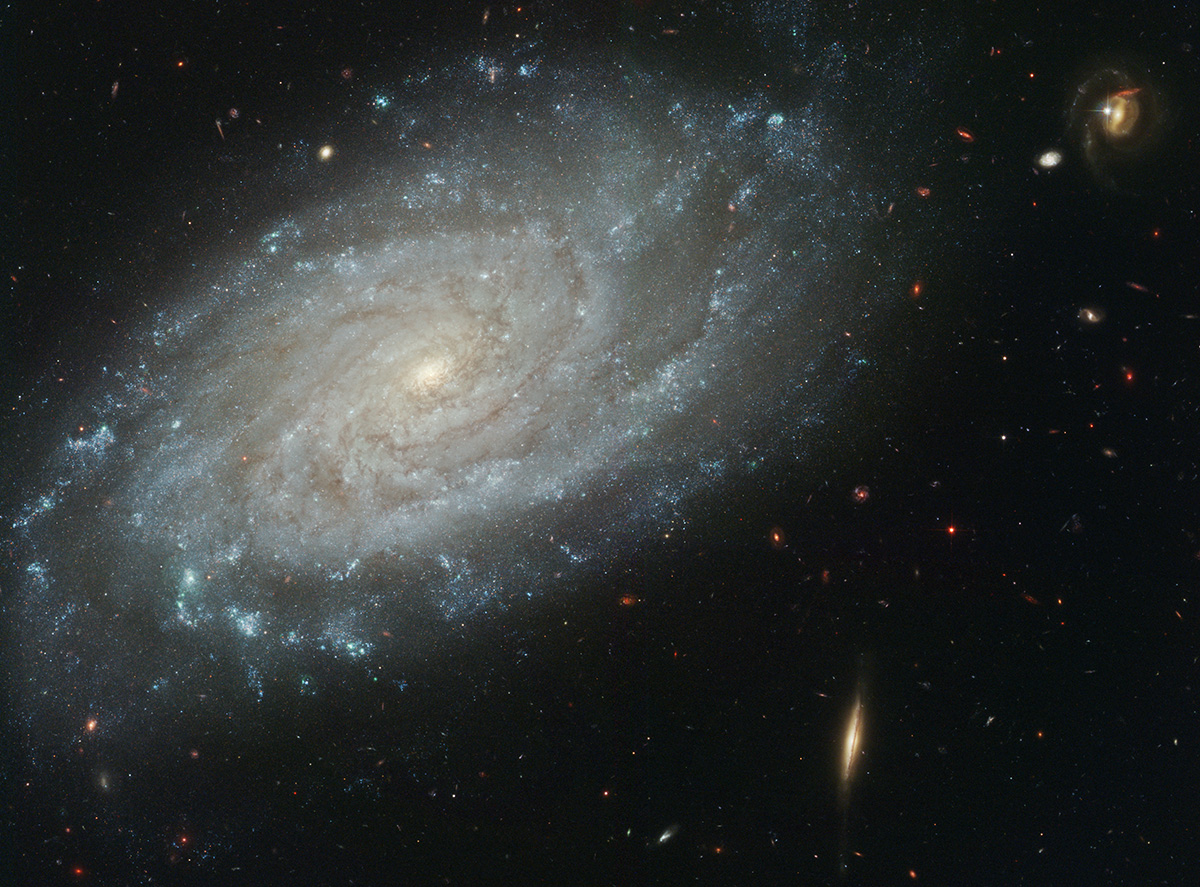
The Hubble Space Telescope has returned to a familiar target and handed astronomers a clearer picture. The subject is NGC 3370, a nearly face-on spiral galaxy in the constellation Leo. The new Hubble image highlights fine dust lanes, bright young star clusters, and a field of distant background galaxies. It is both a visual treat and a data-rich observation for distance studies.
A galaxy of exceptional value
NGC 3370 has long been on the watchlist of astronomers because of its unique combination of features. It’s a nearly face-on spiral galaxy, meaning we view it from above rather than from the side, giving us a clear look at its spiral structure and inner dynamics. Its appearance is striking: a glowing yellow-white bulge surrounded by spiral arms that shimmer in shades of blue. These colours trace the ages of its stars, older, cooler ones near the centre and hot, young blue stars scattered across the arms.
But NGC 3370 also plays a critical scientific role. This galaxy has hosted both Cepheid variable stars and a Type Ia supernova, two of the most reliable tools astronomers use to measure cosmic distances. That makes it a rare and vital object in the grand ladder that links the size of our universe to the rate at which it’s expanding.
Astronomers keep returning to It
Every few years, NGC 3370 draws the attention of researchers again, and for good reason. Back in 1994, a Type Ia supernova, known as SN 1994ae, appeared in this galaxy. It was one of the best-observed supernovae of its kind at the time. Type Ia supernovae explode when a white dwarf star in a binary system accumulates too much mass and reaches a critical limit. Because these explosions always peak at nearly the same brightness, astronomers use them as standard candles to measure distances across the universe.
The problem is calibration. To know exactly how bright a supernova truly is, astronomers need a nearby example whose distance is already known. That’s where Cepheid variables come in. These are pulsating stars whose brightness varies with a predictable rhythm. The period of their pulse reveals their actual luminosity. By comparing it to their observed brightness, astronomers can determine their distance with high precision.
NGC 3370 contains both, Cepheid variables and a recorded Type Ia supernova, making it a perfect calibration target. By studying Cepheids within this galaxy, scientists can anchor the true brightness of the supernova, and then use that calibration to measure even farther galaxies where only supernovae can be seen. This link between local and distant measurements is what refines our understanding of the Hubble constant, the rate at which the universe is expanding.
What the new Hubble image reveals
The latest Hubble image takes a fresh, high-resolution look at NGC 3370 using multiple optical filters from the Advanced Camera for Surveys (ACS) and the Wide Field Camera 3 (WFC3). These filters cover wavelengths from near-ultraviolet to near-infrared, allowing scientists to separate stars by age and temperature.
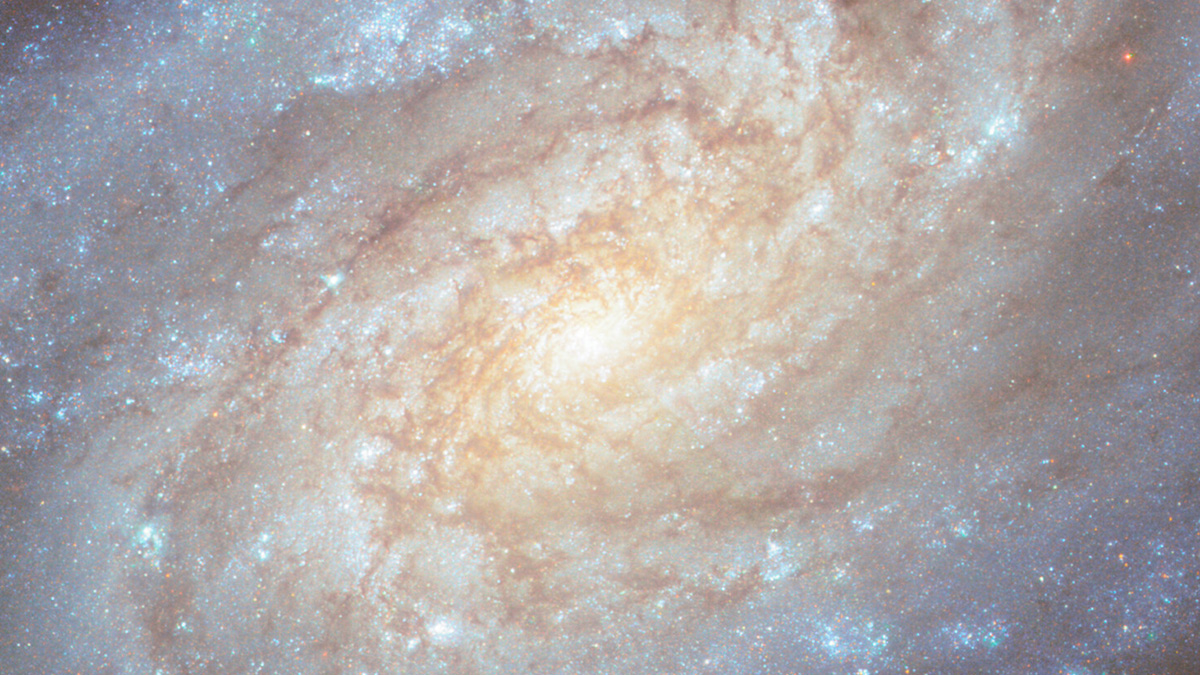
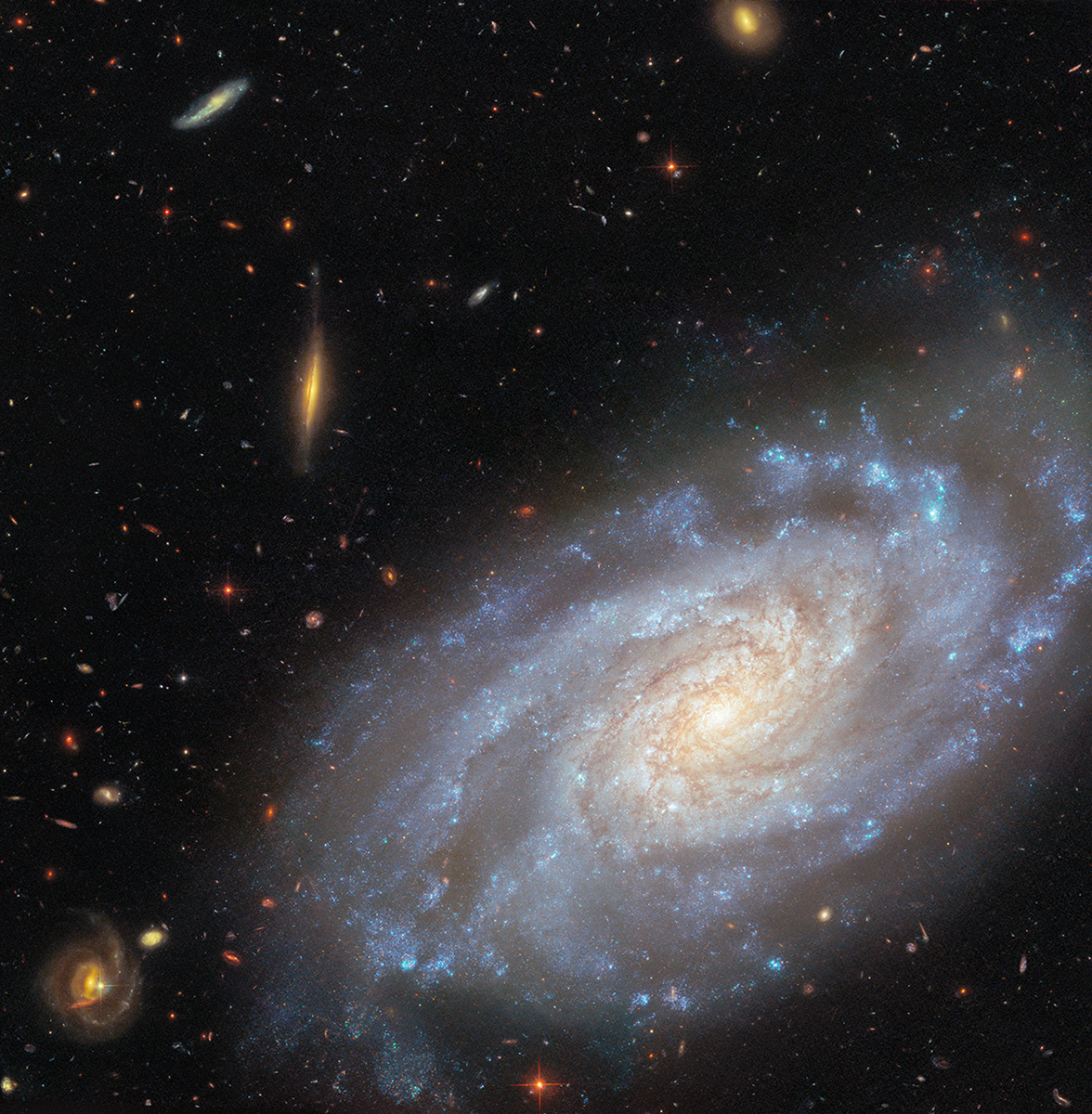
In this composite image, the galaxy’s core glows golden. That’s where older stars dominate. The outer arms, meanwhile, appear bright blue and dotted with clusters of young stars, formed from dense clouds of gas and dust. Dark filaments, the galaxy’s dust lanes, twist along the spiral arms, absorbing light and giving the galaxy a sense of texture and depth.
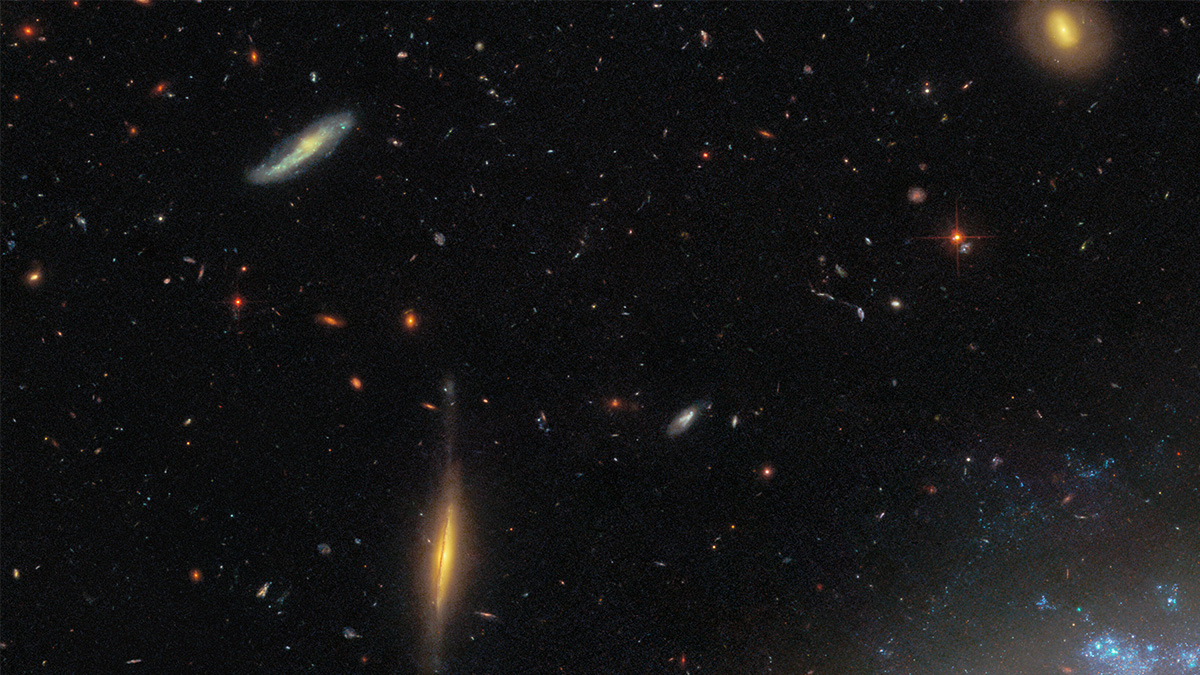
Beyond NGC 3370, countless faint galaxies scatter the background. Each one lies millions or billions of light-years farther away, serving as a silent backdrop to this cosmic foreground. Hubble’s ability to reveal both the main subject and the faint background in the same frame shows just how deep its vision extends.
From data to discovery
Hubble’s high-resolution imaging helps astronomers in practical ways too. When studying Cepheids, researchers must isolate them from the crowded background of stars. Ground-based telescopes, even large ones, often can’t resolve these tiny differences. Hubble’s clarity allows scientists to pinpoint individual stars and measure their brightness changes over time without interference.
This level of precision improves the period-luminosity relationship, which directly affects how accurately we can measure distances. The better we know those distances, the better we can calibrate other cosmic markers. In essence, NGC 3370 acts like a cosmic ruler against which other measurements are checked.
The technical side of the image
The released image from Hubble spans about 3.27 × 2.63 arcminutes of sky. North is rotated slightly from vertical, a detail listed in the image’s metadata. The combination of multiple filters, typically around 390 nm, 435 nm, 555 nm, and 814 nm, allows the final colour composite to highlight structural details and stellar population differences.
Hubble’s instruments captured the data using long exposures to gather faint light, while careful processing balanced brightness without oversaturating the core. The result is a scientifically accurate, visually engaging image that retains real astrophysical meaning.
As Hubble continues to operate alongside newer telescopes such as JWST, galaxies like NGC 3370 will remain vital calibration points. Hubble’s optical clarity complements JWST’s infrared depth. Together, they extend our view from the local universe to the most distant galaxies ever seen.
Clear skies!
See more from DIYPhotography.net on Google
Add DIYPhotography.net as a trusted source. This makes
our stories more likely to appear in your Google Search results.
 Add as a preferred source on Google

Soumyadeep Mukherjee
Soumyadeep Mukherjee is an award-winning astrophotographer from India. He has a doctorate degree in Linguistics. His work extends to the sub-genres of nightscape, deep sky, solar, lunar and optical phenomenon photography. He is also a photography educator and has conducted numerous workshops. His works have appeared in over 40 books & magazines including Astronomy, BBC Sky at Night, Sky & Telescope among others, and in various websites including National Geographic, NASA, Forbes. He was the first Indian to win “Astronomy Photographer of the Year” award in a major category.


Join the Discussion
DIYP Comment Policy
Be nice, be on-topic, no personal information or flames.