




















Sky-Watcher HAC125DX Minigraph: A New Ultra-Fast f/2 Astrograph
Jan 6, 2026
Soumyadeep Mukherjee
Soumyadeep Mukherjee is an award-winning astrophotographer from India. He has a doctorate degree in Linguistics. His work extends to the sub-genres of nightscape, deep sky, solar, lunar and optical phenomenon photography. He is also a photography educator and has conducted numerous workshops. His works have appeared in over 40 books & magazines including Astronomy, BBC Sky at Night, Sky & Telescope among others, and in various websites including National Geographic, NASA, Forbes. He was the first Indian to win “Astronomy Photographer of the Year” award in a major category.
Share:

Astrophotography continues to move toward faster optical systems, smaller sensors, and lighter imaging rigs. Over the past decade, camera sensitivity has increased while mount payload limits have remained largely unchanged. As a result, telescope design has begun to favor speed and efficiency over sheer aperture or focal length. Sky-Watcher’s latest release, the HAC125DX Minigraph, fits squarely within this evolving technical landscape.
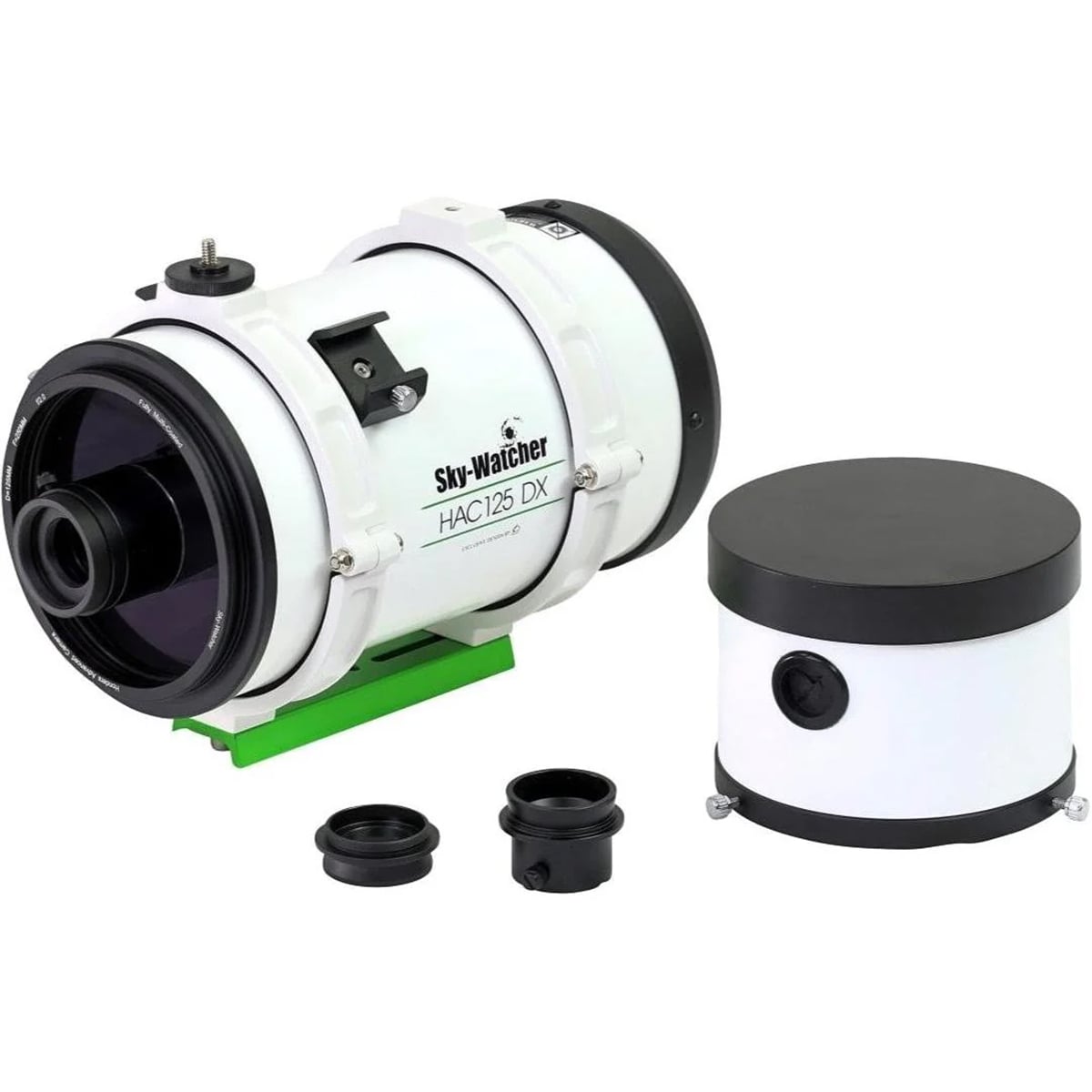
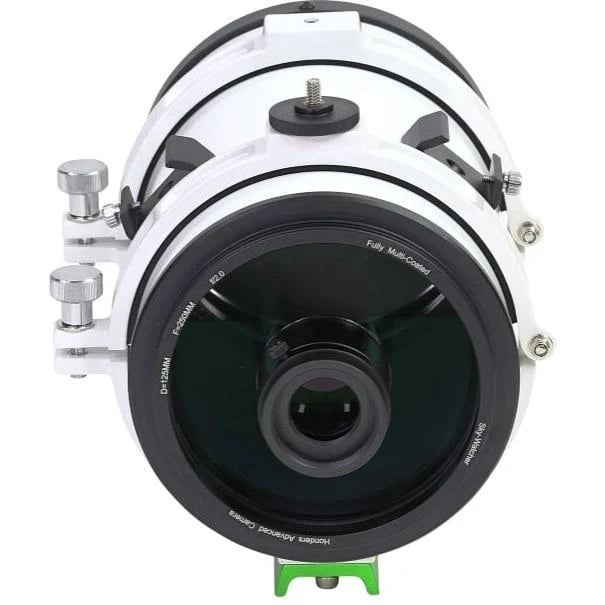
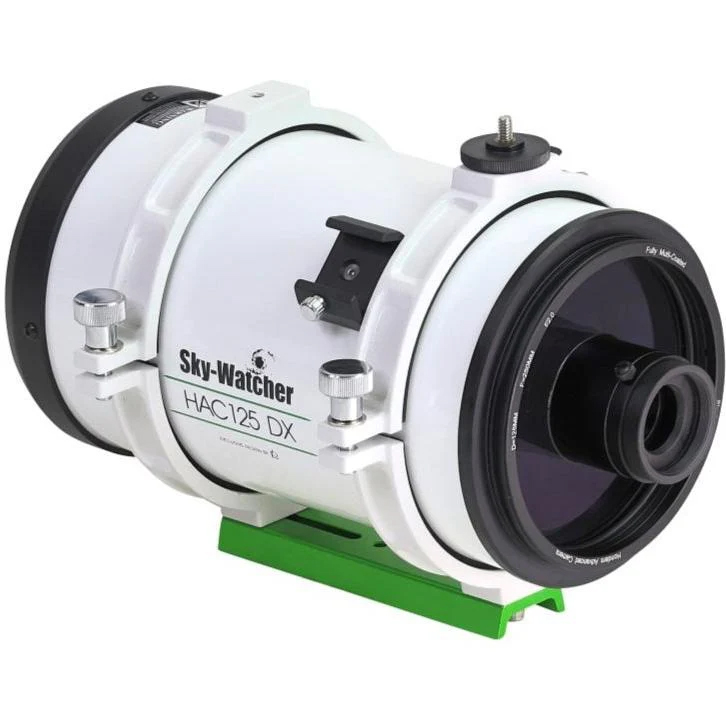
The HAC125DX is not a general-purpose telescope. Sky-Watcher designed it from the ground up as a dedicated imaging instrument. Its optical layout, mechanical structure, and camera interface all reflect this intent. With a 125 mm aperture, a 250 mm focal length, and a very fast f/2 focal ratio, the HAC125DX targets astrophotographers who prioritize rapid signal acquisition and wide-field coverage.
A dedicated imaging telescope
Sky-Watcher positions the HAC125DX as an astrograph in the strictest sense of the term. It does not attempt to balance visual and photographic use. Instead, it commits fully to imaging. This decision regulates every aspect of the telescope.
The absence of a conventional eyepiece system immediately signals this focus. Rather than accommodating visual accessories, the optical path terminates at a camera interface. This simplifies the design and reduces unnecessary components. As a result, the telescope remains compact while maintaining optical speed.
The HAC125DX builds on the original HAC125 concept. However, the DX variant introduces mechanical refinements aimed at improving usability. Sky-Watcher adjusted the focusing system and rear assembly to better support modern imaging workflows. These changes reflect feedback from the imaging community and a clearer understanding of how fast astrographs are actually used in the field.
Optical design and light gathering
At the center of the HAC125DX lies a Honders Advanced Catadioptric (HAC) optical design. This hybrid configuration combines reflective and refractive elements within a short optical path. The design allows Sky-Watcher to achieve a fast focal ratio without the long tube lengths associated with classical refractors.
The telescope delivers a 250 mm focal length at f/2, placing it among the fastest consumer astrographs currently available. This speed has direct consequences for imaging. At f/2, the system gathers light extremely efficiently. Consequently, exposure times drop sharply when compared to slower instruments.
To support this efficiency, Sky-Watcher uses Radiant Aluminum Quartz (RAQ) coatings on the primary mirror. These coatings aim to enhance reflectivity and maintain long-term stability. In addition, the corrector elements feature High Transmission Multi-Coatings (HTMC). Together, these coatings are designed to maximize throughput while preserving contrast.
The optical system produces an image circle of approximately 16 mm. This specification defines the region over which the telescope maintains acceptable correction. Rather than chasing large sensors, Sky-Watcher optimized the design for compact imaging cameras. This choice reflects a practical understanding of the target user base.
Mechanical layout and structure
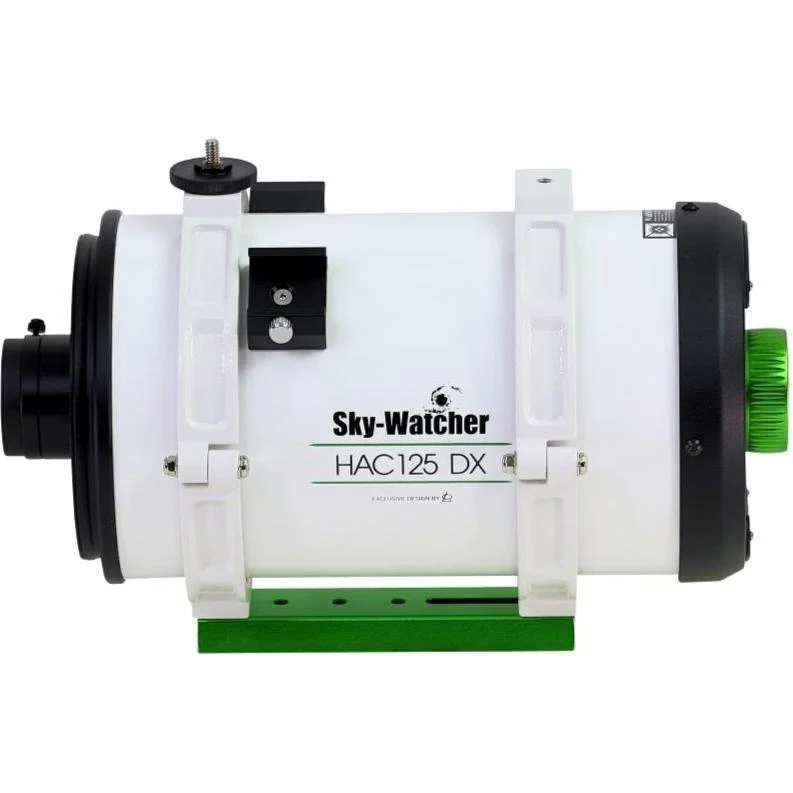
The physical design of the HAC125DX emphasizes portability and rigidity. The optical tube measures roughly 40 cm in length and weighs about 3.8 kg. These dimensions allow the telescope to integrate easily with lightweight equatorial mounts.
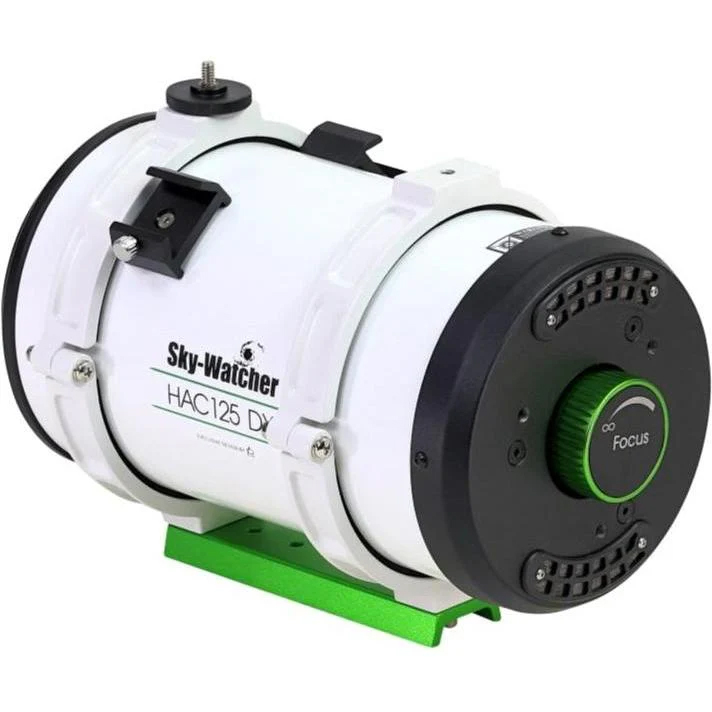
One of the most notable changes in the DX version is the rear focusing system. Instead of a traditional front-mounted focuser, the HAC125DX adjusts focus by moving the primary mirror. This approach shortens the optical train and improves balance. Rear focusing also simplifies camera attachment. The telescope accommodates common imaging backfocus requirements without complex extensions. This benefits users who frequently swap cameras or accessories.
Sky-Watcher includes clamshell mounting rings and a V-style dovetail plate. These components provide secure attachment while allowing easy repositioning. Dual-finder shoe mounts add flexibility for guiding or accessory installation. Threaded adapters, including M42 connections, come standard. This reduces reliance on third-party parts and speeds up initial setup.
Camera compatibility and sensor considerations
The HAC125DX pairs naturally with small-format CMOS astronomy cameras. Sensors in the 1-inch class fall comfortably within the telescope’s corrected image circle. This includes several widely used monochrome and color imaging cameras designed for deep-sky work.
This compatibility shapes the telescope’s real-world role. With a 250 mm focal length, the HAC125DX delivers a wide field of view. Large nebulae, extended emission regions, and dense star fields fit easily within a single frame. The fast optics further enhance this capability by reducing total integration time.
Larger sensors, such as APS-C or full-frame formats, extend beyond the corrected field. Users may observe vignetting or edge degradation when using such cameras. This behavior aligns with the telescope’s specifications and intended design. It does not represent a limitation in execution, but rather a deliberate engineering trade-off.
By focusing on small sensors, Sky-Watcher keeps the optical system compact, affordable, and efficient. This decision also reduces demands on mounts and tracking systems.
Fast optics in practice
The f/2 focal ratio defines how the HAC125DX behaves under the night sky. Fast optics dramatically reduce exposure times. This allows astrophotographers to collect usable data even during short imaging windows. Shorter exposures place fewer demands on the mount’s tracking accuracy. While precise polar alignment remains important, the system becomes more forgiving of minor errors. This characteristic benefits portable imaging setups and travel rigs.
Fast optics also pair well with electronically assisted astronomy. Live stacking software can build images rapidly, revealing faint objects in near real time. The HAC125DX’s speed aligns naturally with this workflow. However, f/2 systems also require precision. Focus tolerance narrows significantly. Small mechanical shifts can affect the star shape. Users must approach setup carefully and methodically. Sky-Watcher’s mechanical refinements aim to support this requirement by improving stability and repeatability.
Many imagers now favor compact rigs that deliver results quickly. Advances in sensor sensitivity reduce the need for long focal lengths or massive apertures. Sky-Watcher’s decision to introduce a small, fast astrograph acknowledges this shift. The HAC125DX does not compete directly with large refractors or classical Newtonians. Instead, it occupies a distinct niche focused on efficiency.
Price and availability
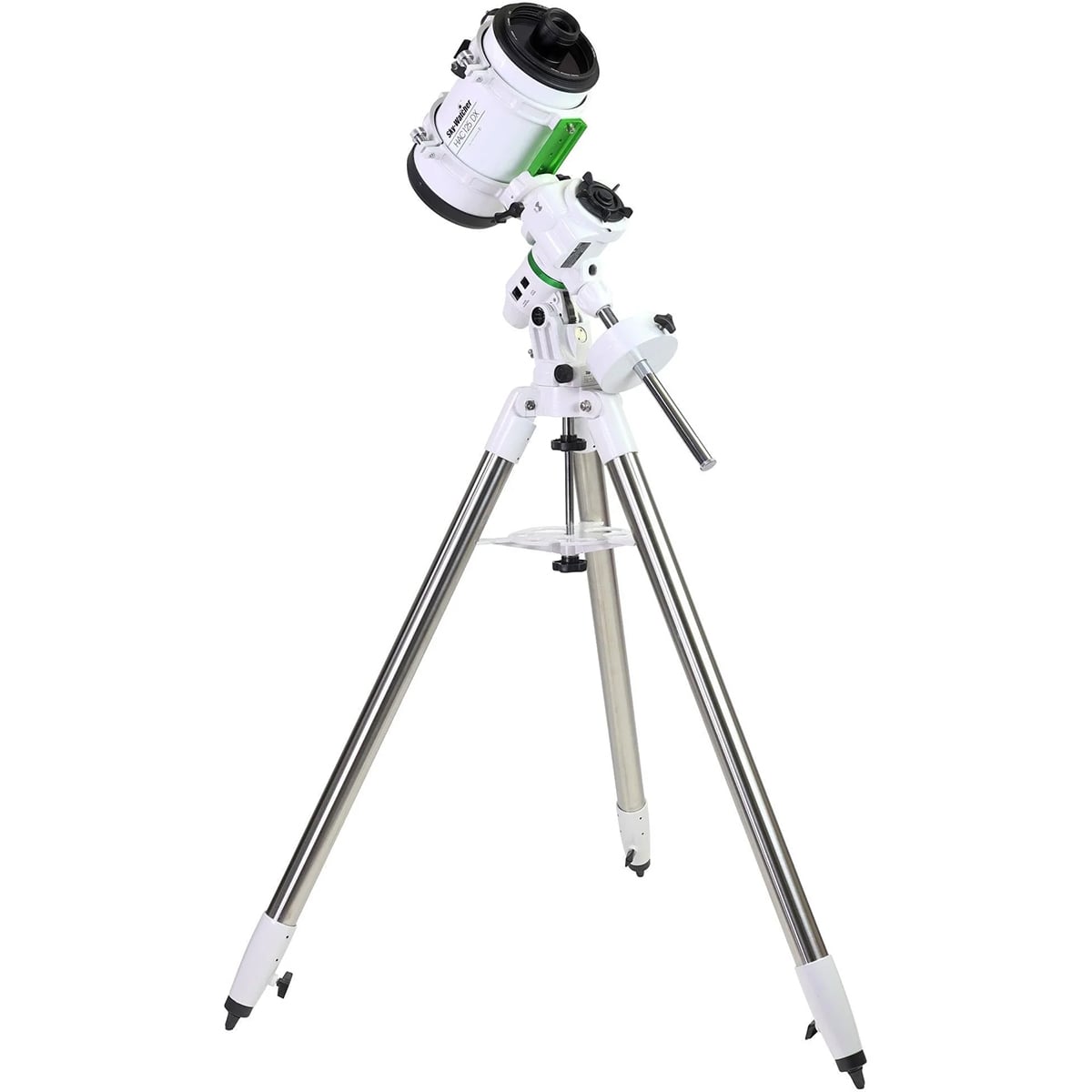
The Sky-Watcher HAC125DX is priced at $995. It is available for ordering via the official website.
The HAC125DX is aimed at astrophotographers who already understand imaging fundamentals. It assumes familiarity with camera operation, focus control, and mount alignment. The telescope suits users who prioritize wide-field deep-sky targets and fast data acquisition. It also fits well into EAA workflows and survey-style imaging. Its fast f/2 optical system, compact mechanical design, and small-sensor optimization align with current astrophotography trends. The telescope emphasizes speed, efficiency, and portability.
Clear skies!
See more from DIYPhotography.net on Google
Add DIYPhotography.net as a trusted source. This makes
our stories more likely to appear in your Google Search results.
 Add as a preferred source on Google

Soumyadeep Mukherjee
Soumyadeep Mukherjee is an award-winning astrophotographer from India. He has a doctorate degree in Linguistics. His work extends to the sub-genres of nightscape, deep sky, solar, lunar and optical phenomenon photography. He is also a photography educator and has conducted numerous workshops. His works have appeared in over 40 books & magazines including Astronomy, BBC Sky at Night, Sky & Telescope among others, and in various websites including National Geographic, NASA, Forbes. He was the first Indian to win “Astronomy Photographer of the Year” award in a major category.



Join the Discussion
DIYP Comment Policy
Be nice, be on-topic, no personal information or flames.
4 responses to “Sky-Watcher HAC125DX Minigraph: A New Ultra-Fast f/2 Astrograph”
excellent write up. thank you soumyadeep.
id just use a camera lense at this point. canon has an excellent 135 f2 that’s half the price and weight.
And if you are looking to save money, nearly every astrophotographer has a Rokinon/Samyang 135/f2
New? This thing has been around for years. I first saw it at NEAF in 2018, though it wasnt for sale.
At first Synta was not marketing it in North America so they didnt compete with themselves with the vastly superior RASA scopes from their Celestron brand.
Enough people asked for the HAC that they brought it over.
It only supports tiny guide/planetary cams, not even the 4/3 let alone APS-C sized ones, which defeats the purpose of the f/2.
If you want a fast telesope but don’t have RASA money, do yourself a favor and get a fast refractor like the Redcat.