






















Sharpstar SCA310 Launched: A Fast 310 mm Cassegrain Astrograph
Dec 29, 2025
Soumyadeep Mukherjee
Soumyadeep Mukherjee is an award-winning astrophotographer from India. He has a doctorate degree in Linguistics. His work extends to the sub-genres of nightscape, deep sky, solar, lunar and optical phenomenon photography. He is also a photography educator and has conducted numerous workshops. His works have appeared in over 40 books & magazines including Astronomy, BBC Sky at Night, Sky & Telescope among others, and in various websites including National Geographic, NASA, Forbes. He was the first Indian to win “Astronomy Photographer of the Year” award in a major category.
Share:

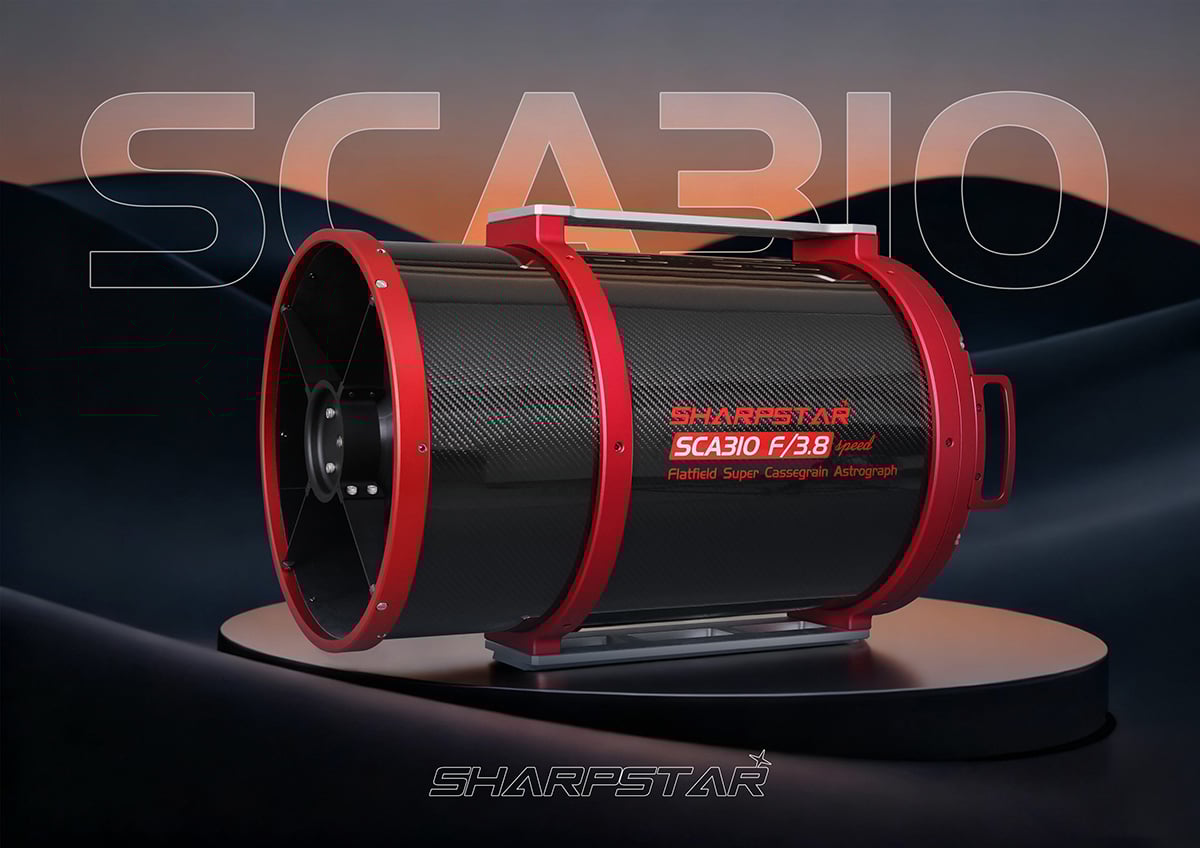
Large-aperture astrographs are no longer experimental instruments. They are now essential tools for astrophotographers working with high-resolution sensors and demanding exposure workflows. The Sharpstar SCA310 enters this space as a purpose-built 310 mm f/3.8 Cassegrain astrograph designed to deliver high signal efficiency, wide corrected fields, and mechanical stability for long-duration imaging. It is not positioned as a visual telescope or a hybrid system. Sharpstar designed it from the start as an imaging platform. Every design decision reflects that goal.
Fast optical systems place strict demands on mirror quality, correction, and mechanical tolerances. At f/3.8, small errors become visible quickly. Sharpstar approaches this challenge with an integrated optical system rather than modular add-ons. The SCA310 combines a large aspherical primary mirror, a thermally stable secondary, and a built-in triplet corrector to control aberrations across large sensors. The result is a telescope designed to work as a complete imaging system, not as a base requiring extensive modification.
Optical system design
The SCA310 uses a classical Cassegrain configuration with a folded optical path. This allows a focal length of approximately 1178 mm within a compact tube length. For imaging, this layout offers practical advantages. It reduces the moment arm on the mount and improves balance. It allows large apertures without extreme tube lengths.
The primary mirror uses an aspherical surface. This choice directly addresses spherical aberration and improves on-axis performance. The secondary mirror is made from fused silica. Sharpstar specifies fused silica due to its low coefficient of thermal expansion. In imaging systems, thermal stability is just as important as optical quality. Temperature gradients across a mirror can soften stars even when seeing is good.
Both mirrors feature enhanced aluminum coatings with a stated reflectivity of above 95 percent. High reflectivity improves throughput. At this aperture size, even small losses affect signal efficiency. The coating choice reflects the telescope’s emphasis on data collection rather than visual contrast alone.
A defining element of the SCA310 is the integrated three-element coma corrector. Sharpstar does not treat correction as optional. The corrector includes ED glass and sits within the optical path by design. This corrector flattens the field and reduces off-axis aberrations. The system aims to deliver consistent star shapes across a wide imaging circle. According to Sharpstar’s published data, the telescope supports near-full illumination on full-frame sensors. This positions the SCA310 firmly in the large-sensor imaging category.
By integrating the corrector, Sharpstar reduces dependency on third-party optics. This simplifies spacing and back-focus control. It also reduces the risk of tilt or misalignment introduced by additional components. The optical system functions as a single engineered unit.
Fast focal ratio and imaging efficiency
At f/3.8, the SCA310 operates significantly faster than traditional long-focus reflectors. This has practical consequences. Exposure times shorten, and the signal accumulates faster. Total integration time decreases for a given target depth. These gains are significant for astrophotographers working under limited sky conditions or time constraints.
The 310 mm aperture provides strong light-gathering power. Combined with the fast focal ratio, the telescope becomes effective for faint emission nebulae and extended targets. The focal length also allows adequate sampling for galaxies and smaller structures when paired with modern pixel sizes.
Fast systems demand precise focus. Depth of focus narrows rapidly at f/3.8. Sharpstar’s mechanical design reflects this requirement. Focus stability and repeatability become essential, not optional.
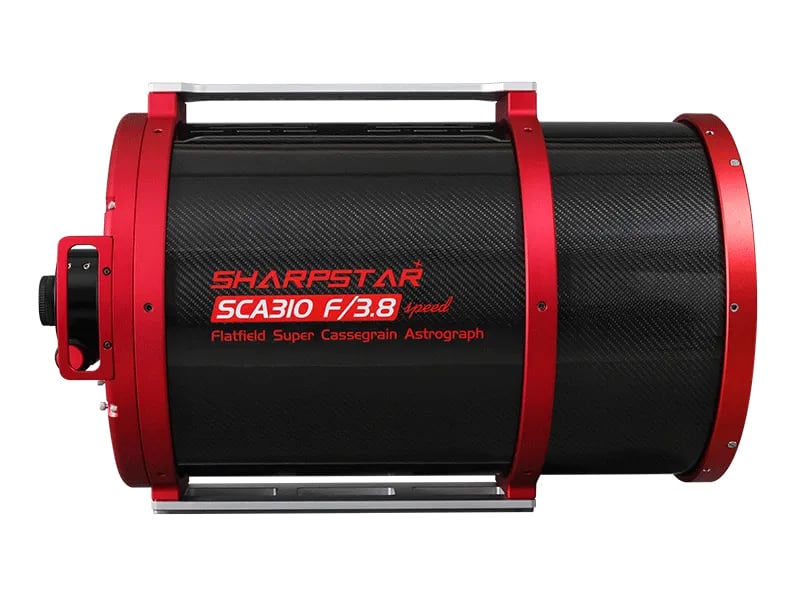
Mechanical architecture
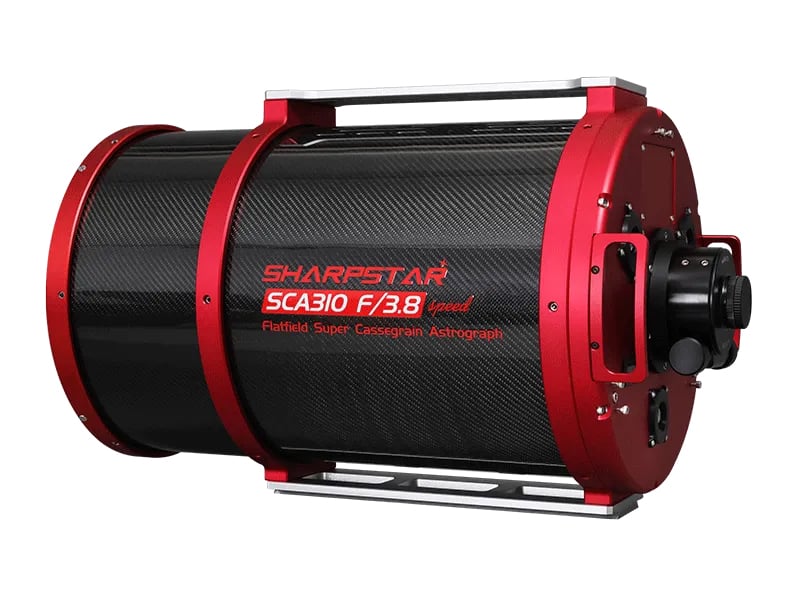
The SCA310 uses a carbon fiber tube. Carbon fiber provides high stiffness with minimal thermal expansion. During long imaging sessions, ambient temperature can change significantly. Tube expansion shifts focus. Carbon fiber minimizes this effect and helps maintain optical alignment.
The mirror cell and rear assembly support active cooling. Sharpstar includes three rear-mounted cooling fans. These fans accelerate thermal equalization of the primary mirror. Faster equilibrium reduces internal tube currents. This improves image sharpness earlier in the session.
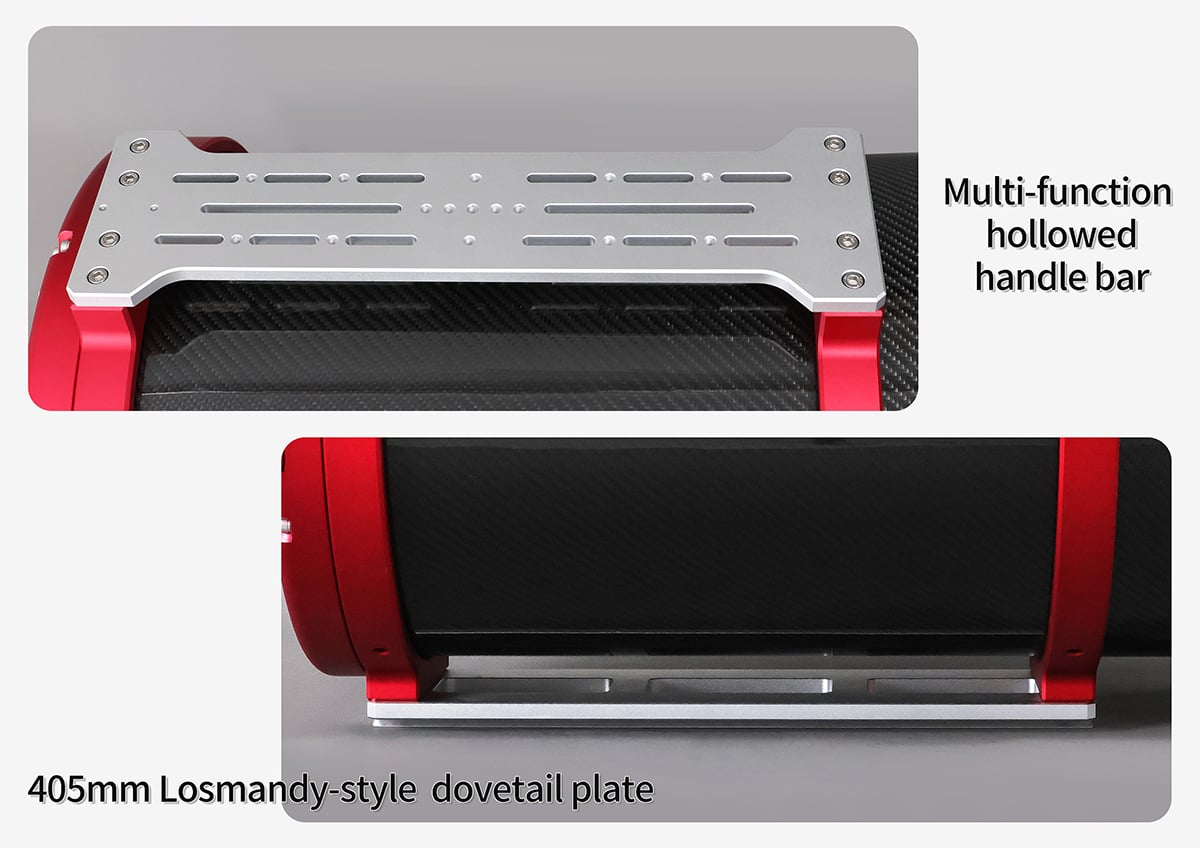
The telescope ships with a wide Losmandy-style dovetail plate. This mounting interface provides rigidity and compatibility with heavy-duty equatorial mounts. With a telescope of this mass and aperture, flexure control is critical. Sharpstar clearly assumes the user will mount the SCA310 on a capable imaging mount.
The overall mechanical layout prioritizes stiffness and balance. Nothing in the design suggests portability as a primary goal. The SCA310 is intended for stable setups, observatories, or carefully planned field installations.

Focuser system and imaging train support
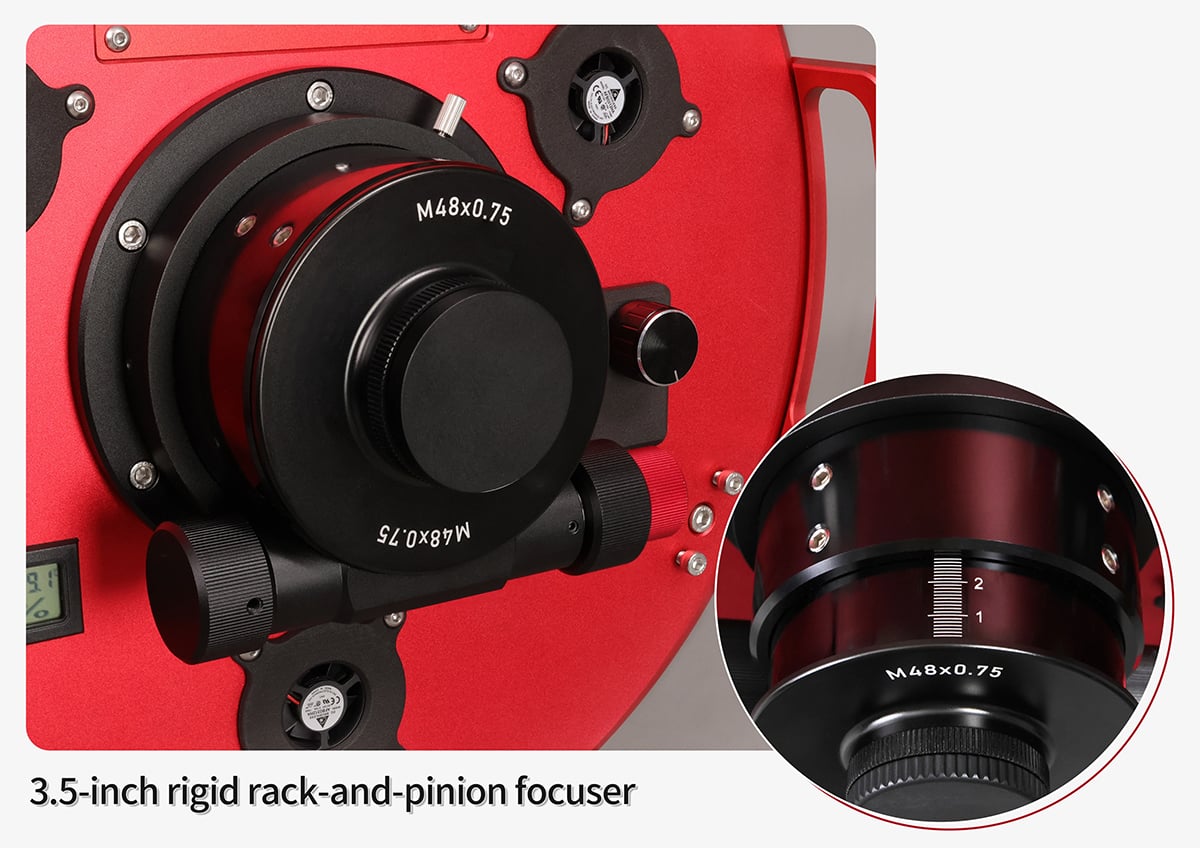
Sharpstar equips the SCA310 with a 3.5-inch rack-and-pinion focuser. This focuser supports heavy imaging loads without sag. Modern astrophotography systems often include filter wheels, off-axis guiders, and cooled cameras. The focuser must maintain alignment under load.
The dual-speed mechanism allows fine focus control. At f/3.8, critical focus tolerance is narrow. Fine adjustment becomes essential for repeatable results. The long focus travel range provides flexibility across different camera configurations.
A built-in 360-degree rotator allows camera framing without disturbing focus. This feature simplifies composition and cable routing. Rotating the camera does not introduce cable twist or stress, which is important for automated imaging sessions.
The rear interface supports multiple thread standards. Sharpstar provides M68, M54, and M48 connections. A built-in 2-inch filter thread adds further compatibility. This approach reduces reliance on custom adapters. It allows imagers to build clean and rigid imaging trains.
Sensor coverage and back-focus control
The SCA310 is designed with large sensors in mind. Sharpstar specifies wide illumination and corrected coverage suitable for full-frame cameras. This is not common at this focal ratio and aperture. Many systems require additional reducers or flatteners to achieve similar results.
Back focus is clearly defined in Sharpstar’s documentation. This helps imagers configure their systems accurately. Precise spacing is critical for maintaining star quality across the field. The integrated corrector simplifies this process by reducing the number of variables.
Medium-format sensor users may also find the SCA310 appealing. While full-frame compatibility is explicitly supported, the optical design suggests headroom beyond smaller sensors. This positions the telescope well for future camera upgrades.
Price, availability, and key specifications
The Sharpstar SCA310 is priced at $7,995. The telescope is available for pre-ordering via the official website and online retailers.
Here are some of the key specifications of the telescope:
| Aperture size | 310mm |
| Focal length/Focal ratio | 1178mm/F3.8 |
| Primary mirror type | Aspherical primary mirror |
| Primary mirror material | Similar to Pyrex glass |
| Secondary mirror material | Fused silica glass |
| Image circle | Medium format(55mm) |
| Tube material | Carbon fiber |
| Corrector type | Triplet design (including one ED glass) |
| Secondary mirror diameter | 184mm |
| lens tube outer diameter | 378mm |
| lens tube total length | 721mm |
| Gross weight | 23.5kg |

The SCA310 is built for advanced deep-sky imagers. It fits observatory environments or semi-permanent setups. The large aperture improves signal strength, and the corrected field supports current camera formats. When properly mounted and collimated, the SCA310 offers a powerful imaging platform. It rewards careful setup with efficient data collection and consistent image quality. For astrophotographers seeking a large-aperture, fast astrograph without moving into the highest cost tier, the Sharpstar SCA310 stands as a serious and deliberate option.
Clear skies!
See more from DIYPhotography.net on Google
Add DIYPhotography.net as a trusted source. This makes
our stories more likely to appear in your Google Search results.
 Add as a preferred source on Google

Soumyadeep Mukherjee
Soumyadeep Mukherjee is an award-winning astrophotographer from India. He has a doctorate degree in Linguistics. His work extends to the sub-genres of nightscape, deep sky, solar, lunar and optical phenomenon photography. He is also a photography educator and has conducted numerous workshops. His works have appeared in over 40 books & magazines including Astronomy, BBC Sky at Night, Sky & Telescope among others, and in various websites including National Geographic, NASA, Forbes. He was the first Indian to win “Astronomy Photographer of the Year” award in a major category.

Join the Discussion
DIYP Comment Policy
Be nice, be on-topic, no personal information or flames.